Bookshelf vs Floorstanding Speakers
A floorstander's bass comes from the same place as its stereo image, and the room disagrees with that arrangement. That is the argument, and it is a placement argument.
Disclosure: we earn a commission if you buy through the links on this page, at no extra cost to you. It does not influence what we pick — our criteria are published and reproducible, so you can check our work. How we pick · Full disclosure
These picks are spec-and-price analyses, not listening tests. We have not heard this gear and we do not pretend to have: every figure below is sourced to the manufacturer and linked, and every price is live or not shown at all. Here are the rules we followed.
Quick picks
Ranked on the published criteria in How We Pick. Prices are live as of October 14, 2026. Tap any row for the full write-up.
- 8.2$329.00View on Amazon
$479.0031% off
- 8.6
- 9.0
- 7.4$149.00View on Amazon
$179.0017% off
| # | Product | Best for | Score | Price |
|---|---|---|---|---|
| 1 | 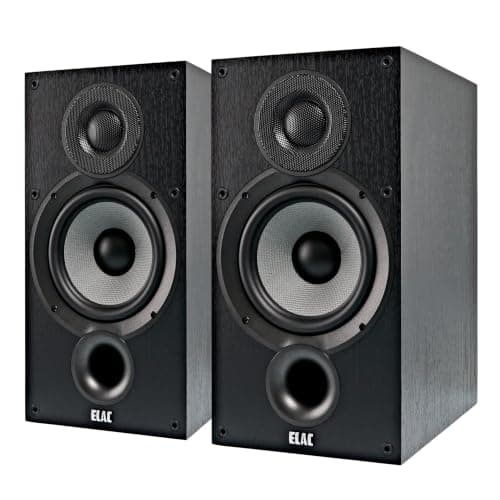 ELAC Debut 2.0 B6.2 A 6.5-inch woofer in a ported cabinet that reaches genuinely low for its size, at the cost of needing an amplifier with real current behind it — and now the outgoing Debut generation rather than the current one. | The outgoing generation, still sold | 8.2 | $329.00View on Amazon $479.0031% off |
| 2 | 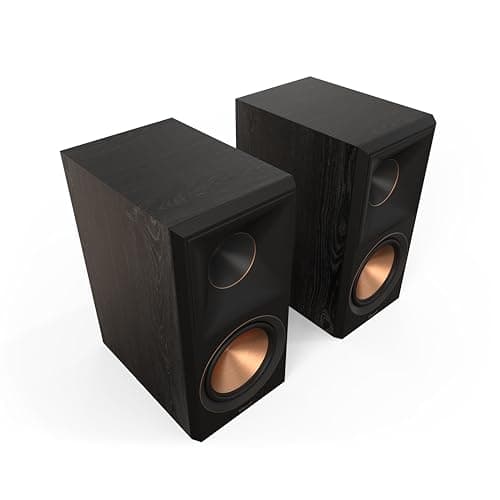 Klipsch RP-600M II Higher sensitivity and a bigger cabinet than the R-51M, which buys headroom rather than a different kind of speaker. | Best step up | 8.6 | |
| 3 | 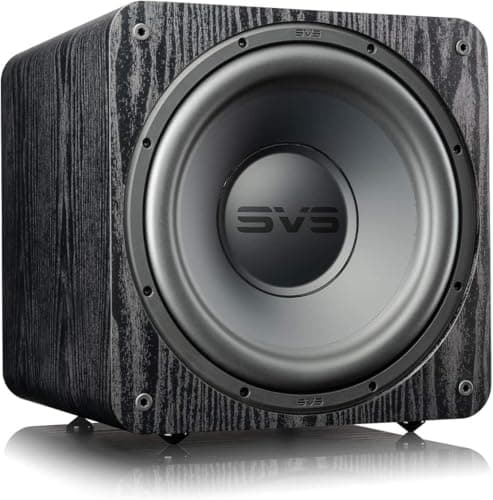 SVS SB-1000 Pro The only subwoofer here whose manufacturer publishes both a continuous power rating and the measurement condition behind its frequency response — 20–270 Hz ± 3 dB at 2 m ground plane — which is what makes its numbers comparable to anything. | Best overall | 9.0 | |
| 4 | 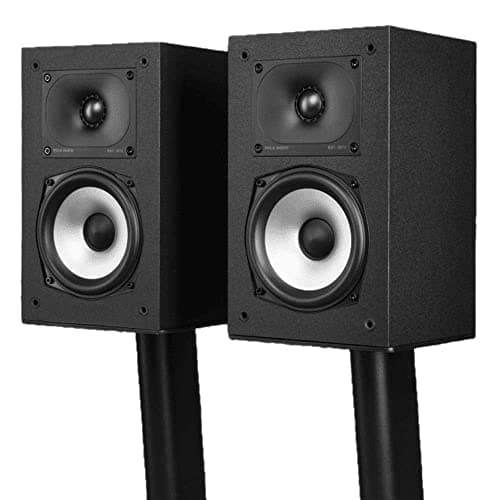 Polk Monitor XT15 48 Hz of published extension and a stated 30–150 W amplifier range, from a maker who tells you what to drive it with but not how they measured its sensitivity. | Best all-rounder under $200 | 7.4 | $149.00View on Amazon $179.0017% off |
What we do and do not cover
Updated 5 September 2026: we now rank floorstanding speakers as well. For most of this site’s life we listed none, because our method requires a product that is currently purchasable through the affiliate programs we are in and whose specifications the manufacturer publishes in a form we can link, and no floorstanding group cleared both bars. Six now do, and they are ranked in the best floorstanding speakers under $1,000. The argument on this page has not changed and neither have its numbers — it is about which shape of speaker suits your room, not about which one we are able to source.
A floorstander is a bookshelf speaker in a bigger box, usually with more woofers. That is not a dismissal — cabinet volume and radiating area are exactly what a speaker needs to produce low frequencies, and there is no way around the physics.
The question is whether that is the best way to spend the money and the floor space, and the answer turns on something that is not about the speaker at all.
What the extra cabinet actually buys
Three things, in order of how much they matter.
1. Bass extension
Moving air at 30 Hz requires displacing a lot of it. You get that from cone area, from excursion, or from cabinet volume — and a floorstander has more of all three than a bookshelf of the same design family.
Here is where the bookshelves we cover actually stop, by their makers’ own numbers:
| Speaker | Published low-frequency limit | Tolerance stated? |
|---|---|---|
| Klipsch RP-600M II | 44 Hz | Yes — ± 3 dB |
| ELAC Debut 2.0 B6.2 | 44 Hz | No tolerance published |
| ELAC Debut 2.0 B5.2 | 46 Hz | No tolerance published |
| Polk Monitor XT15 / ES15 | 48 Hz | No tolerance published |
| Micca RB42 | 50 Hz | “Typical in-room”, no tolerance |
| Klipsch R-51M | 62 Hz | Yes — ± 3 dB |
| KEF Q3 Meta | 49 Hz | Yes — ± 3 dB |
| Q Acoustics 3030i | 46 Hz | Yes — + 3 / − 6 dB |
| Klipsch R-41M | 68 Hz | Yes — ± 3 dB |
Note the two 44 Hz entries. Klipsch publishes theirs with a ± 3 dB tolerance; ELAC publishes theirs with none at all. The numbers look identical and only one of them is a specification you can hold anybody to.
2. Output before strain
More cone area means less excursion for a given level, which means less distortion at high volume. This matters in a large room and matters very little in a normal one.
3. Sensitivity, sometimes
Larger boxes often allow a higher sensitivity for the same extension, which reduces the amplifier requirement. Whether a specific floorstander does is a question for its spec sheet, not a rule — and the measurement conditions have to match before the comparison means anything.
cone area = π × (nominal diameter ÷ 2)²
Inputs
- ELAC Debut 2.0 B6.2 woofer: Single 6.5 in woven aramid-fiber cone (ELAC spec page)
- Klipsch R-52C woofers: Dual 5.25 in spun-copper IMG (Klipsch spec sheet (PDF))
- Klipsch R-41M woofer: Single 4 in spun-copper IMG (Klipsch spec sheet (PDF))
Result
One 6.5 in: π × 3.25² = 33.2 in²
Two 5.25 in: 2 × π × 2.625² = 43.3 in²
One 4 in: π × 2² = 12.6 in²
Two 5.25-inch drivers have about 30% more radiating area than one 6.5-inch driver, and about 3.4× the area of a single 4-inch. This is why a floorstander with three small woofers can move more air than a bookshelf with one large one — area adds, and diameter does not.
Nominal driver diameter is not effective radiating diameter: the surround takes up part of the stated size, and different makers measure the nominal figure differently. Use this to understand why multiple drivers work, not to compare two specific speakers to a decimal place. Note also that the dual-woofer R-52C stops at 89 Hz because it is sealed — more area is not, on its own, more bass.
The argument against, and it is a placement argument
A floorstander’s bass driver is in the same box as its tweeter. So the position that gives you the best stereo image also fixes the position that produces your bass.
Those two positions are almost never the same place. Imaging wants the speakers forward of the wall, symmetrically placed, forming a triangle with your seat — the geometry is worked through in our speaker placement guide. Room modes do not care about any of that; they produce positions where bass piles up and positions where it cancels, determined by the room’s dimensions.
A separate subwoofer decouples those two decisions. You put the main speakers where the image is best, and the subwoofer where the bass is most even, and the two constraints stop fighting. That is the entire case, and it is a case a floorstander cannot answer, because its woofer is bolted to its tweeter.
It is also why the subwoofer crawl works, and why it appears in our setup guide: bass below roughly 80 Hz is hard to localize, so the subwoofer can go where the room wants it without the stereo image following it there.
What the money buys, at a given price
A floorstander costs more to build for the same driver quality, because the cabinet is larger, needs more bracing and more material. At a fixed price, that budget comes from somewhere — usually the drivers and the crossover.
A bookshelf pair plus a subwoofer splits the money differently: the mains handle everything above roughly 50 Hz without needing a large cabinet, and a dedicated powered subwoofer handles what is below with its own amplifier. SVS publishes 325 W RMS and a 12 in driver with 13.3 mm Xmax for the SB-1000 Pro — you are not getting either of those inside a passive floorstander at this level.
The trade-off is honest in both directions: two boxes become three, and the subwoofer needs setting up, which is a real task and covered in how to add a subwoofer to a stereo amplifier.
The stand is part of the price and part of the performance
Any honest comparison has to include it, because a bookshelf speaker on the wrong surface is not the speaker its maker measured.
Height. The tweeter has to be at seated ear height, which is what a stand is for. Klipsch publishes an 11.3 in cabinet for the R-41M and ELAC publishes a 16.3 lb, 6.5 in-woofer cabinet for the B6.2 — neither arrives at ear height on a sideboard, and a floorstander does by construction.
Mass and coupling. A cabinet reacts against whatever it sits on. ELAC publishes 16.3 lb each for the B6.2, Klipsch 18.1 lb for the RP-600M II, Q Acoustics 6.4 kg for the 3030i. A speaker of that weight on a light shelf will drive the shelf, and the shelf will radiate.
Clearance. Klipsch publishes rear-firing ports on the R-41M and R-51M. On an actual bookshelf, backed by a panel, those ports do not do what Klipsch measured — which is covered in ported vs sealed speakers.
We do not currently rank stands — we have no group we can source and compare properly, which is the same bar the floorstanders had to clear before we would rank those. But the cost is real and it belongs in the comparison, because a bookshelf pair without stands is usually not the product being described in the spec sheet.
When a floorstander is the right answer anyway
- You will not accept a third box. Entirely reasonable, and it settles the question.
- You have no stands and no shelf. A bookshelf speaker needs its tweeter at seated ear height, and stands often cost a meaningful fraction of the speakers. A floorstander arrives at the right height.
- The room is large. Output capability starts to matter, and cone area is the direct answer.
- You want one purchase, finished. A legitimate preference, and not everything has to be a system-building exercise.
The rule that actually applies
Do not buy a floorstander to avoid buying a subwoofer if you also intend to buy a subwoofer. Once a subwoofer is in the system, the floorstander’s main advantage — its bass — is the part being crossed over and handed away, and you have paid for cabinet volume you are now filtering out.
For a stereo system that will never have a subwoofer, in a large room, a floorstander is a sound answer, and our floorstanding roundup ranks six of them on published sensitivity, port direction and floor area. For most rooms, and for anyone who might add a subwoofer later, a good bookshelf pair on stands is still where the money works hardest.
“Might add a subwoofer later” is doing a lot of work in that sentence, so our subwoofer guide settles it against each bookshelf speaker’s own published −3 dB point. And for a bookshelf pair going on an AV receiver rather than a stereo amplifier, the home-theater ranking uses different criteria entirely — bass management takes the extension question off the table and replaces it with sensitivity and impedance.
Every pick in detail
Every specification below links to the manufacturer document we read it from. Where a manufacturer does not publish a figure, we say so rather than estimating it.
ELAC Debut 2.0 B6.2
The outgoing generation, still soldA 6.5-inch woofer in a ported cabinet that reaches genuinely low for its size, at the cost of needing an amplifier with real current behind it — and now the outgoing Debut generation rather than the current one.
- sensitivity
- 6/10
- bass extension
- 9/10
- amp friendliness
- 6/10
- value for money
- 10/10
- build quality
- 8/10
| Specification | Published value | Source |
|---|---|---|
| Sensitivity | 87 dB (2.83 V / 1 m) | ELAC spec page |
| Impedance | 6 Ω | ELAC spec page |
| Minimum impedance | Not published | — |
| Frequency response | 44 Hz – 35 kHz (no tolerance published) | ELAC spec page |
| Maximum power input | 120 W (a handling limit — ELAC publishes no recommended amplifier range) | ELAC spec page |
| Woofer | 6.5 in woven aramid-fiber cone | ELAC spec page |
| Tweeter | 1 in cloth dome | ELAC spec page |
| Crossover | 2,200 Hz | ELAC spec page |
| Weight (each) | 16.3 lb / 7.4 kg | ELAC spec page |
Pros
- 6.5in woofer reaches genuinely low for a bookshelf
- Front port, so it tolerates being near a wall better than a rear-ported box
- Well-braced cabinet for the price
Cons
- Wants more amplifier than its size suggests — check the arithmetic before pairing
- Large for a 'bookshelf' speaker
- Finish is functional rather than furniture
- The outgoing generation — ELAC's Debut 3.0 DB63 now builds on it, though ELAC publishes the same 87 dB and 6 Ω for both, so our sensitivity arithmetic holds for either
- ELAC publishes no response tolerance and no recommended amplifier range for this generation. The DB63 publishes both, which is the real reason it ranks ahead
Skip it if your amplifier is a low-power desktop unit. Run the power arithmetic on our amp-matching guide first.
Klipsch RP-600M II
Best step upPrice as of October 14, 2026. #ad
Higher sensitivity and a bigger cabinet than the R-51M, which buys headroom rather than a different kind of speaker.
- sensitivity
- 10/10
- bass extension
- 8/10
- amp friendliness
- 10/10
- value for money
- 7/10
- build quality
- 9/10
| Specification | Published value | Source |
|---|---|---|
| Sensitivity | 94.5 dB (2.83 V / 1 m, half-space anechoic — Klipsch's published footnote) | Klipsch spec sheet (PDF) |
| Impedance | 8 Ω “compatible” (Klipsch's wording) | Klipsch spec sheet (PDF) |
| Minimum impedance | Not published | — |
| Frequency response | 44 Hz – 25 kHz ± 3 dB | Klipsch spec sheet (PDF) |
| Power handling | 100 W continuous / 400 W peak | Klipsch spec sheet (PDF) |
| Woofer | 6.5 in Cerametallic with Faraday rings | Klipsch spec sheet (PDF) |
| Crossover | 1,500 Hz | Klipsch spec sheet (PDF) |
| Weight (each) | 18.1 lb / 8.2 kg | Klipsch spec sheet (PDF) |
Pros
- Very high sensitivity
- Larger cabinet and more extension than the R-51M
- Real wood-veneer finishes
Cons
- Well above the $500 bracket
- Large
- Rear port placement constraints remain
Skip it if you are shopping under $500 — this is a bracket up.
SVS SB-1000 Pro
Best overallPrice as of October 14, 2026. #ad
The only subwoofer here whose manufacturer publishes both a continuous power rating and the measurement condition behind its frequency response — 20–270 Hz ± 3 dB at 2 m ground plane — which is what makes its numbers comparable to anything.
- extension
- 9/10
- published data
- 10/10
- room control
- 10/10
- value for money
- 6/10
- build quality
- 9/10
| Specification | Published value | Source |
|---|---|---|
| Frequency response | 20–270 Hz ± 3 dB, measured 2 m ground plane away from reflective structures (quasi-anechoic). SVS is the only manufacturer in this group that publishes the measurement condition. | SVS product page |
| Amplifier power | 325 W RMS continuous (820+ W peak dynamic), Sledge STA-325D class D | SVS product page |
| Driver | 12 in long-throw, 13.3 mm Xmax / 26.9 mm Xmech, 1.5 in voice coil | SVS product page |
| Enclosure type | Sealed, extra-thick MDF front baffle with internal bracing | SVS product page |
| Inputs | Unbalanced stereo RCA in/out (16 kΩ) plus speaker-level stereo input (1 kΩ); 3–12 V AC/DC trigger | SVS product page |
| DSP / app | 50 MHz Analog Devices DSP; Bluetooth app for iOS/Android with 3 nameable presets, 3 parametric EQ bands per preset, adjustable low pass, phase, polarity and room-gain compensation | SVS product page |
| Dimensions (with grille) | 13.5 in H × 13 in W × 14.76 in D (342 × 330 × 375 mm) | SVS product page |
| Weight | 26 lb (11.9 kg) unboxed with grille | SVS product page |
Pros
- 325 W RMS continuous is a continuous rating, not a peak figure dressed as one
- 20–270 Hz ± 3 dB published WITH its measurement condition — nobody else here does that
- App DSP with three parametric EQ bands per preset and room-gain compensation, which is real control over the one band room correction handles worst
- Speaker-level inputs as well as RCA, so an integrated amp with no sub output can still drive it
- Sealed 13-inch cabinet — it fits where a ported 12 will not
Cons
- The most expensive pick here
- Sealed alignment trades raw output near tuning for a gentler roll-off — a ported box of the same size will play louder at 30 Hz
- The app is the interface for the good features; the front panel alone is not
- One of these in a large open-plan room will run out before a bigger ported sub does
Skip it if your room is large and open-plan and output matters more to you than measured accuracy. A ported 12 costs less and moves more air down low.
Polk Monitor XT15
Best all-rounder under $20048 Hz of published extension and a stated 30–150 W amplifier range, from a maker who tells you what to drive it with but not how they measured its sensitivity.
- specs
- 7/10
- sensitivity
- 6/10
- published data
- 6/10
- value for money
- 9/10
- bass extension
- 8/10
| Specification | Published value | Source |
|---|---|---|
| Sensitivity | 86 dB — Polk publishes NO measurement condition (no 2.83 V/1 m or 1 W/1 m qualifier) | Polk info sheet (PDF) |
| Impedance | “Compatible with 4- and 8-ohm outputs” — Polk publishes no nominal impedance value | Polk info sheet (PDF) |
| Minimum impedance | Not published | — |
| Frequency response | 48 Hz – 40 kHz (no tolerance published) | Polk info sheet (PDF) |
| Recommended amplification | 30–150 W per channel | Polk info sheet (PDF) |
| Woofer | 5.25 in bi-laminate paper | Polk info sheet (PDF) |
| Tweeter | 1 in Terylene dome | Polk info sheet (PDF) |
| Crossover | 2,200 Hz | Polk info sheet (PDF) |
| Weight (each) | 9 lb / 4.08 kg | Polk info sheet (PDF) |
Pros
- 48 Hz – 40 kHz published extension, the deepest bass figure in this bracket
- Polk publishes a recommended amplification range (30–150 W), which Klipsch and ELAC do not
- 1 in Terylene dome tweeter, the same driver family as the more expensive Signature Elite ES15
- Explicitly rated for Dolby Atmos height duty as well as stereo, so it does double service
Cons
- The 86 dB sensitivity is published with NO measurement condition, so it cannot honestly be compared to Klipsch's 2.83 V figures
- “Compatible with 4- and 8-ohm outputs” is not a nominal impedance, and no minimum is published
- 48 Hz – 40 kHz is quoted with no tolerance, which makes the endpoints unverifiable
- The 30 W lower bound rules out several of the smallest amplifiers we recommend
Skip it if your amplifier delivers under 30 W. Polk's own recommendation excludes it, and that is Polk's number, not ours.
Frequently asked questions
Are floorstanding speakers better than bookshelf speakers?
They extend lower and play louder before straining, because cabinet volume and cone area are what produce low frequencies. The counter-argument is placement: a floorstander’s bass comes from the same position as its stereo image, and the room rarely agrees that those should be the same place. A bookshelf pair plus a subwoofer separates the two decisions.
Do I need a subwoofer with bookshelf speakers?
It depends where the speakers stop. Klipsch publishes 68 Hz ± 3 dB for the R-41M and 62 Hz ± 3 dB for the R-51M; ELAC publishes 44 Hz for the Debut B6.2 with no tolerance. If you listen mainly to music without much below 50 Hz, a good bookshelf pair may be complete on its own. For film, a subwoofer is not optional.
Do you review floorstanding speakers?
Yes, since September 2026. For most of this site’s life we did not, because no floorstanding group cleared both of our rules — currently purchasable through the affiliate programs we are in, and with manufacturer-published specifications we can link to. Six towers now do, and they are ranked in the best floorstanding speakers under $1,000, where “under $1,000” means a stereo pair rather than one cabinet.
Do bookshelf speakers need stands?
They need the tweeter at seated ear height, which is what stands are for — an actual bookshelf usually puts them too high or too low, and a rear-ported speaker pushed against a back panel behaves differently from one in free air. Klipsch publishes rear-firing ports on the R-41M and R-51M, so both need clearance behind them.
Read next
The Best Floorstanding Speakers Under $1,000
Six towers that make a stereo pair under $1,000, ranked on sensitivity with its stated condition, bass figures with a tolerance, and where the port fires.
The Best Bookshelf Speakers Under $500
Six pairs under $500 — and only one publishes a minimum impedance and a recommended amp range.
The Best Bookshelf Speakers Under $1,000
Five pairs under $1,000, and the measurement footnote that makes the headline sensitivity figures non-comparable.
How to Add a Subwoofer to a Stereo Amplifier
Three connection routes, which subs support each, and why a stereo amp adds bass rather than redirecting it.
Stereo Speaker Placement
Dolby's 22-30 degree window turned into a listening-distance rule, plus height, toe-in, boundaries and the port clearance most people miss.
Ported vs Sealed Speakers
What a port buys in efficiency and extension, what it costs in placement and roll-off, and how the sealed and ported subwoofers we cover actually compare.
Sources
Every specification on this page was read from one of these documents. If one of them has changed, or we have made an error, tell us — corrections are logged and dated per our editorial policy.
- ELAC Debut 2.0 B6.2 — frequency response
- ELAC Debut 2.0 B5.2 — frequency response
- Klipsch RP-600M II — frequency response (spec sheet, PDF)
- Klipsch R-51M — frequency response (spec sheet, PDF)
- Klipsch R-41M — frequency response and porting (spec sheet, PDF)
- KEF Q3 Meta — frequency response
- Q Acoustics 3030i — frequency response
- Micca RB42 — frequency response
- SVS SB-1000 Pro — amplifier power, driver and Xmax