The Best Floorstanding Speakers for a Small Room
In a small room the bracket pages have it backwards: the tower with the shallowest bass, the narrowest cabinet and a front port is the one that works, and this page ranks accordingly.
Disclosure: we earn a commission if you buy through the links on this page, at no extra cost to you. It does not influence what we pick — our criteria are published and reproducible, so you can check our work. How we pick · Full disclosure
These picks are spec-and-price analyses, not listening tests. We have not heard this gear and we do not pretend to have: every figure below is sourced to the manufacturer and linked, and every price is live or not shown at all. Here are the rules we followed.
Quick picks
Ranked on the published criteria in How We Pick. Prices are live as of September 17, 2026. Tap any row for the full write-up.
- 8.0
- 7.5
- 7.3$209.00View on Amazon
$229.009% off
- 7.9
| # | Product | Best for | Score | Price |
|---|---|---|---|---|
| 1 | 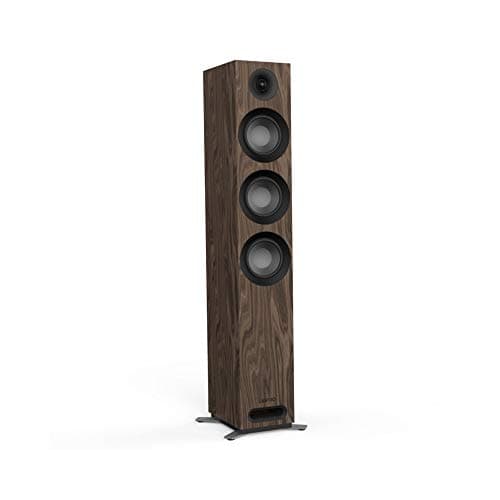 Jamo Studio S 809 The only front-ported tower here, sold as a pair, with a ± 3 dB tolerance on its 37 Hz claim — the answer when the speakers cannot come out into the room. | Best near a wall | 8.0 | |
| 2 | 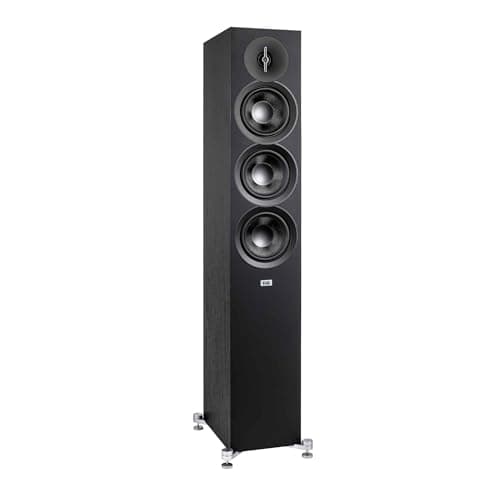 ELAC Debut 3.0 DF53 The same three-way architecture as the DF63 one size down and 6.8 inches wide — and the speaker on this page whose headline bass figure moves furthest once you read ELAC's own stricter measurement. | Narrowest three-way | 7.5 | |
| 3 | 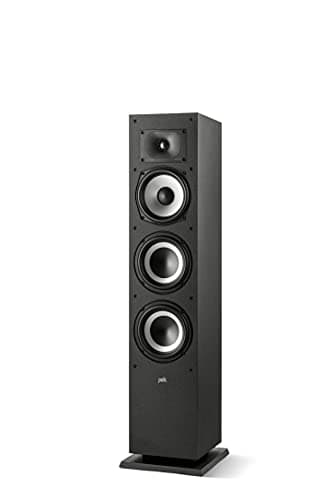 Polk Monitor XT60 7.5 in wide and 20 lb — a tower for a room that has no floor to spare, at the cost of the lowest published sensitivity in the group. | Narrowest footprint | 7.3 | $209.00View on Amazon $229.009% off |
| 4 | 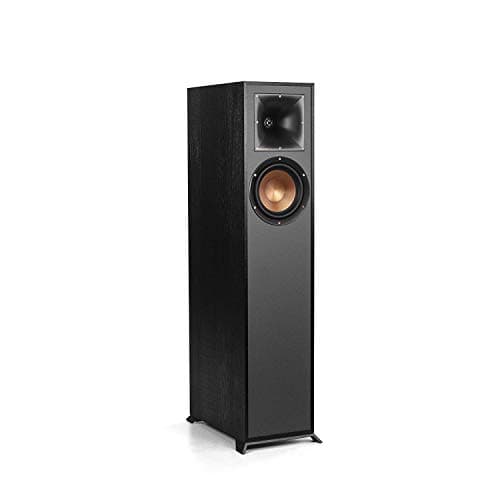 Klipsch R-610F 94 dB at 2.83 V/1 m from the cheapest cabinet here, with Klipsch filling in every field its R-620F sheet leaves blank — and stopping 7 Hz higher for it. | Best for a small room | 7.9 |
A small room has a floor you cannot spare, a wall the speaker will be close to, and room modes that a deep tower excites whether you want it to or not. Those three facts rank floorstanding speakers in nearly the opposite order from a price bracket, which is why this page exists alongside the under-$1,000 roundup rather than repeating it.
Why the bracket ranking is the wrong ranking here
The bracket pages reward the deepest published bass figure, the largest cone area and the most ambitious cabinet. In a room of, say, 10 by 12 feet, each of those is a cost. The lowest room mode along a 12 ft wall sits at about 47 Hz, and our small-room bass-trap guide shows the arithmetic: a speaker that reaches 35 Hz drives every mode below 47 Hz, and in a small room there is nowhere for that energy to go. A speaker whose published limit is 45 Hz drives fewer of them. That is not a loss of quality; it is a match to the room.
The second cost is depth. A tower placed against a wall with a rear port is a tower whose port is firing into the boundary a foot away. A front or slot port removes the problem. A narrow cabinet removes the other problem — the floor it takes — and the published width and depth are the only numbers here that nobody can argue about.
How we ranked this
Port direction first, because it decides whether the speaker can stand where a small room forces it to stand. Then published footprint, width times depth, from each manufacturer’s own dimensions. Then the published low-frequency limit at its stated tolerance, where a higher number is better for this page, not worse. Then sensitivity, because small rooms usually mean small amplifiers. Weight and pair-versus-single are noted but not ranked. Every candidate is one of the eleven floorstanders in the registry; the seven we left out are listed at the end with the number that excluded them.
footprint = width × depth
Inputs
- Jamo S 809 (W × D): 7.52 × 9.92 in (Jamo specifications)
- ELAC Debut 3.0 DF53 (W × D): 6.8 × 9.7 in (ELAC specifications)
- Polk Monitor XT60 (W × D): 7.5 × 9.09 in (Polk product page)
- Klipsch R-610F (W × D): 9.4 × 15.1 in (Klipsch product page)
Result
The front port that lets it stand against the wall
The Jamo Studio S 809 is the only floorstander in the registry with a front-firing port — a slot at the base of the baffle — and that alone puts it first in a room where the speakers will be within a foot of the wall. It is 7.52 in wide and 9.92 in deep, publishes 90 dB at 2.83 V / 1 m and 8 ohms with no hedge, and reaches 37 Hz at ± 3 dB from three 5 in woofers. That 37 Hz is the deepest figure on this page, which counts against it on the third criterion; the front port outweighs it, because a rear-ported 45 Hz speaker jammed against a wall behaves worse than a front-ported 37 Hz one placed the same way. It is sold as a pair.
The narrowest tower we stock
The ELAC Debut 3.0 DF53 is 6.8 in wide, the narrowest floorstanding cabinet in the registry, and 9.7 in deep. It is a genuine three-way with a dedicated 5.25 in midrange and two published crossover points, 500 Hz and 2,100 Hz, and it publishes 87.5 dB. Its bass is the story for this page: ELAC’s product page leads with 38 Hz at − 6 dB, but the owner’s manual publishes 58 Hz at − 3 dB for the same speaker — the shallowest 3 dB figure here by a wide margin, and in a small room that is a feature. The ports are rear-facing dual flared ports, which is what keeps it off first place, and the under-$2,000 page documents ELAC’s 6 ohm versus 4 ohm disagreement with itself. It is sold per cabinet.
The narrowest footprint under $1,000 a pair
The Polk Monitor XT60 is 7.5 in wide and 9.09 in deep — the shallowest cabinet here — with a single 6.5 in woofer and two 6.5 in passive radiators. Polk publishes 38 Hz to 40 kHz with no tolerance window, 86 dB at 1 W rather than 2.83 V, and no nominal impedance, only “compatible with 4- and 8-ohm outputs”. Polk also does not state which way the passive radiators fire, which for this page is the missing fact. It ranks third on footprint alone, with the caveat that the bass figure cannot be checked and the sensitivity is the lowest here, so it wants a larger amplifier than the Jamo or the Klipsch. Sold per cabinet.
The smallest Klipsch tower, and the shallowest bass with a tolerance
The Klipsch R-610F publishes 45 Hz to 21 kHz at ± 3 dB — the highest low-frequency limit on this page that carries a tolerance — 94 dB at 2.83 V, a single 6.5 in woofer and a rear-firing Tractrix port. On the bass criterion it is the best match to a small room in the registry, and its sensitivity means a small amplifier is enough. It ranks fourth because it is 9.4 in wide and 15.1 in deep, nearly twice the footprint of the other three, and because the rear port wants clearance the room may not have. Klipsch labels its impedance “8 ohm compatible” and publishes no minimum. Sold per cabinet.
What we left out, and the number that excluded it
The Klipsch R-620F and RP-6000F II are 15.2 and 17.57 in deep with dual 6.5 in woofers — the wrong size and the wrong bass for this room. The KEF Q7 Meta is 12.5 in wide and 12.4 in deep, although it does ship a port bung for near-wall use and is the pick here if the budget stretches. The JBL Stage 2 280F is 14.1 in wide with its base and has dual 8 in woofers. The ELAC DF63 is the DF53’s larger sibling at 7.7 in wide and 10.6 in deep, with a deeper 46 Hz − 3 dB figure; it is a reasonable choice but the DF53 is the better small-room fit. The Polk XT70 is the XT60 with a second woofer and two 8 in radiators. The Fluance XL8F is 12.99 in deep with a down-firing 8 in woofer, the least suitable tower we stock for a small room.
Or no tower at all
The honest alternative in a small room is a bookshelf pair on stands, and our small-room bookshelf roundup ranks four on the same criteria: port position, cabinet size and boundary gain. A stand-mount takes the same floor as a slim tower but reaches less deep, which in this room is the point. The case for a tower is output and the absence of stands to buy; our comparison puts numbers on both. Whichever you choose, the placement guide covers the distances that matter more than the speaker does.
Every pick in detail
Every specification below links to the manufacturer document we read it from. Where a manufacturer does not publish a figure, we say so rather than estimating it.
Jamo Studio S 809
Best near a wallPrice as of September 17, 2026. #ad
The only front-ported tower here, sold as a pair, with a ± 3 dB tolerance on its 37 Hz claim — the answer when the speakers cannot come out into the room.
- sensitivity
- 8/10
- published data
- 6/10
- bass extension
- 8/10
- amp friendliness
- 8/10
- value for money
- 10/10
| Specification | Published value | Source |
|---|---|---|
| Sensitivity | 90 dB (2.83 V @ 1 m) | Jamo spec table |
| Impedance | 8 Ω — stated flatly, with no “compatible” hedge | Jamo spec table |
| Minimum impedance | Not published | — |
| Frequency response | 37 Hz – 26 kHz ± 3 dB | Jamo spec table |
| Power handling | 120 W / 240 W | Jamo spec table |
| Tweeter | 1 × 25 mm (1 in) soft dome with Anti-Diffraction Waveguide | Jamo spec table |
| Woofers | 3 × 127 mm (5 in) polyfiber | Jamo spec table |
| Crossover frequency | Not published | — |
| Enclosure | Bass reflex via a front-firing slot port — the only front-ported speaker on this page | Jamo spec table |
| Input terminals | Single binding post | Jamo spec table |
| Dimensions (H × W × D) | 41.02 × 7.52 × 9.92 in (1,042 × 191 × 252 mm) | Jamo spec table |
| Weight (each) | 30 lb / 13.6 kg | Jamo spec table |
| Sold as | A pair. Jamo prices the S 809 per pair on its own store, and the Amazon listing is a pair. | Jamo product page |
Pros
- Front-firing slot port — the only speaker on this page that is designed to work close to a back wall
- 37 Hz – 26 kHz ± 3 dB: a tolerance window on the deepest-but-one bass claim here
- 8 Ω stated flatly, with none of the “compatible” hedging Klipsch, Polk and Fluance all use
- Sold as a matched pair, so the listing price is the pair price
Cons
- Jamo publishes NO crossover frequency, so how three 5 in woofers are filtered is undisclosed
- Three 5 in drivers is less cone area than the dual 6.5 in designs it is priced against
- Single binding post — no bi-wiring or bi-amping, which the Polks' 5-way posts allow
- It is the oldest design here, and Jamo's current catalog has moved to other series
Skip it if you want to know how the speaker is filtered. There is no crossover row on Jamo's spec table and no manual figure we can link.
ELAC Debut 3.0 DF53
Narrowest three-wayPrice as of September 17, 2026. #ad
The same three-way architecture as the DF63 one size down and 6.8 inches wide — and the speaker on this page whose headline bass figure moves furthest once you read ELAC's own stricter measurement.
- published data
- 6/10
- sensitivity
- 5/10
- bass extension
- 5/10
- amp friendliness
- 5/10
- value for money
- 8/10
| Specification | Published value | Source |
|---|---|---|
| Design | 3-Way, Bass Reflex — a driver that does nothing but midrange | ELAC spec page |
| Sensitivity | 87.5 dB @ 2.83 V / 1 m — ELAC publishes the same figure for the larger DF63 | ELAC spec page |
| Impedance (nominal) | ELAC publishes two conflicting figures: 6 Ω on the product page, 4 Ω in the Debut 3.0 owner's manual. Plan an amplifier for 4 Ω. | ELAC owner's manual (PDF) |
| Minimum impedance | Not published | — |
| Frequency response | 38 Hz – 38 kHz at −6 dB (the figure ELAC's product page leads with) | ELAC spec page |
| Frequency response (−3 dB) | 58 Hz – 34 kHz — published in the owner's manual only. A 20 Hz gap to the headline number, the widest on this page. | ELAC owner's manual (PDF) |
| Recommended amplifier power | 30 – 150 W | ELAC spec page |
| Power handling | Product page: 140 W peak. Owner's manual: 80 W nominal / 130 W peak. | ELAC owner's manual (PDF) |
| Tweeter | 1 in aluminum dome | ELAC spec page |
| Midrange | 5.25 in aramid fiber — a dedicated midrange, not a mid-woofer | ELAC spec page |
| Woofers | 2 × 5.25 in aramid fiber | ELAC spec page |
| Crossover | 500 Hz, 2,100 Hz | ELAC spec page |
| Enclosure | CARB2-rated 16 mm MDF, dual flared ports | ELAC spec page |
| Input terminals | 5-way metal binding posts | ELAC spec page |
| Dimensions (H × W × D) | 40.6 × 6.8 × 9.7 in (1,030 × 172 × 246 mm) — the narrowest tower in this bracket | ELAC spec page |
| Weight (each) | 34.6 lb / 15.7 kg | ELAC spec page |
| Sold as | One speaker — ELAC's Amazon listing is labelled “Each”. A stereo pair is two purchases. | ELAC product page |
Pros
- 6.8 in wide and 40.6 in tall — the narrowest tower in this bracket by nearly an inch
- A genuine three-way with a dedicated 5.25 in midrange and both crossover points published (500 Hz, 2,100 Hz)
- Same 87.5 dB sensitivity and same binding-post hardware as the larger DF63, for meaningfully less money
- 34.6 lb — light enough for one person to position without help
Cons
- The 38 Hz headline is a −6 dB figure; ELAC's own manual publishes 58 Hz at −3 dB. A 20 Hz gap, the widest on this page
- Same unresolved impedance conflict as the DF63 — 6 Ω on the page, 4 Ω in the manual
- Lowest published power handling here (80 W nominal in the manual), and the two ELAC documents disagree on that too
- At a comparable tolerance it is the shallowest speaker in the bracket, so a subwoofer is not optional for film
- The listing is one speaker, not a pair
Skip it if you are buying for bass. At ELAC's own −3 dB figure this stops higher than anything else here, and the DF63 is the same speaker with the low end the DF53 lacks.
Polk Monitor XT60
Narrowest footprint7.5 in wide and 20 lb — a tower for a room that has no floor to spare, at the cost of the lowest published sensitivity in the group.
- sensitivity
- 4/10
- published data
- 5/10
- bass extension
- 7/10
- amp friendliness
- 6/10
- value for money
- 8/10
| Specification | Published value | Source |
|---|---|---|
| Sensitivity | 86 dB, published by Polk at “1 watt @ 1 meter” — NOT at 2.83 V, so it is not directly comparable to the Klipsch and Jamo figures on this page | Polk product page |
| Impedance | “Compatible with 4- and 8-ohm outputs” — Polk publishes no nominal impedance figure for this speaker | Polk info sheet (PDF) |
| Minimum impedance | Not published | — |
| Frequency response | 38 Hz – 40 kHz, quoted with NO tolerance window, which leaves both endpoints unverifiable | Polk info sheet (PDF) |
| Recommended amplification | 25 – 200 W per channel (a recommendation, not a handling limit — Polk publishes this where Klipsch publishes handling) | Polk info sheet (PDF) |
| Woofer | 1 × 6.5 in bi-laminate paper | Polk info sheet (PDF) |
| Bass radiators | 2 × 6.5 in passive radiators — Polk's feature list claims “deep effortless bass below 38 Hz” | Polk info sheet (PDF) |
| Tweeter | 1 in Terylene dome | Polk info sheet (PDF) |
| Crossover | 2,200 Hz | Polk info sheet (PDF) |
| Input terminals | 5-way nickel-plated binding posts | Polk info sheet (PDF) |
| Passive radiator firing direction | Not published | — |
| Dimensions (H × W × D) | 36.4 × 7.5 × 9.09 in (925 × 190.5 × 230.8 mm) | Polk info sheet (PDF) |
| Weight (each) | 20 lb / 9.07 kg | Polk info sheet (PDF) |
| Sold as | One speaker — Polk's Amazon listing is labelled “Single”. A stereo pair is two purchases. | Polk product page |
Pros
- 7.5 in wide and 9.09 in deep — by some margin the smallest floor footprint here
- Same 25 – 200 W published amplifier recommendation as the larger XT70
- 1 in Terylene dome tweeter, the same driver family Polk uses further up the range
- 20 lb per cabinet makes it the only speaker here one person can position without help
Cons
- 86 dB is the lowest published sensitivity on this page, and it is quoted at 1 watt rather than 2.83 V
- 38 Hz – 40 kHz with no tolerance window, from a single 6.5 in woofer and two 6.5 in radiators
- No nominal impedance and no minimum impedance published
- Radiator firing direction unpublished, same as the XT70
- The Amazon listing is one speaker, not a pair
Skip it if your amplifier is small. The lowest sensitivity in the group is the wrong end to start from with limited power.
Klipsch R-610F
Best for a small roomPrice as of September 17, 2026. #ad
94 dB at 2.83 V/1 m from the cheapest cabinet here, with Klipsch filling in every field its R-620F sheet leaves blank — and stopping 7 Hz higher for it.
- sensitivity
- 9/10
- published data
- 9/10
- bass extension
- 5/10
- amp friendliness
- 10/10
- value for money
- 9/10
| Specification | Published value | Source |
|---|---|---|
| Sensitivity | 94 dB (2.83 V / 1 m) | Klipsch spec sheet (PDF) |
| Impedance | 8 Ω “compatible” (Klipsch's wording — not a measured nominal figure) | Klipsch spec sheet (PDF) |
| Minimum impedance | Not published | — |
| Frequency response | 45 Hz – 21 kHz ± 3 dB | Klipsch spec sheet (PDF) |
| Power handling | 85 W continuous / 340 W peak (a handling limit, not a recommended amplifier range) | Klipsch spec sheet (PDF) |
| Woofer | Single 6.5 in spun-copper IMG | Klipsch spec sheet (PDF) |
| Tweeter | 1 in aluminum LTS on a 90° × 90° square Tractrix horn | Klipsch spec sheet (PDF) |
| Crossover | 1,800 Hz | Klipsch spec sheet (PDF) |
| Enclosure | MDF, bass reflex via a rear-firing Tractrix port | Klipsch product page |
| Input terminals | Single gold-plated binding posts | Klipsch spec sheet (PDF) |
| Dimensions (H × W × D) | 37 × 9.4 × 15.1 in (940 × 240 × 384 mm) | Klipsch spec sheet (PDF) |
| Weight (each) | 36 lb / 16.3 kg | Klipsch spec sheet (PDF) |
| Sold as | One speaker. Klipsch's Amazon listing is a single cabinet; a stereo pair is two purchases. | Klipsch product page |
Pros
- 94 dB at 2.83 V / 1 m — a single 6.5 in woofer that still plays loud on very little power
- 45 Hz – 21 kHz ± 3 dB: a tolerance window, unlike either Polk or the Fluance
- Klipsch publishes the weight (36 lb) and the input hardware here, both of which its R-620F sheet omits
- 37 in tall and 36 lb — the smallest real tower in the group
Cons
- 45 Hz is the shallowest published extension on this page, so a subwoofer is not optional for film
- One 6.5 in woofer against the R-620F's two, for less than double the saving
- Rear-firing Tractrix port, so it still needs clearance behind it
- The Amazon listing is one speaker, not a pair
Skip it if the room is large or the system will never have a subwoofer. The R-620F's extra woofer and 7 Hz are worth the step up.
Frequently asked questions
Are floorstanding speakers too big for a small room?
Why is a shallower bass figure better here?
Which of these can go right against the wall?
How much amplifier do these need?
Should I buy a bookshelf pair instead?
Have you listened to these speakers in a small room?
Read next
The Best Speakers for a Small Room
Four speakers for rooms where the wall is close, chosen on port position, cabinet size and the extension figure each maker publishes.
The Best Floorstanding Speakers Under $1,000
Six towers that make a stereo pair under $1,000, ranked on sensitivity with its stated condition, bass figures with a tolerance, and where the port fires.
Bookshelf vs Floorstanding Speakers
Cabinet volume buys extension; a subwoofer buys extension you can place independently. The trade, with each maker's own numbers.
Stereo Speaker Placement
Dolby's 22-30 degree window turned into a listening-distance rule, plus height, toe-in, boundaries and the port clearance most people miss.
Bass Traps for Small Rooms
The room-mode arithmetic that explains why small rooms sound boomy, and the corner trapping that partially fixes it.
Ported vs Sealed Speakers
What a port buys in efficiency and extension, what it costs in placement and roll-off, and how the sealed and ported subwoofers we cover actually compare.
Sources
Every specification on this page was read from one of these documents. If one of them has changed, or we have made an error, tell us — corrections are logged and dated per our editorial policy.