Ported vs Sealed Speakers
Klipsch builds three speakers from the same drivers, ports two of them and seals the third — and publishes the reason. It is the cleanest illustration of this trade anywhere.

Disclosure: we earn a commission if you buy through the links on this page, at no extra cost to you. It does not influence what we pick — our criteria are published and reproducible, so you can check our work. How we pick · Full disclosure
These picks are spec-and-price analyses, not listening tests. We have not heard this gear and we do not pretend to have: every figure below is sourced to the manufacturer and linked, and every price is live or not shown at all. Here are the rules we followed.
Quick picks
Ranked on the published criteria in How We Pick. Prices are live as of October 15, 2026. Tap any row for the full write-up.
- 7.6
- 8.2$329.00View on Amazon
$479.0031% off
- 9.0
- 8.2$329.00View on Amazon
$599.0045% off
| # | Product | Best for | Score | Price |
|---|---|---|---|---|
| 1 | 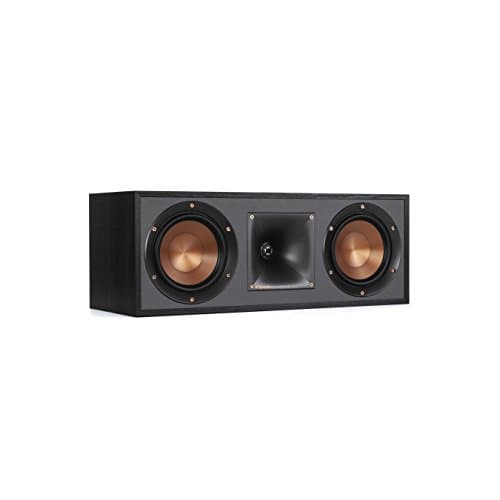 Klipsch R-52C A sealed dual-woofer center with a published 95 dB sensitivity, timbre-matched to the R-41M and R-51M so dialogue does not change character as it pans across the front. | Best center channel | 7.6 | |
| 2 | 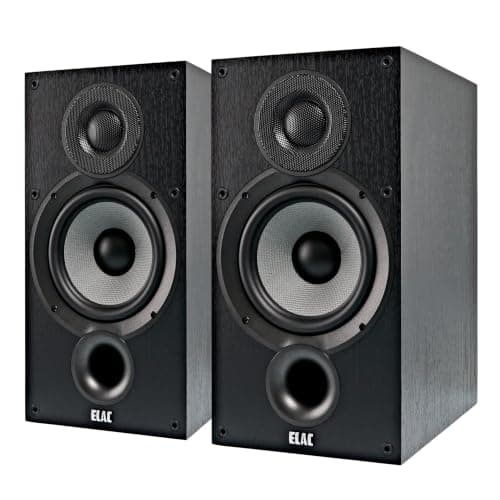 ELAC Debut 2.0 B6.2 A 6.5-inch woofer in a ported cabinet that reaches genuinely low for its size, at the cost of needing an amplifier with real current behind it — and now the outgoing Debut generation rather than the current one. | The outgoing generation, still sold | 8.2 | $329.00View on Amazon $479.0031% off |
| 3 | 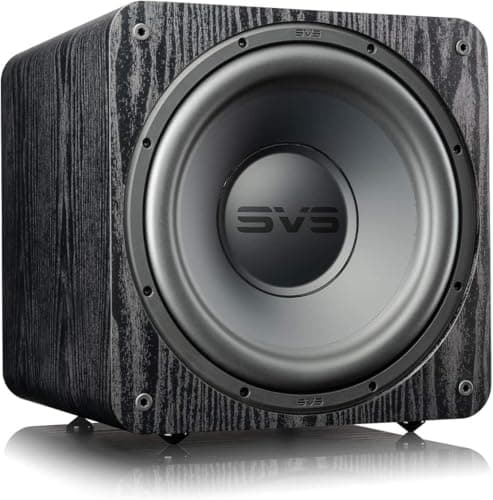 SVS SB-1000 Pro The only subwoofer here whose manufacturer publishes both a continuous power rating and the measurement condition behind its frequency response — 20–270 Hz ± 3 dB at 2 m ground plane — which is what makes its numbers comparable to anything. | Best overall | 9.0 | |
| 4 | 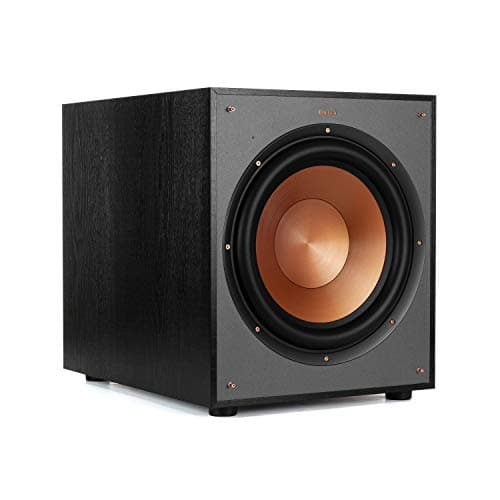 Klipsch R-120SW A 12-inch ported sub whose spec sheet publishes 200 W continuous next to the 400 W peak figure the listings quote — and whose only inputs are RCA, which is the spec that decides whether it works with your amplifier. | Best value 12-inch | 8.2 | $329.00View on Amazon $599.0045% off |
A sealed cabinet is an airtight box. A ported one has a tuned opening that lets the air inside the cabinet work as a second radiator over a narrow band of frequencies. The port is not a hole for the bass to escape through. It is a resonator, tuned to a specific frequency, and it does real acoustic work.
The controlled experiment Klipsch published without meaning to
Klipsch builds the R-41M, R-51M and R-52C from the same driver family — the same 1 in aluminum LTS tweeter on the same 90° × 90° Tractrix horn, the same spun-copper IMG woofer material, spec sheets from the same lab with the same ± 3 dB convention.
Two are ported. One is sealed. And Klipsch states why.
| Speaker | Enclosure | Woofer(s) | Published response | Sensitivity |
|---|---|---|---|---|
| Klipsch R-41M | Bass-reflex, rear-firing ports | Single 4 in | 68 Hz – 21 kHz ± 3 dB | 90 dB |
| Klipsch R-51M | Bass-reflex, rear-firing ports | Single 5.25 in | 62 Hz – 21 kHz ± 3 dB | 93 dB |
| Klipsch R-52C | Sealed | Dual 5.25 in | 89 Hz – 21 kHz ± 3 dB | 95 dB |
The sealed speaker has twice the cone area of the R-51M and stops 27 Hz higher. That is the cost of sealing a box, laid out in one manufacturer’s own numbers with every other variable held roughly constant.
And Klipsch’s reason is a placement reason, not a sound-quality one: the R-52C is a center channel, designed to sit inside a cabinet or on a shelf under a television. A rear-firing port six inches from a cabinet back panel does not work as designed and produces audible port noise. Sealing it removes the problem entirely.
What a port buys
Extension for free, near the tuning frequency
Around the port’s tuning frequency, the air mass in the port radiates in phase with the cone and adds output. You get lower extension out of the same driver in the same size box, with no additional amplifier power. That is genuinely something for nothing, and it is why most speakers are ported.
Less cone excursion at the tuning frequency
At tuning, the cone barely moves — the port is doing the radiating. Less excursion means less distortion in that band.
What a port costs
A steeper roll-off below tuning
Below the port’s tuning frequency the cabinet stops behaving as a resonator and output falls away sharply — considerably more sharply than a sealed box, which rolls off gently. A sealed speaker’s published limit is usually higher, and the octave below that limit is usually less empty.
This matters in a real room, because a room adds boundary gain at the bottom end. A gentle sealed roll-off and a rising room response can partly cancel each other. A steep ported roll-off is harder to rescue that way.
Placement constraints
A rear-firing port needs space behind it. Klipsch publishes rear-firing ports on both the R-41M and the R-51M, and on the R-120SW subwoofer. Push any of them against a wall and you change the tuning and risk audible turbulence from the port.
Front-firing ports avoid this — Polk publishes a front-panel flared port on the PSW10 for exactly that reason. Sealed cabinets avoid it entirely.
Port noise
Air moving fast through a tube makes noise. At high levels and low frequencies, ports chuff. Manufacturers flare the ends to mitigate it, which is what Polk’s “flared port” and BIC’s patented “Venturi” vent are for. ELAC sidesteps the problem on the SUB3010 by using a passive radiator instead of a port — ELAC’s own description is a sealed cabinet loaded by a passive radiator, with no port to chuff.
The subwoofers, where the stereotype breaks
Conventional wisdom says ported goes lower and sealed sounds tighter. The subwoofers we cover do not cooperate.
| Subwoofer | Enclosure | Published response | Continuous amplifier power |
|---|---|---|---|
| SVS SB-1000 Pro | Sealed | 20–270 Hz ± 3 dB, 2 m ground plane quasi-anechoic | 325 W RMS |
| Klipsch R-120SW | Bass-reflex, rear port | 29–120 Hz ± 3 dB | 200 W continuous |
| ELAC SUB3010 | Sealed + passive radiator | 28–150 Hz, no tolerance published | 200 W RMS |
| BIC America F12 | Vented (Venturi vent) | 25–200 Hz, no tolerance published | 150 W RMS |
| Polk PSW10 | Vented, front flared port | 40–160 Hz (−3 dB) | Not published — 100 W peak only |
The sealed SVS publishes the lowest extension on the table, at 20 Hz. It also publishes the largest amplifier by some margin. That is not a coincidence.
It is also why that box wins our home theater roundup, which ranks the same six on continuous power, published response, inputs and room control rather than on alignment — and which spells out the one alignment-independent thing that will change your bass more than any of it: where you put the box.
octaves = log₂(f₁ ÷ f₂) · ΔdB of amplifier power = 10 × log₁₀(P₁ ÷ P₂)
Inputs
- SVS SB-1000 Pro (sealed) published response and power: 20 Hz ± 3 dB, 2 m ground plane · 325 W RMS continuous (SVS product page)
- Klipsch R-120SW (ported) published response and power: 29 Hz ± 3 dB · 200 W continuous (Klipsch spec sheet (PDF))
Result
Extension advantage: log₂(29 ÷ 20) = 0.54 octaves lower
Amplifier cost: 10 × log₁₀(325 ÷ 200) = +2.1 dB more power (1.63×)
Roughly half an octave of extension, bought with about 63% more amplifier — both drivers being 12 inches. That is the sealed trade in a sentence: the cabinet gives you nothing back, so the amplifier and the driver’s excursion have to supply all of it.
These two figures were not measured the same way. SVS is the only manufacturer in this group that publishes its measurement condition — 2 m ground plane, quasi-anechoic — while Klipsch publishes a bare ± 3 dB figure with no condition. The comparison is directionally sound and should not be read to a decimal place.
The passive radiator, which is neither
There is a third option and one of the subwoofers we cover uses it. ELAC describes the SUB3010 as a sealed cabinet loaded by a 10 in doped paper passive radiator alongside its 10 in driven woofer — and states explicitly that there is no port to chuff.
A passive radiator is a cone with no motor. The pressure inside the cabinet drives it, the same way the air in a port is driven, so it performs the same acoustic role — but because it is a cone rather than a column of air in a tube, there is no aperture for air to rush through and no turbulence to generate.
It also decouples the tuning from the cabinet geometry. A port’s tuning depends on its length and diameter, which constrains where it can physically fit; a passive radiator’s tuning depends on its mass, which is a design choice rather than a plumbing problem.
The trade is cost and a second large moving part. ELAC publishes 28–150 Hz for the SUB3010 — but with no tolerance and no measurement condition, so it is not directly comparable to SVS’s 20 Hz ± 3 dB or Klipsch’s 29 Hz ± 3 dB. The design is interesting; the specification is less checkable than either of the others.
How to actually use this
- Speaker going on a shelf or in a cabinet? Sealed, or front-ported. A rear-firing port against a panel is the most common self-inflicted bass problem there is.
- Speaker on stands with room behind it? Ported is fine and will usually give you more bass for the money. Give it the clearance its maker assumes.
- Subwoofer for music in a small room?A sealed design’s gentler roll-off tends to integrate more predictably with room gain. It will want more amplifier to reach the same depth.
- Subwoofer for film? Extension and output matter most, and a ported design gets there with less amplifier. Give it wall clearance if the port fires backward.
And note what is not on that list: which one sounds better. Enclosure type is one design decision among many, and the R-52C shows that a sealed cabinet with twice the cone area can stop 27 Hz higher than a ported one. Buy the published response and the placement constraint, not the enclosure label.
Every pick in detail
Every specification below links to the manufacturer document we read it from. Where a manufacturer does not publish a figure, we say so rather than estimating it.
Klipsch R-52C
Best center channelPrice as of October 15, 2026. #ad
A sealed dual-woofer center with a published 95 dB sensitivity, timbre-matched to the R-41M and R-51M so dialogue does not change character as it pans across the front.
- specs
- 7/10
- sensitivity
- 10/10
- published data
- 6/10
- value for money
- 9/10
- bass extension
- 2/10
| Specification | Published value | Source |
|---|---|---|
| Sensitivity | 95 dB (2.83 V / 1 m) — the highest figure of any center channel on this site | Klipsch spec sheet (PDF) |
| Impedance | 8 Ω “compatible” (Klipsch's wording) | Klipsch spec sheet (PDF) |
| Minimum impedance | Not published | — |
| Frequency response | 89 Hz – 21 kHz ± 3 dB | Klipsch spec sheet (PDF) |
| Power handling | 100 W continuous / 400 W peak | Klipsch spec sheet (PDF) |
| Woofers | Dual 5.25 in spun-copper IMG | Klipsch spec sheet (PDF) |
| Tweeter | 1 in aluminum LTS on a 90° × 90° Tractrix horn | Klipsch spec sheet (PDF) |
| Crossover | 1,630 Hz | Klipsch spec sheet (PDF) |
| Enclosure | MDF, SEALED (the R-41M and R-51M are both ported) | Klipsch spec sheet (PDF) |
| Weight | 13.5 lb / 6.12 kg | Klipsch spec sheet (PDF) |
Pros
- 95 dB at 2.83 V/1 m — the highest published sensitivity of any center channel on this site
- Sealed enclosure, unlike the ported R-41M and R-51M, so it can sit inside a cabinet without port chuffing
- Same 1 in LTS tweeter and Tractrix horn as the R-series bookshelves, which is what timbre matching actually means
- 100 W continuous handling gives a receiver plenty of headroom for dialogue peaks
Cons
- 89 Hz low-end limit — a center channel this shallow depends entirely on the receiver's bass management
- 18.75 in wide, which will not fit under every television
- “8 ohms compatible” again, with no minimum impedance published
- Only useful in a multichannel system; it does nothing for a stereo setup
- Previous generation — Klipsch's own page for it now points buyers to the newer Reference R-50C
Skip it if you are building a stereo system. A center channel has no role in two-channel listening and adding one is not an upgrade.
ELAC Debut 2.0 B6.2
The outgoing generation, still soldA 6.5-inch woofer in a ported cabinet that reaches genuinely low for its size, at the cost of needing an amplifier with real current behind it — and now the outgoing Debut generation rather than the current one.
- sensitivity
- 6/10
- bass extension
- 9/10
- amp friendliness
- 6/10
- value for money
- 10/10
- build quality
- 8/10
| Specification | Published value | Source |
|---|---|---|
| Sensitivity | 87 dB (2.83 V / 1 m) | ELAC spec page |
| Impedance | 6 Ω | ELAC spec page |
| Minimum impedance | Not published | — |
| Frequency response | 44 Hz – 35 kHz (no tolerance published) | ELAC spec page |
| Maximum power input | 120 W (a handling limit — ELAC publishes no recommended amplifier range) | ELAC spec page |
| Woofer | 6.5 in woven aramid-fiber cone | ELAC spec page |
| Tweeter | 1 in cloth dome | ELAC spec page |
| Crossover | 2,200 Hz | ELAC spec page |
| Weight (each) | 16.3 lb / 7.4 kg | ELAC spec page |
Pros
- 6.5in woofer reaches genuinely low for a bookshelf
- Front port, so it tolerates being near a wall better than a rear-ported box
- Well-braced cabinet for the price
Cons
- Wants more amplifier than its size suggests — check the arithmetic before pairing
- Large for a 'bookshelf' speaker
- Finish is functional rather than furniture
- The outgoing generation — ELAC's Debut 3.0 DB63 now builds on it, though ELAC publishes the same 87 dB and 6 Ω for both, so our sensitivity arithmetic holds for either
- ELAC publishes no response tolerance and no recommended amplifier range for this generation. The DB63 publishes both, which is the real reason it ranks ahead
Skip it if your amplifier is a low-power desktop unit. Run the power arithmetic on our amp-matching guide first.
SVS SB-1000 Pro
Best overallPrice as of October 15, 2026. #ad
The only subwoofer here whose manufacturer publishes both a continuous power rating and the measurement condition behind its frequency response — 20–270 Hz ± 3 dB at 2 m ground plane — which is what makes its numbers comparable to anything.
- extension
- 9/10
- published data
- 10/10
- room control
- 10/10
- value for money
- 6/10
- build quality
- 9/10
| Specification | Published value | Source |
|---|---|---|
| Frequency response | 20–270 Hz ± 3 dB, measured 2 m ground plane away from reflective structures (quasi-anechoic). SVS is the only manufacturer in this group that publishes the measurement condition. | SVS product page |
| Amplifier power | 325 W RMS continuous (820+ W peak dynamic), Sledge STA-325D class D | SVS product page |
| Driver | 12 in long-throw, 13.3 mm Xmax / 26.9 mm Xmech, 1.5 in voice coil | SVS product page |
| Enclosure type | Sealed, extra-thick MDF front baffle with internal bracing | SVS product page |
| Inputs | Unbalanced stereo RCA in/out (16 kΩ) plus speaker-level stereo input (1 kΩ); 3–12 V AC/DC trigger | SVS product page |
| DSP / app | 50 MHz Analog Devices DSP; Bluetooth app for iOS/Android with 3 nameable presets, 3 parametric EQ bands per preset, adjustable low pass, phase, polarity and room-gain compensation | SVS product page |
| Dimensions (with grille) | 13.5 in H × 13 in W × 14.76 in D (342 × 330 × 375 mm) | SVS product page |
| Weight | 26 lb (11.9 kg) unboxed with grille | SVS product page |
Pros
- 325 W RMS continuous is a continuous rating, not a peak figure dressed as one
- 20–270 Hz ± 3 dB published WITH its measurement condition — nobody else here does that
- App DSP with three parametric EQ bands per preset and room-gain compensation, which is real control over the one band room correction handles worst
- Speaker-level inputs as well as RCA, so an integrated amp with no sub output can still drive it
- Sealed 13-inch cabinet — it fits where a ported 12 will not
Cons
- The most expensive pick here
- Sealed alignment trades raw output near tuning for a gentler roll-off — a ported box of the same size will play louder at 30 Hz
- The app is the interface for the good features; the front panel alone is not
- One of these in a large open-plan room will run out before a bigger ported sub does
Skip it if your room is large and open-plan and output matters more to you than measured accuracy. A ported 12 costs less and moves more air down low.
Klipsch R-120SW
Best value 12-inchA 12-inch ported sub whose spec sheet publishes 200 W continuous next to the 400 W peak figure the listings quote — and whose only inputs are RCA, which is the spec that decides whether it works with your amplifier.
- extension
- 8/10
- published data
- 8/10
- room control
- 4/10
- value for money
- 9/10
- build quality
- 7/10
| Specification | Published value | Source |
|---|---|---|
| Frequency response | 29 Hz – 120 Hz ± 3 dB | Klipsch spec sheet (PDF) |
| Amplifier power (cont/peak) | 200 W / 400 W, all-digital. The 400 W is the peak figure and it is the one the listings quote. | Klipsch spec sheet (PDF) |
| Maximum acoustic output | 116 dB | Klipsch spec sheet (PDF) |
| Driver | 12 in high-excursion spun-copper IMG woofer, front-firing | Klipsch spec sheet (PDF) |
| Enclosure type | Bass-reflex via rear-firing port, MDF | Klipsch spec sheet (PDF) |
| Inputs | Line level / LFE RCA jacks only — NO speaker-level inputs | Klipsch spec sheet (PDF) |
| Controls | Volume, low-pass, 0/180 phase, auto power on | Klipsch spec sheet (PDF) |
| Dimensions | 16.5 in H × 14 in W × 19.2 in D (419 × 356 × 488 mm) | Klipsch spec sheet (PDF) |
| Weight | 31 lb (14.1 kg) | Klipsch spec sheet (PDF) |
| Low-pass crossover range | Not published | — |
Pros
- 200 W continuous IS published, alongside the 400 W peak — Klipsch prints both
- 29 Hz – 120 Hz ± 3 dB, a real tolerance rather than a bare number
- Maximum acoustic output published at 116 dB
- Front-firing driver with a rear port, so it is less fussy about how far it sits from a wall than a down-firing design
Cons
- Line/LFE RCA inputs ONLY — no speaker-level inputs, so an integrated amp with no subwoofer output cannot drive it without a converter
- The 400 W in every listing headline is the peak figure, not the rating
- A large box: 19.2 inches deep, 31 lb
- Klipsch does not publish the low-pass crossover range, only that a low-pass control exists
- Previous generation — Klipsch's own page for it now points buyers to the newer Reference R-121SW
Skip it if your amplifier has no subwoofer output. This one has no speaker-level input, and that is a hard stop rather than an inconvenience.
Frequently asked questions
Is a sealed or ported speaker better?
Neither, and Klipsch’s own range shows why. The sealed R-52C has twice the cone area of the ported R-51M and stops 27 Hz higher — but it is sealed deliberately, because it is designed to sit in a cabinet where a rear port would not work. A port buys extension and efficiency; sealing buys placement freedom and a gentler roll-off.
Can you put a ported speaker against a wall?
Not a rear-ported one, without changing how it behaves. Klipsch publishes rear-firing ports on the R-41M, R-51M and R-120SW; all three need clearance behind them. Front-ported designs like the Polk PSW10, and sealed designs like the Klipsch R-52C and SVS SB-1000 Pro, do not have this constraint.
Do sealed subwoofers go lower than ported ones?
Not as a rule, but they can. Among the subwoofers we cover, the sealed SVS SB-1000 Pro publishes the lowest figure at 20 Hz ± 3 dB — and it also publishes 325 W RMS against the ported Klipsch R-120SW’s 200 W for 29 Hz. About half an octave lower, bought with roughly 63% more amplifier.
What is port chuffing?
Audible turbulence from air moving fast through the port at high levels and low frequencies. Manufacturers mitigate it by flaring the port ends — Polk publishes a flared front port on the PSW10 and BIC a patented Venturi vent on the F12. ELAC avoids it entirely on the SUB3010 by using a sealed cabinet with a passive radiator instead of a port.
Read next
Stereo Speaker Placement
Dolby's 22-30 degree window turned into a listening-distance rule, plus height, toe-in, boundaries and the port clearance most people miss.
Bookshelf vs Floorstanding Speakers
Cabinet volume buys extension; a subwoofer buys extension you can place independently. The trade, with each maker's own numbers.

The Best Subwoofers for a Home Theater
Six subwoofers ranked on continuous power and published response, including two that publish neither.
Speaker Sensitivity Explained
2.83 V/1 m versus 1 W/1 m, what the conversion is worth in decibels, and the twelve-decibel spread that means sixteen times the power.
The Best Bookshelf Speakers Under $500
Six pairs under $500 — and only one publishes a minimum impedance and a recommended amp range.
How to Add a Subwoofer to a Stereo Amplifier
Three connection routes, which subs support each, and why a stereo amp adds bass rather than redirecting it.
Sources
Every specification on this page was read from one of these documents. If one of them has changed, or we have made an error, tell us — corrections are logged and dated per our editorial policy.
- Klipsch R-52C — sealed enclosure and response (spec sheet, PDF)
- Klipsch R-51M — response and drivers (spec sheet, PDF)
- Klipsch R-41M — rear-firing ports and response (spec sheet, PDF)
- SVS SB-1000 Pro — sealed enclosure, response, measurement condition
- Klipsch R-120SW — bass reflex, rear port, response (spec sheet, PDF)
- ELAC Debut 2.0 SUB3010 — passive radiator, no port
- BIC America F12 — Venturi vent
- Polk PSW10 — front flared port and −3 dB limits
- ELAC Debut 2.0 B6.2 — response