How Much Does a Home Theater Cost?
The receiver is the cheapest part. Almost every budget that goes wrong goes wrong because five speakers were counted as one line item.

Disclosure: we earn a commission if you buy through the links on this page, at no extra cost to you. It does not influence what we pick — our criteria are published and reproducible, so you can check our work. How we pick · Full disclosure
These picks are spec-and-price analyses, not listening tests. We have not heard this gear and we do not pretend to have: every figure below is sourced to the manufacturer and linked, and every price is live or not shown at all. Here are the rules we followed.
Quick picks
Ranked on the published criteria in How We Pick. Prices are live as of October 15, 2026. Tap any row for the full write-up.
- 7.6
- 7.6
- 8.4
- 6.0
| # | Product | Best for | Score | Price |
|---|---|---|---|---|
| 1 | 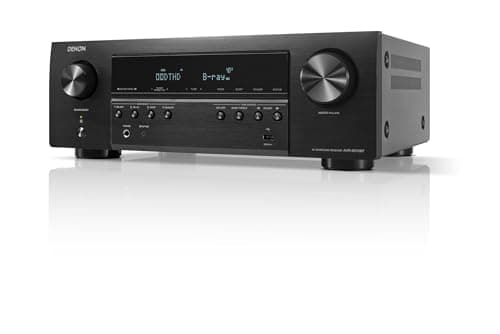 Denon AVR-S570BT The one receiver in this bracket that publishes a single power rating and no flattering second one — and it pays for that restraint by giving up Atmos, room correction and a phono input. | Cleanest single power rating under $500 | 7.6 | |
| 2 | 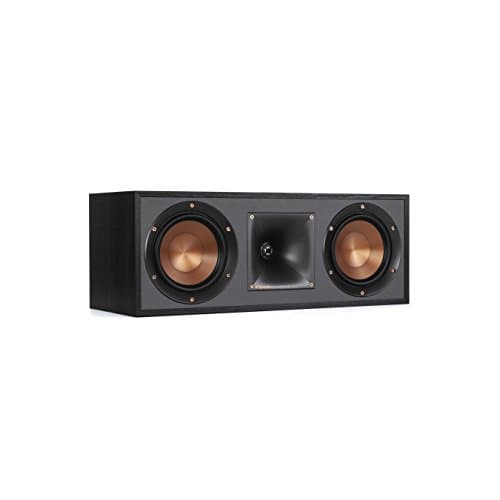 Klipsch R-52C A sealed dual-woofer center with a published 95 dB sensitivity, timbre-matched to the R-41M and R-51M so dialogue does not change character as it pans across the front. | Best center channel | 7.6 | |
| 3 | 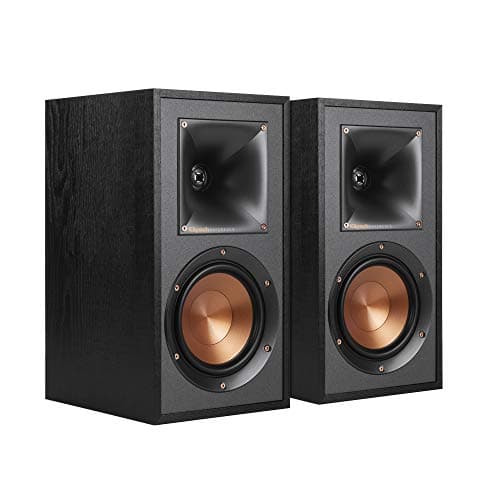 Klipsch R-51M High sensitivity means a modest amplifier drives these to a real volume — the practical answer when the amp is fixed and small. | Best for low-power amplifiers | 8.4 | |
| 4 | 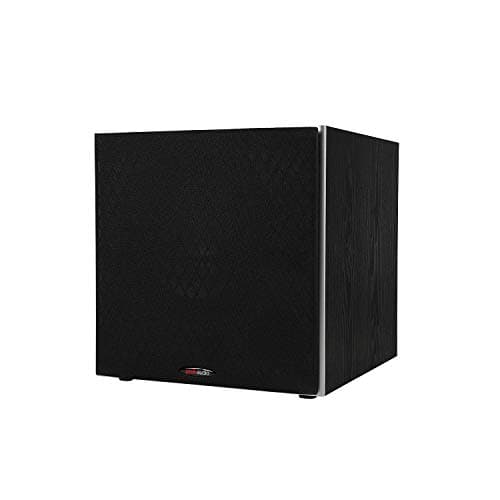 Polk Audio PSW10 The cheapest way into a real .1 channel, and the one where Polk's own page argues with itself — the marketing says 35 Hz, the specification table says the −3 dB point is 40 Hz. | Best for a small room | 6.0 |
We are not going to give you a single number, because the number depends on a decision you have not made yet: how many channels you are buying. What we can do is list every line item, in the order you have to buy it, and price the ones we cover live.
Prices on this page come from Amazon’s API and change daily — the four picks above show today’s figures. Everything below is about proportions and sequence, which do not change.
The line items, in order
A 5.1 system is a receiver, three front speakers, two surrounds and a subwoofer. That is seven boxes, not two, and the arithmetic that surprises people is that the speakers are five of them.
| Line item | Count | Share of a typical entry build |
|---|---|---|
| AV receiver | 1 | Roughly a third |
| Front left / right | 2 (sold as a pair) | Roughly a fifth |
| Center channel | 1 | Roughly a tenth |
| Surrounds | 2 (sold as a pair) | Roughly a tenth |
| Subwoofer | 1 | Roughly a fifth |
| Speaker cable, banana plugs, mounts | — | The part left out of every estimate |
The proportions are what to take from that table, not the percentages to the decimal. Two things follow from them. First, the receiver is not where a tight budget breaks — you can buy a competent one for well under a third of the build. Second, the speaker package is the majority of the spend, and it is the part people underestimate because “speakers” sounds like one purchase.
The costs that never appear in the estimate
Cable, and more of it than you think. A 5.1 system needs five runs of speaker cable, and the surrounds are the long ones because they go behind the seats. Two rooms of identical size can differ by fifty feet of cable depending on whether the runs go around the walls or under the floor.
A phono stage, if a turntable is involved. Receivers under $500 do not publish one. Denon does not list a phono input for the AVR-S570BT and Onkyo does not list one for the TX-NR5100, so a turntable adds a separate box to the bill.
Treatment, eventually. Not on day one, but the first two panels at the first reflection points cost less than most single speakers and change more than most single upgrades. Budget for them as a phase two rather than pretending the room is free.
Where the money goes furthest, in order
If the budget is fixed and something has to give, this is the order we would spend in, and each step is defended by a published number rather than a preference.
- All five channels before any quality. A complete 5.1 of modest speakers beats an incomplete 2.0 of expensive ones for film, because the center channel carries the dialogue. Without it, dialogue is a phantom image that collapses the moment anyone sits off-axis.
- Speaker sensitivity over receiver wattage. Three decibels of sensitivity is worth a doubling of amplifier power, and sensitivity is free at the point of purchase. The Klipsch R-52C center publishes 95 dB and the R-51M publishes 93 dB, both at 2.83 V / 1 m.
- A subwoofer that publishes a continuous rating. Five of the six subwoofers we cover put a peak figure on the box. The continuous number is the one that describes what it does all evening.
- Then the receiver. The whole spread from a 50 W receiver to a 100 W one is three decibels. It is the smallest lever on this list.
Timbre matching is a cost decision, not an audiophile one
Buying the front three from one series is not a refinement. A film mix pans dialogue and effects across the front three constantly, and if the center has a different tweeter from the mains, a sound moving left to right changes character as it crosses the screen.
The practical consequence for a budget is that the front three should be bought together, from the same line, even if that means postponing the surrounds by a month. Our home theater speaker picks are grouped as timbre-matched builds for exactly this reason.
Buying it in phases
The most common way to make a fixed budget produce a good system is to buy it over two or three months rather than in one order, and there is a right sequence for that too.
- Phase one: receiver, front left and right, center. A 3.0 system is a complete, usable system for film. Dialogue is anchored, the front stage works, and it plays music properly. Buy the front three together from the same series so they are timbre matched.
- Phase two: the subwoofer.This is the single largest change to the sound of the system, and it is also the component whose specification most rewards attention — five of six subwoofers we cover put a peak figure on the box.
- Phase three: the surrounds. Last, because they carry the least information and because they are the runs that need the most cable. They also do not have to match the fronts as closely as the center does.
What this sequence avoids is the failure mode of buying five cheap speakers at once: a system that is complete and permanently mediocre, with nothing worth keeping when you upgrade.
What a home theater does not cost
Two things get sold as necessary at this stage and are not. Exotic speaker cable is one: the specification that matters in a domestic run is conductor gauge, and the resistance arithmetic is short. Room correction is the other — it is a feature of receivers you are already buying, not a separate purchase, and what each system corrects varies more than the marketing suggests.
The honest summary
A complete 5.1 system built from parts we cover is a four-figure purchase at the entry end once cable and mounts are counted, and the receiver is the smallest part of it. If that number is out of range, the correct move is to buy fewer channels of the same quality rather than five channels of worse — a good 3.1 today extends to 5.1 next year, and a bad 5.1 has to be replaced entirely.
That principle has a worked example now: our best-home-theater-system-under-$1,000 build names the four boxes, totals them from the live price layer, and states which speakers the ceiling takes away.
Every pick in detail
Every specification below links to the manufacturer document we read it from. Where a manufacturer does not publish a figure, we say so rather than estimating it.
Denon AVR-S570BT
Cleanest single power rating under $500No live price right now. #ad
The one receiver in this bracket that publishes a single power rating and no flattering second one — and it pays for that restraint by giving up Atmos, room correction and a phono input.
- published data
- 9/10
- power
- 8/10
- features
- 5/10
- connectivity
- 7/10
- value for money
- 8/10
| Specification | Published value | Source |
|---|---|---|
| Channels | 5.2 — Denon's own product title is “AVR-S570BT - 5.2 Ch. 70W 8K AV Receiver” | Denon product page |
| Power output | Front 70 W + 70 W, center 70 W, surround 70 W + 70 W (8 Ω, 20 Hz – 20 kHz, 0.08% THD) | Denon specifications (owner's manual) |
| Signal-to-noise | 98 dB (IHF-A weighted, Direct mode) | Denon specifications (owner's manual) |
| Frequency response | 10 Hz – 100 kHz, +1 / −3 dB (Direct mode) | Denon specifications (owner's manual) |
| Analog input sensitivity | 200 mV / 47 kΩ | Denon specifications (owner's manual) |
| Phono input | None — no phono input appears in Denon's specification table for this model. Its dearer siblings, the AVR-S670H and AVR-X1800H, both have one. | Denon specifications (owner's manual) |
| Dolby Atmos / DTS:X | Neither is named anywhere on Denon's product page for this model. The formats Denon does name are Dolby Digital, Dolby TrueHD and DTS-HD. If height channels are why you are buying, this is not the receiver. | Denon product page |
| Room correction | None. Denon publishes “Audyssey Dynamic EQ: No” and “Audyssey Dynamic Volume: No” for this model — it sits a step below the AVR-S670H's Audyssey MultEQ. | Denon product page |
| HDMI in / out | 4 in / 1 out (eARC) | Denon product page |
| Video passthrough | 8K/60 Hz and 4K/120 Hz; Dolby Vision, HDR10+, HLG and Dynamic HDR | Denon product page |
| HDMI 2.1 gaming features | VRR Yes, QFT Yes, QMS No. ALLM does NOT appear in Denon's specification table for this model — it is claimed only in the marketing copy on the same page. Denon also does not state how many of the four inputs carry 8K/4K120, where it prints an explicit count on every dearer model. | Denon product page |
| Pre-outs | 0.2 — two subwoofer outputs and nothing else. No main-channel pre-outs. | Denon product page |
| Network streaming | None published — Bluetooth only. This model sits outside Denon's HEOS range. | Denon product page |
Pros
- 70 W per channel rated 20 Hz – 20 kHz at 0.08% THD — the honest condition, published by Denon
- 8K/60 and 4K/120 passthrough with Dolby Vision, HDR10+ and HLG on four HDMI inputs
- HDMI eARC output, so a modern television can send it a lossless stream
- Two subwoofer outputs, which is unusual at this price
Cons
- No Dolby Atmos and no DTS:X named anywhere by Denon for this model
- No room correction at all — Audyssey Dynamic EQ and Dynamic Volume are both published as “No”
- No phono input, so a turntable needs its own phono stage
- No network streaming; Bluetooth is the only wireless input
Skip it if you want height channels or automatic room correction. Both start one model up, at the AVR-S670H.
Klipsch R-52C
Best center channelPrice as of October 15, 2026. #ad
A sealed dual-woofer center with a published 95 dB sensitivity, timbre-matched to the R-41M and R-51M so dialogue does not change character as it pans across the front.
- specs
- 7/10
- sensitivity
- 10/10
- published data
- 6/10
- value for money
- 9/10
- bass extension
- 2/10
| Specification | Published value | Source |
|---|---|---|
| Sensitivity | 95 dB (2.83 V / 1 m) — the highest figure of any center channel on this site | Klipsch spec sheet (PDF) |
| Impedance | 8 Ω “compatible” (Klipsch's wording) | Klipsch spec sheet (PDF) |
| Minimum impedance | Not published | — |
| Frequency response | 89 Hz – 21 kHz ± 3 dB | Klipsch spec sheet (PDF) |
| Power handling | 100 W continuous / 400 W peak | Klipsch spec sheet (PDF) |
| Woofers | Dual 5.25 in spun-copper IMG | Klipsch spec sheet (PDF) |
| Tweeter | 1 in aluminum LTS on a 90° × 90° Tractrix horn | Klipsch spec sheet (PDF) |
| Crossover | 1,630 Hz | Klipsch spec sheet (PDF) |
| Enclosure | MDF, SEALED (the R-41M and R-51M are both ported) | Klipsch spec sheet (PDF) |
| Weight | 13.5 lb / 6.12 kg | Klipsch spec sheet (PDF) |
Pros
- 95 dB at 2.83 V/1 m — the highest published sensitivity of any center channel on this site
- Sealed enclosure, unlike the ported R-41M and R-51M, so it can sit inside a cabinet without port chuffing
- Same 1 in LTS tweeter and Tractrix horn as the R-series bookshelves, which is what timbre matching actually means
- 100 W continuous handling gives a receiver plenty of headroom for dialogue peaks
Cons
- 89 Hz low-end limit — a center channel this shallow depends entirely on the receiver's bass management
- 18.75 in wide, which will not fit under every television
- “8 ohms compatible” again, with no minimum impedance published
- Only useful in a multichannel system; it does nothing for a stereo setup
- Previous generation — Klipsch's own page for it now points buyers to the newer Reference R-50C
Skip it if you are building a stereo system. A center channel has no role in two-channel listening and adding one is not an upgrade.
Klipsch R-51M
Best for low-power amplifiersPrice as of October 15, 2026. #ad
High sensitivity means a modest amplifier drives these to a real volume — the practical answer when the amp is fixed and small.
- sensitivity
- 10/10
- bass extension
- 6/10
- amp friendliness
- 10/10
- value for money
- 9/10
- build quality
- 7/10
| Specification | Published value | Source |
|---|---|---|
| Sensitivity | 93 dB (2.83 V / 1 m) | Klipsch spec sheet (PDF) |
| Impedance | 8 Ω “compatible” (Klipsch's wording — not a measured nominal figure) | Klipsch spec sheet (PDF) |
| Minimum impedance | Not published | — |
| Frequency response | 62 Hz – 21 kHz ± 3 dB | Klipsch spec sheet (PDF) |
| Power handling | 85 W continuous / 340 W peak (a handling limit, not a recommended amplifier range) | Klipsch spec sheet (PDF) |
| Woofer | 5.25 in spun-copper IMG | Klipsch spec sheet (PDF) |
| Tweeter | 1 in aluminum LTS on a 90° × 90° Tractrix horn | Klipsch spec sheet (PDF) |
| Crossover | 1,660 Hz | Klipsch spec sheet (PDF) |
| Weight (each) | 11 lb / 5 kg | Klipsch spec sheet (PDF) |
Pros
- High sensitivity — plays loud on very little power
- The right answer for a low-wattage or tube amplifier
- Horn tweeter gives strong dispersion control
Cons
- Horn presentation is divisive and we cannot tell you how it sounds — we have not heard them
- Rear port needs breathing room from the wall
- Less low-end than the ELAC B6.2
- Previous generation — Klipsch's own page for it now points buyers to the newer Reference R-50M
Skip it if your amp already has power to spare — you are paying for sensitivity you do not need.
Polk Audio PSW10
Best for a small roomPrice as of October 15, 2026. #ad
The cheapest way into a real .1 channel, and the one where Polk's own page argues with itself — the marketing says 35 Hz, the specification table says the −3 dB point is 40 Hz.
- extension
- 3/10
- published data
- 7/10
- room control
- 3/10
- value for money
- 8/10
- build quality
- 5/10
| Specification | Published value | Source |
|---|---|---|
| Frequency response (−3 dB) | 40 Hz → 160 Hz. Polk's own marketing copy on the same page says “down to 35 Hz”; the specification table says 40 Hz. We publish the table. | Polk product page |
| Amplifier power | 100 W peak, class D. Polk publishes no continuous rating for this model — the 100 W is a peak figure. | Polk product page |
| Amplifier bandwidth / distortion | 40 Hz – 200 Hz, < 1% distortion | Polk product page |
| Driver | 10 in Dynamic Balance polymer composite cone | Polk product page |
| Enclosure type | Vented via front-panel flared port | Polk product page |
| Inputs | Stereo line level (2 × RCA) plus speaker level (2 pairs of gold-plated spring terminals) | Polk product page |
| Dimensions | 14.375 in H × 14 in W × 16.125 in D (36.5 × 35.6 × 41 cm) | Polk product page |
| Weight | 26 lb (11.8 kg) | Polk product page |
Pros
- Polk publishes proper −3 dB limits (40 Hz → 160 Hz), which most sub makers at this price do not
- Line level AND speaker level inputs, so it works with almost anything
- 26 lb and the smallest 10-inch box here — it disappears in an apartment
- Amplifier bandwidth and distortion (< 1%) are published
Cons
- 40 Hz is a genuinely limited bottom end for film — the LFE track goes an octave below that
- Polk's own marketing on the same page claims 35 Hz against its own spec table's 40 Hz
- 100 W is a PEAK figure; Polk publishes no continuous rating for this model
- No DSP, no app, no room correction
Skip it if your room is bigger than a bedroom or you watch action films at volume. This is the entry point, and it is honest about being one.
Frequently asked questions
How much does a home theater cost?
A complete 5.1 built from components we cover is a four-figure purchase at the entry end once cable and mounts are included. The receiver is roughly a third of it; the five speakers together are the largest share. We price the individual components live rather than quoting a total, because component prices change daily.
What is the most expensive part of a home theater?
The speaker package, because it is five boxes rather than one. Front left and right, a center, two surrounds and a subwoofer typically account for well over half the build. Budgets go wrong when “speakers” is written down as a single line item.
What costs are usually left out of a home theater budget?
Speaker cable and connectors for five runs, wall or stand mounting for the surrounds, and a phono stage if a turntable is involved — no AV receiver under $500 that we verified publishes a phono input. Room treatment is a fourth, and it is worth planning as a phase two rather than ignoring.
Should I spend more on the receiver or the speakers?
Speakers. The entire published power range across the receivers we cover is about three decibels, which is one doubling of power. Three decibels of extra speaker sensitivity buys the same loudness for nothing, and speaker choice changes far more than receiver choice at this end of the market.
Read next
Home Theater Setup: The Complete Guide
The complete setup, built on Dolby's published layout angles rather than on vibes — plus what to do when your room disagrees.
The Best AV Receivers Under $500
Three receivers under $500, compared on the condition attached to each power figure — and all three come out at the same seventy watts.
The Best Home Theater Speakers
A timbre-matched 5.1 built from published specs — fronts, center, surrounds and a subwoofer that actually connects.
The Best Subwoofers for a Home Theater
Six subwoofers ranked on continuous power and published response, including two that publish neither.
Are AV Receivers Worth It?
Four products in one chassis, priced as one. Which of the four you actually need decides whether a receiver is the right purchase at all.
The Best Acoustic Panels for a Home Theater
Panels ranked on published per-frequency absorption — and why an NRC of 1.00 can still absorb 12% at 125 Hz.
Sources
Every specification on this page was read from one of these documents. If one of them has changed, or we have made an error, tell us — corrections are logged and dated per our editorial policy.