The Best Acoustic Panels for a Home Theater
This is the category where the headline number is structurally misleading. Not dishonest — misleading by construction. Here is the arithmetic that shows why.

Disclosure: we earn a commission if you buy through the links on this page, at no extra cost to you. It does not influence what we pick — our criteria are published and reproducible, so you can check our work. How we pick · Full disclosure
These picks are spec-and-price analyses, not listening tests. We have not heard this gear and we do not pretend to have: every figure below is sourced to the manufacturer and linked, and every price is live or not shown at all. Here are the rules we followed.
Quick picks
Ranked on the published criteria in How We Pick. Prices are live as of October 15, 2026. Tap any row for the full write-up.
- 8.4
- 7.2
- 8.0
- 5.4
- 3.0
- 2.8
| # | Product | Best for | Score | Price |
|---|---|---|---|---|
| 1 | 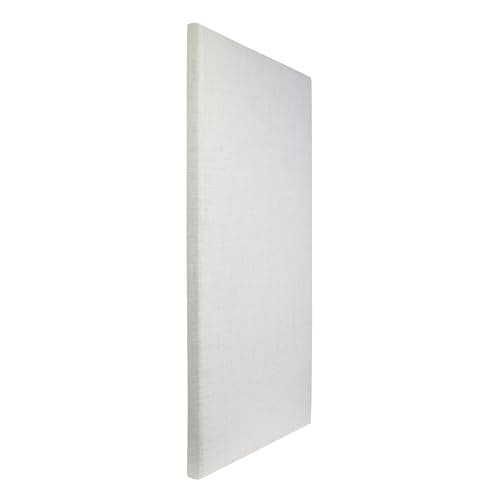 ATS Acoustics Sound Absorbing Panel (24x48) A mineral wool panel with the full absorption curve published — including the 125 Hz figure of 0.12 that its own NRC of 1.00 completely hides. | Best overall panel | 8.4 | |
| 2 | 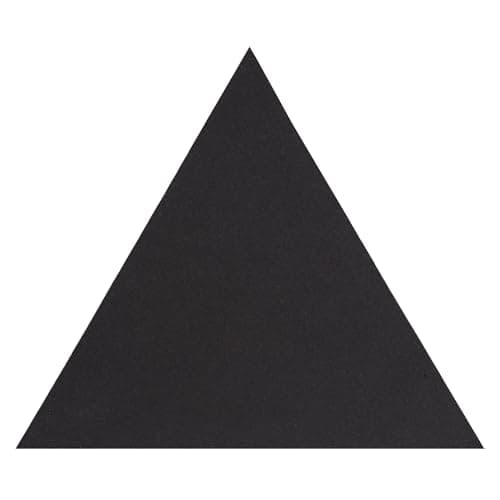 ATS Acoustics Tri-Corner Bass Trap A rigid fiberglass corner section at 6 lb per cubic foot, chosen on material and geometry because ATS publishes no per-frequency data for it at all. | Best bass trap | 7.2 | |
| 3 | 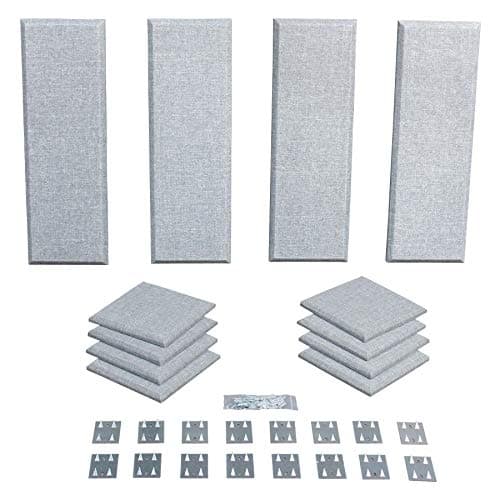 Primacoustic London 8 A planned kit of panels and corner traps with a mounting system included, which removes the hardest part of treating a room: deciding what goes where. | Best complete kit | 8.0 | |
| 4 | 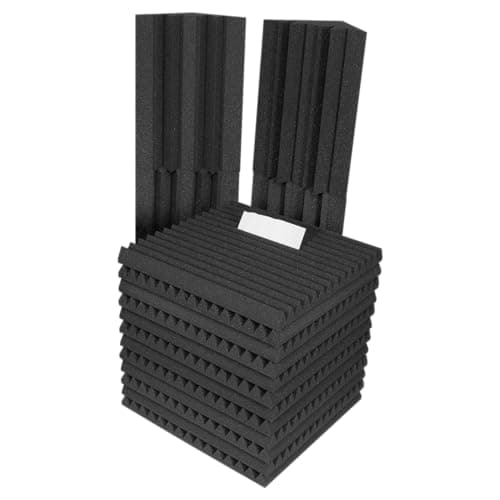 Auralex Roominator Kit A structured foam kit from a manufacturer that does publish absorption data, which separates it from the unbranded foam it resembles. | Best foam kit | 5.4 | |
| 5 | 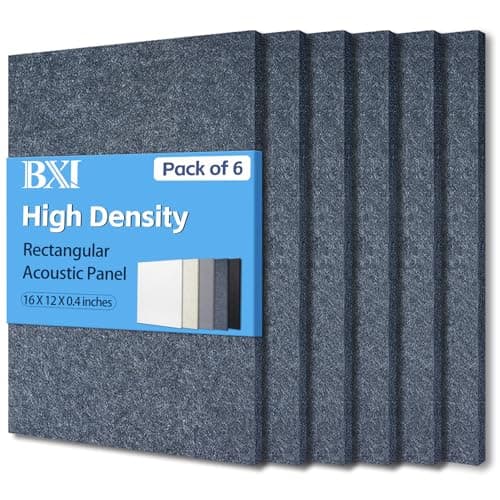 BXI Sound Absorber A thin polyester absorber with no manufacturer, no datasheet, and no published test standard we could find anywhere. | The one with no verifiable data at all | 3.0 | |
| 6 | 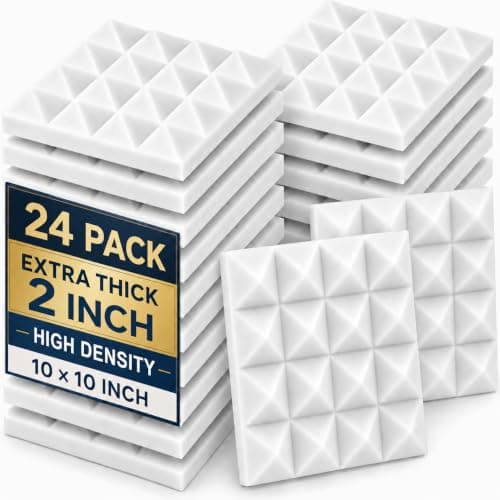 Arrowzoom Acoustic Foam Panels Cheap wedge foam whose own published data starts at 250 Hz — on a page that acknowledges the test standard begins at 125 Hz. | The one we would skip | 2.8 |
Almost every acoustic panel is sold on one number: NRC, the Noise Reduction Coefficient. Higher is better, 1.00 is perfect, and a panel with NRC 1.00 absorbs everything.
That last part is false, and the reason is not a lie by anyone. It is arithmetic.
What NRC actually averages
NRC is the average of a panel’s absorption at just four frequencies: 250 Hz, 500 Hz, 1 kHz and 2 kHz. It does not include 125 Hz. It does not include anything below 250 Hz at all.
So a panel can absorb nothing whatsoever in the bass and still post a perfect NRC, because the bass bands are not in the average. This is not a loophole someone is exploiting — it is the definition of the measurement. But it means the number on the box is silent about the frequencies most rooms actually have problems with.
NRC = (α₂₅₀ + α₅₀₀ + α₁ₖ + α₂ₖ) / 4 · note what is absent: 125 Hz
Inputs
- ATS 24×48×2 published coefficients: 125 Hz: 0.12 · 250 Hz: 0.67 · 500 Hz: 1.17 · 1 kHz: 1.12 · 2 kHz: 1.08 · 4 kHz: 1.08 (ATS Acoustics)
- ATS published NRC: 1.00 (ATS Acoustics)
Result
NRC = (0.67 + 1.17 + 1.12 + 1.08) / 4 = 4.04 / 4 = 1.01 → published as 1.00 ✓
Absorption at 125 Hz: 0.12 — about 12%.
The published NRC checks out exactly. And the same panel that averages “perfect” absorbs roughly one eighth of the energy at 125 Hz. Both facts are ATS’s own, printed on the same page. The NRC is not wrong — it simply cannot show you the 125 Hz row, because that row is not in the formula.
Search snippets for this panel frequently quote “NRC 0.95”. ATS’s own page says 1.00, and as the arithmetic above shows, 1.00 is what their coefficients produce. We are citing the manufacturer, not the snippet.
Why 2 inches cannot absorb bass, and no panel escapes it
A porous absorber works by air movement through the material. Air movement is greatest a quarter-wavelength from a boundary, and it is essentially zero at the wall itself.
At 125 Hz, a wavelength is about 2.7 meters, so a quarter-wavelength is about 69 cm. A two-inch panel is 5 cm. It sits almost entirely in the zone where the air is barely moving at that frequency, so there is almost nothing for it to convert to heat.
At 1 kHz the wavelength is 34 cm and a quarter-wavelength is 8.5 cm — now a 5 cm panel is a significant fraction of that distance, and it absorbs strongly. That is the entire story of why every panel on this page collapses in the bass and works well in the treble. It is physics, not product quality.
Which means the ranking on this page is not really “which panel absorbs bass” — none of them do, much. It is “which manufacturer tells you that”.
Who tells you, and who does not
ATS Acoustics publishes the full curve including the unflattering 125 Hz figure of 0.12. That is why they win: not because the panel is magic, but because they show you the whole measurement and let you conclude what you like.
Auralex deserves genuine credit. They are selling foam, and they publish that their 2-inch DST-114 measures 0.16 at 125 Hz — a number that makes their own product look transparent to bass. Most foam sellers would omit that row. They did not.
Primacoustic publishes the full curve too, and marks their methodology honestly — which turns out to matter. Their 1-inch panels are Riverbank lab-tested to ASTM C423. Their 1.5-inch figures are marked as “typical performance based on quarter wavelength calculations”— calculated, not measured. The London 8 kit’s main Control Columns are the 1.5-inch panels, so the kit’s headline low-frequency numbers are theoretical. Primacoustic says so in a footnote. We are repeating it in body text.
Arrowzoomis the instructive one, and the omission is the finding. Their technical data page states — in their own words — that ASTM C423 tests from 125 Hz to 4000 Hz while NRC uses only 250 Hz to 2000 Hz. They tell you the standard starts at 125 Hz. Then their table starts at 250 Hz. The page is headed “NRC Data Table” and contains no NRC column at all.
BXIpublishes nothing anywhere. We could not find a manufacturer website or datasheet at all. Every figure circulating for it — an “NRC 0.87” for a 3/8-inch panel — appears only in retailer listings. For context, Auralex’s 2-inch foam, over five times thicker, measures NRC 0.65. We are not calling the claim false. We are saying nobody has published anything that would let you check it, and at that point it is not a specification, it is a number in a listing.
What to actually buy, in what order
- Corner traps first. Bass accumulates at room boundaries and most of all in corners, so that is where a trap has the most energy to work with. This is why the ATS corner trap ranks second despite ATS publishing no per-frequency data for it — the placement does more than the material.
- First reflection points next. Two panels at the side-wall mirror points do more for clarity than six panels scattered decoratively.
- Everything else after that, and with diminishing returns.
The Atmos conflict worth knowing about
If you run up-firing Atmos speakers, do not put absorption on the ceiling above your seat. Those speakers work by bouncing sound off the ceiling, and a panel there absorbs the exact reflection they depend on. Two good ideas, in direct conflict. Treat the walls instead.
The honest summary
Buy mineral wool or rigid fiberglass, not foam — at 250 Hz the ATS panel absorbs 0.67 where Arrowzoom’s 1.9-inch tiles manage 0.13. Put it in corners first. Expect it to fix your treble and midrange and to barely touch anything below about 125 Hz, because two inches of anything cannot.
And if a product will not show you its 125 Hz number, assume there is a reason.
For where in the room these go — side walls as a band for every seat, the wall behind the row, the screen wall, the corners for the subwoofer and the ceiling last — our whole-room home-theater treatment guide is the placement companion to this roundup.
Every pick in detail
Every specification below links to the manufacturer document we read it from. Where a manufacturer does not publish a figure, we say so rather than estimating it.
ATS Acoustics Sound Absorbing Panel (24x48)
Best overall panelPrice as of October 15, 2026. #ad
A mineral wool panel with the full absorption curve published — including the 125 Hz figure of 0.12 that its own NRC of 1.00 completely hides.
- low frequency absorption
- 8/10
- published data
- 10/10
- build quality
- 9/10
- value for money
- 7/10
- appearance
- 8/10
| Specification | Published value | Source |
|---|---|---|
| NRC | 1.00 | ATS Acoustics product page |
| Absorption coefficients | 125 Hz: 0.12 · 250 Hz: 0.67 · 500 Hz: 1.17 · 1 kHz: 1.12 · 2 kHz: 1.08 · 4 kHz: 1.08 | ATS Acoustics product page |
| Material | ROCKWOOL AFB mineral wool core, solid wood frame, 1/4 in wood back panel | ATS Acoustics product page |
| Thickness | 2 in | ATS Acoustics product page |
| Dimensions / weight | 24 × 48 × 2 in; ~12 lb per panel | ATS Acoustics product page |
| Fire rating | None — ATS states “This item is not fire rated.” | ATS Acoustics product page |
| ASTM test mounting | Not published | — |
| Density | Not published | — |
Pros
- Publishes the full per-frequency curve, not just an NRC — so you can see what it actually does
- Mineral wool core absorbs 0.67 at 250 Hz, where 1.9 in foam manages 0.13
- Fabric-wrapped and presentable in a living room
Cons
- NRC 1.00 is a real figure and still misleading: at 125 Hz this panel absorbs 0.12. NRC averages 250 Hz–2 kHz only, so it structurally cannot show you the bass performance.
- Not fire rated — ATS states this plainly, and it may matter for your install
- Heavy at ~12 lb, and far more expensive than foam per panel
Skip it if your problem is bass. No 2-inch panel solves that — including this one — and you want corner traps instead.
ATS Acoustics Tri-Corner Bass Trap
Best bass trapPrice as of October 15, 2026. #ad
A rigid fiberglass corner section at 6 lb per cubic foot, chosen on material and geometry because ATS publishes no per-frequency data for it at all.
- low frequency absorption
- 10/10
- published data
- 4/10
- build quality
- 9/10
- value for money
- 6/10
- appearance
- 7/10
| Specification | Published value | Source |
|---|---|---|
| NRC | 0.95 (published for the 2 in fiberglass core) | ATS Acoustics product page |
| Absorption coefficients | Not published. ATS gives only a single NRC figure, and NRC by definition excludes 125 Hz — the band a bass trap exists to address. | ATS Acoustics product page |
| Material | Rigid fiberglass core, frameless | ATS Acoustics product page |
| Density | 6 lb per cubic foot | ATS Acoustics product page |
| Thickness | 2 in, with 35° mitered edges for corner mounting | ATS Acoustics product page |
| Sizes | 12, 18 and 24 in sections — the price here is the 24 in | ATS Acoustics product page |
| Fire rating | ASTM E84 Class A | ATS Acoustics product page |
Pros
- Corner placement targets pressure maxima where bass builds up
- 6 lb/ft³ rigid fiberglass rather than foam, and ATS publishes the density
- ASTM E84 Class A fire rating, published — which the ATS flat panel does not have
Cons
- Expensive per unit
- ATS publishes only an NRC, and NRC by definition excludes 125 Hz — the band a bass trap exists for
- Takes up real corner volume
- You need several to make a measurable difference
Skip it if your room has no accessible corners — the placement is the product.
Primacoustic London 8
Best complete kitPrice as of October 15, 2026. #ad
A planned kit of panels and corner traps with a mounting system included, which removes the hardest part of treating a room: deciding what goes where.
- low frequency absorption
- 8/10
- published data
- 8/10
- build quality
- 9/10
- value for money
- 7/10
- appearance
- 8/10
| Specification | Published value | Source |
|---|---|---|
| Absorption — 1 in Scatter Blocks (LAB MEASURED) | 125 Hz: 0.17 · 250 Hz: 0.28 · 500 Hz: 0.81 · 1 kHz: 1.00 · 2 kHz: 1.02 · 4 kHz: 0.95 — tested by Riverbank Acoustical Laboratories (ASTM C423-02a, E795-05) | Primacoustic engineering data sheet (PDF) |
| Absorption — 1.5 in Control Columns (CALCULATED, NOT MEASURED) | 125 Hz: 0.31 · 250 Hz: 0.56 · 500 Hz: 1.01 · 1 kHz: 1.00 · 2 kHz: 1.01 · 4 kHz: 1.00 — Primacoustic marks this row “typical performance based on quarter wavelength calculations”. These are the kit's main panels, so the kit's headline low-frequency numbers are theoretical, not lab data. | Primacoustic engineering data sheet (PDF) |
| NRC | Not published | — |
| Material | High-density 6 lb/ft³ glass wool, acoustically transparent polyester fabric | Primacoustic engineering data sheet (PDF) |
| Kit contents | 12 panels — 4 × Control Columns (12 × 36 × 1.5 in), 8 × Scatter Blocks (12 × 12 × 1 in); 16 Surface Impalers | Primacoustic engineering data sheet (PDF) |
| Coverage | 20 sq ft (1.85 m²) — rated for rooms up to 100 sq ft (9.3 m²) | Primacoustic engineering data sheet (PDF) |
| Fire rating | ASTM E84-09 Class A/1 (fabric wrap) | Primacoustic engineering data sheet (PDF) |
Pros
- A planned set rather than a pile of panels
- Includes corner traps, not just flat absorbers
- Impaling clip mounting system included
Cons
- Expensive as a single purchase
- Sized for a specific room area — check yours first
- Limited finishes
Skip it if your room is much larger or smaller than the kit assumes — buy panels individually instead.
Auralex Roominator Kit
Best foam kitPrice as of October 15, 2026. #ad
A structured foam kit from a manufacturer that does publish absorption data, which separates it from the unbranded foam it resembles.
- low frequency absorption
- 4/10
- published data
- 8/10
- build quality
- 6/10
- value for money
- 5/10
- appearance
- 4/10
| Specification | Published value | Source |
|---|---|---|
| NRC | DST-112: 0.60 · DST-114: 0.65 (the D36 kit contains both) | Auralex product page |
| Absorption — 2 in DST-114 (ASTM C-423) | 125 Hz: 0.16 · 250 Hz: 0.29 · 500 Hz: 0.57 · 1 kHz: 0.75 · 2 kHz: 0.90 · 4 kHz: 1.00 — Auralex publishes the 125 Hz figure that shows this foam is nearly transparent to bass. Credit where it's due: most foam sellers omit that band entirely. | Auralex performance data |
| Material | Studiofoam (DST-112 and DST-114 panels) | Auralex product page |
| Kit contents | 18 × DST-114, 18 × DST-112, 72 × EZ-Stick Pro tabs | Auralex Roominator spec sheet (PDF) |
| Fire rating | UL 94 HF-1 | Auralex product page |
| Panel dimensions | Not published | — |
| Density | Not published | — |
Pros
- Auralex publishes real absorption data for its foam
- Structured kit with corner treatment
- Light — mounts with adhesive
Cons
- It is still foam: absorption falls away at low frequencies where rooms need it most
- Looks like a studio, not a living room
- Adhesive mounting can mark walls
Skip it if your problem is bass. Foam of this thickness does not solve that, and no amount of it will.
BXI Sound Absorber
The one with no verifiable data at allPrice as of October 15, 2026. #ad
A thin polyester absorber with no manufacturer, no datasheet, and no published test standard we could find anywhere.
- low frequency absorption
- 2/10
- published data
- 1/10
- build quality
- 4/10
- value for money
- 5/10
- appearance
- 5/10
| Specification | Published value | Source |
|---|---|---|
| Published absorption data | None — no manufacturer publication exists. BXI has no locatable manufacturer website or technical datasheet. Every figure circulating for this product (“NRC 0.87”, “200 kg/m³”, “Class B1 flame retardant”) appears only in retailer listings, which are not an acceptable source for a spec — so we do not repeat them. | see note — no BXI source exists |
Pros
- Very cheap per panel
- Thin profile
- Not wedge foam
Cons
- We could not find a manufacturer website or datasheet for BXI at all — every figure circulating for it comes from retailer listings
- No published per-frequency data, no test standard, no lab attribution anywhere
- At 3/8 in thick it cannot physically absorb low frequencies, whatever a listing claims
Skip it if you want evidence. The retailer-listed “NRC 0.87” is not physically plausible for a 3/8-inch panel when Auralex's 2-inch foam — over five times thicker — measures 0.65. We are not saying the claim is false; we are saying nobody has published anything that would let you check it.
Arrowzoom Acoustic Foam Panels
The one we would skipPrice as of October 15, 2026. #ad
Cheap wedge foam whose own published data starts at 250 Hz — on a page that acknowledges the test standard begins at 125 Hz.
- low frequency absorption
- 2/10
- published data
- 1/10
- build quality
- 4/10
- value for money
- 4/10
- appearance
- 3/10
| Specification | Published value | Source |
|---|---|---|
| NRC | Not published. The manufacturer's table is headed “NRC Data Table” yet contains no NRC column and no NRC value for any product. The “NRC 0.9” figure circulating for these panels appears only in retailer listings, which are not an acceptable source for a spec. | Arrowzoom technical data |
| Absorption coefficients | 125 Hz: NOT PUBLISHED for any product — the table starts at 250 Hz. 1.9 in Pyramid tiles: 250 Hz: 0.13 · 500 Hz: 0.27 · 1 kHz: 0.62 · 2 kHz: 0.92 · 4 kHz: 1.00. 0.8 in Wedge tiles: 250 Hz: 0.10 · 500 Hz: 0.13 · 1 kHz: 0.30 · 2 kHz: 0.68 · 4 kHz: 0.94. Their “Bass Traps”: 250 Hz: 0.38, with no 125 Hz figure at all. | Arrowzoom technical data |
| The omission | Arrowzoom's own page states “ASTM C423 tests 125Hz-4000Hz, but NRC calculations use 250Hz-2000Hz” — acknowledging that 125 Hz is part of the test standard — and then publishes a table that begins at 250 Hz. | Arrowzoom technical data |
| Material composition | Not published | — |
| Density | Not published | — |
| Fire rating | Not published | — |
Pros
- Very cheap
- Light and easy to mount
- Genuinely does reduce high-frequency flutter echo
Cons
- Arrowzoom's own table has no 125 Hz column — on a page that states ASTM C423 tests from 125 Hz. They tell you the standard starts lower than their data does.
- The table is headed “NRC Data Table” and contains no NRC value for any product
- Even at the frequencies they do publish, the 1.9 in tiles absorb 0.13 at 250 Hz — against 0.67 for mineral wool at the same frequency
Skip it if you want your room to sound better rather than merely quieter in the treble. Their own numbers show near-total transparency below about 500 Hz, and their “Bass Traps” manage 0.38 at 250 Hz with no 125 Hz figure at all.
Frequently asked questions
Does acoustic foam actually work?
For treble and upper midrange, yes — Auralex publishes 0.75 at 1 kHz and 1.00 at 4 kHz for its 2-inch DST-114. For bass, no: the same panel measures 0.16 at 125 Hz. It will reduce flutter echo and make a room less bright. It will not fix a boomy room, and no quantity of it will.
What does NRC actually mean?
NRC is the average absorption across just four frequencies — 250 Hz, 500 Hz, 1 kHz and 2 kHz. It excludes 125 Hz and everything below 250 Hz entirely. That is why a panel can publish NRC 1.00 and still absorb only 12% at 125 Hz, as ATS’s own data shows. The number is accurate; it just cannot describe bass.
Do acoustic panels soundproof a room?
No, and this is the most expensive misunderstanding in the category. Absorption reduces reflections inside a room. Soundproofing stops sound passing between rooms, and requires mass, decoupling and sealing — panels provide none of those. Foam on a wall will not stop your neighbor hearing your films.
How many acoustic panels do I need?
Fewer than a sales page suggests, if you place them properly. Two at the side-wall first reflection pointsplus corner traps will do most of the audible work. Coverage without placement is money spent on the wrong walls — Primacoustic’s London 8 kit, for instance, is rated for rooms up to 100 sq ft, which is a real constraint worth checking against your room.
Are expensive acoustic panels worth it over cheap foam?
On the published data, in the bass, yes — meaningfully. At 250 Hz, ATS’s mineral wool absorbs 0.67 while Arrowzoom’s 1.9-inch foam tiles absorb 0.13. That is a fivefold difference at a frequency that matters. Above 1 kHz the gap narrows sharply and foam is genuinely competitive.
Why do you rank the Arrowzoom panels last?
Because their own technical page notes that ASTM C423 tests from 125 Hz and then publishes a table starting at 250 Hz, with no NRC column despite being titled “NRC Data Table”. Even the figures they do publish are weak — 0.13 at 250 Hz for the 1.9-inch tiles. We are not disputing their data. We are noting which row is missing.
Read next
Bass Traps vs Acoustic Panels
Same material, different thickness and placement — and that decides whether your room gets fixed or just quieter in the treble.
Find Your First Reflection Points
The mirror trick, in five minutes and for free — plus why those two points matter more than six panels elsewhere.

Home Theater Setup: The Complete Guide
The complete setup, built on Dolby's published layout angles rather than on vibes — plus what to do when your room disagrees.
Dolby Atmos Speaker Placement
Dolby's published height angles, ceiling versus up-firing, and what each needs from your room.
The Best Bass Traps
Ranked on published 125 Hz absorption rather than NRC — and only one maker publishes it for a corner trap.
How Much Room Treatment Do I Need?
The Sabine equation, applied to a real room with real published coefficients — and what the answer costs.
DIY vs Store-Bought Acoustic Panels
Material, lab data, fire rating — the three things you are paying for, and which of them the manufacturers actually publish.
Room Treatment for Home Theater
The whole-room version for a theater: side walls for every seat, the wall behind the seats, the screen wall, the corners for the subwoofer, and the ceiling last.
Sources
Every specification on this page was read from one of these documents. If one of them has changed, or we have made an error, tell us — corrections are logged and dated per our editorial policy.