Denon AVR-X1800H vs Onkyo TX-NR6100
Two 7.2 receivers, $200 apart, that divide the criteria almost perfectly between them. Which one is right depends on four questions about your room.

The short answer
There is no single winner here, and anyone who tells you otherwise has picked a criterion and hidden it. These two receivers divide the specifications almost perfectly. The Denon AVR-X1800H takes room correction, the phono stage and the pre-outs. The Onkyo TX-NR6100 takes rated power, every HDMI question, and about $200.
So: buy the Denonif the receiver is the heart of a music-and-film system — Audyssey MultEQ XT is the stronger room correction, and Denon is the only maker in this bracket that publishes an RIAA figure for its phono stage, so it doubles as a record player’s amplifier. Buy the Onkyo if more than one games console is going into it, or if you want a second HDMI output, or if $200 matters — its HDMI 2.1 disclosure is the most specific any maker in our registry makes, and it is the only one here that publishes an idle power figure. The 100 W against 80 W is worth under 1 dB and should not decide anything.
Disclosure: we earn a commission if you buy through the links on this page, at no extra cost to you. It does not influence what we pick — our criteria are published and reproducible, so you can check our work. How we pick · Full disclosure
These picks are spec-and-price analyses, not listening tests. We have not heard this gear and we do not pretend to have: every figure below is sourced to the manufacturer and linked, and every price is live or not shown at all. Here are the rules we followed.
Quick picks
Ranked on the published criteria in How We Pick. Prices are live as of October 10, 2026. Tap any row for the full write-up.
- 9.0
- 8.2$649.00View on Amazon
$899.9928% off
| # | Product | Best for | Score | Price |
|---|---|---|---|---|
| 1 | 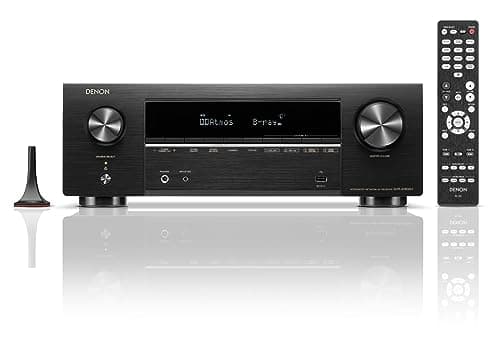 Denon AVR-X1800H Seven channels, 8K passthrough and Audyssey MultEQ XT — the room correction being the feature that actually changes what you hear in a real room. | Best overall under $1,000 | 9.0 | |
| 2 | 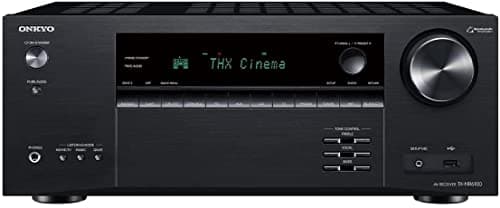 Onkyo TX-NR6100 THX certified with three 4K120 HDMI inputs, which is the specific spec that matters if two consoles and a PC share the same receiver. | Best for gaming | 8.2 | $649.00View on Amazon $899.9928% off |
These are ranks one and three of our best AV receiver under $1,000 roundup, and they are the two readers most often narrow down to. Both are 7.2-channel receivers. Both decode Dolby Atmos and DTS:X, pass 8K video, stream, and have a moving-magnet phono input. Most of what you read comparing them is about the ways they are the same.
Four specifications actually differ in ways that change what you should buy. One more — the one quoted most often — is marketing on both sides.
The picks compared, spec by spec
Four rows, because these are the four that decide it. Power is in the table to show that it does not — see the arithmetic below.
Every figure below is the manufacturer’s own published value and links to the document we read it from. “Not published” means the manufacturer does not publish that figure; an em dash means we have no published figure for that model. Prices are live as of October 10, 2026.
Best overall under $1,000
- Room correction
- Audyssey MultEQ XT
- Rated power (FTC conditions)
- 80 W × 2 (0.08% THD)
- Pre-outs
- 2.2 — front L/R + 2 sub
- Phono input
- MM, 2.5 mV, RIAA ± 1 dB
Best for gaming
- Room correction
- AccuEQ — no Dirac on this model
- Rated power (FTC conditions)
- 100 W/ch (0.08% THD, FTC)
- Pre-outs
- Subwoofer + Zone 2 only
- Phono input
- MM, 3.5 mV / 47 kΩ
| Pick | Room correction | Rated power (FTC conditions) | Pre-outs | Phono input | Price |
|---|---|---|---|---|---|
| 1.Denon AVR-X1800HBest overall under $1,000 | Audyssey MultEQ XT | 80 W × 2 (0.08% THD) | 2.2 — front L/R + 2 sub | MM, 2.5 mV, RIAA ± 1 dB | |
| 2.Onkyo TX-NR6100Best for gaming | AccuEQ — no Dirac on this model | 100 W/ch (0.08% THD, FTC) | Subwoofer + Zone 2 only | MM, 3.5 mV / 47 kΩ |
Prices as of October 10, 2026; every “Check Price” link goes to Amazon and earns us a commission at no extra cost to you. #ad
1. Room correction: the Denon wins, and it is the most important row
Denon fits Audyssey MultEQ XT, with Dynamic EQ and Dynamic Volume. Onkyo fits AccuEQ with AccuReflex, and Dirac Live is not available on this model at all — Onkyo starts Dirac at the TX-NR7100, one model up.
We rank this first because room correction changes what arrives at your listening seat by several decibels across the bass and lower midrange, which is far more than any other difference on this page. A receiver cannot fix a room, but measuring the room and correcting what it can is the single largest intervention either of these boxes makes on the sound. What the different room-correction systems actually do goes through the mechanism; the short version is that MultEQ XT applies more filter resolution than AccuEQ and takes measurements from more positions.
If you are putting speakers into a normal room with furniture, drywall and a sofa against a wall, this row is worth more than the other three put together. It is also the row that justifies the Denon’s extra $200 on its own.
2. Power: the Onkyo wins a difference you cannot hear
Onkyo’s FTC-rated figure is 100 W per channel (8 Ω, 20 Hz – 20 kHz, 0.08% THD, 2 channels driven). Denon’s is 80 W + 80 W under conditions that are identical in every respect. That is a genuinely comparable pair of numbers, which is rarer than it ought to be.
ΔdB = 10 × log₁₀(P₂ ÷ P₁)
Inputs
- Denon AVR-X1800H rated output: 80 W (8 Ω, 20 Hz – 20 kHz, 0.08% THD, 2 ch driven) (Denon AVR-X1800H info sheet (PDF))
- Onkyo TX-NR6100 rated output: 100 W/ch (8 Ω, 20 Hz – 20 kHz, 0.08% THD, 2 ch driven, FTC) (Onkyo TX-NR6100 specifications)
Result
3. The 210 watts that do not exist
Search for the TX-NR6100 and you will find “210 W per channel” everywhere. It is a dynamic-power marketing figure measured under conditions that have nothing to do with playing a film, and it is roughly double the FTC rating above. Both numbers are Onkyo’s; only one is a rating.
We mention it because it is the single most common distortion in comparisons of these two receivers. A page that sets Onkyo’s 210 W against Denon’s 80 W is comparing a burst measurement with a full-band continuous one and reporting a 4 dB gap that does not exist. The real gap is 0.97 dB. If you want the general version of this, how to read an amplifier power rating is the page.
4. HDMI and gaming: the Onkyo wins decisively
Onkyo gives you 6 inputs and 2 outputs, and is the only maker in our registry that enumerates which terminals carry the HDMI 2.1 feature set: inputs 1–3, Main Out and Sub/Zone 2 Out, covering VRR, ALLM, QFT, DSC, QMS and eARC. Inputs 4–6 are HDMI 2.0 up to 4K/60.
Denon gives you 6 inputs and 1 output, three of the inputs 8K-capable, and publishes its HDMI 2.1 features as a yes/no list — ALLM yes, QMS no, QFT yes, VRR yes — without stating which of the six inputs carry them beyond the “3 × 8K” count.
So the Onkyo is ahead on three separate counts:
- Three HDMI 2.1 inputs you can identify. If you own a PS5 and an Xbox Series X and a gaming PC, you can plug all three into known-good terminals. On the Denon you know three inputs are 8K and have to work out the rest.
- A second HDMI output, which a projector-plus-TV room needs and the Denon cannot do.
- QMS, which Denon explicitly publishes as a No.
If gaming is the main use, this row settles it and our best AV receiver for gaming roundup ranks the Onkyo first for these reasons. What eARC actually changes covers the audio-return side, where the two are equivalent.
5. Pre-outs: the Denon wins, narrowly, and neither is good
Denon publishes 2.2 pre-outs — front left and right plus two subwoofer outputs. Onkyo lists a subwoofer pre-out at 1 V rms / 470 Ω and a Zone 2 line-out at 200 mV rms / 470 Ω, and no main-channel pre-outs appear anywhere on its specification page.
So if you ever want an external stereo power amplifier driving your front pair — the most common upgrade anyone makes to a receiver-based system — the Denon allows it and the Onkyo does not. Neither lets you hand off the surround or height channels. Our receivers-with-pre-outs roundup ranks the registry on this one spec, and the honest finding there is that this bracket is not where the problem gets solved.
6. The phono stage, since this is a hi-fi site too
Both have a moving-magnet phono input. The difference is what each maker publishes about it. Denon gives you 2.5 mV input sensitivity, an RIAA deviation of ± 1 dB from 20 Hz to 20 kHz, 74 dB signal-to-noise (IHF-A) and 0.03% distortion. Onkyo gives you 3.5 mV rms into 47 kΩ, and stops.
Sensitivity alone only tells you a stage exists. The RIAA figure tells you whether records come out the shape they went in, and Denon is the only maker in this bracket that prints it. If a turntable is going into this receiver, that is a real advantage — though ± 1 dB is loose next to what a dedicated box does, and phono stages under $500 publish ± 0.3 dB. Either receiver will take an external phono stage on a line input instead; which input and which switch position is the part people get wrong.
7. One row where Onkyo is more honest than Denon
Onkyo publishes 635 W operating, 65 W idle, 0.1 W standby. That middle figure — powered on, not playing anything — is the one almost nobody publishes, and 65 W is a real number: leave it on all day and it is the running cost of a bright light bulb.
Denon publishes 430 W and a 0.1 W standby figure that applies only with Network Control set to “Off In Standby” and HDMI Pass Through off; with CEC standby it is 0.5 W. Denon publishes no idle figure at all. We would rather have Onkyo’s disclosure, and we note it because the pattern across this comparison is that each maker is forthcoming about different things — Denon about its phono stage, Onkyo about its terminals and its power draw.
8. What we would actually buy
A music-and-film system in a real room, with a turntable: the Denon AVR-X1800H. Audyssey MultEQ XT and the published RIAA figure are the two things on this page that change what you hear, and it is the only one of the two you can later put a power amplifier in front of.
Two or more consoles, or a projector and a TV, or a tight budget: the Onkyo TX-NR6100. Three identified HDMI 2.1 inputs, a second output, QMS, and $200 back. You give up the better room correction and the front pre-outs to get there.
Neither, if you are only using five speakers: both of these sell you seven amplifier channels. The broader bracket includes two 5.2 receivers that cost less and do that job, and what a 7.2 badge actually commits the maker to is worth reading before you pay for channels you will not connect.
Every pick in detail
Every specification below links to the manufacturer document we read it from. Where a manufacturer does not publish a figure, we say so rather than estimating it.
Denon AVR-X1800H
Best overall under $1,000Price as of October 10, 2026. #ad
Seven channels, 8K passthrough and Audyssey MultEQ XT — the room correction being the feature that actually changes what you hear in a real room.
- channels
- 9/10
- room correction
- 9/10
- connectivity
- 9/10
- value for money
- 9/10
- future proofing
- 9/10
| Specification | Published value | Source |
|---|---|---|
| Channels | 7.2 (7 power amplifiers — 7.2 or 5.2.2) | Denon info sheet (PDF) |
| Power output | 80 W + 80 W (8 Ω, 20 Hz – 20 kHz, 0.08% THD, 2 ch driven) | Denon info sheet (PDF) |
| Room correction | Audyssey MultEQ XT, with Dynamic EQ and Dynamic Volume | Denon info sheet (PDF) |
| Dolby Atmos / DTS:X | Yes / Yes | Denon info sheet (PDF) |
| Phono input | Yes — MM, 2.5 mV input sensitivity; RIAA deviation ±1 dB (20 Hz – 20 kHz); S/N 74 dB (IHF-A); distortion 0.03% (1 kHz, 3 V) | Denon owner's manual, audio section |
| Analog input sensitivity | 200 mV; frequency response 10 Hz – 100 kHz (+1, −3 dB, Direct mode); S/N 98 dB (IHF-A, Direct mode) | Denon owner's manual, audio section |
| Power consumption | 430 W. Standby 0.1 W — but only with Network Control set to “Off In Standby” and HDMI Pass Through off; CEC standby is 0.5 W. Denon publishes no idle (powered-on, not playing) figure at all. | Denon owner's manual, general section |
| HDMI in / out | 6 in (3 are 8K) / 1 out (eARC) | Denon info sheet (PDF) |
| Video passthrough | 8K/60 Hz, 4K/120 Hz; VRR, QFT, ALLM | Denon product page |
| HDMI 2.1 gaming features | ALLM / QMS / QFT / VRR — Yes / No / Yes / Yes. Denon does not state which of the six inputs carry them beyond the “3 x 8K” count. | Denon product page |
| Pre-outs | 2.2 only (front L/R + 2 subwoofer) — NOT a full 7.2 pre-out | Denon info sheet (PDF) |
| Streaming | HEOS built-in; AirPlay 2, Spotify Connect, Amazon Music HD, TIDAL | Denon info sheet (PDF) |
Pros
- Audyssey MultEQ XT room correction — a step above the plain MultEQ on the cheaper models
- 7.2 channels — enough for a 5.2.2 Atmos layout
- MM phono input, so a turntable connects without a separate stage
- 8K/60 and 4K/120 passthrough with VRR and ALLM
Cons
- Only 2.2 pre-outs (front L/R plus subwoofers) — you cannot add external amplification to the surround channels later
- Menus are dense
- Runs warm in a closed cabinet
Skip it if you only need 5 channels — the AVR-S670H shares the same core for less.
Onkyo TX-NR6100
Best for gamingTHX certified with three 4K120 HDMI inputs, which is the specific spec that matters if two consoles and a PC share the same receiver.
- channels
- 9/10
- room correction
- 6/10
- connectivity
- 10/10
- value for money
- 8/10
- future proofing
- 8/10
| Specification | Published value | Source |
|---|---|---|
| Channels | 7.2, THX certified | Onkyo product page |
| Power output | 100 W/ch (8 Ω, 20 Hz – 20 kHz, 0.08% THD, 2 ch driven, FTC). The “210 W per channel” figure circulating in search results is a dynamic-power marketing number, not the FTC rating. | Onkyo product page |
| Room correction | AccuEQ with AccuReflex. Dirac Live is NOT available on this model — Onkyo starts Dirac at the TX-NR7100. | Onkyo receiver buying guide |
| Dolby Atmos / DTS:X | Yes / Yes (5.2.2 playback) | Onkyo spec page |
| Phono input | Yes — MM, 3.5 mV rms / 47 kΩ | Onkyo spec page |
| HDMI in / out | 6 in / 2 out. HDMI 2.1 (8K/60, 4K/120) on inputs 1–3 and both outputs; inputs 4–6 are 2.0 up to 4K/60 | Onkyo spec page |
| Streaming | Chromecast built-in, AirPlay 2, DTS Play-Fi, works with Sonos | Onkyo spec page |
| HDMI 2.1 gaming features | “HDMI 2.1 features are supported on HDMI inputs 1–3, Main Out, and Sub/Zone 2 Out in Sub Mode output including VRR, ALLM, QFT (Quick Frame Transport), DSC (Display Stream Compression), QMS (Quick Media Switching), and eARC (Main Out).” Inputs 4–6 carry HDMI 2.0 features only. | Onkyo spec page |
| Power consumption | 635 W operating, 65 W idle (on, not playing), 0.1 W standby | Onkyo spec page |
| Pre-outs | Subwoofer pre-out (1 V rms / 470 Ω) and a Zone 2/Zone B line-out (200 mV rms / 470 Ω). No main-channel pre-outs are listed | Onkyo spec page |
Pros
- Three HDMI 2.1 inputs at 8K/60 and 4K/120 — the most console-friendly receiver here
- THX certified
- MM phono input, which is unusual on a gaming-focused receiver
- 100 W/ch FTC-rated into 8 Ω across the full band
Cons
- Room correction is AccuEQ, NOT Dirac Live — Onkyo starts Dirac at the TX-NR7100, and this model has no upgrade path to it
- The “210 W per channel” figure in most search results is dynamic-power marketing; the FTC rating is 100 W
- HDMI inputs 4–6 are only HDMI 2.0, capped at 4K/60
Skip it if you have one source — you are paying for HDMI 2.1 inputs you will never fill.
Frequently asked questions
Is the Onkyo TX-NR6100 more powerful than the Denon AVR-X1800H?
Which is better for gaming, the Denon AVR-X1800H or the Onkyo TX-NR6100?
Does the Onkyo TX-NR6100 have Dirac Live?
Can I add an external power amplifier to either of these receivers?
Which one is better for a turntable?
Read next
The Best AV Receivers Under $1,000
Five receivers under $1,000, compared on FTC-rated power and the pre-out spec almost nobody mentions.
Denon AVR-X1800H Review
80 W two-channels-driven, Audyssey MultEQ XT, 8K passthrough, MM phono — and only 2.2 pre-outs.
The Best 7.2 AV Receivers Under $1,000
Four 7.2 receivers under $1,000, ranked on the speaker layouts their own manuals document rather than on the number printed on the box.
The Best AV Receivers for Gaming
Ranked on published 4K/120 input count and whether VRR is in the maker's spec table, not its ad copy. The receiver with the most HDMI inputs is not on the list, and the reason is the whole page.
AV Receiver Room Correction, Honestly
What Audyssey, YPAO and AccuEQ tiers actually publish, the one difference that is documented, and the physics room correction cannot beat.
The Best AV Receivers With Pre-Outs
Ranked on the one spec the query is about: how many channels of pre-out each receiver actually publishes. One full 7.2, two front-only, and one whose pre-out is a subwoofer socket.
HDMI eARC and HDMI 2.1, Explained
What eARC carries that optical cannot, and the published per-input tables showing that an 8K receiver is 8K on three ports out of six or seven.

How to Connect a Turntable to a Receiver
Which receiver input, which switch position, why the ground screw matters, and what to do when the receiver has no PHONO input at all.
Sources
Every specification on this page was read from one of these documents. If one of them has changed, or we have made an error, tell us — corrections are logged and dated per our editorial policy.