The Best AV Receivers for Music
A receiver bought for films is judged on channels and formats. A receiver bought for music is judged on three specs almost nobody puts on the front of the box.

Disclosure: we earn a commission if you buy through the links on this page, at no extra cost to you. It does not influence what we pick — our criteria are published and reproducible, so you can check our work. How we pick · Full disclosure
These picks are spec-and-price analyses, not listening tests. We have not heard this gear and we do not pretend to have: every figure below is sourced to the manufacturer and linked, and every price is live or not shown at all. Here are the rules we followed.
Quick picks
Ranked on the published criteria in How We Pick. Prices are live as of October 15, 2026. Tap any row for the full write-up.
- 7.6$999.00View on Amazon
$1,300.0023% off
- 9.0
- 8.2$649.00View on Amazon
$899.9928% off
- 8.2
- 7.4
| # | Product | Best for | Score | Price |
|---|---|---|---|---|
| 1 | 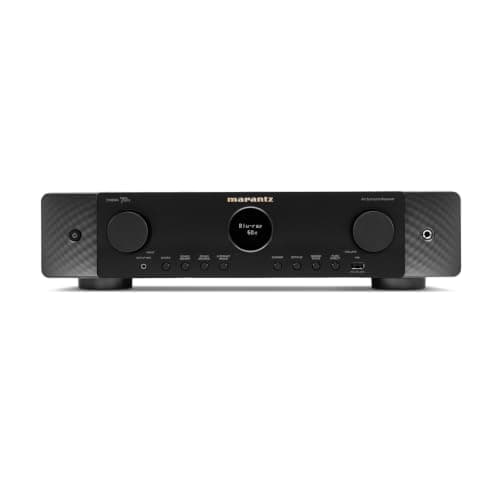 Marantz Cinema 70s A 7.2 receiver in a half-height chassis, which is the entire point — it fits furniture a normal receiver does not. | Slimmest chassis | 7.6 | $999.00View on Amazon $1,300.0023% off |
| 2 | 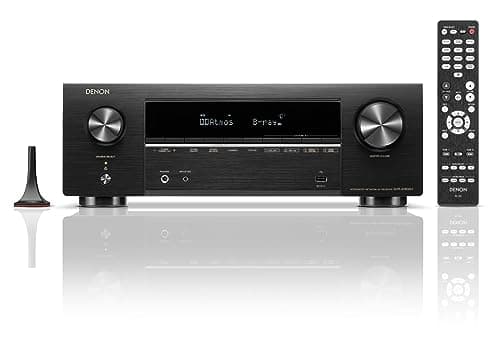 Denon AVR-X1800H Seven channels, 8K passthrough and Audyssey MultEQ XT — the room correction being the feature that actually changes what you hear in a real room. | Best overall under $1,000 | 9.0 | |
| 3 | 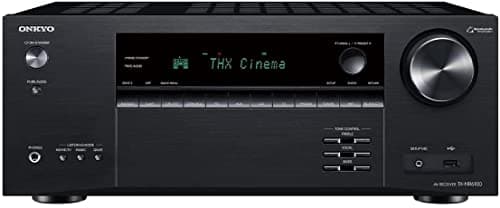 Onkyo TX-NR6100 THX certified with three 4K120 HDMI inputs, which is the specific spec that matters if two consoles and a PC share the same receiver. | Best for gaming | 8.2 | $649.00View on Amazon $899.9928% off |
| 4 | 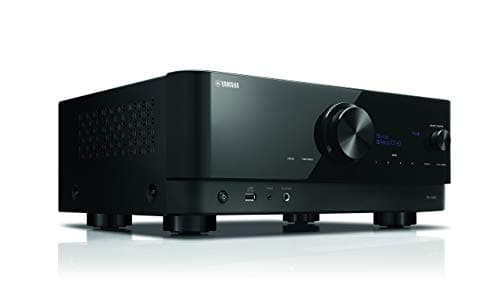 Yamaha RX-V6A The most powerful receiver here on paper — 100 watts a channel rated across the full band — with a phono input and seven HDMI inputs. | Best for music as well as film | 8.2 | |
| 5 | 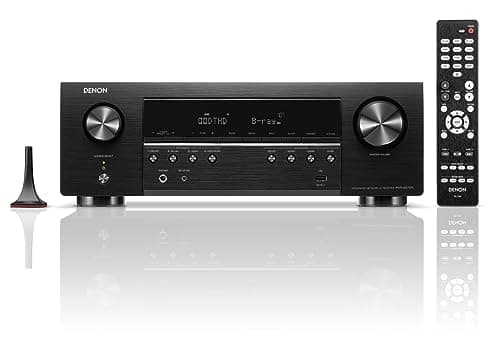 Denon AVR-S670H The X1800H's five-channel sibling: the same 8K plumbing and Audyssey correction, minus the two channels an Atmos height pair would need. | Best 5.2 option | 7.4 |
“Best for music” is not a sound quality claim on this site, because we have not heard any of these receivers. It is a specification claim, and it comes down to three published numbers: whether the receiver can hand its front channels to a better amplifier, whether it has a phono stage and publishes its parameters, and what its power rating was measured under.
Spec one: pre-outs, and why they are the whole argument
A pre-out is a line-level output for a channel. If the front left and right have them, you can bypass the receiver’s own power amplifiers for stereo and drive the front pair with a dedicated amplifier — keeping the receiver for switching, decoding and room correction. That is the single upgrade that turns a home theater receiver into a credible music system, and it is a binary: either the sockets are there or they are not.
Here the tiers separate sharply, and not by price alone:
- Marantz Cinema 70s— a full 7.2 pre-out. Every channel can go to an external amplifier.
- Denon AVR-X1800H— 2.2 only: front left and right plus two subwoofers. Enough for the stereo upgrade, not for the rest.
- Yamaha RX-V6A— front left and right plus two subwoofers, plus a Zone 2 pair. Same practical answer as the Denon.
- Denon AVR-S670H— subwoofer only. No main-channel pre-outs, so the internal amplifier is permanent.
The Marantz costs the most and makes the least power. It is first here anyway, because a full pre-out set means its 50 watts stop being the ceiling the moment you add an amplifier. Splitting preamplification from power amplification is the same idea a two-box hi-fi has always used.
Spec two: the phono stage, and what each maker publishes about it
Four of these five publish a moving-magnet phono input. What they publish about it varies enormously, and one of them is the most complete phono specification on this site.
| Receiver | Phono input | What is published beyond “yes” |
|---|---|---|
| Marantz Cinema 70s | MM | 2.5 mV sensitivity and RIAA deviation of ± 1 dB, 20 Hz – 20 kHz |
| Denon AVR-X1800H | MM | 2.5 mV input sensitivity |
| Onkyo TX-NR6100 | MM | 3.5 mV rms / 47 kΩ |
| Yamaha RX-V6A | MM | 3.5 mV / 47 kΩ at 1 kHz |
| Denon AVR-S670H | MM | 2.5 mV input sensitivity |
Marantz is the only maker here that publishes an RIAA accuracy figure. RIAA deviation is the specification that says how faithfully the phono stage reverses the equalization curve cut into the record — which is the entire job. Everyone else publishes a sensitivity and stops.
Sensitivity still matters for matching. A cartridge with a 2.5 mV output into a 3.5 mV input runs quieter than the designer intended; one with a 5.5 mV output into a 2.5 mV input can overload it. Our cartridge output figures are published per model, so the comparison is a two-minute check rather than a guess.
Spec three: the power rating, read properly
Every receiver here publishes a full-band, two-channels-driven figure, which is the right condition and rarer than it should be. The spread is wide:
difference in dB = 10 × log₁₀(P₁ ÷ P₂)
Inputs
- Onkyo TX-NR6100 (FTC rating): 100 W (8 Ω, 20 Hz – 20 kHz, 0.08% THD, 2 ch driven) (Onkyo product page)
- Marantz Cinema 70s: 50 W + 50 W (8 Ω, 20 Hz – 20 kHz, 0.08% THD, 2 ch driven) (Marantz owner's manual)
- Denon AVR-X1800H: 80 W + 80 W (8 Ω, 20 Hz – 20 kHz, 0.08% THD, 2 ch driven) (Denon info sheet (PDF))
Result
Onkyo vs Marantz: 10 × log₁₀(100 ÷ 50) = 3.0 dB
Denon vs Marantz: 10 × log₁₀(80 ÷ 50) = 2.0 dB
Onkyo vs Denon: 10 × log₁₀(100 ÷ 80) = 1.0 dB
A doubling of power is three decibels. The whole range from the least powerful receiver here to the most is three decibels — about the smallest level difference most listeners reliably notice. Power is not what separates these receivers.
This holds while the speaker is an easy load and the volume is moderate. It stops holding if your speakers dip well below their nominal impedance, because a receiver with a smaller power supply runs out of current before it runs out of watts — and none of these makers publishes a 4-ohm rating. Impedance is the spec that decides that, and most speakers do not publish a minimum.
The Marantz trade, stated plainly
The Cinema 70s is the most expensive receiver on this page and makes half the power of the Onkyo. Marantz says why: it is a slim chassis, and a slim chassis costs real power. What you get for that is the full 7.2 pre-out, the only published RIAA figure here, Audyssey MultEQ, and Atmos and DTS:X.
Whether that is a good trade depends entirely on whether you will ever add a power amplifier. If you will, the Marantz is a preamplifier-processor you can grow into and its 50 watts are temporary. If you will not, you are paying more for less power and the Onkyo or the Denon is the better buy.
The receiver that is not on this list
If music is the majority of what the system plays and film is occasional, the honest answer may be that you do not want an AV receiver at all. An integrated amplifier does fewer things and publishes better numbers doing them — the Marantz PM6007, for instance, publishes a damping factor and a 4-ohm rating across the full band, and no receiver here publishes either.
The case for the receiver is that it decodes surround formats, switches HDMI, corrects the room and drives a subwoofer, and no integrated amplifier under $1,000 does any of that. The full version of that argument is its own page.
Two narrower pages sit beside this one. If the pre-out column is the only thing you care about — because an external amplifier is the plan — our pre-outs page ranks on that alone and includes a receiver whose “pre-out” is a subwoofer socket. If the question is simply how to get a turntable into one of these, the receiver connection guide covers the input, the switch and the ground screw.
Every pick in detail
Every specification below links to the manufacturer document we read it from. Where a manufacturer does not publish a figure, we say so rather than estimating it.
Marantz Cinema 70s
Slimmest chassisA 7.2 receiver in a half-height chassis, which is the entire point — it fits furniture a normal receiver does not.
- channels
- 9/10
- room correction
- 9/10
- connectivity
- 9/10
- value for money
- 5/10
- future proofing
- 8/10
| Specification | Published value | Source |
|---|---|---|
| Channels | 7.2 (7 powered channels) | Marantz product page |
| Power output | 50 W + 50 W (8 Ω, 20 Hz – 20 kHz, 0.08% THD, 2 ch driven). The slim chassis costs real power against full-size rivals. | Marantz owner's manual |
| Room correction | Audyssey MultEQ with Dynamic EQ and Dynamic Volume | Marantz product page |
| Dolby Atmos / DTS:X | Yes / Yes | Marantz product page |
| Phono input | Yes — MM, 2.5 mV; RIAA deviation ± 1 dB (20 Hz – 20 kHz) | Marantz owner's manual |
| Pre-outs | Full 7.2 — notable at this tier, where the Denon AVR-X1800H offers only 2.2 | Marantz product page |
Pros
- Half-height chassis fits furniture a normal receiver cannot
- Full 7.2 pre-outs — the Denon AVR-X1800H at a similar tier gives you only 2.2, so this is the one here you can actually add amplification to
- 7.2 channels with Audyssey MultEQ and an MM phono input
Cons
- Well over the $1,000 bracket
- 50 W + 50 W into 8 Ω — the slim chassis costs real power against full-size rivals rated at 80–100 W
- You pay a premium for the height, not the performance
Skip it if your cabinet fits a full-size receiver. The slim chassis is most of the surcharge.
Denon AVR-X1800H
Best overall under $1,000Price as of October 15, 2026. #ad
Seven channels, 8K passthrough and Audyssey MultEQ XT — the room correction being the feature that actually changes what you hear in a real room.
- channels
- 9/10
- room correction
- 9/10
- connectivity
- 9/10
- value for money
- 9/10
- future proofing
- 9/10
| Specification | Published value | Source |
|---|---|---|
| Channels | 7.2 (7 power amplifiers — 7.2 or 5.2.2) | Denon info sheet (PDF) |
| Power output | 80 W + 80 W (8 Ω, 20 Hz – 20 kHz, 0.08% THD, 2 ch driven) | Denon info sheet (PDF) |
| Room correction | Audyssey MultEQ XT, with Dynamic EQ and Dynamic Volume | Denon info sheet (PDF) |
| Dolby Atmos / DTS:X | Yes / Yes | Denon info sheet (PDF) |
| Phono input | Yes — MM, 2.5 mV input sensitivity; RIAA deviation ±1 dB (20 Hz – 20 kHz); S/N 74 dB (IHF-A); distortion 0.03% (1 kHz, 3 V) | Denon owner's manual, audio section |
| Analog input sensitivity | 200 mV; frequency response 10 Hz – 100 kHz (+1, −3 dB, Direct mode); S/N 98 dB (IHF-A, Direct mode) | Denon owner's manual, audio section |
| Power consumption | 430 W. Standby 0.1 W — but only with Network Control set to “Off In Standby” and HDMI Pass Through off; CEC standby is 0.5 W. Denon publishes no idle (powered-on, not playing) figure at all. | Denon owner's manual, general section |
| HDMI in / out | 6 in (3 are 8K) / 1 out (eARC) | Denon info sheet (PDF) |
| Video passthrough | 8K/60 Hz, 4K/120 Hz; VRR, QFT, ALLM | Denon product page |
| HDMI 2.1 gaming features | ALLM / QMS / QFT / VRR — Yes / No / Yes / Yes. Denon does not state which of the six inputs carry them beyond the “3 x 8K” count. | Denon product page |
| Pre-outs | 2.2 only (front L/R + 2 subwoofer) — NOT a full 7.2 pre-out | Denon info sheet (PDF) |
| Streaming | HEOS built-in; AirPlay 2, Spotify Connect, Amazon Music HD, TIDAL | Denon info sheet (PDF) |
Pros
- Audyssey MultEQ XT room correction — a step above the plain MultEQ on the cheaper models
- 7.2 channels — enough for a 5.2.2 Atmos layout
- MM phono input, so a turntable connects without a separate stage
- 8K/60 and 4K/120 passthrough with VRR and ALLM
Cons
- Only 2.2 pre-outs (front L/R plus subwoofers) — you cannot add external amplification to the surround channels later
- Menus are dense
- Runs warm in a closed cabinet
Skip it if you only need 5 channels — the AVR-S670H shares the same core for less.
Onkyo TX-NR6100
Best for gamingTHX certified with three 4K120 HDMI inputs, which is the specific spec that matters if two consoles and a PC share the same receiver.
- channels
- 9/10
- room correction
- 6/10
- connectivity
- 10/10
- value for money
- 8/10
- future proofing
- 8/10
| Specification | Published value | Source |
|---|---|---|
| Channels | 7.2, THX certified | Onkyo product page |
| Power output | 100 W/ch (8 Ω, 20 Hz – 20 kHz, 0.08% THD, 2 ch driven, FTC). The “210 W per channel” figure circulating in search results is a dynamic-power marketing number, not the FTC rating. | Onkyo product page |
| Room correction | AccuEQ with AccuReflex. Dirac Live is NOT available on this model — Onkyo starts Dirac at the TX-NR7100. | Onkyo receiver buying guide |
| Dolby Atmos / DTS:X | Yes / Yes (5.2.2 playback) | Onkyo spec page |
| Phono input | Yes — MM, 3.5 mV rms / 47 kΩ | Onkyo spec page |
| HDMI in / out | 6 in / 2 out. HDMI 2.1 (8K/60, 4K/120) on inputs 1–3 and both outputs; inputs 4–6 are 2.0 up to 4K/60 | Onkyo spec page |
| Streaming | Chromecast built-in, AirPlay 2, DTS Play-Fi, works with Sonos | Onkyo spec page |
| HDMI 2.1 gaming features | “HDMI 2.1 features are supported on HDMI inputs 1–3, Main Out, and Sub/Zone 2 Out in Sub Mode output including VRR, ALLM, QFT (Quick Frame Transport), DSC (Display Stream Compression), QMS (Quick Media Switching), and eARC (Main Out).” Inputs 4–6 carry HDMI 2.0 features only. | Onkyo spec page |
| Power consumption | 635 W operating, 65 W idle (on, not playing), 0.1 W standby | Onkyo spec page |
| Pre-outs | Subwoofer pre-out (1 V rms / 470 Ω) and a Zone 2/Zone B line-out (200 mV rms / 470 Ω). No main-channel pre-outs are listed | Onkyo spec page |
Pros
- Three HDMI 2.1 inputs at 8K/60 and 4K/120 — the most console-friendly receiver here
- THX certified
- MM phono input, which is unusual on a gaming-focused receiver
- 100 W/ch FTC-rated into 8 Ω across the full band
Cons
- Room correction is AccuEQ, NOT Dirac Live — Onkyo starts Dirac at the TX-NR7100, and this model has no upgrade path to it
- The “210 W per channel” figure in most search results is dynamic-power marketing; the FTC rating is 100 W
- HDMI inputs 4–6 are only HDMI 2.0, capped at 4K/60
Skip it if you have one source — you are paying for HDMI 2.1 inputs you will never fill.
Yamaha RX-V6A
Best for music as well as filmPrice as of October 15, 2026. #ad
The most powerful receiver here on paper — 100 watts a channel rated across the full band — with a phono input and seven HDMI inputs.
- channels
- 9/10
- room correction
- 7/10
- connectivity
- 9/10
- value for money
- 8/10
- future proofing
- 8/10
| Specification | Published value | Source |
|---|---|---|
| Channels | 7.2 | Yamaha spec page |
| Power output | 100 W/ch (8 Ω, 20 Hz – 20 kHz, 0.06% THD, 2 ch driven). Maximum effective output 150 W/ch (1 kHz, 10% THD, 8 Ω) | Yamaha owner's manual |
| Room correction | YPAO with multipoint measurement | Yamaha spec page |
| Dolby Atmos / DTS:X | Yes (with Height Virtualization) / Yes | Yamaha spec page |
| Phono input | Yes — MM, 3.5 mV / 47 kΩ at 1 kHz | Yamaha owner's manual |
| HDMI in / out | 7 in / 1 out (eARC). 8K on inputs 1–3 only | Yamaha spec page |
| HDMI 2.1 gaming features | Not published in the specification table. Yamaha's HDMI feature list for this model reads “8K, 4K Ultra HD (include 8K/60, 50 Hz, 4K/120, 100 Hz 10-bit), 3D Video, ARC, eARC, HDMI Control (CEC), Auto Lip Sync, Deep Color, x.v.Color, HDR10+, Dolby Vision, Hybrid Log-Gamma, DSC FRL, FRL” and HDCP 1.4/2.3 — VRR, ALLM, QMS and QFT are named nowhere in it, and nowhere on the 4K/8K MODE page either. Yamaha adds ALLM and VRR to this model by firmware and documents that separately from the specification. | Yamaha owner's manual, specifications |
| Pre-outs | Front L/R + 2 subwoofer, plus Zone 2 L/R — not a full 7.2 pre-out | Yamaha owner's manual |
| Streaming | MusicCast, AirPlay 2, Bluetooth (SBC/AAC), Spotify Connect | Yamaha spec page |
Pros
- 100 W/ch (8 Ω, 20 Hz – 20 kHz, 0.06% THD) — the highest full-band rating in this group
- Seven HDMI inputs, the most here
- MM phono input, 3.5 mV / 47 kΩ
- YPAO with multipoint measurement, plus MusicCast multiroom
Cons
- YPAO is less sophisticated than Audyssey MultEQ XT on the Denon
- 8K is limited to HDMI inputs 1–3
- Pre-outs are front L/R plus subwoofers only — not a full 7.2
Skip it if room correction quality is your priority — Audyssey MultEQ XT on the Denon goes further.
Denon AVR-S670H
Best 5.2 optionPrice as of October 15, 2026. #ad
The X1800H's five-channel sibling: the same 8K plumbing and Audyssey correction, minus the two channels an Atmos height pair would need.
- channels
- 6/10
- room correction
- 9/10
- connectivity
- 8/10
- value for money
- 8/10
- future proofing
- 6/10
| Specification | Published value | Source |
|---|---|---|
| Channels | 5.2 (5 power amplifiers) | Denon info sheet (PDF) |
| Power output | 75 W + 75 W (8 Ω, 20 Hz – 20 kHz, 0.08% THD, 2 ch driven) | Denon info sheet (PDF) |
| Dolby Atmos | Sources conflict. Denon's info sheet lists NO Atmos and NO DTS:X (Dolby Audio logo, TrueHD/Digital Plus/Pro Logic II only); Denon's own product-page TITLE says “with Dolby Atmos”. We trust the info sheet's spec table over the page title — verify before buying if Atmos is the reason you are buying. | Denon info sheet (PDF) |
| Room correction | Audyssey MultEQ, with Dynamic EQ and Dynamic Volume | Denon info sheet (PDF) |
| Phono input | Yes — MM, 2.5 mV input sensitivity | Denon owner's manual |
| Video passthrough | 8K/60 Hz, 4K/120 Hz | Denon product page |
| HDMI in / out | 6 in (3 x 8K) / 1 out (Main, eARC). No front-panel HDMI | Denon product page |
| HDMI 2.1 gaming features | ALLM / QMS / QFT / VRR — Yes / No / Yes / Yes | Denon product page |
| Pre-outs | Subwoofer only (0.2) — no main-channel pre-outs | Denon info sheet (PDF) |
Pros
- 8K/60 passthrough and HEOS streaming at a lower price
- Audyssey MultEQ room correction
- MM phono input, 2.5 mV / 47 kΩ
- Simpler to set up than a 7.2
Cons
- Denon's own sources conflict on Dolby Atmos: their info sheet lists none, their product-page title says it has it. Verify before buying if Atmos is the point.
- 5.2 only — five channels cannot produce height regardless of decoding
- Subwoofer pre-outs only, so no path to external amplification
Skip it if Dolby Atmos matters to you — both because five channels cannot do height, and because Denon's own documentation does not agree on whether this unit decodes it.
Frequently asked questions
What makes an AV receiver good for music rather than films?
Three published specs. Front left and right pre-outs, so the stereo channels can be handed to a dedicated power amplifier later. A phono input with published parameters, if a turntable is involved. And a power rating measured 20 Hz to 20 kHz with two channels driven rather than at 1 kHz with one. Everything else on the box is about film.
Does a more powerful AV receiver sound louder?
Barely, across this range. Doubling power buys three decibels, and the gap from the 50 W Marantz Cinema 70s to the 100 W Onkyo TX-NR6100 is exactly one doubling. That is close to the smallest level difference most listeners notice. Speaker sensitivity moves loudness far more than receiver wattage does.
Which AV receiver has the best phono stage?
On published data, the Marantz Cinema 70s — it is the only one here that publishes an RIAA deviation figure (± 1 dB, 20 Hz to 20 kHz) alongside its 2.5 mV sensitivity. Denon, Yamaha and Onkyo publish a sensitivity and an impedance and nothing about equalization accuracy. We have not measured any of them.
Should I buy an integrated amplifier instead?
If films are rare, probably. An integrated amplifier at the same price publishes specs a receiver does not — damping factor, 4-ohm ratings, phono signal-to-noise — and spends none of its budget on video switching. If you want surround decoding, HDMI switching, room correction or a subwoofer output, the receiver wins by default.
Read next
The Best AV Receivers Under $1,000
Five receivers under $1,000, compared on FTC-rated power and the pre-out spec almost nobody mentions.
Integrated Amplifier vs Receiver
Two-channel integrated versus multichannel receiver, judged on published power ratings and what each spec actually promises.
Home Theater vs Hi-Fi
Where the two designs actually conflict, where they do not, and the single configuration that lets one room serve both without compromise.
Preamp vs Power Amp
Voltage versus current, what damping factor tells you in ohms, and the pre-out spec that decides whether you can ever split them later.
Do I Need a Phono Preamp?
Yes, unless you already have one — and it might be hiding in your turntable, amplifier or speakers. Check in 30 seconds.
AV Receiver Room Correction, Honestly
What Audyssey, YPAO and AccuEQ tiers actually publish, the one difference that is documented, and the physics room correction cannot beat.
The Best AV Receivers With Pre-Outs
Ranked on the one spec the query is about: how many channels of pre-out each receiver actually publishes. One full 7.2, two front-only, and one whose pre-out is a subwoofer socket.
How to Connect a Turntable to a Receiver
Which receiver input, which switch position, why the ground screw matters, and what to do when the receiver has no PHONO input at all.
Sources
Every specification on this page was read from one of these documents. If one of them has changed, or we have made an error, tell us — corrections are logged and dated per our editorial policy.