Do I Need an Amplifier for My Turntable?
There are two amplifiers in a record player system and they do different jobs. Confusing them is why people buy a phono preamp and still get no sound.
Disclosure: we earn a commission if you buy through the links on this page, at no extra cost to you. It does not influence what we pick — our criteria are published and reproducible, so you can check our work. How we pick · Full disclosure
These picks are spec-and-price analyses, not listening tests. We have not heard this gear and we do not pretend to have: every figure below is sourced to the manufacturer and linked, and every price is live or not shown at all. Here are the rules we followed.
Quick picks
Ranked on the published criteria in How We Pick. Prices are live as of October 14, 2026. Tap any row for the full write-up.
- 8.8
- 8.2
- 7.6
| # | Product | Best for | Score | Price |
|---|---|---|---|---|
| 1 | 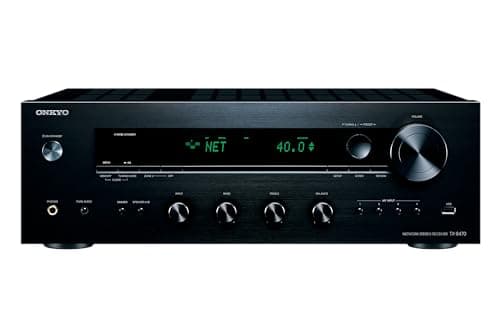 Onkyo TX-8470 The only amplifier we can verify under $500 with a moving-coil phono position as well as a moving-magnet one, and the only one whose maker states its power the FTC way. | Best phono stage under $500 | 8.8 | |
| 2 | 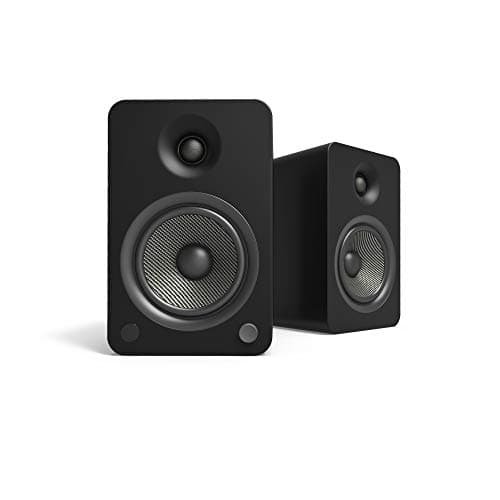 Kanto YU6 Powered speakers with a phono stage already inside, which collapses amp, phono stage and speakers into one purchase and one power cable. | Best all-in-one for a turntable | 8.2 | |
| 3 | 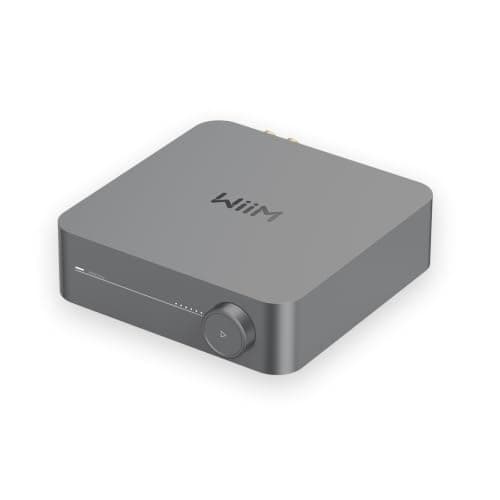 WiiM Amp A streamer with a power amplifier bolted on, which replaces two boxes — and gives up an order of magnitude of measured noise performance to do it. | Best one-box system for passive speakers | 7.6 |
A turntable needs two completely different kinds of amplification, and almost every version of this question is about only one of them.
Stage one is the phono stage. A cartridge puts out a few thousandths of a volt and needs about a thousandfold boost plus RIAA equalization to become a normal line-level signal. That question has its own page and a thirty-second answer.
Stage two is power amplification. A line-level signal is nowhere near enough to move a loudspeaker cone. Something has to deliver watts. This page is about stage two.
The one-sentence answer
You need a power amplifier unless your speakers already contain one, and if you own passive speakers there is no configuration in which you do not.
Everything below is about which box that amplifier lives in, and there are more options than most people realize.
The four routes, and what each one needs
| Route | Boxes | Phono stage lives in | Power amplification lives in |
|---|---|---|---|
| Integrated amplifier + passive speakers | 3 | The amplifier, if it has one | The amplifier |
| Powered speakers with a phono input | 2 | The speakers | The speakers |
| Powered speakers, line input only | 3 | A separate phono stage, or the turntable | The speakers |
| Streaming amplifier + passive speakers | 3 | A separate box — the WiiM Amp has no phono input | The streaming amplifier |
The two-box route is the one people are usually hoping exists, and it does. The Kanto YU6 publishes an RCA input with a phono switch, so a turntable connects directly with nothing in between. The Klipsch The Fives II publishes a dedicated analog input with a built-in phono stage and does the same.
The trap is assuming any powered speaker does this. Audioengine states outright that “all turntables require a phono preamp stage before connecting to Audioengine speakers”. Kanto’s ORA publishes line-level inputs only. Edifier does not state either way for the R1280T, which means assume not and check before buying.
How much power, actually
Less than most people buy, and the figure depends far more on the speaker than on the amplifier.
SPL = sensitivity + 10 × log₁₀(P) − 20 × log₁₀(distance ÷ 1 m)
Inputs
- Onkyo TX-8470 published power: 110 W (8 Ω, 20 Hz – 20 kHz, 0.08% THD, both channels driven) (Onkyo owner's manual (PDF))
- Kanto YU6 published amplifier output: 100 W total RMS (200 W peak) — powered pair (Kanto spec page)
- Polk Monitor XT15 published sensitivity: 86 dB (no measurement condition published) (Polk info sheet (PDF))
Result
10 × log₁₀(110) = 20.4 dB · distance loss at 3 m = 9.5 dB
86 + 20.4 − 9.5 = 97 dB per speaker
Ninety-seven decibels from one speaker at three meters, driving one of the less sensitive speakers we cover. Sustained listening at 97 dB is a hearing-protection question, not a headroom one. And the interesting part is what happens when you take most of the watts away: run the same arithmetic on the Cambridge AXA35’s published 35 W and the answer only falls to 92 dB. Under a third of the power costs five decibels, which is why the speaker decides this and the amplifier rarely does.
Polk publishes no measurement condition for that 86 dB, so it may be a decibel or two optimistic. Free-field arithmetic also ignores room gain, which adds back at low frequencies, and it describes continuous output rather than transient peaks — which is what headroom is for. The full amplifier-to-speaker matching arithmetic covers the peak case.
Why “my turntable has a built-in preamp, so why no sound?”
Because the built-in preamp is stage one. It makes the signal line level. It does not make it loud enough to move a speaker cone, and it never claimed to.
A turntable with a switchable phono stage — the AT-LP120XUSB publishes a switchable PHONO/LINE output at 36 dB nominal gain — can plug into any line input. It still needs something on the other end of that line input with watts in it.
The exception is a turntable with Bluetooth, which sends the signal to a speaker that has its own amplifier. The AT-LP60XBT and Sony PS-LX310BT both do this, and it is why they exist. Every wired route is laid out here.
Three symptoms, and which stage each one points at
Most people arrive at this question through a symptom rather than a schematic, and the symptom tells you which of the two stages is missing.
| What you are hearing | What is missing | The fix |
|---|---|---|
| Very quiet, thin, no bass, but audible | The phono stage | A phono stage, or the turntable’s own switch set to PHONO |
| Nothing at all, from a line input | Power amplification, or a cable | Check the speakers are powered or the amplifier is on the right input |
| Loud enough but distorting on peaks | Headroom, not a stage | A more sensitive speaker or more power |
The first row is the common one, and the reason it sounds thin as well as quiet is RIAA equalization: the record is cut with bass reduced and treble boosted, and a phono stage reverses that. Play a cartridge into a line input and you hear the record as it was cut, which is thin and quiet at once. That combination is the diagnostic.
What about a receiver you already own
An AV receiver already contains power amplification, so if there is one in the house the second question is answered. Whether it answers the first depends on the model, and the split is sharp.
Of the receivers we cover, the Denon AVR-X1800H, Denon AVR-S670H, Yamaha RX-V6A, Onkyo TX-NR6100 and Marantz Cinema 70s all publish a moving-magnet phono input. The Denon AVR-S570BT, Onkyo TX-NR5100 and Yamaha RX-V4A do not — Yamaha lists it as N/A for the RX-V4A, and neither Denon nor Onkyo lists one for the two sub-$500 models.
If yours is in the second group, a separate phono stage in front of any line input finishes the job, and the sub-$200 options are competent. If it is in the first group, plug the turntable into PHONO, connect the ground wire to the ground screw, and you are done.
What to buy, by what you already own
You own passive speakers.An integrated amplifier, and the phono question decides which one. The Onkyo TX-8470 publishes a switched moving-magnet or moving-coil input and 110 W into 8 Ω with both channels driven, and it is our first pick in the under-$500 bracket.
You own nothing yet and want the fewest boxes. Powered speakers with a published phono input — the Kanto YU6 is the clearest example. Two boxes, one cable.
You want streaming as well.The WiiM Amp publishes 60 W into 8 Ω and 120 W into 4 Ω with streaming built in, but publishes no phono input — so a turntable needs a separate phono stage in front of it. Note also that WiiM publishes the wattage with no THD figure and no both-channels-driven condition, so it cannot be compared like for like to the Onkyo’s 110 W.
What you do not need
A separate power amplifier and preamplifier. Not at this stage. Splitting them is a real technique with real reasons, and none of those reasons applies to a first turntable system.
More watts than the arithmetic calls for. Sixty watts reaches 94 dB on one of the less sensitive speakers we cover. Doubling that buys three decibels. Three decibels of extra speaker sensitivity buys the same thing for nothing.
Every pick in detail
Every specification below links to the manufacturer document we read it from. Where a manufacturer does not publish a figure, we say so rather than estimating it.
Onkyo TX-8470
Best phono stage under $500Price as of October 14, 2026. #ad
The only amplifier we can verify under $500 with a moving-coil phono position as well as a moving-magnet one, and the only one whose maker states its power the FTC way.
- power
- 9/10
- phono stage
- 9/10
- value for money
- 8/10
- build quality
- 8/10
- connectivity
- 10/10
| Specification | Published value | Source |
|---|---|---|
| Power output (8 Ω) | 110 W + 110 W — “With 8 ohm loads, both channels driven, from 20 Hz – 20 kHz; rated 110 watts per channel minimum RMS power, with no more than 0.08% total harmonic distortion from 250 milliwatts to rated output” (FTC form, North American models) | Onkyo owner's manual (PDF) |
| Power output (4 Ω) | Not published as a continuous rating for the North American model. The only other North American figure on Onkyo's table is 210 W at 6 Ω, 1 kHz, 2 ch driven at 10% THD — a maximum-output burst measurement, not an RMS rating. | Onkyo owner's manual (PDF) |
| Phono input | Yes — MM or MC on a rear-panel switch, on a dedicated isolated phono board. Maximum input 70 mV (MM, 1 kHz, 0.5%) and 7 mV (MC, 1 kHz, 0.5%). | Onkyo owner's manual (PDF) |
| Phono signal-to-noise | 76 dB (IHF-A, MM 5 mV in, speaker out) · 60 dB (IHF-A, MC 0.5 mV in, speaker out) | Onkyo owner's manual (PDF) |
| THD | 0.08% (20 Hz – 20,000 Hz, at rated output power) | Onkyo owner's manual (PDF) |
| Damping factor | Not published | — |
| DAC | AKM AK4452, 32-bit / 768 kHz stereo; Class G amplifier stage | Onkyo product page |
| Digital inputs | 3 — one coaxial and two optical — plus 4 HDMI in / 1 HDMI out with ARC and 8K passthrough | Onkyo spec sheet (PDF) |
| Subwoofer out | Yes — one subwoofer pre-out, plus a main pre-out L/R and a Zone 2 pre/line out | Onkyo owner's manual (PDF) |
| Signal-to-noise (line) | 106 dB (IHF-A, line in, speaker out) | Onkyo owner's manual (PDF) |
| Dimensions and weight | 435 × 149.5 × 329 mm; 9 kg (19.8 lb) | Onkyo owner's manual (PDF) |
Pros
- 110 W per channel rated the strict way — 8 Ω, 20 Hz to 20 kHz, both channels driven, 0.08% THD — which nothing else in this bracket publishes
- MM and MC phono on a rear-panel switch, with a published signal-to-noise for each: 76 dB on MM and 60 dB on MC
- Four HDMI inputs with ARC, one coaxial and two optical digital inputs, and an AKM AK4452 32-bit/768 kHz DAC
- Subwoofer pre-out, main pre-out and a Zone 2 pre/line out all published
Cons
- Onkyo publishes no damping factor for it anywhere we can find
- The second figure on Onkyo's own North American table — 210 W at 6 Ω, 1 kHz, 10% THD — is a burst measurement at a distortion level nobody listens at
- It is a receiver: an AM/FM tuner and a second zone are part of what you are paying for whether you use them or not
- 9 kg and 435 mm wide, so it needs a rack shelf rather than a desk
Skip it if you want the shortest signal path your money will buy. This is a networked receiver with a tuner, HDMI switching and two zones, and a plain integrated puts more of the budget into the amplifier.
Kanto YU6
Best all-in-one for a turntablePrice as of October 14, 2026. #ad
Powered speakers with a phono stage already inside, which collapses amp, phono stage and speakers into one purchase and one power cable.
- integration
- 10/10
- upgrade path
- 4/10
- value for money
- 8/10
- ease of setup
- 10/10
- connectivity
- 9/10
| Specification | Published value | Source |
|---|---|---|
| Type | Powered (amplifier built in) | Kanto spec page |
| Amplifier output | 100 W total RMS (200 W peak) | Kanto spec page |
| Built-in phono stage | Yes — RCA input with a phono switch; a turntable connects directly | Kanto spec page |
| Frequency response | 50 Hz – 20 kHz (no tolerance published) | Kanto spec page |
| Woofer | 5.25 in Kevlar | Kanto spec page |
| Tweeter | 1 in silk dome | Kanto spec page |
| Weight | Active 11.4 lb / 5.2 kg; passive 8.7 lb / 4.0 kg | Kanto spec page |
| Inputs | 2 × optical (TOSLINK), RCA with phono switch, 3.5 mm aux, Bluetooth 4.0 with Qualcomm aptX. No HDMI | Kanto product page |
| Outputs | Subwoofer out; USB charge port (5 V / 1 A) | Kanto product page |
Pros
- Built-in phono preamp — a turntable plugs straight in with nothing between
- No separate amplifier or phono box to buy, match or house
- Bluetooth and a subwoofer output as well
Cons
- The amplifier is fixed — you cannot upgrade it without replacing the speakers
- One speaker needs mains power and a cable to the other
- Kanto publishes 50 Hz – 20 kHz with no tolerance attached, so the low-end claim is one you cannot check
Skip it if you already own an amplifier. You would be paying for a second one and leaving the first switched off.
WiiM Amp
Best one-box system for passive speakersPrice as of October 14, 2026. #ad
A streamer with a power amplifier bolted on, which replaces two boxes — and gives up an order of magnitude of measured noise performance to do it.
- measured performance
- 6/10
- connectivity
- 8/10
- features
- 9/10
- value for money
- 9/10
- published data
- 5/10
| Specification | Published value | Source |
|---|---|---|
| Power output | 60 W per channel into 8 Ω · 120 W per channel into 4 Ω | WiiM spec page |
| Rated-power measurement condition (THD figure, both channels driven) | Not published | — |
| Audio output quality | SNR 98 dB · THD+N 0.0025% (−92 dB) — an order of magnitude worse than the Pro Plus's line-out, which is what a Class-D power stage costs you | WiiM spec page |
| Inputs | HDMI ARC · optical · RCA line-in | WiiM spec page |
| Outputs | Passive speaker terminals · subwoofer out with auto cable detection and a user-adjustable 30–250 Hz crossover | WiiM spec page |
| Network | Wi-Fi 802.11 b/g/n/ac dual band · 10/100 Mbps LAN · Bluetooth 5.1 | WiiM spec page |
| Protocols | AirPlay 2, Chromecast, Spotify Connect, TIDAL Connect, Alexa Cast, DLNA, Roon Ready | WiiM spec page |
| EQ | 10-band graphic EQ, 10-band parametric EQ, 26 presets | WiiM spec page |
| Home theater formats | Stereo PCM only — Dolby Digital and DTS are NOT supported | WiiM spec page |
| Dimensions / weight | 190 × 190 × 63 mm; 1.84 kg (4.1 lb) | WiiM spec page |
| Phono input | No | WiiM spec page |
Pros
- 60 W into 8 Ω and 120 W into 4 Ω published, which drives every passive speaker we recommend
- Subwoofer output with a user-adjustable 30–250 Hz crossover, so a 2.1 system needs nothing else
- HDMI ARC in, so a television can feed it directly
- Same app, same EQ, same Roon Ready and AirPlay 2 support as the standalone streamers
Cons
- WiiM publishes the wattage with no THD figure and no “both channels driven” condition, so the rating cannot be compared to a Yamaha or Marantz spec
- 98 dB SNR and 0.0025% THD+N — roughly twenty decibels noisier than the Pro Plus's line-out
- Stereo PCM only over HDMI ARC: no Dolby Digital, no DTS
- No phono input, and no analog preamp output to escape the internal amplifier
Skip it if you already own an amplifier you like. This is a worse DAC than the Pro Plus attached to an amplifier you did not need.
Frequently asked questions
Do I need an amplifier for my turntable?
Yes, unless your speakers have one built in. A turntable needs two stages of amplification: a phono stage to bring the cartridge’s few millivolts up to line level with RIAA equalization, and a power amplifier to drive the speakers. Powered speakers contain the second; a few, such as the Kanto YU6, contain both.
My turntable has a built-in preamp — do I still need an amplifier?
Yes. A built-in phono preamp makes the signal line level, which is what a line input expects. It does not make it powerful enough to drive a loudspeaker. The AT-LP120XUSB’s switchable stage publishes 36 dB of nominal gain — enough for a line input, nowhere near enough for a speaker.
How many watts do I need for a turntable system?
Fewer than most people buy. Sixty watts into a speaker publishing 86 dB sensitivity reaches about 94 dB per speaker at three meters, which is louder than sustained home listening. Doubling the power adds three decibels; buying a speaker three decibels more sensitive adds the same for nothing.
Can I connect a turntable straight to powered speakers?
Only if the speakers publish a phono input, or the turntable has a built-in phono stage. The Kanto YU6 publishes an RCA input with a phono switch and Klipsch The Fives II publishes a dedicated analog input with a phono stage. Audioengine states plainly that all turntables need a phono preamp before its speakers, and Kanto’s ORA is line level only.
Read next
Do I Need a Phono Preamp?
Yes, unless you already have one — and it might be hiding in your turntable, amplifier or speakers. Check in 30 seconds.
How to Connect a Turntable to Speakers
Four working routes from turntable to speakers, the two that do not work, and how to fix the hum.
The Best Integrated Amplifiers for a Turntable
Amplifiers with a phono stage inside, ranked on published MM sensitivity and phono signal-to-noise — not watts.
Passive vs Powered Speakers
Total cost, upgrade path, and why powered speakers correctly refuse to publish a sensitivity figure.
The Best Integrated Amplifiers Under $500
Four amplifiers under $500, ranked on the power figure each maker actually publishes — and on which of them will drive a 4-ohm speaker.
Preamp vs Power Amp
Voltage versus current, what damping factor tells you in ohms, and the pre-out spec that decides whether you can ever split them later.
Sources
Every specification on this page was read from one of these documents. If one of them has changed, or we have made an error, tell us — corrections are logged and dated per our editorial policy.
- Kanto YU6 — spec page (RCA input with phono switch, 100 W total RMS)
- Audioengine A5+ — tech specs (states all turntables require a phono preamp)
- Onkyo TX-8470 — owner's manual (110 W FTC rating, MM/MC phono input)
- WiiM Amp — specifications (60 W / 120 W, no phono input)
- Audio-Technica AT-LP120XUSB — manual (switchable phono stage, 36 dB gain)