Why Does My Turntable Hum?
Start with the pitch of the hum, not the cables. A hum at the mains frequency and a hum at twice the mains frequency come from different places, and a third kind is not hum at all — it is a phono stage running at a gain setting its own spec sheet says is 20 dB noisier.

The short answer
Work through it in this order: the ground wire, then the gain setting, then the position of the turntable relative to anything with a transformer in it. Those three account for nearly every case. The single most-missed cause is the second one — a moving-magnet cartridge plugged into a phono stage set for moving coil, where the manufacturer’s own figures say the noise floor is about 20 dB worse. If you are replacing the stage, the Schiit Mani 2 is the one we would buy, because it publishes a signal-to-noise figure at every one of its four gain settings and has a selectable passive subsonic filter.
Disclosure: we earn a commission if you buy through the links on this page, at no extra cost to you. It does not influence what we pick — our criteria are published and reproducible, so you can check our work. How we pick · Full disclosure
These picks are spec-and-price analyses, not listening tests. We have not heard this gear and we do not pretend to have: every figure below is sourced to the manufacturer and linked, and every price is live or not shown at all. Here are the rules we followed.
Quick picks
Ranked on the published criteria in How We Pick. Prices are live as of October 10, 2026. Tap any row for the full write-up.
- 8.6
- 6.8$140.08View on Amazon
$149.006% off
- 6.6
| # | Product | Best for | Score | Price |
|---|---|---|---|---|
| 1 | 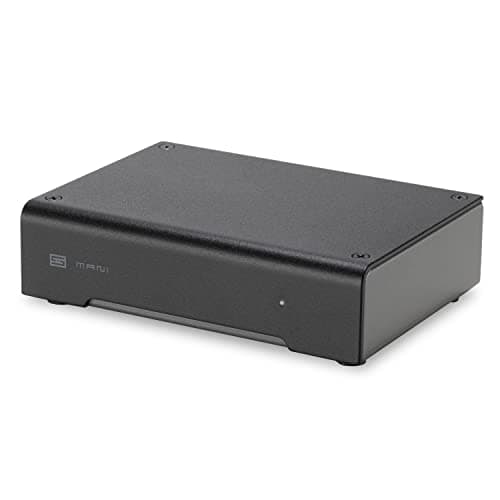 Schiit Mani 2 Four gain settings covering MM, MC and MI cartridges, which means it is the one box here that will still fit whatever cartridge you buy next. | Best overall under $200 | 8.6 | |
| 2 | 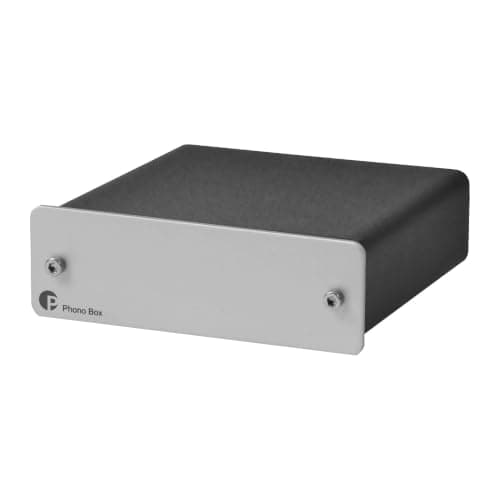 Pro-Ject Phono Box DC A 40 dB moving-magnet stage with a 60 dB moving-coil position on a rear-panel switch, at roughly what the MM-only boxes on this page ask. | Cheapest MM and MC in one box | 6.8 | $140.08View on Amazon $149.006% off |
| 3 | 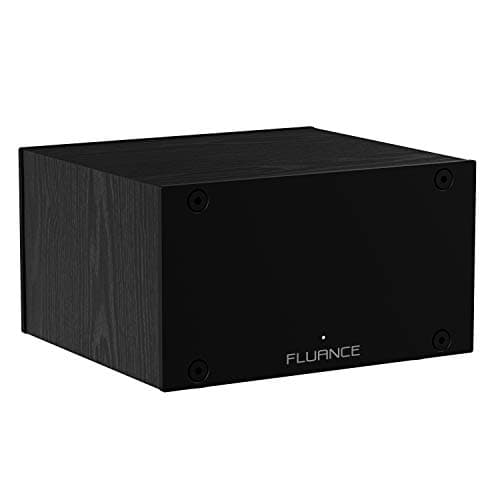 Fluance PA10 A moving-magnet stage priced to sit under a Fluance RT82 or RT85, which is precisely the gap those decks leave by shipping without one. | Best match for a Fluance deck | 6.6 |
A phono input is the most sensitive input in a hi-fi system by a wide margin. A moving-magnet cartridge puts out something like 4 or 5 millivolts and a phono stage multiplies it by a factor of around a hundred, so anything else that gets into that signal path gets multiplied by a hundred too. That is why turntables hum and CD players do not, and it is why the diagnosis has a definite order.
First: what pitch is it?
This single question splits the problem in half, and it is arithmetic rather than opinion. Mains power in the United States alternates at 60 Hz. A full-wave rectifier — which is what sits inside essentially every audio power supply — produces a ripple at twicethe line frequency, because it flips the negative half of each cycle into a positive one: 2 × 60 = 120 Hz.
- A low, smooth 60 Hz hum— roughly the pitch of the lowest B on a bass guitar — is induced or grounding-related. The signal path is picking up the mains field directly, or there is a difference in ground potential between two connected boxes.
- A buzzier 120 Hz hum, an octave higher and harsher, points at a power supply: its own rectifier ripple leaking into the audio, or a nearby transformer radiating into the cartridge or the tonearm wiring.
- A steady rush or hiss with no pitchis not hum at all. That is broadband noise, and it is almost always a gain problem — see below.
You do not need test equipment to tell them apart; the two are an octave apart and the difference is obvious once you know to listen for it. If it changes when you turn the volume up, the source is before the volume control. If it does not, the source is after it, which puts the power amplifier or its supply in the frame and takes the turntable out of it entirely.
Second: the ground wire, which is not optional
Nearly every turntable has a thin separate wire, usually with a spade or bare end, that is not one of the two RCA plugs. It connects the metal of the chassis, platter bearing and tonearm to the ground of whatever the turntable is plugged into. Its entire job is preventing a 60 Hz hum, and it is left disconnected constantly because it looks like something optional.
It goes to the ground terminal on the phono stage or the amplifier — the one marked GND or with the earth symbol — and not to a mains earth, a radiator or a screw on the back of the case. If the amplifier has no ground terminal, which some do not, the usual fix is a chassis screw on the same unit the RCAs go into. If the hum gets worsewhen you connect it, you have a ground loop rather than a missing ground: two paths to ground between the same two boxes. In that case the cure is removing one path, not adding another — our connection guide covers the orders in which to try it.
Third: the gain setting, and the figures that prove it
This is the most useful section on the page, because the symptom is usually described as hum and the cause is published in black and white by every maker who bothers to document their product.
A phono stage has to amplify much harder for a moving-coil cartridge (output measured in tenths of a millivolt) than for a moving magnet (around 4–5 mV). More gain means more of the stage’s own noise. Here is what the makers publish:
- Schiit Mani 2:> 108 dB signal-to-noise at 33 dB gain, > 98 dB at 42 dB, > 96 dB at 48 dB, and > 87 dB at 60 dB gain— all A-weighted, referenced to 2 V RMS. That is a 21 dB range across one box.
- Pro-Ject Phono Box DC: 94 dBA noise floor in MM, 75 dBA in MC— a 19 dB penalty for flipping one switch.
- iFi ZEN Phono 3: 91 dB(A) in MM, 81 dB(A) in MC High, 89.6 dB(A) in MC Low, 78.6 dB(A) in MC V-Low. Note that this one is not in order— iFi’s published MC Low figure is better than its MC High figure. We publish it as published; a maker’s own sequence is not something to tidy up by guessing.
noise penalty = S/N at the correct gain − S/N at the wrong gain
Inputs
- Schiit Mani 2 signal-to-noise by gain setting: > 108 dB at 33 dB · > 98 dB at 42 dB · > 96 dB at 48 dB · > 87 dB at 60 dB (A-weighted, ref 2 V RMS) (Schiit spec page)
- Pro-Ject Phono Box DC noise floor: 94 dBA (MM) · 75 dBA (MC) (Pro-Ject spec page)
- iFi ZEN Phono 3 signal-to-noise by mode: MM 91 dB(A) · MC High 81 dB(A) · MC Low 89.6 dB(A) · MC V-Low 78.6 dB(A) (iFi spec page)
Result
Fourth: double amplification, which is the other switch problem
Several turntables we cover have a phono stage inside them with a PHONO/LINE switch — the Audio-Technica AT-LP120XUSB (36 dB nominal gain), the AT-LP70X (36 dB), the Fluance RT81. If that switch is on LINE and the output is plugged into an amplifier’s PHONO input, the signal gets amplified and RIAA-equalised twice. The result is loud, bass-heavy, distorted and usually hums, because the second stage is amplifying the first stage’s noise floor by another factor of a hundred.
The rule is one stage, ever. Deck set to PHONO into a phono input, or deck set to LINE into a line input — never LINE into PHONO. Our phono stage guide has the 30-second test for working out which you have.
Fifth: position, and what a transformer radiates
A cartridge is a coil of wire moving in a magnetic field, which is also a perfectly good receiver for any other magnetic field nearby. Mains transformers radiate one. So does a dimmer, a fluorescent ballast, a laptop charger and the power supply of the phono stage itself.
Every stage in our top three uses an externalsupply, which is a design choice made for exactly this reason: Schiit specifies a 16 VAC transformer feeding dual filtered regulated ± 16 V rails, Pro-Ject an outboard 18 V DC unit, Fluance a 24 V 500 mA adapter, and iFi a 5 V DC supply. The point of putting the transformer in a separate lump is that you can move the lump. If there is a 120 Hz buzz, move the wall wart as far from the turntable and the phono stage as its cable allows, then move the turntable away from the amplifier, then try a different socket. Each of those is free and any one of them can be the whole fix.
Sixth: what a subsonic filter does, and does not, do
A rumble you can feel more than hear — cones visibly moving, bass thickening on every record — is usually below the audio band rather than in it, coming from bearing noise, a warped record or footfall. That is what a subsonic filter is for, and it is a specification worth checking:
- Schiit Mani 2: yes, selectable 6 or 12 dB/octave at 15 Hz, and fully passive— the most completely specified filter among the stages we cover.
- Fluance PA10: yes, selectable high-pass rolling off below 20 Hz.
- iFi ZEN Phono 3:yes, described as an “Intelligent Subsonic Filter” — iFi publishes no corner frequency or slope for it.
- Pro-Ject Phono Box DC: not published.
What it will not do is fix a 60 Hz hum, because 60 Hz is well inside the audio band and a filter at 15 or 20 Hz does not touch it. If a subsonic filter cures your problem, the problem was rumble; if it does not, work back up this page.
The short diagnostic list
- Is the hum an octave above or below the one your neighbour’s fridge makes? 60 Hz means grounding or induction; 120 Hz means a power supply.
- Is the ground wire connected to the GND terminal on the box the RCAs go into?
- Is the phono stage set for the cartridge you own — MM for a moving magnet?
- Is anything amplifying the signal twice: a deck on LINE into a PHONO input?
- How far is the nearest transformer, and does the hum change if you move it?
- Does it change with the volume control? If not, the turntable is not the cause.
Work down that list before buying anything. If the answer turns out to be the phono stage — and it does when the stage is a cheap one with no published noise figure at all — our roundup ranks seven of them on exactly the specifications this page uses.
Every pick in detail
Every specification below links to the manufacturer document we read it from. Where a manufacturer does not publish a figure, we say so rather than estimating it.
Schiit Mani 2
Best overall under $200No live price right now. #ad
Four gain settings covering MM, MC and MI cartridges, which means it is the one box here that will still fit whatever cartridge you buy next.
- flexibility
- 10/10
- noise
- 9/10
- value for money
- 8/10
- build quality
- 8/10
- connectivity
- 7/10
| Specification | Published value | Source |
|---|---|---|
| Gain | 33, 42, 48 or 60 dB (factory default 42 dB) | Schiit spec page |
| Cartridge support | MM, MC or MI | Schiit spec page |
| Loading | Capacitance 47, 100, 150 or 200 pF (default 47 pF); resistive 47 kΩ, 200 Ω, 47 Ω, 38 Ω | Schiit spec page |
| Signal-to-noise | > 108 dB at 33 dB gain; > 98 dB at 42 dB; > 96 dB at 48 dB; > 87 dB at 60 dB (A-weighted, ref 2 V RMS) | Schiit spec page |
| THD | < 0.0003% at 33 dB gain; < 0.0015% at 60 dB | Schiit spec page |
| Subsonic filter | Yes — selectable 6 or 12 dB/octave at 15 Hz, fully passive | Schiit spec page |
| Power | External 16 VAC transformer; dual-filtered regulated ±16 V rails | Schiit manual (PDF) |
Pros
- Four gain settings (33/42/48/60 dB) covering MM, MC and MI
- Four capacitance and four resistance loading options — the most adjustable box here by a distance
- A selectable, fully passive subsonic filter at 15 Hz
- Publishes a full spec sheet including THD and signal-to-noise at every gain setting
Cons
- Gain and loading are set by switches on the underside, so changing them means picking the unit up
- External wall-wart transformer
- Costs roughly double the entry options here
Skip it if you own one moving-magnet cartridge and will never change it — the extra gain settings are the thing you are paying for.
Pro-Ject Phono Box DC
Cheapest MM and MC in one boxA 40 dB moving-magnet stage with a 60 dB moving-coil position on a rear-panel switch, at roughly what the MM-only boxes on this page ask.
- flexibility
- 6/10
- noise
- 8/10
- value for money
- 7/10
- build quality
- 7/10
- connectivity
- 6/10
| Specification | Published value | Source |
|---|---|---|
| Gain | 40 dB (MM) · 60 dB (MC) | Pro-Ject spec page |
| Cartridge support | MM or MC, selected by a switch on the rear panel | Pro-Ject spec page |
| Loading | MM 47 kΩ / 120 pF · MC 100 Ω / 120 pF | Pro-Ject spec page |
| Noise floor | 94 dBA (MM) · 75 dBA (MC) | Pro-Ject spec page |
| THD | 0.01% (MM) · 0.05% (MC) | Pro-Ject spec page |
| RIAA accuracy | 20 Hz – 20 kHz / max. 0.5 dB | Pro-Ject spec page |
| Subsonic filter | Not published | — |
| Power | Outboard 18 V / 200 mA DC supply; under 1 W standby | Pro-Ject spec page |
Pros
- Moving magnet and moving coil on one switch — 40 dB or 60 dB from the same box
- Pro-Ject publishes a noise figure for both positions: 94 dBA on MM, 75 dBA on MC
- RIAA accuracy published as max. 0.5 dB across 20 Hz – 20 kHz, which nothing else near this price states
Cons
- Loading is fixed in both positions — 47 kΩ / 120 pF on MM, 100 Ω on MC, with no adjustment either way
- No subsonic filter published
- One moving-coil setting only, so a cartridge that wants anything other than 100 Ω has to live with it
Skip it if your cartridge is a moving magnet and always will be. The Fluance PA10 does that job for less and you would be paying for a switch position you never use.
Fluance PA10
Best match for a Fluance deckPrice as of October 10, 2026. #ad
A moving-magnet stage priced to sit under a Fluance RT82 or RT85, which is precisely the gap those decks leave by shipping without one.
- flexibility
- 4/10
- noise
- 8/10
- value for money
- 8/10
- build quality
- 7/10
- connectivity
- 6/10
| Specification | Published value | Source |
|---|---|---|
| Gain | 38 dB | Fluance spec page |
| Cartridge support | Moving magnet only | Fluance spec page |
| Loading | 100 pF | Fluance spec page |
| Signal-to-noise | > 90 dB | Fluance spec page |
| THD | 0.004% | Fluance spec page |
| Subsonic filter | Yes — selectable high-pass, rolls off below 20 Hz | Fluance spec page |
| Power | External 24 V / 500 mA adapter; 0.4 W consumption | Fluance spec page |
Pros
- Fills the exact gap the RT82/RT85 leave
- Aluminum chassis
- Simple and quiet
Cons
- MM only
- No gain adjustment
- No subsonic filter
Skip it if you need MC support now or later.
Frequently asked questions
Why does my turntable hum?
What is the difference between a 60 Hz and a 120 Hz hum?
Where does the turntable ground wire go?
Can the wrong gain setting make my turntable hum?
Will a subsonic filter stop my turntable humming?
Does a turntable with a built-in preamp hum more?
Have you measured any of these phono stages?
Read next
Why Does My Record Player Skip?
Diagnose by where it skips. Includes the one specification that actually measures groove-holding ability — Ortofon's tracking ability in micrometres — and which cartridges publish it.
Do I Need a Phono Preamp?
Yes, unless you already have one — and it might be hiding in your turntable, amplifier or speakers. Check in 30 seconds.
How to Connect a Turntable to a Receiver
Which receiver input, which switch position, why the ground screw matters, and what to do when the receiver has no PHONO input at all.
The Best Phono Preamps Under $200
Phono stages under $200 ranked on published gain, loading flexibility and noise — including one we would actively skip.
How to Set Up a Turntable
Nine steps, and the two everyone gets wrong. Both have a published number you can set them to.
How to Connect a Turntable to Speakers
Four working routes from turntable to speakers, the two that do not work, and how to fix the hum.
Sources
Every specification on this page was read from one of these documents. If one of them has changed, or we have made an error, tell us — corrections are logged and dated per our editorial policy.
- Schiit Mani 2 — specifications (signal-to-noise by gain, subsonic filter)
- Pro-Ject Phono Box DC — specifications (MM and MC noise floor)
- iFi ZEN Phono 3 — specifications (signal-to-noise by mode)
- Fluance PA10 — specifications (subsonic filter, power supply)
- Audio-Technica AT-LP120XUSB — manual (built-in stage, PHONO/LINE switch)