How to Connect a Turntable to Speakers
There are four working routes and two that do not work at all. The two that do not are responsible for almost every “my new turntable sounds terrible” post on the internet.
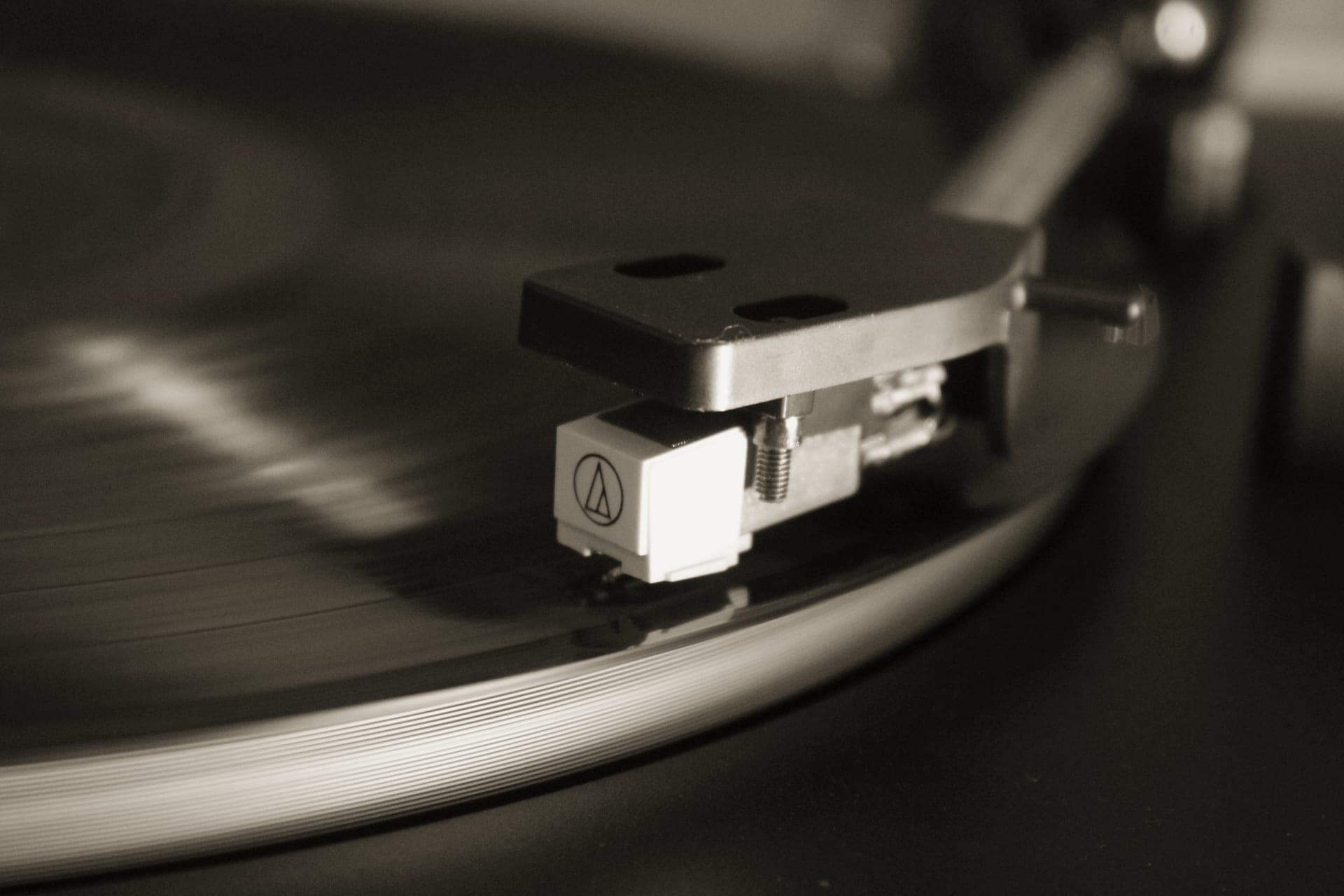
A turntable cannot drive a speaker. Nothing about that is obvious, and it is the root of nearly every problem on this page.
What comes out of a cartridge is a signal of roughly 3.5 to 5.5 millivolts — about a hundred times quieter than the line-level signal a CD player or a phone puts out — and it has had its bass deliberately removed and its treble deliberately boosted at the cutting stage. Both of those have to be undone before anything else can happen. The circuit that undoes them is a phono stage, and it has to be somewhere in the chain.
The four routes that work
1. Turntable → powered speakers, and nothing else
This works when the phono stage lives inside one of the two boxes. Either the turntable has a switchable built-in stage — the Audio-Technica AT-LP120XUSB, AT-LP70X and AT-LP60XBT, the Fluance RT81 and the Sony PS-LX310BT all do — or the speaker does. The Kanto YU6 publishes an “RCA with phono switch” input and a built-in phono preamp; Klipsch The Fives II has one too.
If both the deck and the speakers have a phono stage, switch one of them off. Running a phono signal through two stages in series applies the RIAA curve twice and adds 40 dB of gain you did not want. It sounds thin, harsh and distorted, and it is not a fault — it is a setting. Our speakers-for-a-turntable roundup marks which ones have a stage inside.
2. Turntable → phono preamp → powered speakers
The route for a deck with no built-in stage feeding speakers with no built-in stage. Audioengine is admirably blunt about needing this: “All turntables require a phono preamp stage before connecting to Audioengine speakers.”
Turntable RCA out → phono preamp in; phono preamp out → speaker line in. Ground wire from the deck to the preamp’s ground post. Any of the stages in our roundup does this job, and the cheapest competent one costs less than a couple of records.
3. Turntable → amplifier with a PHONO input → passive speakers
The classic three-box system, and the one with the longest life. The amplifier’s PHONO socket is a phono stage — that is the whole difference between it and the AUX sockets next to it. The Yamaha A-S501, Onkyo TX-8470, Cambridge AXA35, Denon PMA-600NE, Marantz PM6007 and Sony STR-DH190 all have one.
Turntable → PHONO in. Speaker terminals → speakers. If your deck also has a built-in stage, switch it to PHONO (bypassing its own preamp) so the amplifier’s stage does the work.
4. Turntable → phono preamp → amplifier line input → passive speakers
For an amplifier with no PHONO socket, which describes most modern AV receivers and every amplifier designed after about 2005 that was not aimed at vinyl. The external stage converts phono to line level, and then it is just another source plugged into AUX.
This is also the route to take if you own an amplifier with a PHONO input you do not rate. An external stage overrides it entirely — plug into a line input instead.
The two routes that do not work
Turntable with no phono stage, straight into a line input. You will hear music, very faintly, with almost no bass and a shrill top end. It is not broken and the volume knob will not fix it. It is a phono-level signal being asked to behave like a line-level one, and the RIAA curve never got undone.
Turntable straight into passive speakers. Nothing at all, or something so quiet you assume the deck is dead. A passive speaker needs watts; a cartridge produces thousandths of a volt. There is no cable that fixes this — you need an amplifier, either a separate one or the kind built into a powered speaker.
The ground wire, and the hum
Most turntables have a thin separate wire, often with a spade connector, that is not part of the RCA pair. It connects the metal parts of the deck to the ground post on your phono stage or amplifier — usually a small screw terminal marked GND, SIGNAL GND or with the earth symbol.
Leave it off and you typically get a steady 60 Hz hum. Attach it and the hum usually disappears. Some decks with a fully shielded, molded cable do not have one and do not need one, and a small number of combinations hum more when grounded, which is a real phenomenon and worth trying both ways before concluding something is faulty.
If hum persists with the ground connected, in our experience the usual causes are worth ruling out in this order: a power supply or wall wart sitting too close to the deck or the phono stage; the turntable stacked directly on top of an amplifier; a cheap unshielded interconnect running parallel to a mains cable; and a genuine mains ground loop, which usually announces itself by changing when you move equipment to a different outlet.
Cables: what actually matters
Two things, and neither is expensive. Length — a phono-level signal is tiny and traveling meters of cable before amplification is asking for noise, so keep the run from turntable to phono stage short and put the length after the stage if you need it. And capacitance, which is the one specification that genuinely alters the sound.
Moving magnet cartridges specify a total load capacitance, and the cable is part of that total. Audio-Technica specifies 100–200 pF for the entire VM95 range; Ortofon specifies 150–300 pF for the 2M series. Note that those ranges barely overlap, which means a cable that is correct for one is at the edge for the other. Grado, for its part, publishes no capacitance recommendation at all.
Miss the window high and the top end develops a rise and then a rolloff; miss it low and it sounds a little bare. This is one of very few places in audio where cable specification has a measurable, documented effect — and it is about picking the right capacitance, not about spending more money.
A quick troubleshooting list
- Very quiet, thin, no bass— no phono stage in the chain, or the deck’s switch is set to PHONO while it is plugged into a line input.
- Loud, harsh, distorted — two phono stages in series. Switch one off.
- Steady low hum — ground wire not connected, or a power supply sitting too close.
- One channel silent — usually a cartridge clip that has worked loose at the headshell, not a cable. Check the four colored tags before you buy anything.
- Nothing at all into passive speakers — there is no amplifier in the chain. That is the whole problem.
Once it is connected and quiet, the setup guide covers tracking force, anti-skate and leveling — which is where the sound actually gets made.
If the amplifier in routes 3 and 4 is a stereo or AV receiver, our receiver-specific guide covers the PHONO input, the ground screw, the receivers we cover that have no phono input at all, and the three AV receiver settings that catch people.
Frequently asked questions
Can I connect a turntable directly to speakers?
Only to powered speakers, and only if a phono stage exists somewhere — either inside the turntable or inside the speakers. Passive speakers can never be connected directly, because a cartridge produces a few thousandths of a volt and a passive speaker needs watts. There is no cable that solves that; you need an amplifier.
Why is my turntable so quiet through my amplifier?
Almost always because the signal has not been through a phono stage. A cartridge puts out roughly 3.5–5.5 mV against the ~1 V a line input expects, and the record's bass was deliberately removed at the cutting stage. Plug into a PHONO input, switch your deck's built-in stage to LINE, or add an external phono preamp.
What is the ground wire on a turntable for?
It connects the deck's metalwork to the ground post on your phono stage or amplifier, and it is there to stop a 60 Hz hum. Attach it to the terminal marked GND or SIGNAL GND. Some fully shielded decks do not have one and do not need one, and a small number of setups actually hum more when grounded — try it both ways before assuming something is broken.
Does turntable cable capacitance really matter?
For moving magnet cartridges, yes, and it is one of the few cable specifications with a documented effect. Audio-Technica specifies a 100–200 pF total load for the VM95 range; Ortofon specifies 150–300 pF for the 2M series. The cable is part of that total, so a cable correct for one is at the edge of the window for the other. Getting it wrong alters the top end audibly.
Can I use two phono preamps at once?
No — running a phono signal through two stages applies the RIAA curve twice and adds around 40 dB of unwanted gain. The result is loud, thin and distorted. If your turntable and your speakers or amplifier both have a phono stage, switch one of them off; that is what the PHONO/LINE switch on the back of most decks is for.
Read next
Do I Need a Phono Preamp?
Yes, unless you already have one — and it might be hiding in your turntable, amplifier or speakers. Check in 30 seconds.
The Best Speakers for a Turntable
Which speakers need an amplifier, which need a phono stage, and the one that needs neither.
The Best Integrated Amplifiers Under $1,000
Six amps under $1,000, and the dynamic-power trap that overstates the popular pick by roughly 2x.
How to Set Up a Turntable
Nine steps, and the two everyone gets wrong. Both have a published number you can set them to.
How to Digitize Vinyl Records
USB deck, external ADC, or streamer — and why the USB route tops out at 16-bit/44.1 kHz per Audio-Technica's own manual.
How to Connect a Turntable to a Receiver
Which receiver input, which switch position, why the ground screw matters, and what to do when the receiver has no PHONO input at all.
Sources
Every specification on this page was read from one of these documents. If one of them has changed, or we have made an error, tell us — corrections are logged and dated per our editorial policy.