The Best Bookshelf Speakers Under $200
The bracket where two of four makers stop publishing a measurement condition, and where a seven-decibel sensitivity spread decides which amplifier you can get away with.
Disclosure: we earn a commission if you buy through the links on this page, at no extra cost to you. It does not influence what we pick — our criteria are published and reproducible, so you can check our work. How we pick · Full disclosure
These picks are spec-and-price analyses, not listening tests. We have not heard this gear and we do not pretend to have: every figure below is sourced to the manufacturer and linked, and every price is live or not shown at all. Here are the rules we followed.
Quick picks
Ranked on the published criteria in How We Pick. Prices are live as of October 15, 2026. Tap any row for the full write-up.
- 7.4$149.00View on Amazon
$179.0017% off
- 7.2
- 7.0
- 6.8
| # | Product | Best for | Score | Price |
|---|---|---|---|---|
| 1 | 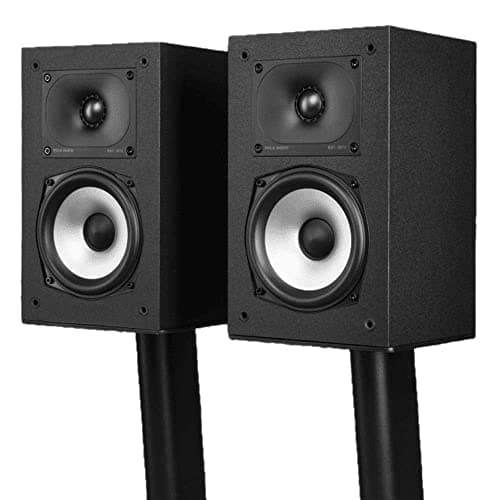 Polk Monitor XT15 48 Hz of published extension and a stated 30–150 W amplifier range, from a maker who tells you what to drive it with but not how they measured its sensitivity. | Best all-rounder under $200 | 7.4 | $149.00View on Amazon $179.0017% off |
| 2 | 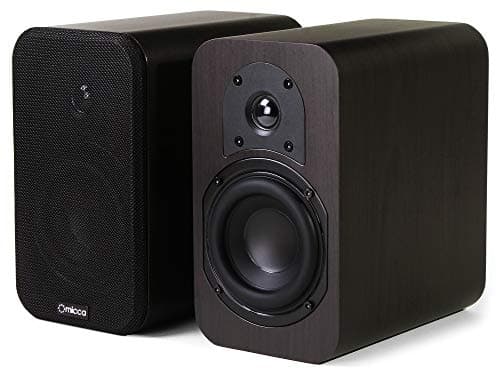 Micca RB42 A 4-inch speaker that publishes 50 Hz of extension and an honest 83 dB at 1 W — the two facts are the same fact, and Micca is unusual in showing you both. | Most bass from the smallest box | 7.2 | |
| 3 | 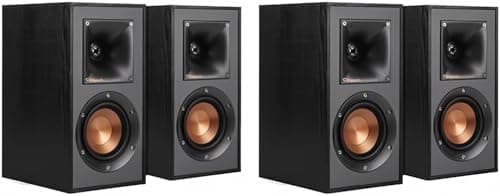 Klipsch R-41M A 4-inch two-way with a published 90 dB sensitivity, which means it goes loud on an amplifier that would embarrass most of its competition. | Best for a very small amplifier | 7.0 | |
| 4 | 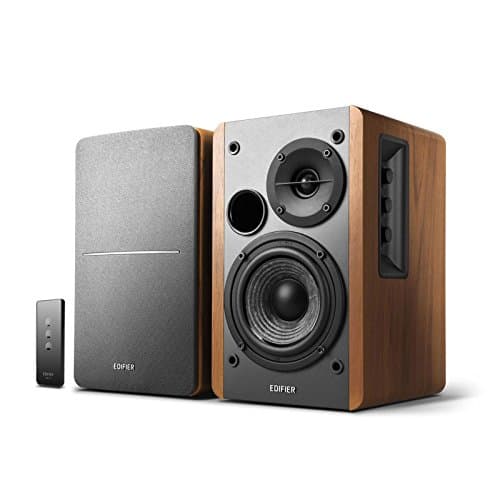 Edifier R1280T The cheapest credible way to get a turntable making sound in a small room, provided the turntable brings its own phono stage. | Best budget powered pair | 6.8 |
Under $200 the speakers are still honest and the specification sheets stop being. Two of the four pairs here publish a sensitivity figure with no measurement condition attached, one publishes the harder condition and is punished for it, and one is not a passive speaker at all.
What each maker publishes, and under what condition
| Speaker | Sensitivity | Condition stated? | Amplifier guidance |
|---|---|---|---|
| Polk Monitor XT15 | 86 dB | No | 30–150 W per channel, published |
| Micca RB42 | 83 dB | Yes — 1 W / 1 m, the harder one | 15–100 W each (power handling, doubling as a floor) |
| Klipsch R-41M | 90 dB | Yes — 2.83 V / 1 m | None — only power handling (50 W / 200 W) |
| Edifier R1280T (powered) | Not applicable | — | 21 W + 21 W RMS built in |
The Micca’s 83 dB is the most trustworthy number on this page and it costs the speaker the top spot. 1 W / 1 m is the harder condition; 2.83 V / 1 m equals one watt only into 8 ohms, and into anything lower it is more than a watt, which flatters the figure. The conversion between the two is arithmetic, and it needs an impedance figure Micca publishes as a range (4–8 Ω) rather than a value.
Polk publishes a bare 86 dB with no qualifier at all. Depending which convention they used, it is comparable to Klipsch’s or a decibel or so optimistic. Polk redeems itself with the single most useful spec on this page: an actual recommended amplifier range, 30 to 150 watts per channel. Klipsch publishes only power handling, which tells you what will break the speaker rather than what will drive it.
One buying note on the Klipsch, because the price you see for it is not a price for a pair. As of September 2026 Amazon no longer lists the R-41M as a single pair at all — the live listing is a two-pair, four-speaker pack. Per pair it still belongs on this page; as a single line on your card it does not, and you should know that before you click.
What the sensitivity spread costs in amplifier power
power ratio = 10^(ΔdB ÷ 10) · 3 dB of sensitivity = a doubling of amplifier power
Inputs
- Klipsch R-41M published sensitivity: 90 dB (2.83 V / 1 m) (Klipsch spec sheet (PDF))
- Micca RB42 published sensitivity: 83 dB (1 W / 1 m) (Micca spec page)
- Polk Monitor XT15 published sensitivity: 86 dB (no condition published) (Polk info sheet (PDF))
Result
Klipsch vs Micca: 10^(7 ÷ 10) = 5.0× the amplifier power
Klipsch vs Polk: 10^(4 ÷ 10) = 2.5×
Polk vs Micca: 10^(3 ÷ 10) = 2.0×
A 20-watt amplifier driving the Klipsch to a given level needs about 100 watts to drive the Micca to the same one. That is the difference between a small desktop amplifier being ample and being useless, and it is by far the most consequential number on this page.
The 7 dB gap is between figures measured under different conditions, so the real gap is smaller than 7 dB — probably by a decibel or two, depending on the Micca’s actual impedance, which Micca publishes only as a 4–8 Ω range. The direction is certain; the exact multiplier is not. This is what happens when a manufacturer publishes the honest condition and its competitors do not.
The powered option, and when it is the right answer
The Edifier R1280T is on this list because at this price the amplifier is a real cost. A passive pair plus even a cheap amplifier is a two-box purchase; the Edifier publishes 21 W + 21 W RMS built in and needs nothing else.
What you give up is the upgrade path and the specification. Edifier publishes an “input sensitivity” in millivolts, which is a line-level input spec and not loudspeaker sensitivity in decibels — the two are unrelated and are frequently confused in listings. And Edifier does not state either way whether the R1280T has a phono stage, so assume it does not.
The full passive-versus-powered comparison is its own page. The short version for this bracket: powered wins on total cost, passive wins on everything you might do next.
Extension, and what it is worth here
Nobody in this bracket publishes deep bass and one of them publishes a figure you should read carefully.
- Polk Monitor XT15:48 Hz – 40 kHz, no tolerance published. A response figure with no ± dB limits is a claim rather than a specification.
- Klipsch R-41M:68 Hz – 21 kHz ± 3 dB. The highest low-end figure here and the only one with a tolerance attached, which makes it the only comparable number.
- Micca RB42:50 Hz – 20 kHz, stated as “typical in-room”. An in-room figure includes room gain and is not comparable to an anechoic one.
- Edifier R1280T:52 Hz – 20 kHz, no tolerance.
Read honestly, only Klipsch publishes something you can compare, and what it says is 68 Hz. At this size that is expected physics, not a failing — a 4-inch woofer in a small box does not go low. A subwoofer is the answer if the bottom octave matters, and it is a better use of the next $200 than a bigger pair of speakers.
What we would buy
The Polk Monitor XT15 if you are pairing them with a real amplifier, because Polk is the only maker here that tells you what amplifier the speaker wants. That single published range is worth more than the missing sensitivity condition costs.
The Klipsch R-41M if the amplifier is small. Ninety decibels at 2.83 V is the highest figure here and it makes a modest amplifier behave like a bigger one.
The Micca RB42 if you value a manufacturer that publishes the harder number, and you have the power to feed it. Read its 83 dB as a disclosure rather than a weakness.
The Edifier R1280T if this is the whole system and there will be no amplifier.
If the Polk Monitor XT15 is the front-runner and you are weighing it against the Klipsch one bracket up, our head-to-head takes the two apart on the five figures where they differ — and explains why the 7 dB sensitivity gap between them cannot be verified from what either maker publishes.
Every pick in detail
Every specification below links to the manufacturer document we read it from. Where a manufacturer does not publish a figure, we say so rather than estimating it.
Polk Monitor XT15
Best all-rounder under $20048 Hz of published extension and a stated 30–150 W amplifier range, from a maker who tells you what to drive it with but not how they measured its sensitivity.
- specs
- 7/10
- sensitivity
- 6/10
- published data
- 6/10
- value for money
- 9/10
- bass extension
- 8/10
| Specification | Published value | Source |
|---|---|---|
| Sensitivity | 86 dB — Polk publishes NO measurement condition (no 2.83 V/1 m or 1 W/1 m qualifier) | Polk info sheet (PDF) |
| Impedance | “Compatible with 4- and 8-ohm outputs” — Polk publishes no nominal impedance value | Polk info sheet (PDF) |
| Minimum impedance | Not published | — |
| Frequency response | 48 Hz – 40 kHz (no tolerance published) | Polk info sheet (PDF) |
| Recommended amplification | 30–150 W per channel | Polk info sheet (PDF) |
| Woofer | 5.25 in bi-laminate paper | Polk info sheet (PDF) |
| Tweeter | 1 in Terylene dome | Polk info sheet (PDF) |
| Crossover | 2,200 Hz | Polk info sheet (PDF) |
| Weight (each) | 9 lb / 4.08 kg | Polk info sheet (PDF) |
Pros
- 48 Hz – 40 kHz published extension, the deepest bass figure in this bracket
- Polk publishes a recommended amplification range (30–150 W), which Klipsch and ELAC do not
- 1 in Terylene dome tweeter, the same driver family as the more expensive Signature Elite ES15
- Explicitly rated for Dolby Atmos height duty as well as stereo, so it does double service
Cons
- The 86 dB sensitivity is published with NO measurement condition, so it cannot honestly be compared to Klipsch's 2.83 V figures
- “Compatible with 4- and 8-ohm outputs” is not a nominal impedance, and no minimum is published
- 48 Hz – 40 kHz is quoted with no tolerance, which makes the endpoints unverifiable
- The 30 W lower bound rules out several of the smallest amplifiers we recommend
Skip it if your amplifier delivers under 30 W. Polk's own recommendation excludes it, and that is Polk's number, not ours.
Micca RB42
Most bass from the smallest boxNo live price right now. #ad
A 4-inch speaker that publishes 50 Hz of extension and an honest 83 dB at 1 W — the two facts are the same fact, and Micca is unusual in showing you both.
- specs
- 7/10
- sensitivity
- 3/10
- published data
- 7/10
- value for money
- 8/10
- bass extension
- 8/10
| Specification | Published value | Source |
|---|---|---|
| Sensitivity | 83 dB (1 W / 1 m) — note the condition: this is the TRUE 1 W figure, not the flattering 2.83 V one most brands quote | Micca spec page |
| Impedance | 4–8 Ω (Micca publishes a range rather than a nominal value) | Micca spec page |
| Minimum impedance | Not published | — |
| Frequency response | 50 Hz – 20 kHz, stated as “typical in-room” — an in-room figure is not an anechoic one and carries no tolerance | Micca spec page |
| Power handling | 15–100 W each — Micca's lower bound doubles as a de facto minimum amplifier recommendation | Micca spec page |
| Woofer | 4 in coated paper cone, rubber surround | Micca spec page |
| Tweeter | 0.75 in silk dome | Micca spec page |
| Crossover | 18 dB/octave slope — Micca publishes the SLOPE but not the crossover FREQUENCY | Micca spec page |
| Dimensions | 8.7 in H × 4.9 in W × 7.9 in D | Micca spec page |
| Weight | Not published | — |
Pros
- Micca quotes sensitivity at 1 W/1 m, the harder and more honest condition — most brands quote 2.83 V, which flatters a low-impedance speaker
- 50 Hz from a 4-inch driver in an 8.7-inch cabinet is genuinely unusual
- A 10-element crossover with film capacitors and air-core coils, described in detail on Micca's own page
- Micca publishes a 15 W lower power bound, which functions as a minimum amplifier recommendation
Cons
- 83 dB is the lowest sensitivity on this site — it needs roughly five times the power of the Klipsch R-41M for the same level
- The 50 Hz figure is qualified “typical in-room”, which is not an anechoic measurement and carries no tolerance
- Micca publishes the crossover SLOPE (18 dB/octave) but not the crossover FREQUENCY
- “4–8 ohms” is a range, not a nominal impedance, and no minimum is published
Skip it if your amplifier is small. A 20 W amp that drives the Klipsch R-41M to a satisfying level will not do the same job here — the arithmetic is on our amp-matching page and it is not close.
Klipsch R-41M
Best for a very small amplifierPrice as of October 15, 2026. #ad
A 4-inch two-way with a published 90 dB sensitivity, which means it goes loud on an amplifier that would embarrass most of its competition.
- specs
- 6/10
- sensitivity
- 9/10
- published data
- 6/10
- value for money
- 9/10
- bass extension
- 3/10
| Specification | Published value | Source |
|---|---|---|
| Sensitivity | 90 dB (2.83 V / 1 m) | Klipsch spec sheet (PDF) |
| Impedance | 8 Ω “compatible” (Klipsch's wording — not a measured nominal figure) | Klipsch spec sheet (PDF) |
| Minimum impedance | Not published | — |
| Frequency response | 68 Hz – 21 kHz ± 3 dB | Klipsch spec sheet (PDF) |
| Power handling | 50 W continuous / 200 W peak (a handling limit, not a recommended amplifier range) | Klipsch spec sheet (PDF) |
| Woofer | Single 4 in spun-copper IMG | Klipsch spec sheet (PDF) |
| Tweeter | 1 in aluminum LTS on a 90° × 90° Tractrix horn | Klipsch spec sheet (PDF) |
| Crossover | 1,730 Hz | Klipsch spec sheet (PDF) |
| Enclosure | MDF, bass-reflex via rear-firing ports | Klipsch spec sheet (PDF) |
| Weight (each) | 7 lb / 3.2 kg | Klipsch spec sheet (PDF) |
Pros
- 90 dB at 2.83 V/1 m — seven decibels more sensitive than the Micca RB42, which is about five times less amplifier for the same volume
- Klipsch publishes a real ±3 dB tolerance on the frequency response
- 7 lb each and 11.3 in tall: the smallest cabinet here by a clear margin
- Timbre-matched to the R-51M and R-52C if you later build a surround system around it
Cons
- 68 Hz is the shallowest bass extension of any speaker on this site
- “8 ohms compatible” is not a measured nominal impedance, and no minimum impedance is published
- Rear-ported, so it needs clearance behind it — an actual bookshelf will change its bass
- Klipsch publishes power handling, not a recommended amplifier range; those are different specs
- Amazon no longer lists a single pair: the live listing is a two-pair, four-speaker pack, so the price shown here buys four speakers
- Previous generation — Klipsch's own page for it now points buyers to the newer Reference R-40M
Skip it if you listen to anything with real low end and have no subwoofer. 68 Hz means the bottom octave and a half simply is not there.
Edifier R1280T
Best budget powered pairPrice as of October 15, 2026. #ad
The cheapest credible way to get a turntable making sound in a small room, provided the turntable brings its own phono stage.
- integration
- 6/10
- upgrade path
- 3/10
- value for money
- 10/10
- ease of setup
- 9/10
- connectivity
- 6/10
| Specification | Published value | Source |
|---|---|---|
| Type | Powered (amplifier built in) | Edifier spec page |
| Amplifier output | 21 W + 21 W RMS | Edifier spec page |
| Frequency response | 52 Hz – 20 kHz (no tolerance published) | Edifier spec page |
| Inputs | Dual RCA | Edifier spec page |
| Built-in phono stage | Not stated either way by Edifier — assume none and check before buying | Edifier spec page |
| Woofer | 4 in | Edifier spec page |
| Tweeter | 0.5 in | Edifier spec page |
Pros
- Very cheap for a powered pair
- Two RCA inputs
- Tone controls on the cabinet
Cons
- NO built-in phono stage — the turntable must have one or you need a separate box
- Modest power output
- Small drivers, limited extension
Skip it if your turntable has no built-in phono stage — this pair will not make a sound without one.
Frequently asked questions
What are the best bookshelf speakers under $200?
The Polk Monitor XT15 for a system with a real amplifier, because Polk is the only maker in this bracket that publishes a recommended amplifier range (30–150 W per channel). The Klipsch R-41M if the amplifier is small, since its published 90 dB at 2.83 V / 1 m is the highest sensitivity here.
How much amplifier power do $200 bookshelf speakers need?
It depends on which pair, by a factor of five. The 7 dB gap between the Klipsch R-41M’s published 90 dB and the Micca RB42’s published 83 dB means the Micca needs roughly five times the power for the same loudness. Polk publishes an explicit 30–150 W recommendation for the XT15; Klipsch publishes no recommendation at all.
Are powered speakers better value than passive under $200?
On total cost, usually — a passive pair still needs an amplifier, and the Edifier R1280T publishes 21 W + 21 W built in. What you lose is the upgrade path and the specification: Edifier publishes an input sensitivity in millivolts, which is a line-level spec rather than loudspeaker sensitivity, and does not state whether there is a phono stage.
Do bookshelf speakers under $200 need a subwoofer?
For the bottom octave, yes. The only comparable extension figure in this bracket is the Klipsch R-41M’s 68 Hz ± 3 dB; the others publish numbers with no tolerance or measured in-room. A 4-inch woofer in a small cabinet does not reach low, and a subwoofer is a better use of the next $200 than a larger pair.
Read next
The Best Bookshelf Speakers Under $300
Five passive pairs at the $300 mark, and a ten-decibel sensitivity spread that decides which amplifier each one needs.
Speaker Sensitivity Explained
2.83 V/1 m versus 1 W/1 m, what the conversion is worth in decibels, and the twelve-decibel spread that means sixteen times the power.
The Best High-Sensitivity Bookshelf Speakers
The speakers that make a small amplifier sound big, ranked on published sensitivity and the condition each figure was measured under.
Will This Amplifier Drive My Speakers?
Two published numbers, one formula, and the answer is almost always less power than you expected.
Passive vs Powered Speakers
Total cost, upgrade path, and why powered speakers correctly refuse to publish a sensitivity figure.
The Best Speakers for a Small Room
Four speakers for rooms where the wall is close, chosen on port position, cabinet size and the extension figure each maker publishes.
Sources
Every specification on this page was read from one of these documents. If one of them has changed, or we have made an error, tell us — corrections are logged and dated per our editorial policy.