The Best Speakers for a Small Room
A small room adds bass you did not ask for. The right speaker for one is not the one with the deepest published extension — it is the one whose port is not aimed at the wall behind it.
Disclosure: we earn a commission if you buy through the links on this page, at no extra cost to you. It does not influence what we pick — our criteria are published and reproducible, so you can check our work. How we pick · Full disclosure
These picks are spec-and-price analyses, not listening tests. We have not heard this gear and we do not pretend to have: every figure below is sourced to the manufacturer and linked, and every price is live or not shown at all. Here are the rules we followed.
Quick picks
Ranked on the published criteria in How We Pick. Prices are live as of October 15, 2026. Tap any row for the full write-up.
- 7.2
- 8.2
- 7.0
- 6.4
| # | Product | Best for | Score | Price |
|---|---|---|---|---|
| 1 | 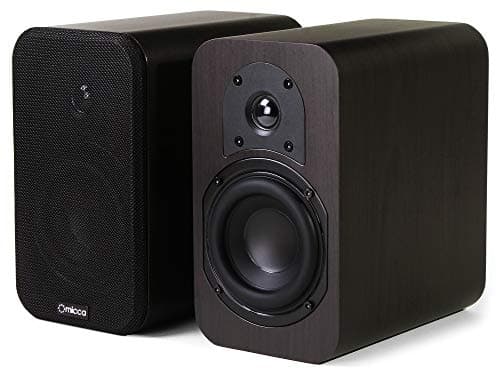 Micca RB42 A 4-inch speaker that publishes 50 Hz of extension and an honest 83 dB at 1 W — the two facts are the same fact, and Micca is unusual in showing you both. | Most bass from the smallest box | 7.2 | |
| 2 | 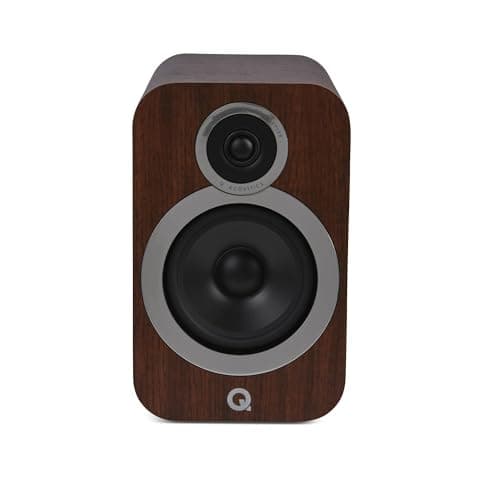 Q Acoustics 3030i The only speaker in this bracket that publishes both a minimum impedance and a recommended amplifier range, on top of a cabinet that is its whole design argument. | Best cabinet | 8.2 | |
| 3 | 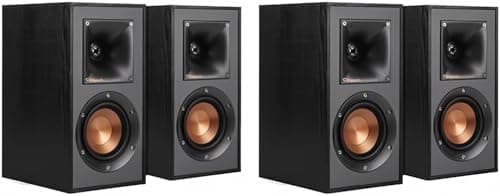 Klipsch R-41M A 4-inch two-way with a published 90 dB sensitivity, which means it goes loud on an amplifier that would embarrass most of its competition. | Best for a very small amplifier | 7.0 | |
| 4 | 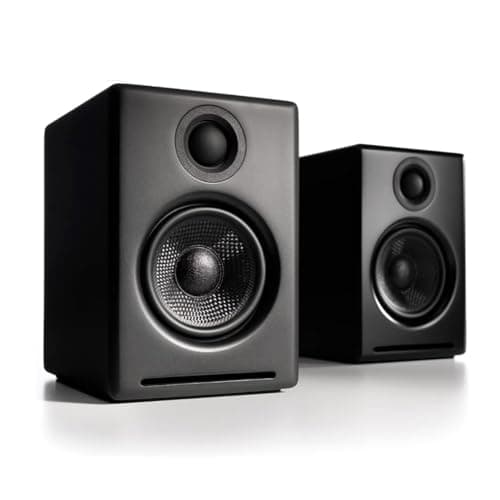 Audioengine A2+ Desktop-scale powered speakers with a built-in DAC, sized for an arm's length and honest about it. | Smallest powered option | 6.4 |
A small room does not need a speaker that goes deep. It needs a speaker that behaves when the wall is 30 centimeters away. Those are different requirements, and the specification that decides the second one is usually the port.
Why a small room adds bass
Put a speaker near a boundary and the room reinforces its low frequencies, because the reflected wave from the wall arrives in phase with the direct one at long wavelengths. Push it into a corner and two boundaries do it. The effect is real, it is free, and in a small room where every speaker is near something, it is unavoidable.
The consequence is counterintuitive: in a small room, a speaker with a modest published low end often sounds better balanced than one with a deep one, because the room is already adding what the deeper speaker also adds.
It also means the room’s modes are doing more than the speaker’s response below about 100 Hz, and no speaker choice changes that.
The port, which is the deciding spec
A rear-firing port aimed at a nearby wall does two things: it reinforces the port’s output unevenly, and at higher levels the air moving through it can be audible as chuffing because there is nowhere for it to go. A front port, a sealed cabinet, or a rear port with real clearance all avoid that.
| Speaker | Enclosure as published | Published extension | Cabinet width |
|---|---|---|---|
| Micca RB42 | Not published by Micca | 50 Hz – 20 kHz, stated “typical in-room” | 4.9 in |
| Q Acoustics 3030i | Reflex — port location not published | 46 Hz – 30 kHz (+3 / −6 dB) | 7.9 in |
| Klipsch R-41M | Bass-reflex, REAR-firing ports | 68 Hz – 21 kHz ± 3 dB | Not published |
| Audioengine A2+ (powered) | Not published by Audioengine | 65 Hz – 22 kHz ± 2.0 dB | Not published |
Klipsch is the only maker here that publishes its port arrangement, and what it publishes is the awkward answer: the R-41M and R-51M are rear-ported, while the R-52C center is sealed. That is genuinely useful and genuinely inconvenient, and it is the kind of spec that only appears when a manufacturer bothers. What a port changes, and what it costs is the longer version.
Q Acoustics publishes the enclosure type — reflex — but not where the port fires, which is the half of the answer that matters near a wall. For Micca and Audioengine neither is published, and we are not going to assert one from photographs. If a speaker must go close to a wall, that gap is a reason to plan for clearance rather than assume it does not matter.
Size, honestly
Two makers here publish cabinet dimensions, and they are at opposite ends of the group. The Micca RB42 is 8.7 in high, 4.9 in wide and 7.9 in deep — genuinely small, and in a room where the shelf is the constraint that is the spec that decides everything else. The Q Acoustics 3030i is 12.8 × 7.9 × 13.0 in and 14.1 lb per speaker, which is a stand-mount that happens to be called a bookshelf. It is on this page for how completely it is documented, not because it is small.
Micca also publishes the sensitivity figure nobody else does — 83 dB at 1 W / 1 m, the harder condition — and pairs it with a 15–100 W power handling range whose lower bound works as a minimum amplifier recommendation. A small, insensitive speaker in a small room is a reasonable combination precisely because the listening distance is short.
ΔSPL = 20 × log₁₀(d₂ ÷ d₁) · free-field inverse-square law
Inputs
- Listening distance, small room: 2.0 m (our example distance; Micca's 1 m reference is published)
- Listening distance, larger room: 4.0 m (our example distance; Micca's 1 m reference is published)
- Micca RB42 published sensitivity: 83 dB (1 W / 1 m) (Micca spec page)
Result
Loss at 2 m: 20 × log₁₀(2) = 6.0 dB
Loss at 4 m: 20 × log₁₀(4) = 12.0 dB
Difference: 6 dB = 4× the amplifier power
Halving the listening distance is worth six decibels, which is worth four times the amplifier power — and it is worth exactly as much as buying a speaker six decibels more sensitive. A small room hands you that for free, which is why a low sensitivity figure is far less of an obstacle at two meters than at four.
Free-field arithmetic again. A small room is the least free-field environment there is: reflected energy fills in some of the loss, so real measured differences are smaller than this. The direction is right and the magnitude is an upper bound.
The powered option for a desk
If the small room is actually a desk, the Audioengine A2+ is the sensible answer. It publishes 20 W RMS per channel into 4 Ω, a 65 Hz – 22 kHz ± 2.0 dB response — one of the few tolerance-carrying figures in this bracket — and USB, RCA, 3.5 mm and Bluetooth inputs.
At desk distance the inverse-square arithmetic above is doing even more of the work: at one meter you lose nothing at all relative to the 1 m reference. Twenty watts is more than enough.
What actually fixes a small room
Speaker choice is third on the list. Ahead of it are two things that cost nothing and one that costs less than a speaker upgrade.
- Pull the speakers off the wall. Even 20 cm changes the boundary reinforcement measurably. The geometry is published.
- Move the seat.A small room’s modes are far apart, so a null is a position rather than a property. Thirty centimeters often recovers a missing note.
- Trap the front corners. The Auralex LENRD publishes 1.30 at 125 Hz, against 0.12 for a flat wall panel. In a small room that is the highest-value purchase in the category.
Do those three, then choose the speaker. In that order the choice matters less, which is the point.
If you would rather not buy stands, a slim tower takes about the same floor as a stand-mounted pair, and our small-room floorstanding page ranks the towers we cover on the same criteria as this page: port direction, published footprint and the shallowest bass figure rather than the deepest.
Every pick in detail
Every specification below links to the manufacturer document we read it from. Where a manufacturer does not publish a figure, we say so rather than estimating it.
Micca RB42
Most bass from the smallest boxNo live price right now. #ad
A 4-inch speaker that publishes 50 Hz of extension and an honest 83 dB at 1 W — the two facts are the same fact, and Micca is unusual in showing you both.
- specs
- 7/10
- sensitivity
- 3/10
- published data
- 7/10
- value for money
- 8/10
- bass extension
- 8/10
| Specification | Published value | Source |
|---|---|---|
| Sensitivity | 83 dB (1 W / 1 m) — note the condition: this is the TRUE 1 W figure, not the flattering 2.83 V one most brands quote | Micca spec page |
| Impedance | 4–8 Ω (Micca publishes a range rather than a nominal value) | Micca spec page |
| Minimum impedance | Not published | — |
| Frequency response | 50 Hz – 20 kHz, stated as “typical in-room” — an in-room figure is not an anechoic one and carries no tolerance | Micca spec page |
| Power handling | 15–100 W each — Micca's lower bound doubles as a de facto minimum amplifier recommendation | Micca spec page |
| Woofer | 4 in coated paper cone, rubber surround | Micca spec page |
| Tweeter | 0.75 in silk dome | Micca spec page |
| Crossover | 18 dB/octave slope — Micca publishes the SLOPE but not the crossover FREQUENCY | Micca spec page |
| Dimensions | 8.7 in H × 4.9 in W × 7.9 in D | Micca spec page |
| Weight | Not published | — |
Pros
- Micca quotes sensitivity at 1 W/1 m, the harder and more honest condition — most brands quote 2.83 V, which flatters a low-impedance speaker
- 50 Hz from a 4-inch driver in an 8.7-inch cabinet is genuinely unusual
- A 10-element crossover with film capacitors and air-core coils, described in detail on Micca's own page
- Micca publishes a 15 W lower power bound, which functions as a minimum amplifier recommendation
Cons
- 83 dB is the lowest sensitivity on this site — it needs roughly five times the power of the Klipsch R-41M for the same level
- The 50 Hz figure is qualified “typical in-room”, which is not an anechoic measurement and carries no tolerance
- Micca publishes the crossover SLOPE (18 dB/octave) but not the crossover FREQUENCY
- “4–8 ohms” is a range, not a nominal impedance, and no minimum is published
Skip it if your amplifier is small. A 20 W amp that drives the Klipsch R-41M to a satisfying level will not do the same job here — the arithmetic is on our amp-matching page and it is not close.
Q Acoustics 3030i
Best cabinetNo live price right now. #ad
The only speaker in this bracket that publishes both a minimum impedance and a recommended amplifier range, on top of a cabinet that is its whole design argument.
- sensitivity
- 8/10
- bass extension
- 8/10
- amp friendliness
- 7/10
- value for money
- 8/10
- build quality
- 10/10
| Specification | Published value | Source |
|---|---|---|
| Sensitivity | 88 dB (2.83 V / 1 m) | Q Acoustics spec page |
| Impedance (nominal) | 6 Ω | Q Acoustics spec page |
| Minimum impedance | 4 Ω | Q Acoustics spec page |
| Frequency response | 46 Hz – 30 kHz (+3 dB / −6 dB) | Q Acoustics spec page |
| Recommended amplifier power | 25–75 W (stereo amplifier); 50–145 W (AV receiver, 2 ch driven) | Q Acoustics spec page |
| Bass unit | 165 mm (6.5 in) | Q Acoustics spec page |
| Treble unit | 22 mm (0.9 in) decoupled | Q Acoustics spec page |
| Crossover | 2.4 kHz | Q Acoustics spec page |
| Dimensions (H × W × D) | 325 × 200 × 329 mm (12.8 × 7.9 × 13.0 in), including grille and terminals | Q Acoustics spec page |
| Weight (each) | 6.4 kg / 14.1 lb | Q Acoustics spec page |
Pros
- Publishes a minimum impedance (4 Ω) and a recommended amplifier range (25–75 W) — almost nobody else at this price does
- 88 dB sensitivity, the highest here outside the horn-loaded Klipsch
- Unusually inert cabinet for the price, with P2P bracing
- A published 46 Hz low end, which is real extension rather than a bigger box
Cons
- Dips to 4 Ω, so a weak amplifier will struggle despite the friendly sensitivity figure
- Large and deep for a bookshelf at 325 × 200 × 329 mm and 6.4 kg each — this wants a stand
- Reflex port, so it needs clearance behind it
Skip it if your amplifier is rated only into 8 Ω and says nothing about 4 Ω. This speaker's published 4 Ω minimum is exactly the case that exposes it.
Klipsch R-41M
Best for a very small amplifierPrice as of October 15, 2026. #ad
A 4-inch two-way with a published 90 dB sensitivity, which means it goes loud on an amplifier that would embarrass most of its competition.
- specs
- 6/10
- sensitivity
- 9/10
- published data
- 6/10
- value for money
- 9/10
- bass extension
- 3/10
| Specification | Published value | Source |
|---|---|---|
| Sensitivity | 90 dB (2.83 V / 1 m) | Klipsch spec sheet (PDF) |
| Impedance | 8 Ω “compatible” (Klipsch's wording — not a measured nominal figure) | Klipsch spec sheet (PDF) |
| Minimum impedance | Not published | — |
| Frequency response | 68 Hz – 21 kHz ± 3 dB | Klipsch spec sheet (PDF) |
| Power handling | 50 W continuous / 200 W peak (a handling limit, not a recommended amplifier range) | Klipsch spec sheet (PDF) |
| Woofer | Single 4 in spun-copper IMG | Klipsch spec sheet (PDF) |
| Tweeter | 1 in aluminum LTS on a 90° × 90° Tractrix horn | Klipsch spec sheet (PDF) |
| Crossover | 1,730 Hz | Klipsch spec sheet (PDF) |
| Enclosure | MDF, bass-reflex via rear-firing ports | Klipsch spec sheet (PDF) |
| Weight (each) | 7 lb / 3.2 kg | Klipsch spec sheet (PDF) |
Pros
- 90 dB at 2.83 V/1 m — seven decibels more sensitive than the Micca RB42, which is about five times less amplifier for the same volume
- Klipsch publishes a real ±3 dB tolerance on the frequency response
- 7 lb each and 11.3 in tall: the smallest cabinet here by a clear margin
- Timbre-matched to the R-51M and R-52C if you later build a surround system around it
Cons
- 68 Hz is the shallowest bass extension of any speaker on this site
- “8 ohms compatible” is not a measured nominal impedance, and no minimum impedance is published
- Rear-ported, so it needs clearance behind it — an actual bookshelf will change its bass
- Klipsch publishes power handling, not a recommended amplifier range; those are different specs
- Amazon no longer lists a single pair: the live listing is a two-pair, four-speaker pack, so the price shown here buys four speakers
- Previous generation — Klipsch's own page for it now points buyers to the newer Reference R-40M
Skip it if you listen to anything with real low end and have no subwoofer. 68 Hz means the bottom octave and a half simply is not there.
Audioengine A2+
Smallest powered optionPrice as of October 15, 2026. #ad
Desktop-scale powered speakers with a built-in DAC, sized for an arm's length and honest about it.
- integration
- 6/10
- upgrade path
- 3/10
- value for money
- 6/10
- ease of setup
- 9/10
- connectivity
- 7/10
| Specification | Published value | Source |
|---|---|---|
| Type | Powered (amplifier built in) | Audioengine tech specs (Gen 3) |
| Amplifier output | 20 W RMS per channel at 4 Ω; 30 W peak per channel (AES) | Audioengine tech specs (Gen 3) |
| Frequency response | 65 Hz – 22 kHz ± 2.0 dB | Audioengine tech specs (Gen 3) |
| Inputs | 3.5 mm, RCA L/R, USB, Bluetooth | Audioengine tech specs (Gen 3) |
| Woofer | 2.75 in aramid fiber | Audioengine tech specs (Gen 3) |
Pros
- Very compact
- Built-in USB DAC
- Wood cabinets at a small size
Cons
- Little low-end extension without a sub
- No phono stage
- Near-field only
Skip it if this is for a room rather than a desk.
Frequently asked questions
What speakers are best for a small room?
Compact ones that will tolerate being near a wall. The Micca RB42 is the smallest here at a published 8.7 × 4.9 × 7.9 in; the Q Acoustics 3030i publishes the most complete data including a 4 Ω minimum impedance; the Klipsch R-41M is the most sensitive but is rear-ported, which needs clearance behind it.
Do small rooms need speakers with deep bass?
Usually the opposite. Boundaries reinforce low frequencies, so a speaker near a wall in a small room already gets bass added for free. A speaker with a modest published low end often balances better than one with a deep one, because the room is contributing what the deeper speaker also contributes.
Are rear-ported speakers bad near a wall?
They need clearance. A rear port aimed at a close wall reinforces unevenly and can chuff audibly at higher levels. Klipsch publishes that the R-41M and R-51M are rear-ported and that the R-52C is sealed — it is one of the few makers that publishes the port arrangement at all, which is why we can say so.
Does an insensitive speaker still work in a small room?
Better than in a large one. Halving the listening distance is worth about six decibels by the inverse-square law, which is the same as buying a speaker six decibels more sensitive — roughly four times the amplifier power. That is why the Micca RB42’s honest 83 dB at 1 W / 1 m is much less of an obstacle at two meters than at four.
Read next
Stereo Speaker Placement
Dolby's 22-30 degree window turned into a listening-distance rule, plus height, toe-in, boundaries and the port clearance most people miss.
Ported vs Sealed Speakers
What a port buys in efficiency and extension, what it costs in placement and roll-off, and how the sealed and ported subwoofers we cover actually compare.
The Best Bookshelf Speakers Under $300
Five passive pairs at the $300 mark, and a ten-decibel sensitivity spread that decides which amplifier each one needs.
Bass Traps for Small Rooms
The room-mode arithmetic that explains why small rooms sound boomy, and the corner trapping that partially fixes it.
The Best Bookshelf Speakers Under $200
Four bookshelf pairs at the $200 mark, and a seven-decibel sensitivity gap that is worth five times the amplifier power.
Room Treatment for a Hi-Fi Listening Room
What changes when a room has one seat instead of a console: the four surfaces that matter, in the order that returns the most per panel.
The Best Floorstanding Speakers for a Small Room
Four towers for a small room, ranked on published footprint, port direction and the shallowest bass figure — the opposite of what a price bracket rewards.
Sources
Every specification on this page was read from one of these documents. If one of them has changed, or we have made an error, tell us — corrections are logged and dated per our editorial policy.
- Micca RB42 — spec page (dimensions, 1 W / 1 m sensitivity, in-room response note)
- Q Acoustics 3030i — spec page (response with tolerance, 4 Ω minimum)
- Klipsch R-41M — spec sheet (rear-firing ports, 68 Hz ± 3 dB)
- Audioengine A2+ — tech specs (20 W RMS at 4 Ω, ± 2.0 dB response)
- Auralex — performance data (LENRD 125 Hz figure)