The Best Polk Speakers
Polk publishes a recommended amplifier range on every passive speaker here, which almost nobody does. It also publishes no nominal impedance on any of them, which almost nobody admits.
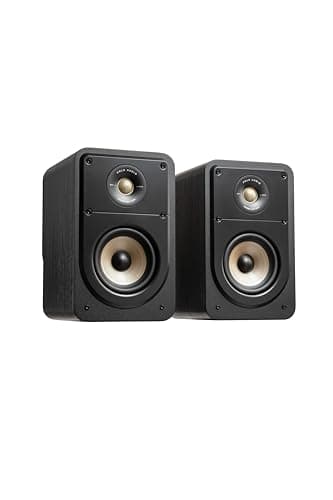
Top pick: Polk Signature Elite ES15
$299.0020% off
Best for double duty with home theater. #ad Affiliate link — we earn a commission at no extra cost to you.
The short answer
The best Polk speaker for most people is the Signature Elite ES15 — it is the only model on this page from Polk’s step-up line, it publishes a 20 to 100 W recommended amplification range that is realistic for a small integrated amplifier, and at 48 Hz it reaches as low as the much cheaper Monitor XT15 while using a better-specified 5.25-inch mica-fortified polypropylene cone and a 2.5 kHz crossover. It is for someone pairing a bookshelf pair with a modest amplifier and expecting it to do music and film. The budget pick is the Monitor XT15— the cheapest Polk we stock and the one with the most useful amplifier spec on the page, a 30 to 150 W recommendation rather than a handling limit. The trade is stated below: Polk publishes its 86 dB sensitivity with no measurement condition at all, so that number cannot honestly be set beside a Klipsch or KEF figure.
The brand-level finding is worth having before you shop. Polk publishes sensitivity three different ways across these six products — at 1 W / 1 m on the Monitor XT towers, with no stated condition at all on the ES15 and XT15, and not at all on the subwoofers — and publishes no nominal impedance on any passive model, only “compatible with 4- and 8-ohm outputs.” And its cheapest subwoofer is considerably better documented than its most expensive one.
Disclosure: we earn a commission if you buy through the links on this page, at no extra cost to you. It does not influence what we pick — our criteria are published and reproducible, so you can check our work. How we pick · Full disclosure
These picks are spec-and-price analyses, not listening tests. We have not heard this gear and we do not pretend to have: every figure below is sourced to the manufacturer and linked, and every price is live or not shown at all. Here are the rules we followed.
Quick picks
Ranked on the published criteria in How We Pick. Prices are live as of November 23, 2026. Tap any row for the full write-up.
- 7.0$239.00View on Amazon
$299.0020% off
- 7.8$289.00View on Amazon
$349.0017% off
- 7.4$149.00View on Amazon
$179.0017% off
- 6.0$209.00View on Amazon
$249.0016% off
- 6.6$319.00View on Amazon
$399.0020% off
- 7.3$185.00View on Amazon
$229.0019% off
| # | Product | Best for | Score | Price |
|---|---|---|---|---|
| 1 | Polk Signature Elite ES15 Voiced and certified to sit in a surround system as easily as a stereo pair, which matters if this room has to do both jobs. | Best for double duty with home theater | 7.0 | $239.00View on Amazon $299.0020% off |
| 2 | 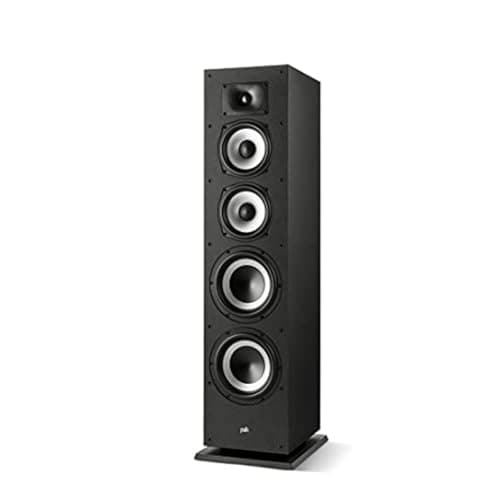 Polk Monitor XT70 Two 6.5 in woofers, two 8 in passive radiators and a 25–200 W recommendation from a maker that tells you what to drive it with — then declines to say what impedance it presents or how the bass figure was measured. | Best published amplifier range | 7.8 | $289.00View on Amazon $349.0017% off |
| 3 | 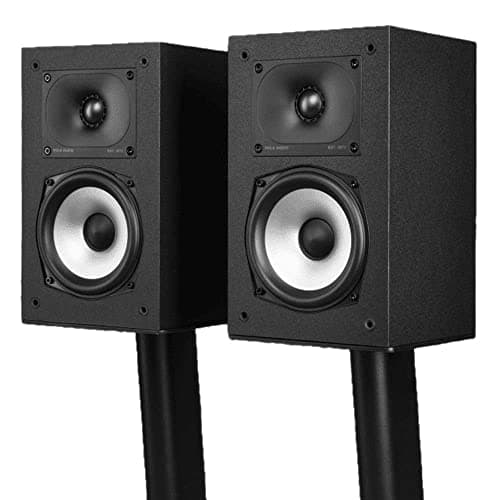 Polk Monitor XT15 48 Hz of published extension and a stated 30–150 W amplifier range, from a maker who tells you what to drive it with but not how they measured its sensitivity. | Best all-rounder under $200 | 7.4 | $149.00View on Amazon $179.0017% off |
| 4 | 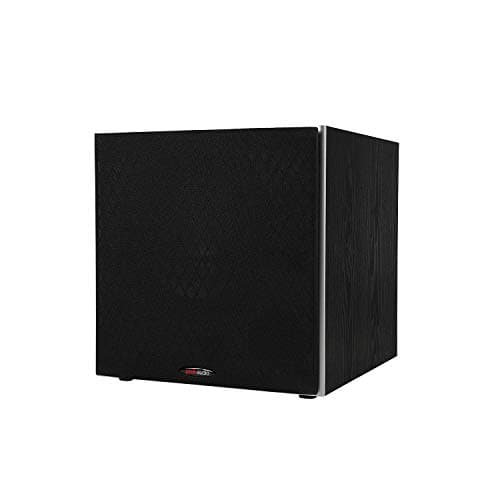 Polk Audio PSW10 The cheapest way into a real .1 channel, and the one where Polk's own page argues with itself — the marketing says 35 Hz, the specification table says the −3 dB point is 40 Hz. | Best for a small room | 6.0 | $209.00View on Amazon $249.0016% off |
| 5 | 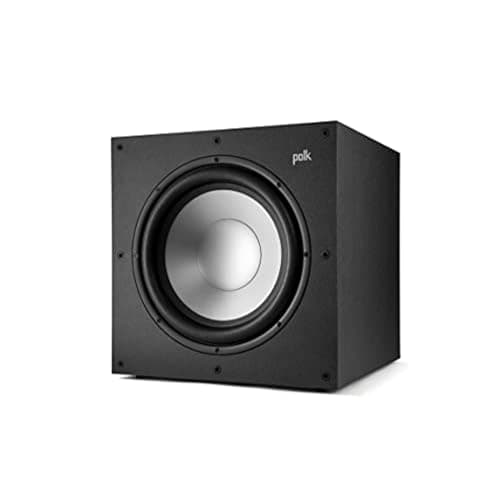 Polk Monitor XT12 A braced, ported 12-inch with line, LFE and binding-post inputs and a published 80–160 Hz crossover — and a manufacturer specification table that lists no amplifier power and no frequency response at all. | Best connectivity | 6.6 | $319.00View on Amazon $399.0020% off |
| 6 | 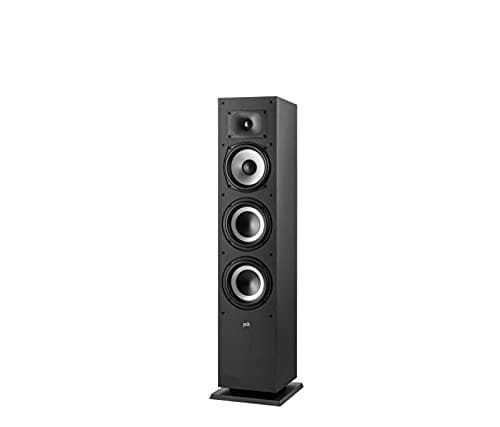 Polk Monitor XT60 7.5 in wide and 20 lb — a tower for a room that has no floor to spare, at the cost of the lowest published sensitivity in the group. | Narrowest footprint | 7.3 | $185.00View on Amazon $229.0019% off |
Polk is the easiest brand on this site to recommend and the hardest one to tabulate. Easy, because it does the single most useful thing a loudspeaker maker can do: it tells you what amplifier to buy. Every passive speaker here carries a recommended amplification range — 20 to 100 W, 25 to 200 W, 30 to 150 W — where Klipsch, ELAC and Fluance all publish a power handlinglimit instead and leave the recommendation to you. Hard, because almost every other figure in Polk’s tables arrives without the condition that would let you compare it to anything.
This page ranks the six Polk products currently in our registry on how completely Polk documents each one and how well the documented version of it does its job. That means the ranking cuts across product types: a bookshelf pair, two towers, a 10-inch subwoofer and a 12-inch subwoofer are all here, because “best Polk speakers” is a brand question, not a category one.
The passive Polks and the PSW10, spec by spec
The Monitor XT12 is deliberately absent from this table and present in the ranking below, because there is almost nothing to put in these columns for it: Polk publishes neither an amplifier power rating nor a frequency response figure for its twelve-inch subwoofer. The em dashes in the impedance row are not gaps in our research — Polk publishes the same compatibility wording and no nominal value on all four passive models, which is why that whole column reads the same way.
Every figure below is the manufacturer’s own published value and links to the document we read it from. “Not published” means the manufacturer does not publish that figure; an em dash means we have no published figure for that model. Prices are live as of November 23, 2026.
Best for double duty with home theater
- Sensitivity, as published
- 88 dB · no condition stated
- Bass figure
- 48 Hz, no tolerance
- Amplifier spec
- 20–100 W recommended
Best published amplifier range
- Sensitivity, as published
- 89 dB · 1 W / 1 m
- Bass figure
- 35 Hz, no tolerance
- Amplifier spec
- 25–200 W recommended
Best all-rounder under $200
- Sensitivity, as published
- 86 dB · no condition stated
- Bass figure
- 48 Hz, no tolerance
- Amplifier spec
- 30–150 W recommended
Best for a small room
- Sensitivity, as published
- —
- Bass figure
- 40 Hz at −3 dB
- Amplifier spec
- 100 W peak, class D (no continuous figure)
- Impedance
- —
Narrowest footprint
- Sensitivity, as published
- 86 dB · 1 W / 1 m
- Bass figure
- 38 Hz, no tolerance
- Amplifier spec
- 25–200 W recommended
| Pick | Sensitivity, as published | Bass figure | Amplifier spec | Impedance | Price |
|---|---|---|---|---|---|
| 1.Polk Signature Elite ES15Best for double duty with home theater | 88 dB · no condition stated | 48 Hz, no tolerance | 20–100 W recommended | “4- and 8-ohm compatible” — no nominal value | |
| 2.Polk Monitor XT70Best published amplifier range | 89 dB · 1 W / 1 m | 35 Hz, no tolerance | 25–200 W recommended | “4- and 8-ohm compatible” — no nominal value | |
| 3.Polk Monitor XT15Best all-rounder under $200 | 86 dB · no condition stated | 48 Hz, no tolerance | 30–150 W recommended | “4- and 8-ohm compatible” — no nominal value | |
| 4.Polk Audio PSW10Best for a small room | — | 40 Hz at −3 dB | 100 W peak, class D (no continuous figure) | — | |
| 6.Polk Monitor XT60Narrowest footprint | 86 dB · 1 W / 1 m | 38 Hz, no tolerance | 25–200 W recommended | “4- and 8-ohm compatible” — no nominal value |
Prices as of November 23, 2026; every “Check Price” link goes to Amazon and earns us a commission at no extra cost to you. #ad
Three sensitivity conventions inside one brand
Sensitivity is the figure that decides how much amplifier a speaker needs, and Polk quotes it inconsistently within its own catalogue. The Monitor XT60 and XT70 info sheet states the condition explicitly: “1 watt @ 1 meter.” That is the harder of the two legitimate conventions, and quoting it makes the number look worse — credit where it is due. The ES15 and XT15 info sheets state a bare decibel figure with no condition attached at all. The subwoofers publish no sensitivity figure, which is normal for a powered subwoofer.
P = V² ÷ R, so 2.83 V into 8 Ω = 1 W but into 4 Ω = 2 W
Inputs
- Polk Monitor XT70 sensitivity: 89 dB at “1 watt @ 1 meter” (Polk product page)
- Polk Signature Elite ES15 sensitivity: 88 dB, with no measurement condition published (Polk info sheet (PDF))
Result
The subwoofer inversion: the cheap one is the documented one
Polk sells two subwoofers we stock, and the dearer, larger one tells you less. The PSW10 publishes a 40 Hz −3 dB lower limit, a 100 W peak class-D amplifier rating, an amplifier bandwidth of 40 Hz to 200 Hz with less than 1% distortion, a 10-inch Dynamic Balance cone, and a front-panel flared port. The Monitor XT12 publishes a 12-inch bi-laminate cone, a class A/B amplifier, a continuously variable 80 to 160 Hz low-pass with an LFE bypass, 0/180 phase, speaker-level inputs on binding posts — and no amplifier power figure and no frequency response figure at all. Its “extension down to 24 Hz” appears in a feature bullet, not in the specification table, with no tolerance and no measurement condition.
So the XT12 ranks fifth and the PSW10 fourth, which inverts the price order. That is the ranking this page’s criteria produce, and we are not going to quietly suspend them for a bigger driver. The XT12 is still the better-connected subwoofer and the one to buy if you need speaker-level inputs for an older amplifier with no subwoofer output; it is simply the one you cannot plan a crossover point around from its own documents. Our subwoofer sizing guide goes through what the missing figures would have told you.
The ranking, pick by pick
1. Signature Elite ES15— for a bookshelf pair on a small amplifier. The 20 to 100 W recommendation is the narrowest and most honest on the page: Polk is telling you this speaker does not need a big amplifier, which is unusual and useful. Mica-fortified polypropylene cone, Terylene dome, 2.5 kHz crossover, 13 lb each. It reaches 48 Hz, same as the XT15, with better-specified materials and a lighter amplifier requirement.
2. Monitor XT70— for a real room that wants full range from two boxes. Two 6.5-inch woofers plus two 8-inch passive radiators, a 2.7 kHz crossover, 35 lb each, and the deepest published figure of any Polk here at 35 Hz. The caveat is that the 35 Hz has no tolerance window, and Polk does not state which way the radiators fire — which matters, because a rear-firing radiator wants space behind the cabinet.
3. Monitor XT15— the budget pick, and the cheapest way into the brand. A 5.25-inch bi-laminate paper woofer, a 2.2 kHz crossover, 9 lb each, and a 30 to 150 W recommendation that asks for more amplifier than the dearer ES15 does. It is the Polk that appears on the most pages across this site, and our head-to-head against the Klipsch R-51M is where its sensitivity problem gets worked through in detail.
4. PSW10— the documented subwoofer, and the right first subwoofer for a small room. Read the 100 W as what Polk says it is: a peak figure with no continuous rating published beside it. The published 40 Hz −3 dB point is the one number on this page you can actually set a crossover from.
5. Monitor XT12— for connectivity rather than specification. Speaker-level binding posts, variable low-pass, phase switch, 12-inch driver, 39 lb. Buy it for the inputs, not for the numbers, because the numbers are not published.
6. Monitor XT60— for a room that is too small for the XT70 and too tall for a bookshelf pair. The narrowest floorstanding footprint we cover at 7.5 inches wide, with a single 6.5-inch woofer, two 6.5-inch radiators, and the lowest published sensitivity of any Polk here at 86 dB measured at 1 W / 1 m. It ranks last on documentation rather than on merit, and it is the budget pick on our floorstanding head page.
What Polk does not publish, anywhere
Four things are absent across the whole ladder, and knowing that is worth more than another paragraph of praise. There is no nominal impedance on any passive model, only “compatible with 4- and 8-ohm outputs” — so you cannot check whether a 4-ohm-shy amplifier is safe. There is no minimum impedance on anything. There is no tolerance window on any passive frequency-response figure, which makes every bass number on this page a different kind of claim from a Klipsch or KEF ± 3 dB figure. And there is no harmonic distortion figure anywhere, at any price, on any model. Polk is not unusual in that last one; it is unusual in how consistently it leaves the first three out while being better than everyone else at the amplifier recommendation.
Every pick in detail
Every specification below links to the manufacturer document we read it from. Where a manufacturer does not publish a figure, we say so rather than estimating it.
Polk Signature Elite ES15
Best for double duty with home theaterVoiced and certified to sit in a surround system as easily as a stereo pair, which matters if this room has to do both jobs.
- sensitivity
- 7/10
- bass extension
- 7/10
- amp friendliness
- 7/10
- value for money
- 7/10
- build quality
- 7/10
| Specification | Published value | Source |
|---|---|---|
| Sensitivity | 88 dB — Polk publishes NO measurement condition (no 2.83 V/1 m or 1 W/1 m qualifier), so this figure is not directly comparable to the others in this table | Polk info sheet (PDF) |
| Impedance | “Compatible with 4- and 8-ohm outputs” — Polk publishes no nominal impedance value | Polk info sheet (PDF) |
| Minimum impedance | Not published | — |
| Frequency response | 48 Hz – 40 kHz (no tolerance published) | Polk info sheet (PDF) |
| Recommended amplification | 20–100 W per channel | Polk info sheet (PDF) |
| Woofer | 5.25 in mica-fortified polypropylene | Polk info sheet (PDF) |
| Tweeter | 1 in Terylene dome | Polk info sheet (PDF) |
| Crossover | 2.5 kHz | Polk info sheet (PDF) |
| Weight (each) | 13 lb / 5.9 kg | Polk info sheet (PDF) |
Pros
- Designed to integrate with a matching surround range
- Hi-Res certified
- Keyhole mount for wall use
Cons
- Less distinctive than the ELAC or Klipsch at the price
- Rear port
- Not the best pure-stereo value here
Skip it if this is a stereo-only system — the ELAC B6.2 gives more for the money.
Polk Monitor XT70
Best published amplifier rangeTwo 6.5 in woofers, two 8 in passive radiators and a 25–200 W recommendation from a maker that tells you what to drive it with — then declines to say what impedance it presents or how the bass figure was measured.
- sensitivity
- 6/10
- published data
- 5/10
- bass extension
- 9/10
- amp friendliness
- 7/10
- value for money
- 8/10
| Specification | Published value | Source |
|---|---|---|
| Sensitivity | 89 dB, published by Polk at “1 watt @ 1 meter” — NOT at 2.83 V, so it is not directly comparable to the Klipsch and Jamo figures on this page | Polk product page |
| Impedance | “Compatible with 4- and 8-ohm outputs” — Polk publishes no nominal impedance figure for this speaker | Polk info sheet (PDF) |
| Minimum impedance | Not published | — |
| Frequency response | 35 Hz – 40 kHz, quoted with NO tolerance window — the deepest published figure on this page and the one with the least to back it | Polk info sheet (PDF) |
| Recommended amplification | 25 – 200 W per channel | Polk info sheet (PDF) |
| Woofers | 2 × 6.5 in bi-laminate paper | Polk info sheet (PDF) |
| Bass radiators | 2 × 8 in passive radiators — Polk's feature list claims “deep effortless bass below 35 Hz” | Polk info sheet (PDF) |
| Tweeter | 1 in Terylene dome | Polk info sheet (PDF) |
| Crossover | 2,700 Hz | Polk info sheet (PDF) |
| Input terminals | 5-way nickel-plated binding posts | Polk info sheet (PDF) |
| Passive radiator firing direction | Not published | — |
| Dimensions (H × W × D) | 40.4 × 9.25 × 12.5 in (1,026.6 × 235 × 317.9 mm) | Polk info sheet (PDF) |
| Weight (each) | 35 lb / 15.88 kg | Polk info sheet (PDF) |
| Sold as | One speaker — Polk's Amazon listing is labelled “Single”. A stereo pair is two purchases. | Polk product page |
Pros
- Polk publishes a recommended amplification range (25 – 200 W per channel); Klipsch and Jamo publish handling limits instead
- Dual 8 in passive radiators — the largest radiating area for bass on this page
- 35 Hz is the deepest published low-frequency figure in the bracket
- 9.25 in wide and 40.4 in tall, so it disappears into a room better than its driver count suggests
Cons
- The 89 dB sensitivity is published at 1 watt, not 2.83 V, so it cannot be compared like-for-like with the Klipsch and Jamo numbers
- “Compatible with 4- and 8-ohm outputs” is not a nominal impedance, and no minimum is published
- 35 Hz – 40 kHz carries no tolerance, so the endpoints are unfalsifiable
- Polk never says which face the passive radiators are on, which is the one fact you need to place a radiator-loaded cabinet
- The Amazon listing is one speaker, not a pair
Skip it if you need to know exactly how close to the wall it can go. Polk does not publish the radiator orientation, and we will not guess it.
Polk Monitor XT15
Best all-rounder under $20048 Hz of published extension and a stated 30–150 W amplifier range, from a maker who tells you what to drive it with but not how they measured its sensitivity.
- specs
- 7/10
- sensitivity
- 6/10
- published data
- 6/10
- value for money
- 9/10
- bass extension
- 8/10
| Specification | Published value | Source |
|---|---|---|
| Sensitivity | 86 dB — Polk publishes NO measurement condition (no 2.83 V/1 m or 1 W/1 m qualifier) | Polk info sheet (PDF) |
| Impedance | “Compatible with 4- and 8-ohm outputs” — Polk publishes no nominal impedance value | Polk info sheet (PDF) |
| Minimum impedance | Not published | — |
| Frequency response | 48 Hz – 40 kHz (no tolerance published) | Polk info sheet (PDF) |
| Recommended amplification | 30–150 W per channel | Polk info sheet (PDF) |
| Woofer | 5.25 in bi-laminate paper | Polk info sheet (PDF) |
| Tweeter | 1 in Terylene dome | Polk info sheet (PDF) |
| Crossover | 2,200 Hz | Polk info sheet (PDF) |
| Weight (each) | 9 lb / 4.08 kg | Polk info sheet (PDF) |
Pros
- 48 Hz – 40 kHz published extension, the deepest bass figure in this bracket
- Polk publishes a recommended amplification range (30–150 W), which Klipsch and ELAC do not
- 1 in Terylene dome tweeter, the same driver family as the more expensive Signature Elite ES15
- Explicitly rated for Dolby Atmos height duty as well as stereo, so it does double service
Cons
- The 86 dB sensitivity is published with NO measurement condition, so it cannot honestly be compared to Klipsch's 2.83 V figures
- “Compatible with 4- and 8-ohm outputs” is not a nominal impedance, and no minimum is published
- 48 Hz – 40 kHz is quoted with no tolerance, which makes the endpoints unverifiable
- The 30 W lower bound rules out several of the smallest amplifiers we recommend
Skip it if your amplifier delivers under 30 W. Polk's own recommendation excludes it, and that is Polk's number, not ours.
Polk Audio PSW10
Best for a small roomThe cheapest way into a real .1 channel, and the one where Polk's own page argues with itself — the marketing says 35 Hz, the specification table says the −3 dB point is 40 Hz.
- extension
- 3/10
- published data
- 7/10
- room control
- 3/10
- value for money
- 8/10
- build quality
- 5/10
| Specification | Published value | Source |
|---|---|---|
| Frequency response (−3 dB) | 40 Hz → 160 Hz. Polk's own marketing copy on the same page says “down to 35 Hz”; the specification table says 40 Hz. We publish the table. | Polk product page |
| Amplifier power | 100 W peak, class D. Polk publishes no continuous rating for this model — the 100 W is a peak figure. | Polk product page |
| Amplifier bandwidth / distortion | 40 Hz – 200 Hz, < 1% distortion | Polk product page |
| Driver | 10 in Dynamic Balance polymer composite cone | Polk product page |
| Enclosure type | Vented via front-panel flared port | Polk product page |
| Inputs | Stereo line level (2 × RCA) plus speaker level (2 pairs of gold-plated spring terminals) | Polk product page |
| Dimensions | 14.375 in H × 14 in W × 16.125 in D (36.5 × 35.6 × 41 cm) | Polk product page |
| Weight | 26 lb (11.8 kg) | Polk product page |
Pros
- Polk publishes proper −3 dB limits (40 Hz → 160 Hz), which most sub makers at this price do not
- Line level AND speaker level inputs, so it works with almost anything
- 26 lb and the smallest 10-inch box here — it disappears in an apartment
- Amplifier bandwidth and distortion (< 1%) are published
Cons
- 40 Hz is a genuinely limited bottom end for film — the LFE track goes an octave below that
- Polk's own marketing on the same page claims 35 Hz against its own spec table's 40 Hz
- 100 W is a PEAK figure; Polk publishes no continuous rating for this model
- No DSP, no app, no room correction
Skip it if your room is bigger than a bedroom or you watch action films at volume. This is the entry point, and it is honest about being one.
Polk Monitor XT12
Best connectivityA braced, ported 12-inch with line, LFE and binding-post inputs and a published 80–160 Hz crossover — and a manufacturer specification table that lists no amplifier power and no frequency response at all.
- extension
- 5/10
- published data
- 2/10
- room control
- 4/10
- value for money
- 7/10
- build quality
- 8/10
| Specification | Published value | Source |
|---|---|---|
| Amplifier power | Not published | — |
| Frequency response | Not published | — |
| Manufacturer's bass claim | Polk's feature bullet says “smooth low frequency extension down to 24 Hz”. It appears nowhere in the specification table, carries no ± dB tolerance and no measurement condition — so it is a claim, not a spec. | Polk Monitor XT12 info sheet (PDF) |
| Amplifier type | Class A/B | Polk product page |
| Low-pass crossover | 80 Hz – 160 Hz, continuously variable, plus LFE | Polk product page |
| Phase adjustment | 0/180 | Polk product page |
| Driver | 12 in bi-laminate paper cone with foam surround | Polk product page |
| Enclosure type | Bass reflex (ported), braced MDF | Polk product page |
| Inputs | Line level, LFE (single RCA) and speaker level via left/right 5-way binding posts | Polk product page |
| Dimensions | 16 in W × 16.4 in H × 17.9 in D (407 × 418 × 456 mm) | Polk product page |
| Weight | 39 lb (17.7 kg) | Polk product page |
Pros
- Line level, LFE and 5-way binding posts — the most complete input set here alongside the SVS
- Low-pass crossover published as 80–160 Hz continuously variable, with 0/180 phase
- Braced low-resonance MDF cabinet with a removable grille
- A 12-inch driver in a ported box — the alignment that moves the most air for the money
Cons
- Polk's specification table publishes NO amplifier wattage and NO frequency response — the “down to 24 Hz” is a marketing bullet with no tolerance and no measurement condition
- 39 lb and 17.9 inches deep
- No DSP, no app, no room EQ — volume, crossover, phase and nothing else
- Nothing published that lets you compare it against the SVS or the Klipsch on paper
Skip it if you want to check the claim before you buy. There is no published response spec here to check it against.
Polk Monitor XT60
Narrowest footprint7.5 in wide and 20 lb — a tower for a room that has no floor to spare, at the cost of the lowest published sensitivity in the group.
- sensitivity
- 4/10
- published data
- 5/10
- bass extension
- 7/10
- amp friendliness
- 6/10
- value for money
- 8/10
| Specification | Published value | Source |
|---|---|---|
| Sensitivity | 86 dB, published by Polk at “1 watt @ 1 meter” — NOT at 2.83 V, so it is not directly comparable to the Klipsch and Jamo figures on this page | Polk product page |
| Impedance | “Compatible with 4- and 8-ohm outputs” — Polk publishes no nominal impedance figure for this speaker | Polk info sheet (PDF) |
| Minimum impedance | Not published | — |
| Frequency response | 38 Hz – 40 kHz, quoted with NO tolerance window, which leaves both endpoints unverifiable | Polk info sheet (PDF) |
| Recommended amplification | 25 – 200 W per channel (a recommendation, not a handling limit — Polk publishes this where Klipsch publishes handling) | Polk info sheet (PDF) |
| Woofer | 1 × 6.5 in bi-laminate paper | Polk info sheet (PDF) |
| Bass radiators | 2 × 6.5 in passive radiators — Polk's feature list claims “deep effortless bass below 38 Hz” | Polk info sheet (PDF) |
| Tweeter | 1 in Terylene dome | Polk info sheet (PDF) |
| Crossover | 2,200 Hz | Polk info sheet (PDF) |
| Input terminals | 5-way nickel-plated binding posts | Polk info sheet (PDF) |
| Passive radiator firing direction | Not published | — |
| Dimensions (H × W × D) | 36.4 × 7.5 × 9.09 in (925 × 190.5 × 230.8 mm) | Polk info sheet (PDF) |
| Weight (each) | 20 lb / 9.07 kg | Polk info sheet (PDF) |
| Sold as | One speaker — Polk's Amazon listing is labelled “Single”. A stereo pair is two purchases. | Polk product page |
Pros
- 7.5 in wide and 9.09 in deep — by some margin the smallest floor footprint here
- Same 25 – 200 W published amplifier recommendation as the larger XT70
- 1 in Terylene dome tweeter, the same driver family Polk uses further up the range
- 20 lb per cabinet makes it the only speaker here one person can position without help
Cons
- 86 dB is the lowest published sensitivity on this page, and it is quoted at 1 watt rather than 2.83 V
- 38 Hz – 40 kHz with no tolerance window, from a single 6.5 in woofer and two 6.5 in radiators
- No nominal impedance and no minimum impedance published
- Radiator firing direction unpublished, same as the XT70
- The Amazon listing is one speaker, not a pair
Skip it if your amplifier is small. The lowest sensitivity in the group is the wrong end to start from with limited power.
Frequently asked questions
What is the best Polk speaker?
What impedance are Polk speakers?
Is the Polk Monitor XT12 better than the PSW10?
How much amplifier power do Polk speakers need?
Are Polk speakers sold in pairs?
Read next
The Best Bookshelf Speakers Under $300
Five passive pairs at the $300 mark, and a ten-decibel sensitivity spread that decides which amplifier each one needs.
The Best Floorstanding Speakers Under $1,000
Six towers that make a stereo pair under $1,000, ranked on sensitivity with its stated condition, bass figures with a tolerance, and where the port fires.
The Best Floorstanding Speakers
The head of our floorstanding cluster: six towers from the narrowest $200-class cabinet to a three-way at $1,000, ranked on published bass tolerance, cone area, amplifier spec and how many speakers the listing actually ships.
The Best Klipsch Speakers
Nine Klipsch speakers across five categories, ranked on Klipsch's own spec sheets — including the sensitivity footnote that only some of those sheets carry.
Klipsch Alternatives
Five speakers matched against Klipsch's own published numbers — including the one that publishes a harmonic distortion figure, which no Klipsch model does at any price.
Speaker Sensitivity Explained
2.83 V/1 m versus 1 W/1 m, what the conversion is worth in decibels, and the twelve-decibel spread that means sixteen times the power.
Sources
Every specification on this page was read from one of these documents. If one of them has changed, or we have made an error, tell us — corrections are logged and dated per our editorial policy.