The Best Gifts for Desk and Headphone Listeners
The person who listens at a desk is the easiest hi-fi recipient to buy for, because the room is a metre wide and the source is already a computer. Almost everything here is one USB cable away from working.
Disclosure: we earn a commission if you buy through the links on this page, at no extra cost to you. It does not influence what we pick — our criteria are published and reproducible, so you can check our work. How we pick · Full disclosure
These picks are spec-and-price analyses, not listening tests. We have not heard this gear and we do not pretend to have: every figure below is sourced to the manufacturer and linked, and every price is live or not shown at all. Here are the rules we followed.
Quick picks
Ranked on the published criteria in How We Pick. Prices are live as of September 15, 2026. Tap any row for the full write-up.
- 7.4$249.99View on Amazon
$349.9929% off
- 7.8
- 6.4
- 7.2
- 7.0
| # | Product | Best for | Score | Price |
|---|---|---|---|---|
| 1 | 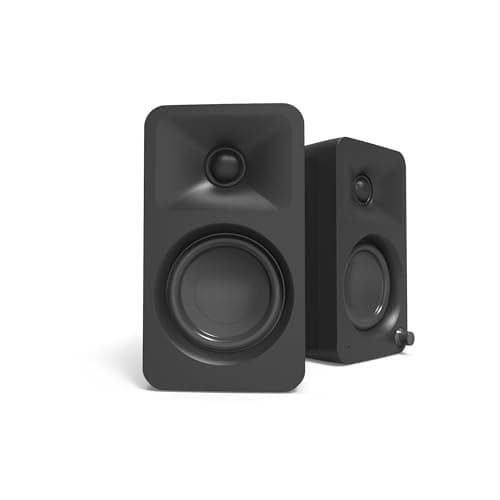 Kanto ORA Small powered reference speakers built for near-field listening, where the distance is short and the cabinet does not need to move much air. | Best for a desk | 7.4 | $249.99View on Amazon $349.9929% off |
| 2 | 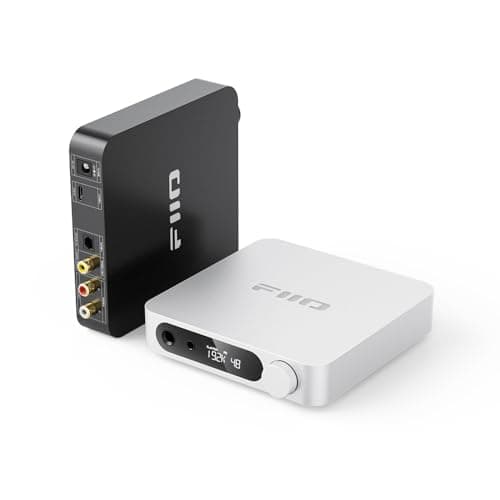 FiiO K11 The K7's cheaper relative — less headphone power, the same basic idea, at a price that undercuts most DAC-only boxes. | Best budget DAC and amp | 7.8 | |
| 3 | 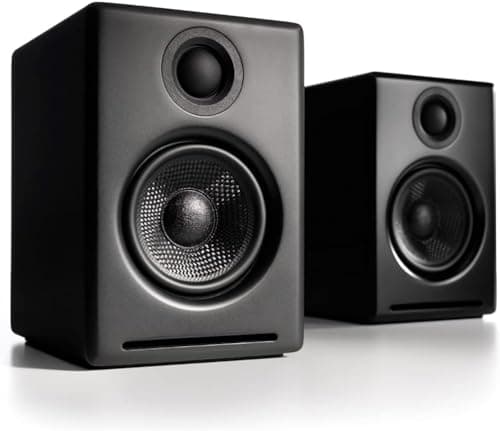 Audioengine A2+ Desktop-scale powered speakers with a built-in DAC, sized for an arm's length and honest about it. | Smallest powered option | 6.4 | |
| 4 | 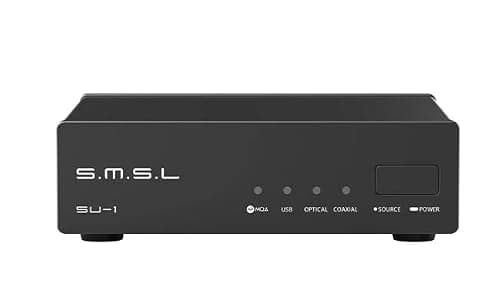 SMSL SU-1 The cheapest box here that still measures well, which makes it the sensible first upgrade from a motherboard's headphone jack. | Best cheap DAC | 7.2 | |
| 5 | 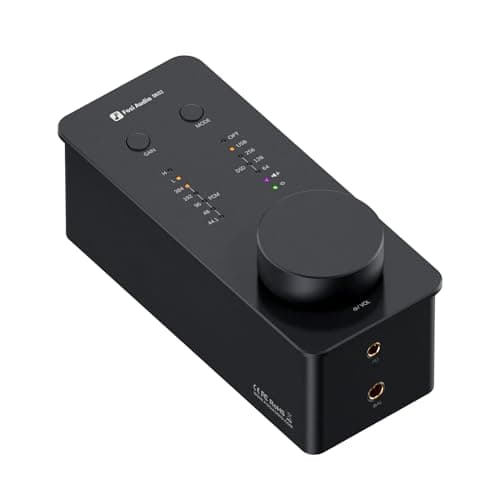 Fosi Audio SK02 A third of the desk area of any other DAC and headphone amp here, running entirely from the USB cable that carries its audio — with a specification sheet that leaves two important boxes empty. | Smallest desk footprint | 7.0 |
Desk listening is the friendliest corner of this category for a gift-buyer. There is no room to correct, no amplifier matching to get wrong, no speaker cable to run, and the source is a computer that already has a USB port. The main thing you need to know is whether they mostly listen on speakers or mostly on headphones, because that decides which half of this page applies.
The second thing worth knowing is that a desk is a fixed amount of space, and desk gear is usually being fitted around a monitor, a keyboard and a laptop. Footprint is a real specification here, not a footnote.
If they listen on speakers: a powered pair
Powered speakers have the amplifier built in, so there is nothing else to buy and nothing to match. For a gift that is close to ideal.
The Kanto ORA is our desk pick because it is genuinely desk-sized rather than a bookshelf speaker being described as one, and because it takes USB-C as well as analog — one cable from the laptop and it works. It also has a subwoofer output, which matters more than it sounds like: small drivers on a desk run out of low end, and Kanto giving you somewhere to go later is a real feature.
Be clear-eyed about what “desk-sized” costs: these are near-field speakers designed for a listener about a metre away. In a living room, at four metres, they are the wrong tool. If the recipient’s “desk” is really a shelf in a lounge, buy from the under-$250 guide instead.
The Audioengine A2+ is the smaller alternative, with a built-in USB DAC and wood cabinets, for a desk where the ORA is simply too big. Same caveat, more so: very little low-end extension without a subwoofer, and near-field only. Our passive-versus-powered page covers the trade you are making by buying speakers with the amplifier baked in.
If they listen on headphones: a DAC and amp in one box
A laptop headphone jack is a compromise built to a cost. A dedicated box does two things: it converts the digital signal with better-measured circuitry, and it supplies more power than a laptop can.
The FiiO K11 is our budget DAC-and-amp pick and it costs less than several DAC-only boxes, with a balanced output at a price where balanced is usually absent. For a desk where headphones are the main event, this is the pick.
The check to run: what headphones do they own? The K11 is a budget amplifier and if they are driving genuinely demanding high-impedance headphones it is not enough — that is a step up to the K7. Headphone impedance and how much power it actually needs is a page of arithmetic, and it takes about two minutes to check a specific pair against it.
The Fosi Audio SK02 is the answer when desk space is the binding constraint — 121 × 51 mm, under a third of the footprint of a K11, running from USB-C bus power so there is no brick under the desk, with a 4.4 mm balanced output. Fosi publishes its signal-to-noise figures at both gain settings on both outputs, which is more than most makers bother with.
It also has two gaps we will not paper over: Fosi publishes no distortion condition with either power figure, so its 755 mW at 32 Ω cannot be compared like-for-like with FiiO’s figures measured at THD+N below 1%; and although the listing calls it a preamp, the specification publishes no line output level and does not say whether that output is fixed or variable. On published data this is a headphone box with a line socket, not a preamp.
If they already have powered speakers and just need a better source
Then they need a DAC on its own, and the SMSL SU-1 is the cheapest box we cover that still measures well. It is the sensible first upgrade from a motherboard’s headphone jack and it takes USB, optical and coaxial in, which is a good set of inputs at the price.
Two things it does not have, and both are the kind of thing a gift-buyer discovers too late: no headphone output, and no preamp mode or volume control. It is a converter that feeds something else. If their speakers have a volume knob, that is fine. If they were planning to plug headphones into it, it is the wrong box.
An honest word about what a DAC does not do
It is worth saying, because gift-buying in this category is prone to it. Every DAC we recommend measures far beyond the threshold of audibility, and so does every one of its rivals. A DAC will not make a compressed streaming service sound like a master tape and it will do nothing at all about the room.
A DAC is worth buying when there is a specific problem to solve: a computer with a noisy headphone jack, an amplifier with no digital input, headphones the laptop cannot drive properly. Our explainer covers what it actually changes and, more usefully, what it does not. Buying one because someone else’s desk has one more box on it is not a problem worth solving.
Every pick in detail
Every specification below links to the manufacturer document we read it from. Where a manufacturer does not publish a figure, we say so rather than estimating it.
Kanto ORA
Best for a deskSmall powered reference speakers built for near-field listening, where the distance is short and the cabinet does not need to move much air.
- integration
- 8/10
- upgrade path
- 4/10
- value for money
- 7/10
- ease of setup
- 9/10
- connectivity
- 9/10
| Specification | Published value | Source |
|---|---|---|
| Type | Powered (amplifier built in) | Kanto spec page |
| Amplifier output | 50 W total RMS (100 W peak); 9 W RMS per tweeter, 16 W RMS per woofer | Kanto spec page |
| Frequency response | 70 Hz – 22 kHz (no tolerance published) | Kanto spec page |
| Inputs | RCA line-level, USB-C (24-bit/96 kHz), Bluetooth 5.0 | Kanto spec page |
| Built-in phono stage | Not stated — inputs are line-level only, so assume none | Kanto spec page |
| Woofer | 3 in paper cone | Kanto spec page |
Pros
- Genuinely desk-sized
- USB-C input as well as analog
- Sub output for when the low end runs out
Cons
- Small drivers mean limited low end without a subwoofer
- No built-in phono stage
- Near-field by design
Skip it if this is a living-room system — these are built for a meter away, not four.
FiiO K11
Best budget DAC and ampPrice as of September 15, 2026. #ad
The K7's cheaper relative — less headphone power, the same basic idea, at a price that undercuts most DAC-only boxes.
- measured specs
- 8/10
- inputs
- 7/10
- value for money
- 10/10
- build quality
- 6/10
- features
- 8/10
| Specification | Published value | Source |
|---|---|---|
| Chipset | DAC: CS43198; USB: SA9312L; amp: 2 × SGM8262-2 | FiiO parameters page |
| Max sample rate | USB: 384 kHz/32-bit, DSD256 native; coaxial: 192 kHz/24-bit; optical: 96 kHz/24-bit | FiiO parameters page |
| Headphone power | 6.35 mm: ≥ 520 mW + 520 mW (32 Ω), ≥ 60 mW + 60 mW (300 Ω). 4.4 mm balanced: ≥ 1,400 mW + 1,400 mW (32 Ω), ≥ 250 mW + 250 mW (300 Ω). All at THD+N < 1% | FiiO parameters page |
| Signal-to-noise | Line out ≥ 126 dB (A-weighted) | FiiO parameters page |
| Output level | 1.95 V RMS (line out) | FiiO parameters page |
| Preamp mode | Yes — LO/PO switching, each remembering its own volume | FiiO product page |
Pros
- DAC and headphone amp for less than most DAC-only boxes
- Balanced output at the price
- Compact
Cons
- Less headphone power than the K7
- Plastic-heavy build
- Fewer inputs
Skip it if you drive demanding high-impedance headphones — step up to the K7.
Audioengine A2+
Smallest powered optionPrice as of September 15, 2026. #ad
Desktop-scale powered speakers with a built-in DAC, sized for an arm's length and honest about it.
- integration
- 6/10
- upgrade path
- 3/10
- value for money
- 6/10
- ease of setup
- 9/10
- connectivity
- 7/10
| Specification | Published value | Source |
|---|---|---|
| Type | Powered (amplifier built in) | Audioengine tech specs (Gen 3) |
| Amplifier output | 20 W RMS per channel at 4 Ω; 30 W peak per channel (AES) | Audioengine tech specs (Gen 3) |
| Frequency response | 65 Hz – 22 kHz ± 2.0 dB | Audioengine tech specs (Gen 3) |
| Inputs | 3.5 mm, RCA L/R, USB, Bluetooth | Audioengine tech specs (Gen 3) |
| Woofer | 2.75 in aramid fiber | Audioengine tech specs (Gen 3) |
Pros
- Very compact
- Built-in USB DAC
- Wood cabinets at a small size
Cons
- Little low-end extension without a sub
- No phono stage
- Near-field only
Skip it if this is for a room rather than a desk.
SMSL SU-1
Best cheap DACPrice as of September 15, 2026. #ad
The cheapest box here that still measures well, which makes it the sensible first upgrade from a motherboard's headphone jack.
- measured specs
- 9/10
- inputs
- 8/10
- value for money
- 10/10
- build quality
- 5/10
- features
- 4/10
| Specification | Published value | Source |
|---|---|---|
| DAC chip | AK4493S; XMOS XU-316 | SMSL product page |
| Max sample rate | USB: PCM 44.1–768 kHz, up to 32-bit; DSD to 22.5792 MHz. Optical/coaxial: 44.1–192 kHz, 16–24 bit | SMSL manual (PDF) |
| Inputs | USB, optical, coaxial | SMSL manual (PDF) |
| Outputs | RCA | SMSL manual (PDF) |
| THD+N | 0.00013% (−117 dB) | SMSL manual (PDF) |
| Signal-to-noise | 121 dB | SMSL manual (PDF) |
| Output level | 2.0 V RMS | SMSL manual (PDF) |
| Headphone amp | No — RCA output only | SMSL manual (PDF) |
Pros
- Very cheap for the measured performance
- Tiny footprint
- USB, optical and coaxial in
Cons
- No headphone output
- No preamp mode
- Minimal build
Skip it if you need a headphone output or volume control.
Fosi Audio SK02
Smallest desk footprintPrice as of September 15, 2026. #ad
A third of the desk area of any other DAC and headphone amp here, running entirely from the USB cable that carries its audio — with a specification sheet that leaves two important boxes empty.
- measured specs
- 6/10
- inputs
- 5/10
- value for money
- 9/10
- build quality
- 6/10
- features
- 7/10
| Specification | Published value | Source |
|---|---|---|
| DAC chip | ES9038Q2M | Fosi Audio spec table |
| Max sample rate | USB: 32-bit/384 kHz, DSD256; optical: 24-bit/192 kHz | Fosi Audio spec table |
| Inputs | USB-C, optical | Fosi Audio spec table |
| Outputs | 3.5 mm headphone, 4.4 mm balanced headphone, and one 3.5 mm socket shared between line out and optical out | Fosi Audio spec table |
| Headphone power | 3.5 mm: 190 mW at 32 Ω. 4.4 mm: 755 mW at 32 Ω. Fosi states no distortion condition for either figure | Fosi Audio spec table |
| Headphone impedance match | 16–300 Ω | Fosi Audio spec table |
| THD | ≤ 0.001% at 1 kHz (Fosi does not state the output level it was measured at) | Fosi Audio spec table |
| Signal-to-noise | 3.5 mm: 116 dB low gain, 120 dB high gain. 4.4 mm: 110 dB low gain, 115 dB high gain | Fosi Audio spec table |
| Frequency range | 20 Hz–20 kHz (±0.02 dB) | Fosi Audio spec table |
| Dimensions | 121 × 51 × 43 mm (4.76 × 2 × 1.69 in) | Fosi Audio spec table |
| Weight | 380 g (0.84 lb) | Fosi Audio spec table |
| Power supply | 5 V over USB Type-C — no separate supply, and no current figure published | Fosi Audio spec table |
| Line output level | Not published | — |
| Line output fixed or variable | Not published | — |
Pros
- 121 × 51 mm on the desk — under a third of the footprint of a FiiO K11 or an iFi ZEN DAC 3
- Runs from USB-C bus power alone, so the installation is one cable and there is no brick under the desk
- A 4.4 mm balanced headphone output at a price where balanced is usually absent
- Published SNR at both gain settings on both outputs, which is more than most makers bother with
Cons
- Fosi publishes no distortion condition with either power figure, so 755 mW at 32 Ω cannot be compared like-for-like with FiiO's figures at THD+N < 1%
- The product listing calls it a preamp, but Fosi's specification publishes no line output level and does not state whether that output is fixed or variable
- Line out and optical out share one 3.5 mm socket, so a fixed feed to an amplifier and a digital feed onward are mutually exclusive
- USB and optical only — no coaxial, and no analog input of any kind
Skip it if you need to know exactly what the line output does. On published data, this is a headphone box that has a line socket, not a preamp.
Frequently asked questions
What is the best gift for someone who listens to music at their computer?
How do I know if a headphone amp is powerful enough for their headphones?
Will a DAC make their music sound better?
Are desk speakers any good in a normal room?
How much desk space do these take up?
Read next
The Best Hi-Fi Gifts Under $100
Six sub-$100 gifts, each matched to a specific problem in the recipient's existing system rather than picked for being cheap.
The Best Hi-Fi Gifts Under $250
Six gifts under $250, led by the ones that arrive as a complete working system rather than one component of one.
The Best DACs Under $200
Five DACs under $200, all measuring beyond audibility — so the ranking is about inputs, outputs and output level.
The Best DAC and Amp Combos
Four DAC and headphone amp combos, ranked on published power into 32 Ω and 300 Ω rather than on chip names.
Headphone Impedance and How Much Power You Need
Why published headphone power collapses at high impedance, what output impedance does to the sound, and how to check a pairing before you buy.
What Is a DAC in Audio?
A DAC turns digital audio into analog voltage. You already own several — here is when another one helps.
Sources
Every specification on this page was read from one of these documents. If one of them has changed, or we have made an error, tell us — corrections are logged and dated per our editorial policy.