Optical vs Coaxial vs USB
The same DAC accepts different maximum sample rates depending on which socket you use — and on two of the DACs we cover, the difference is fourfold.
Disclosure: we earn a commission if you buy through the links on this page, at no extra cost to you. It does not influence what we pick — our criteria are published and reproducible, so you can check our work. How we pick · Full disclosure
These picks are spec-and-price analyses, not listening tests. We have not heard this gear and we do not pretend to have: every figure below is sourced to the manufacturer and linked, and every price is live or not shown at all. Here are the rules we followed.
Quick picks
Ranked on the published criteria in How We Pick. Prices are live as of October 14, 2026. Tap any row for the full write-up.
- 7.0
- 8.2
- 7.2
- 8.8
| # | Product | Best for | Score | Price |
|---|---|---|---|---|
| 1 | 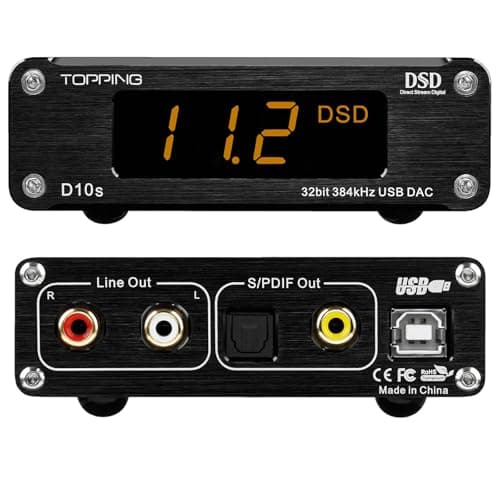 Topping D10s A USB DAC that also works as a USB-to-coaxial bridge, which is the specific thing that rescues an older receiver with no USB input. | Best DAC with a coaxial output | 7.0 | |
| 2 | 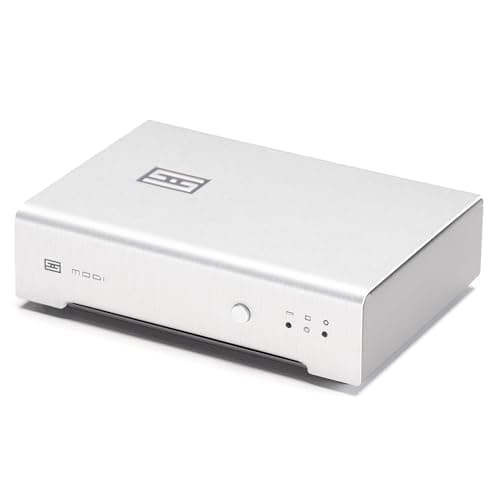 Schiit Modi 5 A no-nonsense DAC with three inputs and unity gain, doing the one job a DAC has without bundling a headphone amp you may not want. | Best overall under $500 | 8.2 | |
| 3 | 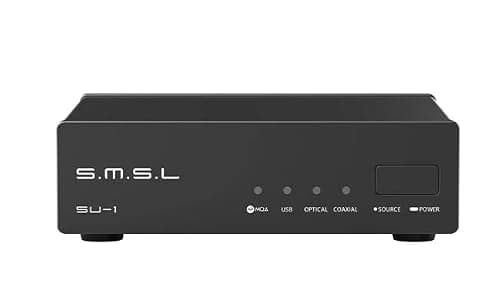 SMSL SU-1 The cheapest box here that still measures well, which makes it the sensible first upgrade from a motherboard's headphone jack. | Best cheap DAC | 7.2 | |
| 4 | 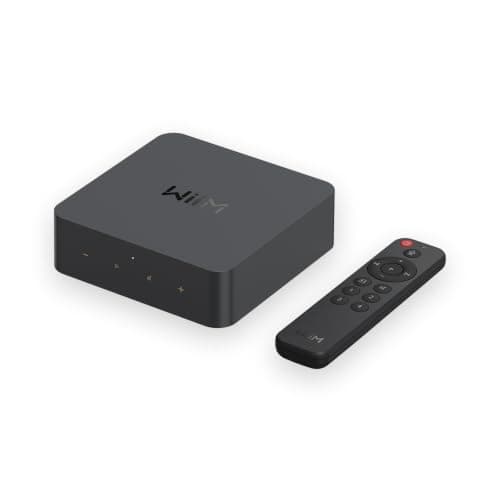 WiiM Pro Plus A streamer and DAC that publishes its line-out performance twice — once as the chip figure and once as the finished product — and is honest enough to print both. | Best streamer for an existing system | 8.8 |
All three carry the same digital data. What differs is the maximum rate each one is specified for, whether it makes an electrical connection between your boxes, and what audio formats it will pass.
Those three differences are all published, and they decide the answer more cleanly than any argument about sound quality does — because at the level where these connections are working correctly, the bits arriving are identical.
The published limits, per input, per DAC
Every figure below is from the manufacturer’s own specification page. Notice how often the three columns disagree with each other on the same box.
| DAC | USB | Coaxial | Optical |
|---|---|---|---|
| Topping E30 II | 768 kHz / 32-bit, DSD512 | 192 kHz / 24-bit | 192 kHz / 24-bit |
| SMSL SU-1 | 768 kHz / 32-bit, DSD | 192 kHz / 24-bit | 192 kHz / 24-bit |
| Schiit Modi 5 | 384 kHz / 32-bit | 192 kHz / 24-bit | 192 kHz / 24-bit |
| FiiO K7 | 384 kHz / 32-bit, DSD256 | 192 kHz / 24-bit | 96 kHz / 24-bit |
| FiiO K11 | 384 kHz / 32-bit, DSD256 | 192 kHz / 24-bit | 96 kHz / 24-bit |
| iFi ZEN DAC 3 | 768 kHz / 32-bit, DSD512 | No input | No input |
| Topping D10s | 384 kHz / 32-bit, DSD256 | Output only | Output only |
Three findings drop out of that table immediately.
USB is the only input that exceeds 192 kHz on any DAC here. If a specification above 192 kHz matters to you, it is a USB-only specification.
FiiO caps optical at 96 kHz where coaxial gets 192 kHz — on both models. Same box, same data, half the rate, decided by which socket. Topping, SMSL and Schiit publish parity between the two. FiiO does not, and FiiO says so plainly on its own parameters page.
The iFi ZEN DAC 3 has USB and nothing else. It is an excellent converter that cannot connect to a television, a CD player, or anything without a computer-style USB output. That is a compatibility question, not a quality one, and it is the sort of thing worth checking before rather than after.
What each connection actually is
Optical (TOSLINK)
The signal travels as light down a plastic or glass fiber. That has one consequence that neither other connection can offer: there is no electrical connection between the two devices at all.
Ground loops — the hum you get when two mains-powered boxes are connected by a cable that also joins their grounds — are physically impossible over optical, because there is no conductor for a ground current to flow through. If you have hum you cannot chase down, optical is the one connection that eliminates an entire class of cause rather than mitigating it.
The cost is the rate ceiling, and on FiiO’s DACs a lower one than coaxial.
Coaxial (S/PDIF over RCA)
Electrical, over a 75 Ω cable with an RCA plug. Higher published rates than optical on the FiiO units and equal on the rest, no fiber to snap, and connectors that lock in more securely than TOSLINK.
It does make an electrical connection between your boxes, so it can carry a ground loop that optical would not.
USB
The only bidirectional connection of the three. The DAC tells the computer what it can do, and the computer sends data at that rate — which is why USB reaches rates the one-way S/PDIF formats do not.
It also carries power, which is worth noting on the DACs that use it. Schiit publishes 1.5 V RMS output on USB power and 2.0 V RMS with an external supply for the Modi 5 — a difference in output level decided by how you power it.
Manufacturers publish the USB interface chip because it matters: Topping uses an XMOS XU208 in the E30 II, SMSL an XMOS XU-316 in the SU-1, FiiO an XMOS XUF208 in the K7 and an SA9312L in the K11. Topping and Schiit both publish UAC2 compliance, which is what allows the higher rates without a manufacturer driver on most systems.
Bus power, and the specification it quietly changes
USB carries power as well as data, and several DACs use it — which is convenient until you read what it costs.
Schiit publishes two output levels for the Modi 5 depending on how it is powered: 1.5 V RMS on USB power, 2.0 V RMS with the external supply. That is a 2.5 dB difference in output level decided by which socket you plug into the wall — enough to make an A/B comparison against another source misleading if you are not matching levels.
The iFi ZEN DAC 3 is the pure case: USB-C is its only input and, in normal use, its only power. iFi publishes a line dynamic range of ≥ 113 dB(A) for it — the lowest figure of any DAC we cover, though still around 18.5 bits of resolution.
Meanwhile the units with separate supplies publish the strongest numbers: Topping 123 dB for the E30 II, SMSL 121 dB for the SU-1, FiiO ≥ 126 dB on the K11’s line out. That is not proof of causation — these are different chips and different designs — but the pattern is worth knowing, and the Schiit figure shows the effect directly on one product.
If your DAC offers an external supply, use it and check the published output level. It is the one specification that changes with nothing else changing.
The trap: what optical will and will not pass from a television
This is the most common real-world failure with optical and it has nothing to do with sound quality.
An optical connection carries a stereo PCM stream comfortably. It does not carry every surround format, and the devices we cover state their limits explicitly:
- WiiM Pro Plus:its optical input accepts up to 192 kHz/24-bit, “stereo PCM only” — WiiM states that Dolby Digital and DTS are explicitly unsupported.
- WiiM Ultra: optical to 192 kHz/24-bit, and separately an HDMI ARC input that WiiM publishes as accepting PCM and Dolby Digital 5.1. Same box, different socket, different format support.
- WiiM Amp: HDMI ARC input, stereo PCM only — WiiM publishes that Dolby Digital and DTS are not supported at all.
- Denon PMA-600NE: coaxial and optical inputs, published as linear PCM.
If you connect a television by optical and get silence on some content, this is usually why: the television is sending a bitstream the receiving device does not decode. The fix is normally to set the television’s audio output to PCM, or to use HDMI eARC instead, which is specified to carry the high-bitrate formats optical cannot.
The box that solves the opposite problem
The Topping D10s is worth singling out because it runs the chain backwards. Its only input is USB — and it publishes RCA line out plus optical and coaxial S/PDIF outputs.
That makes it a USB-to-S/PDIF bridge as well as a DAC. If you have a good older receiver with optical and coaxial inputs but no USB, this is the part that connects a modern computer to it without replacing anything. It is a small point that solves a specific and common problem, and it is why the D10s heads this page.
The Bluesound Node Nano is the counter-example: it publishes an optical TOSLINK output and no coaxial output at all. If you own an external DAC whose best input is coaxial, that single missing socket decides the pairing.
Does the connection change the sound?
When all three are working within their specification, they deliver identical data. There is a long-running argument about jitter — timing variation in the recovered clock — that differs between transports.
We are not going to adjudicate it, because none of the manufacturers here publish a jitter figure we could compare. Topping, Schiit, SMSL and FiiO all publish THD+N and signal-to-noise; none publishes jitter per input. In the absence of published data, we would rather say we do not know than repeat an argument as though it were a measurement.
How to choose
- Computer or phone as the source? USB. It is the only input that goes above 192 kHz on any DAC here and the only one that negotiates rates rather than assuming them.
- Television as the source? Optical, and set the television to PCM output — or use HDMI eARC if the formats matter.
- Hum you cannot trace? Optical, because it physically cannot carry a ground loop.
- A source with both S/PDIF outputs, and a FiiO DAC? Coaxial. FiiO publishes twice the sample rate on it.
- Old receiver, new computer? A Topping D10s in between, using its S/PDIF outputs as a bridge.
Every pick in detail
Every specification below links to the manufacturer document we read it from. Where a manufacturer does not publish a figure, we say so rather than estimating it.
Topping D10s
Best DAC with a coaxial outputPrice as of October 14, 2026. #ad
A USB DAC that also works as a USB-to-coaxial bridge, which is the specific thing that rescues an older receiver with no USB input.
- measured specs
- 9/10
- inputs
- 5/10
- value for money
- 8/10
- build quality
- 6/10
- features
- 6/10
| Specification | Published value | Source |
|---|---|---|
| DAC chip | ES9038Q2M; XMOS XU208 | Topping spec page |
| Max sample rate | USB: 44.1–384 kHz/16–32 bit, DSD64–DSD256 native | Topping spec page |
| Inputs | USB | Topping spec page |
| Outputs | RCA line out, plus optical and coaxial S/PDIF OUT — it doubles as a USB-to-S/PDIF bridge, which is what rescues an older receiver with no USB input | Topping spec page |
| THD+N | < 0.0002% at 1 kHz (A-weighted) | Topping spec page |
| Signal-to-noise | 120 dB (A-weighted, 1 kHz) | Topping spec page |
| Output level | 2 V RMS at 0 dBFS | Topping spec page |
Pros
- Doubles as a USB-to-SPDIF bridge for older gear
- Strong published measurements
- USB powered
Cons
- USB input only
- No headphone output
- No volume control
Skip it if you do not need the SPDIF output — the SU-1 costs less.
Schiit Modi 5
Best overall under $500Price as of October 14, 2026. #ad
A no-nonsense DAC with three inputs and unity gain, doing the one job a DAC has without bundling a headphone amp you may not want.
- measured specs
- 9/10
- inputs
- 8/10
- value for money
- 9/10
- build quality
- 8/10
- features
- 6/10
| Specification | Published value | Source |
|---|---|---|
| D/A conversion | Schiit Mesh — their digital filter plus a delta-sigma modulator, in this case an ES9018 | Schiit spec page |
| Max sample rate | USB: up to 32-bit/384 kHz (UAC2); optical and coaxial: up to 24/192 | Schiit spec page |
| DSD support | Not published | — |
| Inputs | USB, optical S/PDIF, coaxial S/PDIF | Schiit spec page |
| Outputs | RCA single-ended | Schiit spec page |
| THD+N | 0.0003% | Schiit spec page |
| Signal-to-noise | 118 dB referenced to full output | Schiit spec page |
| Output level | 1.5 V RMS on USB power; 2.0 V RMS with the external supply | Schiit spec page |
| Headphone amp | No — RCA output only | Schiit spec page |
Pros
- Three inputs — USB, optical and coaxial
- Small footprint and a published spec sheet
- Made in the USA
Cons
- No headphone amplifier
- External power
- No remote or display
Skip it if you want a headphone output in the same box — the FiiO K7 does both.
SMSL SU-1
Best cheap DACPrice as of October 14, 2026. #ad
The cheapest box here that still measures well, which makes it the sensible first upgrade from a motherboard's headphone jack.
- measured specs
- 9/10
- inputs
- 8/10
- value for money
- 10/10
- build quality
- 5/10
- features
- 4/10
| Specification | Published value | Source |
|---|---|---|
| DAC chip | AK4493S; XMOS XU-316 | SMSL product page |
| Max sample rate | USB: PCM 44.1–768 kHz, up to 32-bit; DSD to 22.5792 MHz. Optical/coaxial: 44.1–192 kHz, 16–24 bit | SMSL manual (PDF) |
| Inputs | USB, optical, coaxial | SMSL manual (PDF) |
| Outputs | RCA | SMSL manual (PDF) |
| THD+N | 0.00013% (−117 dB) | SMSL manual (PDF) |
| Signal-to-noise | 121 dB | SMSL manual (PDF) |
| Output level | 2.0 V RMS | SMSL manual (PDF) |
| Headphone amp | No — RCA output only | SMSL manual (PDF) |
Pros
- Very cheap for the measured performance
- Tiny footprint
- USB, optical and coaxial in
Cons
- No headphone output
- No preamp mode
- Minimal build
Skip it if you need a headphone output or volume control.
WiiM Pro Plus
Best streamer for an existing systemPrice as of October 14, 2026. #ad
A streamer and DAC that publishes its line-out performance twice — once as the chip figure and once as the finished product — and is honest enough to print both.
- measured performance
- 9/10
- connectivity
- 8/10
- features
- 9/10
- value for money
- 10/10
- published data
- 8/10
| Specification | Published value | Source |
|---|---|---|
| DAC | AKM AK4493SEQ (ADC: TI Burr-Brown PCM1861) | WiiM spec comparison |
| Analog out SNR | 121 dB (WiiM's comparison table, the AKM chip figure) · 120 dB A-weighted (WiiM's own “line-out performance” figure for the finished unit) | WiiM spec comparison |
| Analog out THD+N | −113 dB / 0.00023% (comparison table) · 0.00032% / −110 dB at 1 kHz, 44.1k–192k (line-out performance panel) | WiiM spec comparison |
| Line-out frequency response | ± 0.05 dB | WiiM spec comparison |
| Outputs | 1 × RCA line-out · 1 × optical S/PDIF (192 kHz/24-bit) · 1 × coaxial (192 kHz/24-bit) | WiiM spec comparison |
| Inputs | Line-in (2 Vrms, digitized by the ADC at 192 kHz/24-bit) · optical S/PDIF in up to 192 kHz/24-bit, stereo PCM only (no Dolby Digital or DTS) | WiiM spec comparison |
| Network | Wi-Fi 5 (802.11 b/g/n/ac, 2.4 and 5 GHz) · 10/100 Mbps Ethernet · Bluetooth 5.0 | WiiM spec comparison |
| Protocols | AirPlay 2, Google Cast Audio, Spotify Connect, TIDAL Connect, Amazon Music Casting, DLNA, Qplay 2.0, Roon Ready | WiiM spec comparison |
| EQ / room correction | 10-band parametric EQ, 10-band graphic EQ, 24 presets, per-source EQ, room correction | WiiM FAQ |
| Output impedance | Not published | — |
Pros
- AKM AK4493SEQ DAC with a published line-out SNR of 120 dB A-weighted and ±0.05 dB response for the finished unit, not just the chip
- Coaxial AND optical outputs, so it feeds an existing external DAC bit-perfectly if you already own one
- Roon Ready, AirPlay 2, Chromecast, Spotify Connect and TIDAL Connect all supported at once
- 10-band parametric EQ and room correction included, which is a genuinely rare feature at this price
Cons
- No display of any kind — everything happens in the phone app
- The optical input accepts stereo PCM only; Dolby Digital and DTS are explicitly unsupported
- No phono input, so a turntable still needs a separate stage
- WiiM publishes no output impedance, which matters if you feed a low-input-impedance amplifier
Skip it if your amplifier already streams. Paying twice for the same function is the most common mistake in this category.
Frequently asked questions
Is optical or coaxial better for audio?
It depends on the DAC, and the manufacturers publish the answer. Topping, SMSL and Schiit specify 192 kHz/24-bit on both. FiiO specifies 192 kHz on coaxial but only 96 kHz on optical, for both the K7 and the K11. Optical has one advantage neither of the others can match: it makes no electrical connection between the boxes, so it cannot carry a ground loop.
Why does my optical connection not play Dolby Digital?
Because the receiving device may only accept stereo PCM on that input. WiiM publishes exactly this for the Pro Plus: optical in up to 192 kHz/24-bit, stereo PCM only, with Dolby Digital and DTS explicitly unsupported. Setting your television’s audio output to PCM usually fixes it; HDMI eARC carries the formats optical cannot.
Is USB the best digital input on a DAC?
For maximum sample rate, yes — it is the only input that exceeds 192 kHz on any DAC we cover, reaching 768 kHz on the Topping E30 II, SMSL SU-1 and iFi ZEN DAC 3. It is also bidirectional, which is how those rates get negotiated. It does make an electrical connection between devices, which optical does not.
How do I connect a computer to an older receiver with no USB?
Use a DAC with S/PDIF outputs as a bridge. The Topping D10s takes USB in and publishes optical and coaxial S/PDIF out alongside its RCA line output, so it connects a modern computer to a receiver that predates USB audio without replacing the receiver.
Read next
Hi-Res Audio Explained
24-bit implies 146 dB of dynamic range; the best published DAC figure here is 126 dB, or about 20.6 bits. The arithmetic, and what it means.
The Best DACs Under $200
Five DACs under $200, all measuring beyond audibility — so the ranking is about inputs, outputs and output level.
What Is a DAC in Audio?
A DAC turns digital audio into analog voltage. You already own several — here is when another one helps.
The Best DACs Under $500
Seven DACs under $500. They all measure superbly — so the decision is inputs, outputs and whether you want a headphone amp.

HDMI eARC and HDMI 2.1, Explained
What eARC carries that optical cannot, and the published per-input tables showing that an 8K receiver is 8K on three ports out of six or seven.
Bluetooth vs Wi-Fi Audio
LDAC's published 990 kbps against a 1,411 kbps CD stream — and the codec-matching trap that means your phone's best codec may never be used.
Sources
Every specification on this page was read from one of these documents. If one of them has changed, or we have made an error, tell us — corrections are logged and dated per our editorial policy.
- Topping E30 II — input sample rate limits
- Topping D10s — USB input, S/PDIF outputs
- FiiO K7 — per-input sample rates
- FiiO K11 — per-input sample rates
- Schiit Modi 5 — inputs and USB-power output level
- SMSL SU-1 — manual (PDF)
- iFi ZEN DAC 3 — inputs
- WiiM Pro Plus — optical input format limits
- WiiM Ultra — HDMI ARC and optical inputs
- WiiM Amp — HDMI ARC format support
- Bluesound Node Nano — outputs (optical only, no coaxial)