The Best Speakers for a Turntable
The real question is not which speakers. It is how many boxes you are willing to own — and one speaker here removes two of them.
Disclosure: we earn a commission if you buy through the links on this page, at no extra cost to you. It does not influence what we pick — our criteria are published and reproducible, so you can check our work. How we pick · Full disclosure
These picks are spec-and-price analyses, not listening tests. We have not heard this gear and we do not pretend to have: every figure below is sourced to the manufacturer and linked, and every price is live or not shown at all. Here are the rules we followed.
Quick picks
Ranked on the published criteria in How We Pick. Prices are live as of October 15, 2026. Tap any row for the full write-up.
- 8.2
- 7.2
- 7.0
- 8.2$329.00View on Amazon
$479.0031% off
- 7.4
- 7.8
| # | Product | Best for | Score | Price |
|---|---|---|---|---|
| 1 | 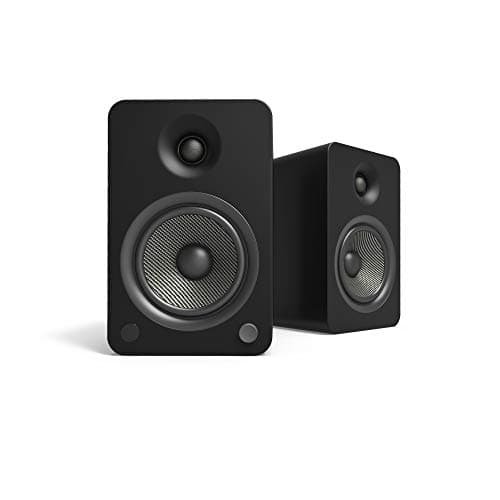 Kanto YU6 Powered speakers with a phono stage already inside, which collapses amp, phono stage and speakers into one purchase and one power cable. | Best all-in-one for a turntable | 8.2 | |
| 2 | 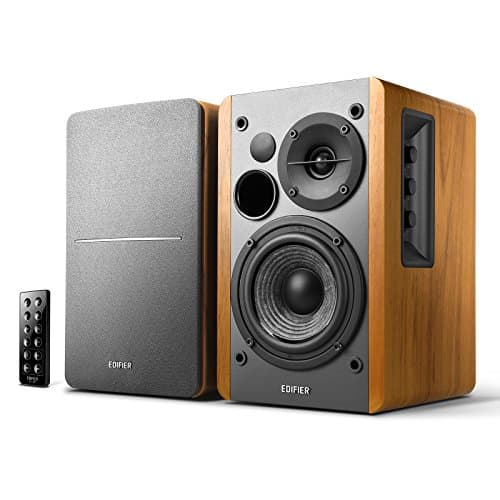 Edifier R1280DB The R1280T plus Bluetooth and optical/coaxial inputs — still no phono stage, but a far more useful set of sockets. | Best budget powered pair with digital inputs | 7.2 | |
| 3 | 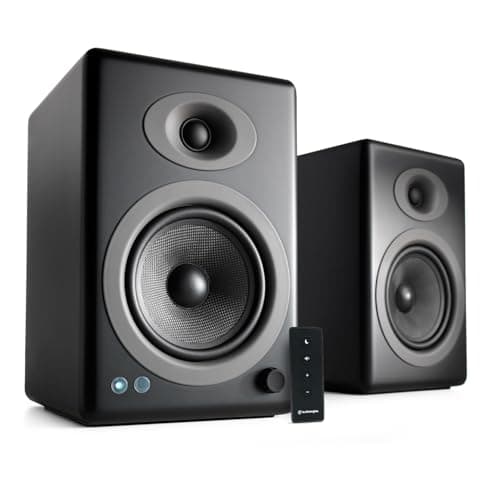 Audioengine A5+ A larger powered pair with enough output to fill a living room rather than a desk, which is the line most powered speakers fail to cross. | Best powered pair for a real room | 7.0 | |
| 4 | 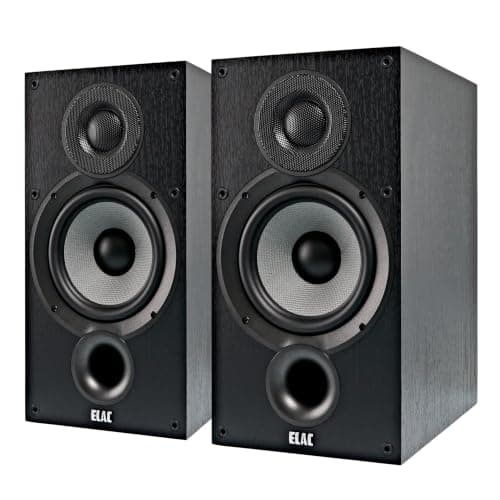 ELAC Debut 2.0 B6.2 A 6.5-inch woofer in a ported cabinet that reaches genuinely low for its size, at the cost of needing an amplifier with real current behind it — and now the outgoing Debut generation rather than the current one. | The outgoing generation, still sold | 8.2 | $329.00View on Amazon $479.0031% off |
| 5 | 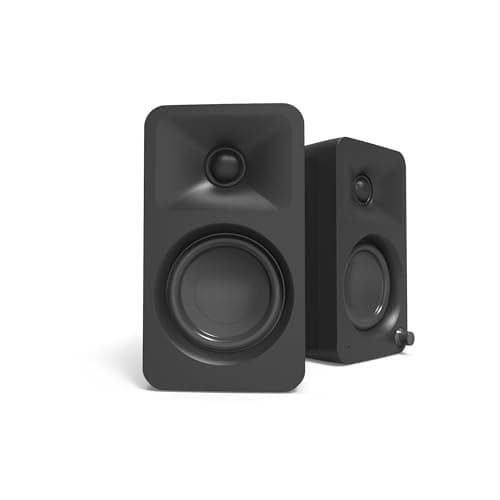 Kanto ORA Small powered reference speakers built for near-field listening, where the distance is short and the cabinet does not need to move much air. | Best for a desk | 7.4 | |
| 6 | 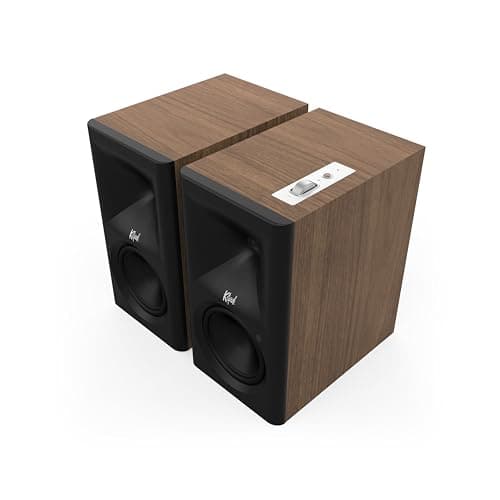 Klipsch The Fives II Powered speakers with HDMI-ARC and a phono input, built to replace both a soundbar and a stereo system in one box pair. | Most connected powered pair | 7.8 |
A turntable needs three things between it and your ears: a phono stage, an amplifier, and speakers. You can buy those as three boxes, two, or — in exactly one case on this page — one.
That is the actual decision here, and it is worth more thought than the speakers themselves.
The three routes, and what each costs
One box: powered speakers with a phono stage inside. The Kanto YU6 publishes an “RCA with phono switch” input and a built-in phono preamp — a turntable plugs straight in, with nothing between. Klipsch The Fives II has one too. Nothing else on this page does, and this is the whole reason the YU6 wins.
Two boxes: powered speakers plus a phono stage. The Edifier and Audioengine pairs contain amplifiers but no phono stage. Audioengine is admirably blunt about it: “All turntables require a phono preamp stage before connecting to Audioengine speakers.” If your turntable has a built-in stage — most of the decks in our beginner roundup do — then this is still effectively one purchase.
Three boxes: passive speakers, an amplifier, a phono stage. More expensive and more to go wrong, and the only route where every component can be upgraded independently. The ELAC B6.2 is here to represent it.
Why powered speakers are not simply better
They are cheaper and simpler for exactly one reason: the amplifier is fixed. You cannot upgrade it, you cannot replace it if it fails, and when you outgrow the speakers you replace the amplifier too whether it deserved it or not.
If you already own an amplifier, powered speakers mean buying a second one and leaving the first switched off. That is not a saving.
The Klipsch honesty problem
Klipsch publishes no amplifier wattage at allfor The Fives II. Not a low number — no number. Their spec sheet substitutes “Max Output: 103 dB (1 m, stereo pair)” where the power figure would be.
That is worth pausing on. Every other powered speaker here publishes its output: 100 W total RMS for the Kanto YU6, 50 W RMS per channel for the Audioengine A5+ (measured, they note, per 16 C.F.R. § 432.3), 21 W + 21 W for the Edifiers. The Fives II is the most expensive product on this page by a distance and it is the only one where you cannot compare that spec to anything, because it does not exist. We are not saying the amplifier is weak. We are saying you have been given no way to find out, and at this price that is a fair thing to notice.
Where the sensitivity arithmetic stops applying
On our passive speaker page we spend a lot of time converting sensitivity figures to a true 1 W basis. None of that applies here, and it is worth saying why rather than leaving a suspicious gap in the spec tables.
Sensitivity and impedance are amplifier-matching specs. On a powered speaker the amplifier is already inside and already matched by the designer, so those numbers have no buyer-facing meaning — which is why Kanto, Audioengine and Edifier all decline to publish them. That is correct behavior, not an omission.
One caution: Edifier doespublish an “input sensitivity” in millivolts. That is a line-level input specification and has nothing whatever to do with loudspeaker sensitivity in dB. Do not compare it to the 87 dB on an ELAC spec sheet; they are unrelated quantities that share a word.
What we would actually do
If you are starting from nothing and want it finished: the Kanto YU6, plus any deck from our under-$500 roundup. Its built-in phono stage makes the deck’s own stage redundant, which means you can buy the Fluance RT82 — which ships without one and puts the saving into an Ortofon cartridge instead.
If you already own an amplifier: ignore this entire page and read the passive roundup instead.
If the same pair has to serve a television as well as the deck, the question changes from phono stage to HDMI and optical inputs, and our powered-speakers-for-a-TV page ranks on exactly that; the Kanto YU6 and Klipsch The Fives II are the two that answer both.
Every pick in detail
Every specification below links to the manufacturer document we read it from. Where a manufacturer does not publish a figure, we say so rather than estimating it.
Kanto YU6
Best all-in-one for a turntablePrice as of October 15, 2026. #ad
Powered speakers with a phono stage already inside, which collapses amp, phono stage and speakers into one purchase and one power cable.
- integration
- 10/10
- upgrade path
- 4/10
- value for money
- 8/10
- ease of setup
- 10/10
- connectivity
- 9/10
| Specification | Published value | Source |
|---|---|---|
| Type | Powered (amplifier built in) | Kanto spec page |
| Amplifier output | 100 W total RMS (200 W peak) | Kanto spec page |
| Built-in phono stage | Yes — RCA input with a phono switch; a turntable connects directly | Kanto spec page |
| Frequency response | 50 Hz – 20 kHz (no tolerance published) | Kanto spec page |
| Woofer | 5.25 in Kevlar | Kanto spec page |
| Tweeter | 1 in silk dome | Kanto spec page |
| Weight | Active 11.4 lb / 5.2 kg; passive 8.7 lb / 4.0 kg | Kanto spec page |
| Inputs | 2 × optical (TOSLINK), RCA with phono switch, 3.5 mm aux, Bluetooth 4.0 with Qualcomm aptX. No HDMI | Kanto product page |
| Outputs | Subwoofer out; USB charge port (5 V / 1 A) | Kanto product page |
Pros
- Built-in phono preamp — a turntable plugs straight in with nothing between
- No separate amplifier or phono box to buy, match or house
- Bluetooth and a subwoofer output as well
Cons
- The amplifier is fixed — you cannot upgrade it without replacing the speakers
- One speaker needs mains power and a cable to the other
- Kanto publishes 50 Hz – 20 kHz with no tolerance attached, so the low-end claim is one you cannot check
Skip it if you already own an amplifier. You would be paying for a second one and leaving the first switched off.
Edifier R1280DB
Best budget powered pair with digital inputsPrice as of October 15, 2026. #ad
The R1280T plus Bluetooth and optical/coaxial inputs — still no phono stage, but a far more useful set of sockets.
- integration
- 7/10
- upgrade path
- 3/10
- value for money
- 9/10
- ease of setup
- 9/10
- connectivity
- 8/10
| Specification | Published value | Source |
|---|---|---|
| Type | Powered (amplifier built in) | Edifier spec page |
| Amplifier output | 21 W + 21 W RMS | Edifier spec page |
| Frequency response | 55 Hz – 20 kHz per the US spec table (Edifier's global site markets 51 Hz in body copy — the two disagree) | Edifier US spec page |
| Inputs | Optical, coaxial, Bluetooth, dual RCA | Edifier spec page |
| Built-in phono stage | Not stated either way by Edifier — assume none | Edifier spec page |
| Woofer | 4 in | Edifier spec page |
Pros
- Optical and coaxial digital inputs as well as analog
- Bluetooth
- Still inexpensive
Cons
- NO built-in phono stage
- Same modest drivers as the R1280T
- Bluetooth codec support is basic
Skip it if your turntable has no phono stage of its own.
Audioengine A5+
Best powered pair for a real roomPrice as of October 15, 2026. #ad
A larger powered pair with enough output to fill a living room rather than a desk, which is the line most powered speakers fail to cross.
- integration
- 7/10
- upgrade path
- 4/10
- value for money
- 6/10
- ease of setup
- 9/10
- connectivity
- 6/10
| Specification | Published value | Source |
|---|---|---|
| Type | Powered (amplifier built in) | Audioengine tech specs |
| Amplifier output | 50 W RMS per channel (measured per 16 C.F.R. § 432.3); 75 W peak per channel (AES) | Audioengine tech specs |
| Frequency response | 50 Hz – 22 kHz ± 1.5 dB | Audioengine tech specs |
| Built-in phono stage | No — Audioengine states “All turntables require a phono preamp stage before connecting to Audioengine speakers.” | Audioengine tech specs |
| Woofer | 5 in aramid fiber | Audioengine tech specs |
| Weight | Left (active) 15.4 lb / 7 kg; right (passive) 9.6 lb / 4.4 kg | Audioengine tech specs |
Pros
- Enough power for a real room, not just a desktop
- Wood cabinets
- Sub output
Cons
- No phono stage
- No digital inputs on the base model
- Expensive for the driver complement
Skip it if you need a phono stage included — the Kanto YU6 does that and this does not.
ELAC Debut 2.0 B6.2
The outgoing generation, still soldA 6.5-inch woofer in a ported cabinet that reaches genuinely low for its size, at the cost of needing an amplifier with real current behind it — and now the outgoing Debut generation rather than the current one.
- sensitivity
- 6/10
- bass extension
- 9/10
- amp friendliness
- 6/10
- value for money
- 10/10
- build quality
- 8/10
| Specification | Published value | Source |
|---|---|---|
| Sensitivity | 87 dB (2.83 V / 1 m) | ELAC spec page |
| Impedance | 6 Ω | ELAC spec page |
| Minimum impedance | Not published | — |
| Frequency response | 44 Hz – 35 kHz (no tolerance published) | ELAC spec page |
| Maximum power input | 120 W (a handling limit — ELAC publishes no recommended amplifier range) | ELAC spec page |
| Woofer | 6.5 in woven aramid-fiber cone | ELAC spec page |
| Tweeter | 1 in cloth dome | ELAC spec page |
| Crossover | 2,200 Hz | ELAC spec page |
| Weight (each) | 16.3 lb / 7.4 kg | ELAC spec page |
Pros
- 6.5in woofer reaches genuinely low for a bookshelf
- Front port, so it tolerates being near a wall better than a rear-ported box
- Well-braced cabinet for the price
Cons
- Wants more amplifier than its size suggests — check the arithmetic before pairing
- Large for a 'bookshelf' speaker
- Finish is functional rather than furniture
- The outgoing generation — ELAC's Debut 3.0 DB63 now builds on it, though ELAC publishes the same 87 dB and 6 Ω for both, so our sensitivity arithmetic holds for either
- ELAC publishes no response tolerance and no recommended amplifier range for this generation. The DB63 publishes both, which is the real reason it ranks ahead
Skip it if your amplifier is a low-power desktop unit. Run the power arithmetic on our amp-matching guide first.
Kanto ORA
Best for a deskPrice as of October 15, 2026. #ad
Small powered reference speakers built for near-field listening, where the distance is short and the cabinet does not need to move much air.
- integration
- 8/10
- upgrade path
- 4/10
- value for money
- 7/10
- ease of setup
- 9/10
- connectivity
- 9/10
| Specification | Published value | Source |
|---|---|---|
| Type | Powered (amplifier built in) | Kanto spec page |
| Amplifier output | 50 W total RMS (100 W peak); 9 W RMS per tweeter, 16 W RMS per woofer | Kanto spec page |
| Frequency response | 70 Hz – 22 kHz (no tolerance published) | Kanto spec page |
| Inputs | RCA line-level, USB-C (24-bit/96 kHz), Bluetooth 5.0 | Kanto spec page |
| Built-in phono stage | Not stated — inputs are line-level only, so assume none | Kanto spec page |
| Woofer | 3 in paper cone | Kanto spec page |
Pros
- Genuinely desk-sized
- USB-C input as well as analog
- Sub output for when the low end runs out
Cons
- Small drivers mean limited low end without a subwoofer
- No built-in phono stage
- Near-field by design
Skip it if this is a living-room system — these are built for a meter away, not four.
Klipsch The Fives II
Most connected powered pairPrice as of October 15, 2026. #ad
Powered speakers with HDMI-ARC and a phono input, built to replace both a soundbar and a stereo system in one box pair.
- integration
- 10/10
- upgrade path
- 4/10
- value for money
- 6/10
- ease of setup
- 9/10
- connectivity
- 10/10
| Specification | Published value | Source |
|---|---|---|
| Type | Powered monitor (pair) | Klipsch spec sheet (PDF) |
| Amplifier output | Not published — Klipsch publishes “Max Output: 103 dB (1 m, stereo pair)” instead of any wattage figure | Klipsch spec sheet (PDF) |
| Built-in phono stage | Yes — a dedicated analog input with a built-in phono stage | Klipsch product page |
| Frequency response | 50 Hz – 25 kHz ± 3 dB | Klipsch spec sheet (PDF) |
| Woofer | 5.25 in Jet Cerametallic | Klipsch spec sheet (PDF) |
| Inputs | HDMI-ARC/eARC with CEC, Bluetooth, RCA phono, RCA analog, USB-C audio, USB-A, optical digital | Klipsch spec sheet (PDF) |
| Outputs | Single RCA line-level output for a subwoofer; HDMI output (HDMI 2.1 pass-through, eARC) | Klipsch spec sheet (PDF) |
| Bluetooth | 5.4 — A2DP, SBC and AAC codecs | Klipsch spec sheet (PDF) |
| Dimensions / weight | 12.9 × 7.2 × 10.7 in (327 × 181 × 273 mm) each; primary 18.2 lb, secondary 15.5 lb | Klipsch spec sheet (PDF) |
Pros
- HDMI-ARC — works as a TV system as well as a stereo
- Built-in phono stage, so a turntable plugs straight in
- Genuinely large drivers for a powered pair
Cons
- By far the most expensive option here
- Klipsch publishes NO amplifier wattage for these — only a “max output 103 dB” figure. You cannot compare their power to anything else here, because there is no number to compare.
- Fixed amplification, so the electronics are the ceiling
Skip it if the TV is not part of this system — most of what you are paying for is the HDMI board.
Frequently asked questions
Can I connect a turntable directly to powered speakers?
Only if one of them has a phono stage. The Kanto YU6 does — Kanto publishes an “RCA with phono switch” input — so a turntable connects with no other box. Klipsch The Fives II has one too. Audioengine explicitly does not. If your turntable has its own built-in stage, it will work with any powered speaker.
Are powered or passive speakers better for a turntable?
Powered means fewer boxes and a lower total price; passive means every part can be upgraded independently. Neither is better in the abstract. The deciding question is whether you already own an amplifier — if you do, powered speakers mean buying a second one and never using the first.
How much power do powered speakers need for a living room?
More than a desk needs. The Kanto ORA publishes 50 W total RMS and Kanto positions it as a desktop speaker; the Audioengine A5+ publishes 50 W RMS per channel and the Kanto YU6 publishes 100 W total. The Edifier R1280 pairs publish 21 W + 21 W, which is genuinely small for a room. Match the output to the distance — and note that the honest answer for The Fives II is that Klipsch does not say.
Why do powered speakers not publish a sensitivity figure?
Because it would tell you nothing. Sensitivity exists to help you match a speaker to an external amplifier; when the amplifier is built in and matched at the factory, the number has no use. Kanto, Audioengine and Edifier all omit it, and that is correct. Edifier does publish an “input sensitivity” in mV, but that is a line-input spec and unrelated.
Read next
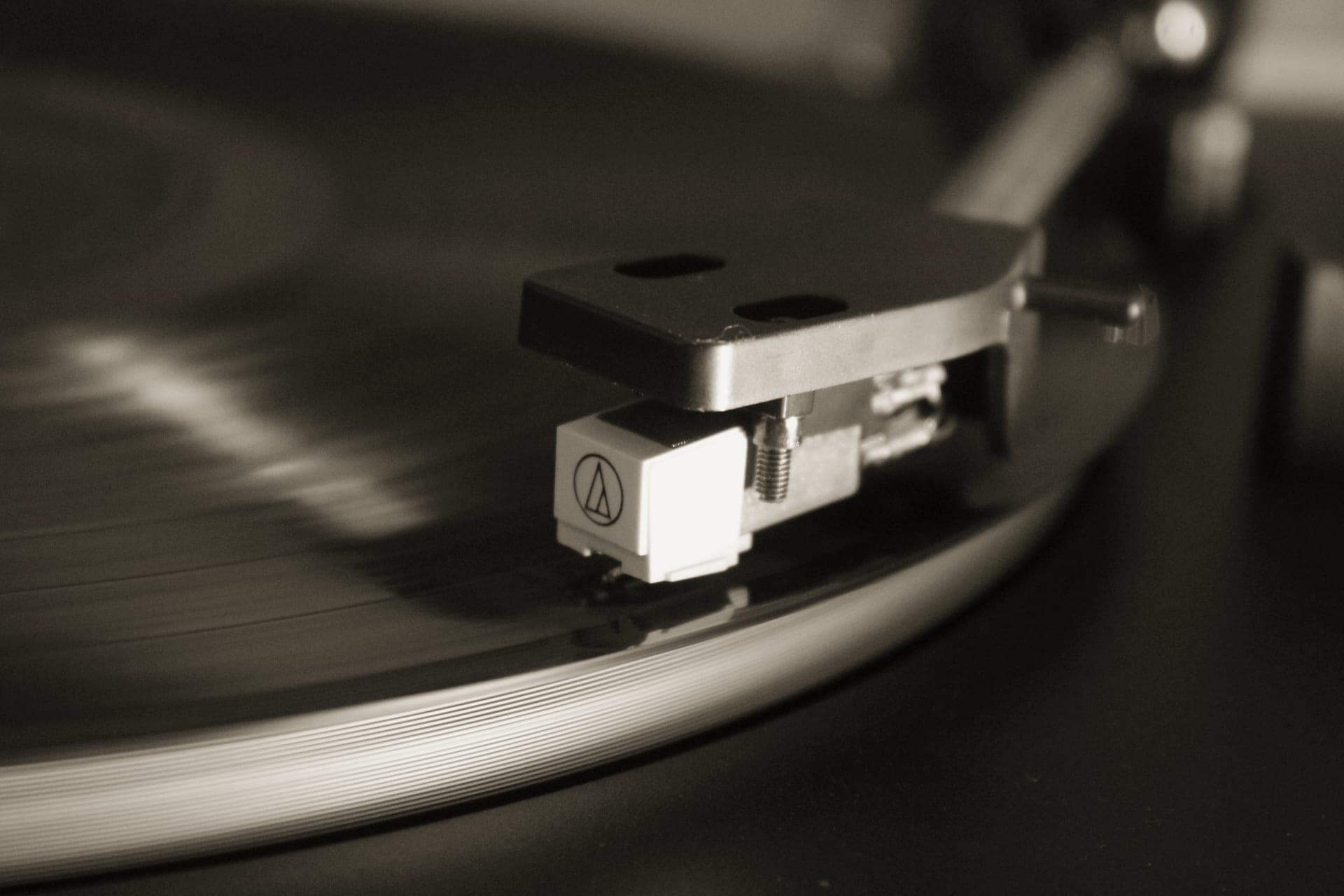
Do I Need a Phono Preamp?
Yes, unless you already have one — and it might be hiding in your turntable, amplifier or speakers. Check in 30 seconds.
The Best Bookshelf Speakers for Vinyl
Bookshelf speakers for a turntable, ranked on published sensitivity and impedance — with the amp arithmetic shown.
The Best Integrated Amplifiers Under $1,000
Six amps under $1,000, and the dynamic-power trap that overstates the popular pick by roughly 2x.
The Best Turntables Under $500
Five decks under $500, ranked on published specs and total cost — including the phono stage two of them make you buy separately.
Passive vs Powered Speakers
Total cost, upgrade path, and why powered speakers correctly refuse to publish a sensitivity figure.
How to Connect a Turntable to Speakers
Four working routes from turntable to speakers, the two that do not work, and how to fix the hum.
Stereo Speaker Placement
Dolby's 22-30 degree window turned into a listening-distance rule, plus height, toe-in, boundaries and the port clearance most people miss.
The Best Powered Speakers for a TV
Four ways to put stereo speakers on a television, ranked by connection: HDMI eARC with CEC, two optical inputs, one optical input, or HDMI ARC into an amplifier for passive speakers.
Sources
Every specification on this page was read from one of these documents. If one of them has changed, or we have made an error, tell us — corrections are logged and dated per our editorial policy.