Preamp vs Power Amp
One of these deals in voltage and the other deals in current. Which is also the reason an integrated amplifier is the right answer for almost everyone reading this.
Disclosure: we earn a commission if you buy through the links on this page, at no extra cost to you. It does not influence what we pick — our criteria are published and reproducible, so you can check our work. How we pick · Full disclosure
These picks are spec-and-price analyses, not listening tests. We have not heard this gear and we do not pretend to have: every figure below is sourced to the manufacturer and linked, and every price is live or not shown at all. Here are the rules we followed.
Quick picks
Ranked on the published criteria in How We Pick. Prices are live as of October 15, 2026. Tap any row for the full write-up.
- 8.6
- 7.8
- 6.0
- 7.6
| # | Product | Best for | Score | Price |
|---|---|---|---|---|
| 1 | 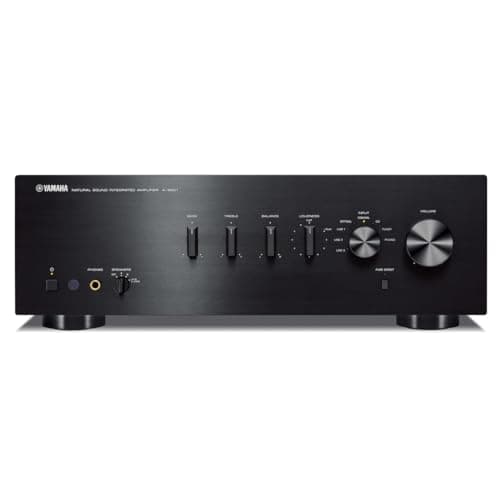 Yamaha A-S501 85 watts per channel into 8 ohms with a damping factor of 240 and an MM phono input fitted — the most amplifier here for the money, provided your speakers are an 8-ohm load. | Best overall under $1,000 | 8.6 | |
| 2 | 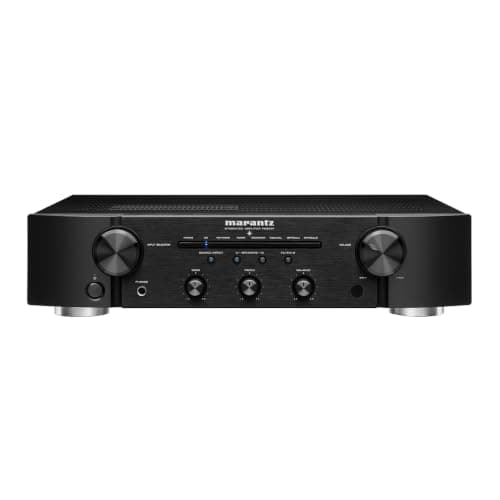 Marantz PM6007 A phono stage plus a proper DAC section in a well-made chassis, at the top of what this bracket will bear. | Best built-in DAC | 7.8 | |
| 3 | 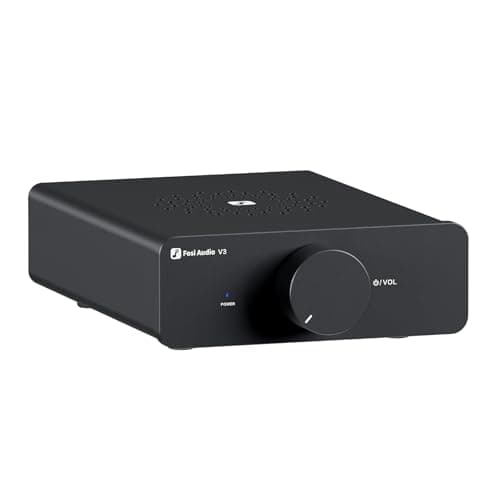 Fosi Audio V3 A class-D power amplifier the size of a paperback whose headline wattage depends entirely on the power supply you feed it. | Best tiny amplifier | 6.0 | |
| 4 | 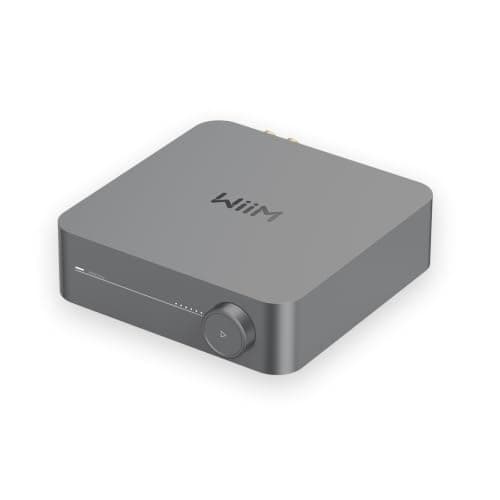 WiiM Amp A streamer with a power amplifier bolted on, which replaces two boxes — and gives up an order of magnitude of measured noise performance to do it. | Best one-box system for passive speakers | 7.6 |
A preamplifier selects a source and sets the level. A power amplifier turns that level-set signal into enough current to move a loudspeaker cone. They are consecutive jobs, not alternatives — the same relationship a DAC has with an amplifier.
An integrated amplifier is both, in one chassis. That is all “integrated” means, and it is why the word exists.
What a preamplifier actually does
Three jobs, and only one of them involves making the signal bigger.
- Selection. Choosing which input reaches the output. Cambridge publishes four RCA inputs plus a phono input and a front 3.5 mm aux on the AXA35; that switching is the preamp section doing its most basic job.
- Level. Almost always attenuation rather than gain. A DAC putting out 2.1 V into an amplifier that reaches full output on well under that needs the signal made smaller, not larger, for most of the volume range.
- Gain where a source cannot supply it. This is what a phono stageis: a specialized preamp for the one source that outputs millivolts. Yamaha publishes the A-S501’s phono input at 3.0 mV; Marantz publishes the PM6007’s at 2.2 mV. Both live in the preamp section.
Everything a preamp does happens in the voltage domain, into a high-impedance load. It never has to supply meaningful current, which is why preamps run cool and weigh nothing.
What a power amplifier actually does
It takes a signal of roughly a volt or two and produces one of tens of volts, while supplying the current that a load of a few ohms demands at that voltage. That current requirement is the entire engineering problem, and it is why power amplifiers have large transformers and heatsinks.
A loudspeaker is also not a resistor. It is a motor being pushed by the amplifier and, once moving, generating its own voltage back into it. The amplifier’s ability to absorb that and keep control is what damping factor describes — and it is one of the few power-amp specifications that gets published.
Damping factor = Z_load ÷ Z_out → Z_out = Z_load ÷ DF (Z_load = 8 Ω)
Inputs
- Yamaha A-S501 published damping factor: 240 (Yamaha spec page)
- Marantz PM6007 published damping factor: 100 (8 Ω, 40 Hz – 20 kHz) (Marantz owner's manual)
- Cambridge Audio AXA35 published damping factor: > 50 (Cambridge Audio spec page)
Result
Yamaha A-S501: 8 ÷ 240 = 0.033 Ω output impedance
Marantz PM6007: 8 ÷ 100 = 0.080 Ω
Cambridge AXA35: 8 ÷ 50 = < 0.16 Ω
All three are small fractions of an ohm — and all three are smaller than the resistance of the speaker cable most people use. Which is the useful conclusion: once a damping factor is comfortably into the tens, the amplifier is no longer the dominant series resistance in the circuit, and pushing the figure higher changes progressively less.
Damping factor is quoted against a nominal 8 Ω load. Real speakers are not 8 Ω at every frequency — Q Acoustics publishes a 4 Ω minimum for the 3030i against a 6 Ω nominal, and KEF publishes a 3.2 Ω minimum against a 4 Ω nominal for the Q3 Meta. Denon publishes no damping factor at all for the PMA-600NE, so this arithmetic cannot be run on it. See speaker impedance explained.
Why anyone splits them into separate boxes
Upgrading one half at a time
The usual argument, and a real one. A power amplifier is a mature technology that changes slowly; a preamplifier accumulates features — streaming, digital inputs, room correction — that date quickly. Splitting them lets you replace the half that has aged.
Getting the small signals away from the big ones
A phono cartridge delivers a couple of millivolts and a power stage swings tens of volts into a few ohms, inside the same box. Separating them removes an entire class of interference problem by geometry rather than by engineering.
Driving something the integrated cannot
If your speakers present a genuinely difficult load, a dedicated power amplifier with a bigger supply is the direct answer.
Why almost nobody should
Two boxes, two power cables, an interconnect between them, and a preamp that must have a low enough output impedance to drive that interconnect into the power amp’s input impedance. Manufacturers publish the second half of that pairing rarely enough that you often cannot check it in advance.
More to the point: the integrated amplifiers we cover already publish damping factors of 100 and 240, distortion figures of 0.019% and 0.08%, and signal-to-noise ratios of 99 and 102 dB. Those numbers do not describe a compromised design that separates would rescue.
The specification that decides whether you can split later
If you might ever add a power amplifier, you need a preamp output — and this is where AV receivers in particular differ sharply from one another. From the specifications we hold:
| Component | Published pre-outs | What that allows |
|---|---|---|
| Marantz Cinema 70s | Full 7.2 | Every channel can be handed to an external power amplifier |
| Denon AVR-X1800H | 2.2 | Front left/right and subwoofers only — surrounds are locked in |
| Yamaha RX-V6A | Front L/R + 2 sub, plus Zone 2 | Same limitation as the Denon, with a second zone added |
| Denon AVR-S670H | Subwoofer only | No main-channel pre-outs at all |
| Yamaha RX-V4A | 2 subwoofer only | No main-channel pre-outs at all |
| WiiM Amp | Subwoofer out only | No analog preamp output — you cannot escape the internal amplifier |
Marantz publishes a full 7.2 pre-out at a tier where Denon publishes 2.2. That single line in a spec sheet is the difference between a receiver you can grow out of gracefully and one you have to replace. It is covered in detail in our AV receiver roundup.
Volume controls: where the attenuation happens
The preamp’s most-used job is the one people think about least, and modern systems have quietly moved it around.
An analog attenuator — the knob on an integrated amplifier — reduces the signal voltage before the power stage. The digital data is untouched because there is none; everything after the DAC is analog.
A digital volume control reduces the numbers before conversion. Historically this was a real concern, because attenuating in the digital domain discards resolution. In practice, look at the numbers on hi-res audio explained: the converters we cover resolve about 18.5 to 20.6 bits against source material of 16, so there is real headroom to give away before it becomes audible.
What the manufacturers publish about it is instructive. FiiO publishes LO/PO switching on the K11 with each mode remembering its own volume — a genuine convenience that also implies the line output can be fixed. iFi publishes a variable/fixed switch on the ZEN DAC 3. Topping publishes a preamp mode on the E30 II. FiiO publishes three separate output modes on the K7: headphone, speaker preamp, and pure DAC.
The specification to check is whether a fixed output exists. A DAC with only a variable output feeding an integrated amplifier gives you two volume controls in series, and the usual result is a source set too low into an amplifier turned up too far — which is the one arrangement that reliably raises the noise floor. Set the DAC to fixed and use the amplifier’s knob.
What about a DAC as the preamp?
Several DACs we cover publish a preamp mode: the Topping E30 II, the FiiO K11 with LO/PO switching that remembers a separate volume for each, the FiiO K7 with switchable headphone, speaker-preamp and pure-DAC modes, the iFi ZEN DAC 3 with a variable/fixed switch.
For a fully digital system that genuinely can replace a preamplifier — one source, one volume control, straight into a power amplifier. The catch is that it selects between the inputs it has and no others, and it has no phono stage. That trade-off is worked through in DAC vs preamp.
The honest summary
Buy an integrated amplifier. It is the same two circuits in one box, sharing one power supply and one chassis, and the published specifications of the ones we cover are not the specifications of a compromise.
If you buy anything at all with separation in mind, buy it for its pre-outs — because that is the only decision on this page you cannot reverse later.
The most common place a home listener meets this split is an AV receiver with pre-outs: the receiver becomes the preamp and processor, and a separate power amplifier takes the front channels. Our pre-outs page ranks the receivers we cover on how many channels of pre-out each actually publishes, which is fewer than the feature lists suggest.
Every pick in detail
Every specification below links to the manufacturer document we read it from. Where a manufacturer does not publish a figure, we say so rather than estimating it.
Yamaha A-S501
Best overall under $1,000Price as of October 15, 2026. #ad
85 watts per channel into 8 ohms with a damping factor of 240 and an MM phono input fitted — the most amplifier here for the money, provided your speakers are an 8-ohm load.
- power
- 9/10
- phono stage
- 8/10
- value for money
- 9/10
- build quality
- 9/10
- connectivity
- 6/10
| Specification | Published value | Source |
|---|---|---|
| Power output (8 Ω) | 85 W + 85 W (8 Ω, 20 Hz – 20 kHz, 0.019% THD) — minimum RMS | Yamaha spec page |
| Power output (4 Ω) | Not published as a continuous rating. Yamaha publishes only “High Dynamic Power/Channel (8/6/4/2 Ω): 130 / 150 / 185 / 220 W” — a short-burst IHF measurement, NOT an RMS rating. The “185 W into 4 Ω” figure circulating for this amp is that dynamic number, and treating it as continuous overstates the amplifier by roughly two-fold. | Yamaha spec page |
| Phono input | Yes — MM, 3.0 mV / 47 kΩ | Yamaha owner's manual (PDF) |
| THD | 0.019% (50 W into 8 Ω, 20 Hz – 20 kHz) | Yamaha spec page |
| Signal-to-noise | 99 dB (CD, input shorted); phono MM 82 dB or more | Yamaha spec page |
| Damping factor | 240 | Yamaha spec page |
| Digital inputs | Yes — optical and coaxial (Yamaha does not publish the DAC part number) | Yamaha spec page |
| Bluetooth | Not published — no Bluetooth row appears in Yamaha's specification table | Yamaha spec page |
| Subwoofer out | Yes | Yamaha spec page |
Pros
- 85 W + 85 W into 8 Ω rated across the full 20 Hz – 20 kHz band at 0.019% THD — a real rating, not a 1 kHz-only one
- Damping factor 240, the highest published here
- MM phono input and optical/coaxial digital inputs included
Cons
- Yamaha publishes NO continuous 4 Ω rating — only a “High Dynamic Power” burst figure, so its behavior into a 4 Ω speaker is genuinely unknown from the spec sheet
- No Bluetooth or network streaming
- Large and heavy
Skip it if your speakers dip to 4 Ω and you want to know what you are getting. Marantz and Denon both publish real 4 Ω ratings; Yamaha does not.
Marantz PM6007
Best built-in DACPrice as of October 15, 2026. #ad
A phono stage plus a proper DAC section in a well-made chassis, at the top of what this bracket will bear.
- power
- 7/10
- phono stage
- 8/10
- value for money
- 7/10
- build quality
- 9/10
- connectivity
- 8/10
| Specification | Published value | Source |
|---|---|---|
| Power output (8 Ω) | 45 W × 2 (8 Ω, 20 Hz – 20 kHz, both channels driven, 0.08% THD) | Marantz owner's manual |
| Power output (4 Ω) | 60 W × 2 (4 Ω, 20 Hz – 20 kHz, both channels driven) — rated across the full band, unlike most rivals' 1 kHz-only 4 Ω figures | Marantz owner's manual |
| Phono input | Yes — MM only, 2.2 mV / 47 kΩ | Marantz owner's manual |
| Signal-to-noise | 102 dB (line); 83 dB (phono MM) | Marantz owner's manual |
| Damping factor | 100 (8 Ω, 40 Hz – 20 kHz) | Marantz owner's manual |
| Digital inputs | Coaxial and optical | Marantz owner's manual |
| Subwoofer out | Yes — 2.8 V (200 mV input, volume max) | Marantz owner's manual |
Pros
- Good DAC section with optical and coaxial in
- MM phono stage
- Solid build and finish
Cons
- Most expensive here
- No Bluetooth
- Power output is mid-pack for the money
Skip it if you already own a DAC — you are buying a second one.
Fosi Audio V3
Best tiny amplifierPrice as of October 15, 2026. #ad
A class-D power amplifier the size of a paperback whose headline wattage depends entirely on the power supply you feed it.
- power
- 6/10
- phono stage
- 0/10
- value for money
- 10/10
- build quality
- 6/10
- connectivity
- 4/10
| Specification | Published value | Source |
|---|---|---|
| Power output (4 Ω) | 300 W × 2 at 4 Ω (Fosi's headline “600 W total”). No THD condition is attached to this figure, and it depends on the supply: published power input range is DC 24–48 V, with 32 V/5 A and 48 V/5 A supplies listed. | Fosi Audio spec page |
| Power output (8 Ω) | Not published. Fosi publishes a 4 Ω figure only, though it states a terminating impedance of 2–8 Ω — so an 8 Ω speaker will see meaningfully less than the headline number, and Fosi does not say how much less. | Fosi Audio spec page |
| Amplifier chip | TPA3255; TI NE5532 × 2 op-amps | Fosi Audio spec page |
| THD | ≤ 0.003% (measurement condition not published) | Fosi Audio spec page |
| Signal-to-noise | ≥ 110 dB (SINAD ≥ 88 dB) | Fosi Audio spec page |
| Inputs | RCA line level only | Fosi Audio spec page |
| Phono input | None — a turntable needs its own phono stage before this amplifier | Fosi Audio spec page |
Pros
- Very cheap and very small
- Class D efficiency — runs cool
- Genuinely useful power for the size
Cons
- The advertised power figure requires a power supply that may be sold separately — read the fine print
- No phono stage
- Power amp with a volume knob, not a full integrated
Skip it if you need a phono input. This has none, so a turntable needs its own stage before it.
WiiM Amp
Best one-box system for passive speakersPrice as of October 15, 2026. #ad
A streamer with a power amplifier bolted on, which replaces two boxes — and gives up an order of magnitude of measured noise performance to do it.
- measured performance
- 6/10
- connectivity
- 8/10
- features
- 9/10
- value for money
- 9/10
- published data
- 5/10
| Specification | Published value | Source |
|---|---|---|
| Power output | 60 W per channel into 8 Ω · 120 W per channel into 4 Ω | WiiM spec page |
| Rated-power measurement condition (THD figure, both channels driven) | Not published | — |
| Audio output quality | SNR 98 dB · THD+N 0.0025% (−92 dB) — an order of magnitude worse than the Pro Plus's line-out, which is what a Class-D power stage costs you | WiiM spec page |
| Inputs | HDMI ARC · optical · RCA line-in | WiiM spec page |
| Outputs | Passive speaker terminals · subwoofer out with auto cable detection and a user-adjustable 30–250 Hz crossover | WiiM spec page |
| Network | Wi-Fi 802.11 b/g/n/ac dual band · 10/100 Mbps LAN · Bluetooth 5.1 | WiiM spec page |
| Protocols | AirPlay 2, Chromecast, Spotify Connect, TIDAL Connect, Alexa Cast, DLNA, Roon Ready | WiiM spec page |
| EQ | 10-band graphic EQ, 10-band parametric EQ, 26 presets | WiiM spec page |
| Home theater formats | Stereo PCM only — Dolby Digital and DTS are NOT supported | WiiM spec page |
| Dimensions / weight | 190 × 190 × 63 mm; 1.84 kg (4.1 lb) | WiiM spec page |
| Phono input | No | WiiM spec page |
Pros
- 60 W into 8 Ω and 120 W into 4 Ω published, which drives every passive speaker we recommend
- Subwoofer output with a user-adjustable 30–250 Hz crossover, so a 2.1 system needs nothing else
- HDMI ARC in, so a television can feed it directly
- Same app, same EQ, same Roon Ready and AirPlay 2 support as the standalone streamers
Cons
- WiiM publishes the wattage with no THD figure and no “both channels driven” condition, so the rating cannot be compared to a Yamaha or Marantz spec
- 98 dB SNR and 0.0025% THD+N — roughly twenty decibels noisier than the Pro Plus's line-out
- Stereo PCM only over HDMI ARC: no Dolby Digital, no DTS
- No phono input, and no analog preamp output to escape the internal amplifier
Skip it if you already own an amplifier you like. This is a worse DAC than the Pro Plus attached to an amplifier you did not need.
Frequently asked questions
What is the difference between a preamp and a power amp?
A preamp selects the source and sets the level, working in the voltage domain into a high-impedance load. A power amp takes that signal and supplies the current a loudspeaker needs, which is why it has the transformer and the heatsinks. An integrated amplifier is both circuits in one chassis.
Do I need a preamp if I have an integrated amplifier?
No — an integrated amplifier already contains one. That is the definition of the word. You would only add an external preamp to get a facility the integrated lacks, such as a moving coil phono stage or additional inputs.
What is a good damping factor for an amplifier?
High enough that the amplifier is no longer the dominant resistance in the circuit, which happens quickly. Yamaha’s published 240 for the A-S501 works out to about 0.033 Ω of output impedance; Marantz’s 100 for the PM6007 to 0.08 Ω. Both are lower than typical speaker cable resistance, so the difference between them is smaller than the numbers suggest.
Can I add a power amplifier to my AV receiver later?
Only if it has pre-outs for the channels you want to hand over, and this varies enormously. Marantz publishes a full 7.2 pre-out on the Cinema 70s. Denon publishes only 2.2 on the AVR-X1800H, and subwoofer-only on the AVR-S670H. Yamaha publishes 2 subwoofer outputs and nothing else on the RX-V4A. Check that line before you buy, not after.
Read next
Integrated Amplifier vs Receiver
Two-channel integrated versus multichannel receiver, judged on published power ratings and what each spec actually promises.
DAC vs Preamp
What a preamp adds beyond a volume control, and the two real costs of going DAC-direct.
How to Read an Amplifier Power Rating
Impedance, bandwidth, distortion, channels driven — the four conditions that turn a watts number into a spec, and which manufacturers publish all four.
The Best Integrated Amplifiers Under $1,000
Six amps under $1,000, and the dynamic-power trap that overstates the popular pick by roughly 2x.
Will This Amplifier Drive My Speakers?
Two published numbers, one formula, and the answer is almost always less power than you expected.
How to Add a Subwoofer to a Stereo Amplifier
Three connection routes, which subs support each, and why a stereo amp adds bass rather than redirecting it.

The Best AV Receivers With Pre-Outs
Ranked on the one spec the query is about: how many channels of pre-out each receiver actually publishes. One full 7.2, two front-only, and one whose pre-out is a subwoofer socket.
Sources
Every specification on this page was read from one of these documents. If one of them has changed, or we have made an error, tell us — corrections are logged and dated per our editorial policy.
- Yamaha A-S501 — damping factor and phono input
- Marantz PM6007 — damping factor, phono input, specifications
- Cambridge Audio AXA35 — damping factor and inputs
- Marantz Cinema 70s — 7.2 pre-outs
- Denon AVR-X1800H — pre-out configuration (info sheet, PDF)
- Yamaha RX-V4A — pre-outs
- WiiM Amp — outputs
- Topping E30 II — preamp mode and output level
- KEF Q3 Meta — minimum impedance