Home Theater vs Hi-Fi
Five channels optimized for a film mix and two channels optimized for a stereo recording are not the same system. Three of the conflicts are real; the rest is folklore.
Disclosure: we earn a commission if you buy through the links on this page, at no extra cost to you. It does not influence what we pick — our criteria are published and reproducible, so you can check our work. How we pick · Full disclosure
These picks are spec-and-price analyses, not listening tests. We have not heard this gear and we do not pretend to have: every figure below is sourced to the manufacturer and linked, and every price is live or not shown at all. Here are the rules we followed.
Quick picks
Ranked on the published criteria in How We Pick. Prices are live as of October 15, 2026. Tap any row for the full write-up.
- 7.6$999.00View on Amazon
$1,300.0023% off
- 9.0
- 8.6
- 8.4
| # | Product | Best for | Score | Price |
|---|---|---|---|---|
| 1 | 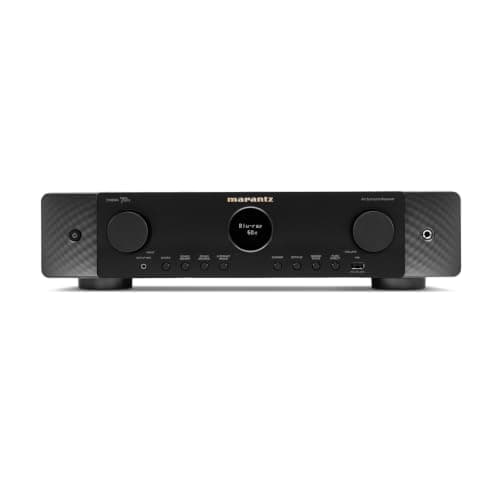 Marantz Cinema 70s A 7.2 receiver in a half-height chassis, which is the entire point — it fits furniture a normal receiver does not. | Slimmest chassis | 7.6 | $999.00View on Amazon $1,300.0023% off |
| 2 | 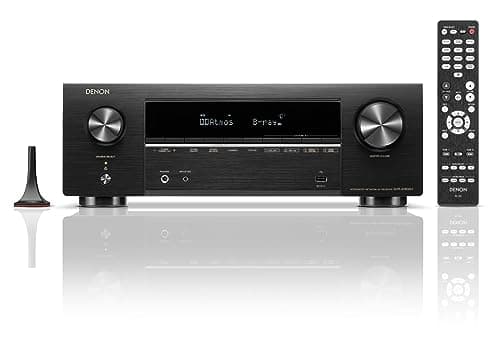 Denon AVR-X1800H Seven channels, 8K passthrough and Audyssey MultEQ XT — the room correction being the feature that actually changes what you hear in a real room. | Best overall under $1,000 | 9.0 | |
| 3 | 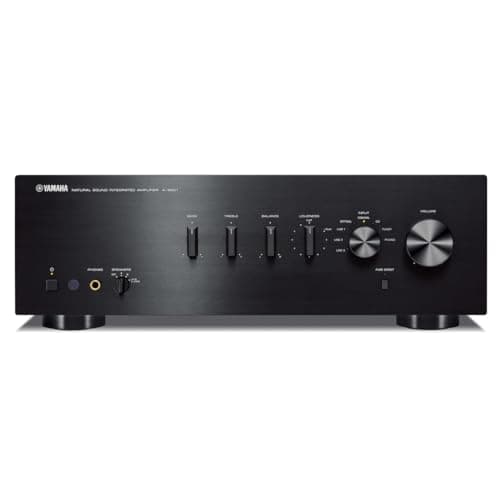 Yamaha A-S501 85 watts per channel into 8 ohms with a damping factor of 240 and an MM phono input fitted — the most amplifier here for the money, provided your speakers are an 8-ohm load. | Best overall under $1,000 | 8.6 | |
| 4 | 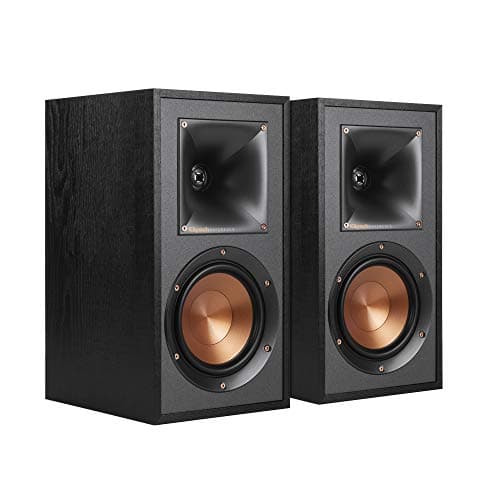 Klipsch R-51M High sensitivity means a modest amplifier drives these to a real volume — the practical answer when the amp is fixed and small. | Best for low-power amplifiers | 8.4 |
A film mix and a stereo recording are addressed to different rooms, and the differences are documented rather than mystical. Three of them force a genuine design decision. Most of the rest of the argument is habit.
Conflict one: the speaker positions do not agree
Dolby publishes front left and right at 22–30° from the center for a film layout, because the screen sits between them and the center channel does the heavy lifting. A stereo pair wants a wider spread — the classic equilateral triangle puts each speaker at 30°, and many rooms sound better wider still.
More importantly, the film layout wants the mains close enough to the screen edges to keep the sound anchored to the picture, and the stereo layout wants them far enough from side walls to control the first reflection. Those two goals pull in opposite directions in a normal-width room.
Which is real: yes. This is the conflict that cannot be processed away, and it is the reason the stereo geometry has its own page separate from the film layout.
Conflict two: the crossover
A film system sends everything below 80 Hz to the subwoofer as a matter of course, because the LFE channel exists and the speakers are relieved of bass they were not built for. A traditional two-channel system runs the mains full range and often has no subwoofer at all.
The mistake is assuming the film approach is a compromise. It is not: crossing a bookshelf speaker at 80 Hz and letting a subwoofer take over removes the excursion that causes most distortion in a small woofer, and it lets you place the bass source where the room supports it.
Which is real:partly. The conflict is genuine in that the two systems are configured differently, but the resolution is one-sided — the film convention is usually the better one for music too. Getting a subwoofer onto a stereo amplifier is the harder part, because stereo amplifiers rarely publish a crossover.
Conflict three: what the electronics publish
This is where the specification sheets diverge most, and it is measurable rather than arguable.
| Spec | Integrated amplifiers we cover | AV receivers we cover |
|---|---|---|
| Damping factor | Published by Yamaha (240 on the A-S501), Marantz (100) and Cambridge (> 50) | Not published by any of them |
| 4-ohm power rating | Published by Marantz (60 W, full band) and Denon (70 W, 1 kHz) | Not published by any of them |
| Phono signal-to-noise | Published: 82 dB (Yamaha A-S501), 83 dB (Marantz PM6007), 84 dB (Denon PMA-600NE) | Not published — sensitivity only |
| Surround decoding | None | Every one of them |
| Room correction | None | Audyssey, YPAO or AccuEQ on all |
Read that table honestly and it does not say receivers are worse. It says the two categories publish different things because they are engineered for different questions. An integrated amplifier publishes what a two-channel buyer asks; a receiver publishes what a film buyer asks. Neither is hiding anything.
What is not actually a conflict
“Receivers are underpowered for music.” The receivers we cover publish 50 to 100 watts per channel under a full-band, two-channels-driven condition. The integrated amplifiers we cover publish 35 to 85 watts under the same condition. The receivers are, if anything, ahead on paper.
“All the processing degrades stereo.” Every receiver here has a direct or pure-direct mode that bypasses the tone controls and bass management. Denon publishes the AVR-S570BT’s frequency response and signal-to-noise specifically in Direct mode, which is a fair way to spec it.
“You need separate speakers for each.” You need speakers appropriate to the room. The Klipsch R-51M is a stereo bookshelf speaker and a home theater front channel, and its published sensitivity of 93 dB is useful in both jobs for the same reason.
The configuration that resolves it
One arrangement genuinely does both, and it depends on a single specification: front left/right pre-outs.
Run an AV receiver as the processor. Take its front-channel pre-outs into a stereo power amplifier or an integrated amplifier with a home-theater bypass. Films get the receiver’s decoding, switching and room correction; stereo gets the better amplifier on the two channels that matter. Nothing is duplicated and nothing is compromised except your shelf space.
The catch is that pre-outs are scarce. Of the receivers we cover, only the Marantz Cinema 70s publishes a full set; the Denon AVR-X1800H and Yamaha RX-V6A publish front-plus-subwoofer, which is all this arrangement needs; the Denon AVR-S670H publishes subwoofer only and cannot do it at all. That spec is the first thing to check if this is the plan.
If you have to pick one
Count the hours. A room that plays films four evenings a week and music on Sunday afternoon should be built as a home theater, and it will play music perfectly well. A room that plays records every day and a film occasionally should be built as a two-channel system, and the occasional film will sound better through good stereo than most people expect.
The system that disappoints is the one built for the hobby the owner wishes they had. The specifications will not fix that.
If the honest answer is stereo but the question behind it is whether hi-fi is worth the money at all, our hi-fi-worth-it page separates the parts of the hobby that move a published number from the parts that do not, and builds a starter system on that separation.
Every pick in detail
Every specification below links to the manufacturer document we read it from. Where a manufacturer does not publish a figure, we say so rather than estimating it.
Marantz Cinema 70s
Slimmest chassisA 7.2 receiver in a half-height chassis, which is the entire point — it fits furniture a normal receiver does not.
- channels
- 9/10
- room correction
- 9/10
- connectivity
- 9/10
- value for money
- 5/10
- future proofing
- 8/10
| Specification | Published value | Source |
|---|---|---|
| Channels | 7.2 (7 powered channels) | Marantz product page |
| Power output | 50 W + 50 W (8 Ω, 20 Hz – 20 kHz, 0.08% THD, 2 ch driven). The slim chassis costs real power against full-size rivals. | Marantz owner's manual |
| Room correction | Audyssey MultEQ with Dynamic EQ and Dynamic Volume | Marantz product page |
| Dolby Atmos / DTS:X | Yes / Yes | Marantz product page |
| Phono input | Yes — MM, 2.5 mV; RIAA deviation ± 1 dB (20 Hz – 20 kHz) | Marantz owner's manual |
| Pre-outs | Full 7.2 — notable at this tier, where the Denon AVR-X1800H offers only 2.2 | Marantz product page |
Pros
- Half-height chassis fits furniture a normal receiver cannot
- Full 7.2 pre-outs — the Denon AVR-X1800H at a similar tier gives you only 2.2, so this is the one here you can actually add amplification to
- 7.2 channels with Audyssey MultEQ and an MM phono input
Cons
- Well over the $1,000 bracket
- 50 W + 50 W into 8 Ω — the slim chassis costs real power against full-size rivals rated at 80–100 W
- You pay a premium for the height, not the performance
Skip it if your cabinet fits a full-size receiver. The slim chassis is most of the surcharge.
Denon AVR-X1800H
Best overall under $1,000Price as of October 15, 2026. #ad
Seven channels, 8K passthrough and Audyssey MultEQ XT — the room correction being the feature that actually changes what you hear in a real room.
- channels
- 9/10
- room correction
- 9/10
- connectivity
- 9/10
- value for money
- 9/10
- future proofing
- 9/10
| Specification | Published value | Source |
|---|---|---|
| Channels | 7.2 (7 power amplifiers — 7.2 or 5.2.2) | Denon info sheet (PDF) |
| Power output | 80 W + 80 W (8 Ω, 20 Hz – 20 kHz, 0.08% THD, 2 ch driven) | Denon info sheet (PDF) |
| Room correction | Audyssey MultEQ XT, with Dynamic EQ and Dynamic Volume | Denon info sheet (PDF) |
| Dolby Atmos / DTS:X | Yes / Yes | Denon info sheet (PDF) |
| Phono input | Yes — MM, 2.5 mV input sensitivity; RIAA deviation ±1 dB (20 Hz – 20 kHz); S/N 74 dB (IHF-A); distortion 0.03% (1 kHz, 3 V) | Denon owner's manual, audio section |
| Analog input sensitivity | 200 mV; frequency response 10 Hz – 100 kHz (+1, −3 dB, Direct mode); S/N 98 dB (IHF-A, Direct mode) | Denon owner's manual, audio section |
| Power consumption | 430 W. Standby 0.1 W — but only with Network Control set to “Off In Standby” and HDMI Pass Through off; CEC standby is 0.5 W. Denon publishes no idle (powered-on, not playing) figure at all. | Denon owner's manual, general section |
| HDMI in / out | 6 in (3 are 8K) / 1 out (eARC) | Denon info sheet (PDF) |
| Video passthrough | 8K/60 Hz, 4K/120 Hz; VRR, QFT, ALLM | Denon product page |
| HDMI 2.1 gaming features | ALLM / QMS / QFT / VRR — Yes / No / Yes / Yes. Denon does not state which of the six inputs carry them beyond the “3 x 8K” count. | Denon product page |
| Pre-outs | 2.2 only (front L/R + 2 subwoofer) — NOT a full 7.2 pre-out | Denon info sheet (PDF) |
| Streaming | HEOS built-in; AirPlay 2, Spotify Connect, Amazon Music HD, TIDAL | Denon info sheet (PDF) |
Pros
- Audyssey MultEQ XT room correction — a step above the plain MultEQ on the cheaper models
- 7.2 channels — enough for a 5.2.2 Atmos layout
- MM phono input, so a turntable connects without a separate stage
- 8K/60 and 4K/120 passthrough with VRR and ALLM
Cons
- Only 2.2 pre-outs (front L/R plus subwoofers) — you cannot add external amplification to the surround channels later
- Menus are dense
- Runs warm in a closed cabinet
Skip it if you only need 5 channels — the AVR-S670H shares the same core for less.
Yamaha A-S501
Best overall under $1,000Price as of October 15, 2026. #ad
85 watts per channel into 8 ohms with a damping factor of 240 and an MM phono input fitted — the most amplifier here for the money, provided your speakers are an 8-ohm load.
- power
- 9/10
- phono stage
- 8/10
- value for money
- 9/10
- build quality
- 9/10
- connectivity
- 6/10
| Specification | Published value | Source |
|---|---|---|
| Power output (8 Ω) | 85 W + 85 W (8 Ω, 20 Hz – 20 kHz, 0.019% THD) — minimum RMS | Yamaha spec page |
| Power output (4 Ω) | Not published as a continuous rating. Yamaha publishes only “High Dynamic Power/Channel (8/6/4/2 Ω): 130 / 150 / 185 / 220 W” — a short-burst IHF measurement, NOT an RMS rating. The “185 W into 4 Ω” figure circulating for this amp is that dynamic number, and treating it as continuous overstates the amplifier by roughly two-fold. | Yamaha spec page |
| Phono input | Yes — MM, 3.0 mV / 47 kΩ | Yamaha owner's manual (PDF) |
| THD | 0.019% (50 W into 8 Ω, 20 Hz – 20 kHz) | Yamaha spec page |
| Signal-to-noise | 99 dB (CD, input shorted); phono MM 82 dB or more | Yamaha spec page |
| Damping factor | 240 | Yamaha spec page |
| Digital inputs | Yes — optical and coaxial (Yamaha does not publish the DAC part number) | Yamaha spec page |
| Bluetooth | Not published — no Bluetooth row appears in Yamaha's specification table | Yamaha spec page |
| Subwoofer out | Yes | Yamaha spec page |
Pros
- 85 W + 85 W into 8 Ω rated across the full 20 Hz – 20 kHz band at 0.019% THD — a real rating, not a 1 kHz-only one
- Damping factor 240, the highest published here
- MM phono input and optical/coaxial digital inputs included
Cons
- Yamaha publishes NO continuous 4 Ω rating — only a “High Dynamic Power” burst figure, so its behavior into a 4 Ω speaker is genuinely unknown from the spec sheet
- No Bluetooth or network streaming
- Large and heavy
Skip it if your speakers dip to 4 Ω and you want to know what you are getting. Marantz and Denon both publish real 4 Ω ratings; Yamaha does not.
Klipsch R-51M
Best for low-power amplifiersPrice as of October 15, 2026. #ad
High sensitivity means a modest amplifier drives these to a real volume — the practical answer when the amp is fixed and small.
- sensitivity
- 10/10
- bass extension
- 6/10
- amp friendliness
- 10/10
- value for money
- 9/10
- build quality
- 7/10
| Specification | Published value | Source |
|---|---|---|
| Sensitivity | 93 dB (2.83 V / 1 m) | Klipsch spec sheet (PDF) |
| Impedance | 8 Ω “compatible” (Klipsch's wording — not a measured nominal figure) | Klipsch spec sheet (PDF) |
| Minimum impedance | Not published | — |
| Frequency response | 62 Hz – 21 kHz ± 3 dB | Klipsch spec sheet (PDF) |
| Power handling | 85 W continuous / 340 W peak (a handling limit, not a recommended amplifier range) | Klipsch spec sheet (PDF) |
| Woofer | 5.25 in spun-copper IMG | Klipsch spec sheet (PDF) |
| Tweeter | 1 in aluminum LTS on a 90° × 90° Tractrix horn | Klipsch spec sheet (PDF) |
| Crossover | 1,660 Hz | Klipsch spec sheet (PDF) |
| Weight (each) | 11 lb / 5 kg | Klipsch spec sheet (PDF) |
Pros
- High sensitivity — plays loud on very little power
- The right answer for a low-wattage or tube amplifier
- Horn tweeter gives strong dispersion control
Cons
- Horn presentation is divisive and we cannot tell you how it sounds — we have not heard them
- Rear port needs breathing room from the wall
- Less low-end than the ELAC B6.2
- Previous generation — Klipsch's own page for it now points buyers to the newer Reference R-50M
Skip it if your amp already has power to spare — you are paying for sensitivity you do not need.
Frequently asked questions
What is the difference between home theater and hi-fi?
Home theater is five or more channels optimized for a film mix, with a center channel carrying dialogue, bass managed to a subwoofer and speaker angles published by Dolby. Hi-fi is two channels optimized for a stereo recording, usually placed wider and often run full range. The electronics also publish different specs: integrated amplifiers publish damping factor and 4-ohm ratings, AV receivers publish decoding formats and room correction.
Can one system do both home theater and hi-fi?
Yes, if the receiver publishes front left and right pre-outs. Run the receiver as the processor and feed its front-channel pre-outs into a stereo power amplifier. Films get the decoding and room correction, stereo gets the better amplifier. Of the receivers we cover, only the Marantz Cinema 70s publishes a full pre-out set, though the Denon AVR-X1800H and Yamaha RX-V6A publish enough for this arrangement.
Are AV receivers worse than integrated amplifiers for music?
Not on published power — the receivers we cover publish 50 to 100 W per channel full band, against 35 to 85 W for the integrated amplifiers. They do publish less: no damping factor, no 4-ohm rating and no phono signal-to-noise on any receiver we cover. That is a difference in what gets specified, not a demonstrated difference in performance, and we have not measured either.
Should I use the same speakers for music and films?
Usually yes for the front pair. A sensitive, well-behaved bookshelf speaker does both jobs, and sensitivity helps in both for the same reason. What differs is placement: film wants the mains near the screen edges, stereo wants them clear of side-wall reflections. That conflict is about position, not about the speaker.
Read next
The Best AV Receivers for Music
The receivers that take two-channel seriously, ranked on pre-outs, published phono specs and a power rating measured across the whole band.
Integrated Amplifier vs Receiver
Two-channel integrated versus multichannel receiver, judged on published power ratings and what each spec actually promises.
Stereo Speaker Placement
Dolby's 22-30 degree window turned into a listening-distance rule, plus height, toe-in, boundaries and the port clearance most people miss.
Home Theater Setup: The Complete Guide
The complete setup, built on Dolby's published layout angles rather than on vibes — plus what to do when your room disagrees.
Are AV Receivers Worth It?
Four products in one chassis, priced as one. Which of the four you actually need decides whether a receiver is the right purchase at all.
Room Treatment for a Hi-Fi Listening Room
What changes when a room has one seat instead of a console: the four surfaces that matter, in the order that returns the most per panel.
Is Hi-Fi Audio Worth It?
What hi-fi means, which of its claims can be measured, where the money moves a published number, and a starter system chosen on those numbers rather than on adjectives.
Sources
Every specification on this page was read from one of these documents. If one of them has changed, or we have made an error, tell us — corrections are logged and dated per our editorial policy.