The Best DACs Under $200
Every DAC on this page measures far beyond the threshold of audibility, which means the specification that actually decides your purchase is which sockets it has on the back.
Disclosure: we earn a commission if you buy through the links on this page, at no extra cost to you. It does not influence what we pick — our criteria are published and reproducible, so you can check our work. How we pick · Full disclosure
These picks are spec-and-price analyses, not listening tests. We have not heard this gear and we do not pretend to have: every figure below is sourced to the manufacturer and linked, and every price is live or not shown at all. Here are the rules we followed.
Quick picks
Ranked on the published criteria in How We Pick. Prices are live as of October 15, 2026. Tap any row for the full write-up.
- 8.4
- 8.2
- 7.0
- 7.8
- 7.2
| # | Product | Best for | Score | Price |
|---|---|---|---|---|
| 1 | 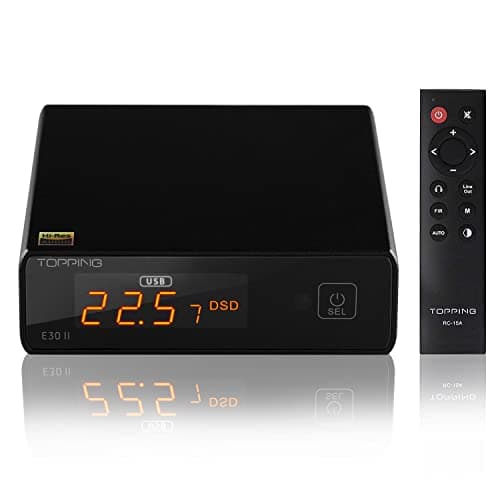 Topping E30 II Dual AK4493S converters and a preamp mode with a remote, at a price where a remote alone is usually the differentiator. | Best measured performance for the money | 8.4 | |
| 2 | 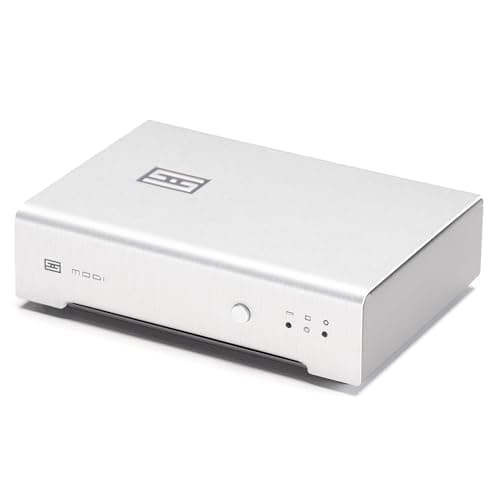 Schiit Modi 5 A no-nonsense DAC with three inputs and unity gain, doing the one job a DAC has without bundling a headphone amp you may not want. | Best overall under $500 | 8.2 | |
| 3 | 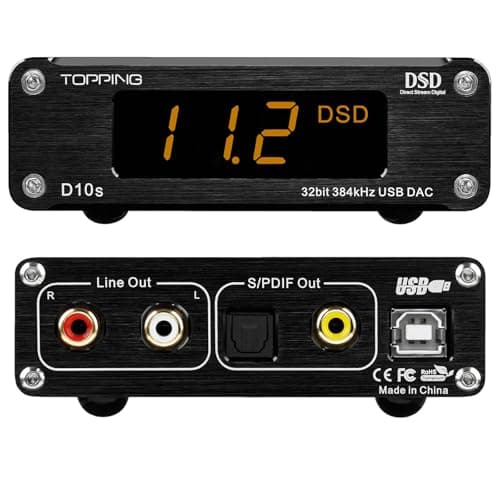 Topping D10s A USB DAC that also works as a USB-to-coaxial bridge, which is the specific thing that rescues an older receiver with no USB input. | Best DAC with a coaxial output | 7.0 | |
| 4 | 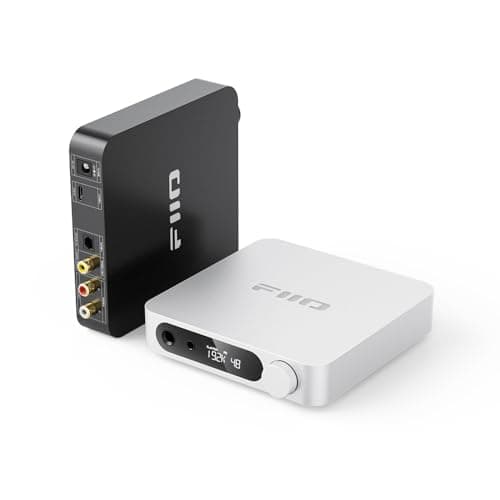 FiiO K11 The K7's cheaper relative — less headphone power, the same basic idea, at a price that undercuts most DAC-only boxes. | Best budget DAC and amp | 7.8 | |
| 5 | 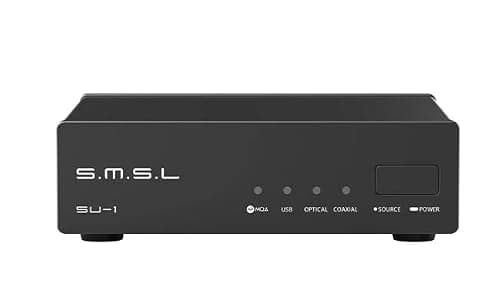 SMSL SU-1 The cheapest box here that still measures well, which makes it the sensible first upgrade from a motherboard's headphone jack. | Best cheap DAC | 7.2 |
Let us start with the finding, because it changes how you should read everything below.
The five DACs here publish signal-to-noise ratios between 118 and 126 dB, and THD+N figures between 0.00013% and 0.0003%. All of those numbers are far beyond the point where any human being could hear a difference, and they are also far beyond what the recording, the speakers and the room will ever deliver. The cheapest DAC on this page and the most expensive are separated by margins that are real, measurable, and inaudible.
That is not a reason to buy the cheapest one blindly. It is a reason to stop ranking on distortion figures and start ranking on the things that vary meaningfully at this price: what you can plug in, what you can plug out, and what voltage comes out.
The published numbers, side by side
| DAC | THD+N | SNR | Output level | Digital inputs |
|---|---|---|---|---|
| Topping E30 II | < 0.00015% | 123 dB (A-wt) | 2.1 V RMS | USB, coax, optical |
| Schiit Modi 5 | 0.0003% | 118 dB | 1.5 V (USB power) / 2.0 V (external) | USB, coax, optical |
| Topping D10s | < 0.0002% | 120 dB (A-wt) | 2.0 V RMS | USB only |
| FiiO K11 | Not published for line out | ≥ 126 dB (A-wt) | 1.95 V RMS | USB, coax, optical |
| SMSL SU-1 | 0.00013% (−117 dB) | 121 dB | 2.0 V RMS | USB, coax, optical |
Note the FiiO row: it publishes a line-out signal-to-noise figure of 126 dB — the best on the page — but does not publish a line-out THD+N. It publishes headphone-output distortion instead. That is a real gap in an otherwise well-documented product, and it means the one number where the K11 leads cannot be checked against a companion figure.
The spec that actually matters: output level
Here is the one difference on that table you might genuinely hear, and it has nothing to do with fidelity.
The Schiit Modi 5 outputs 1.5 V RMS when powered from USB, and 2.0 V only with the external supply. Everything else here delivers roughly 2 V. That is a difference of about 2.5 dB, which on an A/B comparison will make the Schiit sound quieter — and quieter, in a level-matched-free comparison, reliably reads as “worse” to human ears.
It is not worse. It is quieter, and the volume knob fixes it. But if you are comparing two DACs at home without matching levels, this is the effect you will be hearing, and it is worth knowing before you form an opinion.
Why the Topping D10s ranks despite having one input
The D10s has a single USB input, which on a table full of three-input rivals looks like a straightforward loss.
It also has optical and coaxial S/PDIF outputs, which nothing else here does. That makes it a USB-to-S/PDIF bridge as well as a DAC — and that is the specific thing that rescues an older AV receiver or integrated amplifier that has digital inputs but no USB port.
If that is your situation, the D10s is not the third-best DAC on this page; it is the only one that solves your problem. If it is not your situation, the extra outputs are dead weight and you should buy something with more inputs.
The K11 is not really a DAC
The FiiO K11 is on this page because it is a competent DAC at the price and it has a preamp mode with independent line-out and headphone-out volume memory. But its actual purpose is headphones: it publishes 520 mW per channel into 32 Ω from the 6.35 mm output and 1,400 mW from the 4.4 mm balanced output.
If you want a DAC to feed an amplifier, you are paying for a headphone amplifier you will not use, and the Topping E30 II does the DAC job with better published distortion. If you want both, our DAC and headphone amp roundup is the right page.
The chip does not decide this
Across these five you will find an ES9038Q2M, two AK4493S implementations, a CS43198 and Schiit’s own filter around an ES9018. Chip forums will tell you these have characteristic sounds.
What the published measurements show is that the implementation dominates: the SMSL SU-1 and the Topping E30 II both use AK4493S silicon and publish different distortion figures, because the analog output stage, the power supply and the clocking differ. A DAC chip is a component in a circuit, not a sound. Our explainer covers what a DAC actually does and, more usefully, what it does not.
USB power, and the noise problem it can bring
Three of these run from USB bus power alone. That is convenient and it is also the one place where a real, audible difference between them can arise — not in conversion, but in what rides in on the ground.
A computer’s USB ground is a busy, noisy place. A DAC whose analog ground is connected to it can pick up a hum or a fine hash that changes when the laptop charges or the screen brightness shifts. Some designs galvanically isolate the USB input to prevent this; the manufacturers here do not publish whether they do.
What they do publish is the workaround. The Schiit Modi 5 accepts an external supply, and Schiit publishes the consequence in a specification most people read as a downside: 1.5 V RMS output on USB power, 2.0 V with the external supply. That is Schiit telling you the two power routes are not equivalent, in the only place a manufacturer can tell you — the spec table.
If you have heard hum or hash from a computer-connected DAC before, prefer the one with an external supply option. If you have not, do not go looking for a problem you do not have.
What none of these will fix
A DAC will not make a compressed streaming service sound like a master tape, it will not improve a speaker, and it will not do anything at all about your room. The room is almost always the largest measurable problem in a listening setup, and it is usually the cheapest to fix.
A DAC is worth buying when you have a specific problem: a computer with a noisy headphone jack, an amplifier with no digital input, a television whose optical output is your only route, or a streamer feeding an old receiver. Buying one because your system has one fewer box than someone else’s is not a problem.
How we would choose
For most people the Topping E30 II: three inputs, 2.1 V output, the best published distortion figure here, and a preamp mode that lets it drive a power amplifier directly if you ever need that.
If you want the external power supply option and a five-year warranty from a US company, the Schiit Modi 5 — remembering the 1.5 V USB-powered output level. If your amplifier has digital inputs but no USB, the Topping D10s and nothing else. And if you also want to drive headphones, the FiiO K11 or something from the bracket above.
If what you actually want is network playback rather than conversion, a streamer with a built-in DAC does both jobs in one box. And if you are unsure whether the DAC’s volume control is enough on its own, that question has its own page.
Every pick in detail
Every specification below links to the manufacturer document we read it from. Where a manufacturer does not publish a figure, we say so rather than estimating it.
Topping E30 II
Best measured performance for the moneyPrice as of October 15, 2026. #ad
Dual AK4493S converters and a preamp mode with a remote, at a price where a remote alone is usually the differentiator.
- measured specs
- 10/10
- inputs
- 8/10
- value for money
- 9/10
- build quality
- 7/10
- features
- 8/10
| Specification | Published value | Source |
|---|---|---|
| DAC chip | 2 × AK4493S; XMOS XU208 USB interface | Topping spec page |
| Max sample rate | USB: PCM 44.1–768 kHz/16–32 bit, DSD64–DSD512 native; coaxial/optical: PCM up to 192 kHz/24 bit | Topping spec page |
| THD+N | < 0.00015% at 1 kHz (A-weighted, line out, USB 96 kHz) | Topping spec page |
| Signal-to-noise | 123 dB (A-weighted, 1 kHz) | Topping spec page |
| Output level | 2.1 V RMS at 0 dBFS (20 Ω output impedance) | Topping spec page |
| Preamp mode | Yes | Topping spec page |
| Headphone amp | No | Topping spec page |
Pros
- Dual DAC chips and strong published measurements
- Preamp mode with variable output
- Remote control included
Cons
- Small display is hard to read across a room
- No headphone output
- Menu system is fiddly
Skip it if you need a headphone amp built in.
Schiit Modi 5
Best overall under $500Price as of October 15, 2026. #ad
A no-nonsense DAC with three inputs and unity gain, doing the one job a DAC has without bundling a headphone amp you may not want.
- measured specs
- 9/10
- inputs
- 8/10
- value for money
- 9/10
- build quality
- 8/10
- features
- 6/10
| Specification | Published value | Source |
|---|---|---|
| D/A conversion | Schiit Mesh — their digital filter plus a delta-sigma modulator, in this case an ES9018 | Schiit spec page |
| Max sample rate | USB: up to 32-bit/384 kHz (UAC2); optical and coaxial: up to 24/192 | Schiit spec page |
| DSD support | Not published | — |
| Inputs | USB, optical S/PDIF, coaxial S/PDIF | Schiit spec page |
| Outputs | RCA single-ended | Schiit spec page |
| THD+N | 0.0003% | Schiit spec page |
| Signal-to-noise | 118 dB referenced to full output | Schiit spec page |
| Output level | 1.5 V RMS on USB power; 2.0 V RMS with the external supply | Schiit spec page |
| Headphone amp | No — RCA output only | Schiit spec page |
Pros
- Three inputs — USB, optical and coaxial
- Small footprint and a published spec sheet
- Made in the USA
Cons
- No headphone amplifier
- External power
- No remote or display
Skip it if you want a headphone output in the same box — the FiiO K7 does both.
Topping D10s
Best DAC with a coaxial outputPrice as of October 15, 2026. #ad
A USB DAC that also works as a USB-to-coaxial bridge, which is the specific thing that rescues an older receiver with no USB input.
- measured specs
- 9/10
- inputs
- 5/10
- value for money
- 8/10
- build quality
- 6/10
- features
- 6/10
| Specification | Published value | Source |
|---|---|---|
| DAC chip | ES9038Q2M; XMOS XU208 | Topping spec page |
| Max sample rate | USB: 44.1–384 kHz/16–32 bit, DSD64–DSD256 native | Topping spec page |
| Inputs | USB | Topping spec page |
| Outputs | RCA line out, plus optical and coaxial S/PDIF OUT — it doubles as a USB-to-S/PDIF bridge, which is what rescues an older receiver with no USB input | Topping spec page |
| THD+N | < 0.0002% at 1 kHz (A-weighted) | Topping spec page |
| Signal-to-noise | 120 dB (A-weighted, 1 kHz) | Topping spec page |
| Output level | 2 V RMS at 0 dBFS | Topping spec page |
Pros
- Doubles as a USB-to-SPDIF bridge for older gear
- Strong published measurements
- USB powered
Cons
- USB input only
- No headphone output
- No volume control
Skip it if you do not need the SPDIF output — the SU-1 costs less.
FiiO K11
Best budget DAC and ampPrice as of October 15, 2026. #ad
The K7's cheaper relative — less headphone power, the same basic idea, at a price that undercuts most DAC-only boxes.
- measured specs
- 8/10
- inputs
- 7/10
- value for money
- 10/10
- build quality
- 6/10
- features
- 8/10
| Specification | Published value | Source |
|---|---|---|
| Chipset | DAC: CS43198; USB: SA9312L; amp: 2 × SGM8262-2 | FiiO parameters page |
| Max sample rate | USB: 384 kHz/32-bit, DSD256 native; coaxial: 192 kHz/24-bit; optical: 96 kHz/24-bit | FiiO parameters page |
| Headphone power | 6.35 mm: ≥ 520 mW + 520 mW (32 Ω), ≥ 60 mW + 60 mW (300 Ω). 4.4 mm balanced: ≥ 1,400 mW + 1,400 mW (32 Ω), ≥ 250 mW + 250 mW (300 Ω). All at THD+N < 1% | FiiO parameters page |
| Signal-to-noise | Line out ≥ 126 dB (A-weighted) | FiiO parameters page |
| Output level | 1.95 V RMS (line out) | FiiO parameters page |
| Preamp mode | Yes — LO/PO switching, each remembering its own volume | FiiO product page |
Pros
- DAC and headphone amp for less than most DAC-only boxes
- Balanced output at the price
- Compact
Cons
- Less headphone power than the K7
- Plastic-heavy build
- Fewer inputs
Skip it if you drive demanding high-impedance headphones — step up to the K7.
SMSL SU-1
Best cheap DACPrice as of October 15, 2026. #ad
The cheapest box here that still measures well, which makes it the sensible first upgrade from a motherboard's headphone jack.
- measured specs
- 9/10
- inputs
- 8/10
- value for money
- 10/10
- build quality
- 5/10
- features
- 4/10
| Specification | Published value | Source |
|---|---|---|
| DAC chip | AK4493S; XMOS XU-316 | SMSL product page |
| Max sample rate | USB: PCM 44.1–768 kHz, up to 32-bit; DSD to 22.5792 MHz. Optical/coaxial: 44.1–192 kHz, 16–24 bit | SMSL manual (PDF) |
| Inputs | USB, optical, coaxial | SMSL manual (PDF) |
| Outputs | RCA | SMSL manual (PDF) |
| THD+N | 0.00013% (−117 dB) | SMSL manual (PDF) |
| Signal-to-noise | 121 dB | SMSL manual (PDF) |
| Output level | 2.0 V RMS | SMSL manual (PDF) |
| Headphone amp | No — RCA output only | SMSL manual (PDF) |
Pros
- Very cheap for the measured performance
- Tiny footprint
- USB, optical and coaxial in
Cons
- No headphone output
- No preamp mode
- Minimal build
Skip it if you need a headphone output or volume control.
Frequently asked questions
What is the best DAC under $200?
On our published criteria, the Topping E30 II: USB, coaxial and optical inputs, a 2.1 V RMS output, a published THD+N below 0.00015% and 123 dB A-weighted signal-to-noise, plus a preamp mode. All five DACs in this bracket measure well beyond audibility, so the ranking comes down to connectivity and output level rather than distortion figures.
Can you hear the difference between a $85 DAC and a $170 DAC?
On published measurements, no — the distortion and noise differences between these units are far below audibility. What you can hear is an output-level difference: the Schiit Modi 5 delivers 1.5 V RMS on USB power against roughly 2 V for the others, about 2.5 dB quieter. In an unmatched A/B comparison, quieter consistently reads as worse, which is the effect most people are actually hearing.
Do I need a DAC if my amplifier already has digital inputs?
Usually not. An amplifier with optical or coaxial inputs already contains a DAC — the Yamaha A-S501, Marantz PM6007 and Denon PMA-600NE all do. Adding an external one is worth it if you need a USB input the amplifier lacks, or if the built-in DAC's specifications are unpublished and you want figures you can check.
Does the DAC chip inside matter?
Far less than the implementation around it. The SMSL SU-1 and the Topping E30 II both use AK4493S silicon and publish different distortion figures, because the analog output stage, power supply and clocking differ. Buy on published output measurements and connectivity, not on the chip part number.
Read next
What Is a DAC in Audio?
A DAC turns digital audio into analog voltage. You already own several — here is when another one helps.
The Best DACs Under $500
Seven DACs under $500. They all measure superbly — so the decision is inputs, outputs and whether you want a headphone amp.
DAC vs Amp: Which Do You Need?
Not alternatives — consecutive steps. If your system is silent, you need the amp.
DAC vs Preamp
What a preamp adds beyond a volume control, and the two real costs of going DAC-direct.
Optical vs Coaxial vs USB
Per-input sample rate limits for every DAC we cover, the ground-loop problem only optical solves, and the surround-format trap on TV optical outputs.
The Best DAC and Amp Combos
Four DAC and headphone amp combos, ranked on published power into 32 Ω and 300 Ω rather than on chip names.
Sources
Every specification on this page was read from one of these documents. If one of them has changed, or we have made an error, tell us — corrections are logged and dated per our editorial policy.