How to Clean Vinyl Records
Most of the value is in one brush and one habit. The rest of this page is about the things that quietly destroy records, and why we are not selling you anything on it.
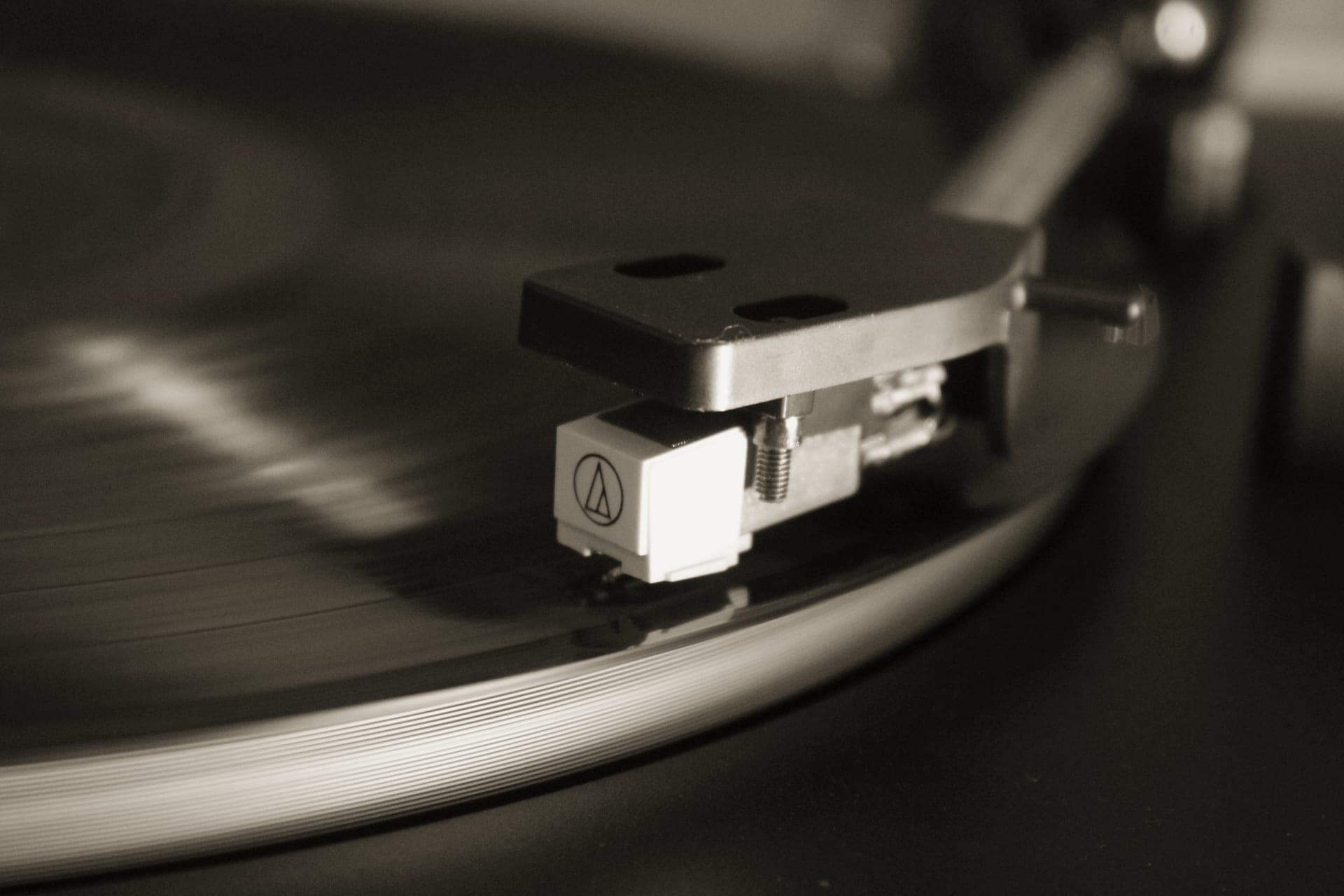
A record groove is a physical channel a few tens of microns wide, and a stylus is a diamond dragged along it under about two grams of force. Anything sitting in that channel gets driven into the vinyl by the stylus. That is the whole reason cleaning matters, and it is why the order of operations is brush-before-you-play rather than clean-when-it-sounds-bad.
Why this page recommends no product
We rank products on specifications their manufacturers publish. Record cleaning fluids and brushes are sold almost entirely on claims — “anti-static”, “residue-free”, “archival” — with no published measurement behind any of them that we could find and cite. We have no way to rank them that would mean anything, so we are not going to pretend otherwise and put affiliate links here. Everything below is method, not merchandise.
The habit that does most of the work
Brush the record before every single side. Not when it looks dirty — every time, as part of putting it on.
- Start the platter turning.
- Lay the brush lightly across the record so its fibers sit in the grooves, holding it still while the record rotates beneath it. Do not scrub back and forth: you want the groove to pass through the fibers, not the fibers to travel across the groove.
- After two or three rotations, draw the brush slowly outward to the edge, carrying the collected dust off the record rather than pushing it back in.
- Wipe the brush clean before the next side.
The reason this works is mechanical. Loose dust sitting on top of the groove is easy to lift. The same dust after one play has been pressed into the groove wall by a diamond under two grams, and lifting it then is a much harder job. Brushing first is not fastidiousness — it is doing the easy version of the task instead of the hard one.
Wet cleaning, when a record needs it
Charity shop finds, anything with visible film, and anything that crackles constantly in the same places all justify a wet clean. The basic recipe is distilled water with a very small amount of a surfactant, applied gently along the groove and then removed completely.
Two details do most of the damage when they go wrong:
- Use distilled water, not tap water. Tap water carries dissolved minerals. The water evaporates; the minerals do not. You have then deposited a fine abrasive into the groove, which is worse than the dust you removed.
- Remove everything you applied. Any residue left in the groove attracts dust and is then driven in by the stylus. If you cannot get the fluid back off, do not put it on.
Always work along the groove, in the direction of rotation — never across it. The groove is a spiral, and anything dragged across it drags whatever it is carrying across every turn of the spiral at once.
Never let fluid reach the label. Paper labels wick, stain and can lift.
The alcohol question, and the one record it destroys
Isopropyl alcohol appears in most home cleaning recipes because it cuts grease and evaporates without residue. On modern vinyl, in modest concentration, it is widely used.
On a 78, it is destructive. Most 78 rpm records are shellac, not vinyl, and shellac is soluble in alcohol. Cleaning a shellac disc with an alcohol solution can dissolve the playing surface.
This matters here because several decks we cover play 78s. Audio-Technica publishes 33⅓, 45 and 78 rpm for the AT-LP120XUSB, and Pro-Ject supplies a second belt with the Debut Carbon EVO specifically to reach 78. If your deck can play shellac, at some point you will own shellac. Water and a mild surfactant only.
Three things that damage records
Wood glue
The technique — flood the record with PVA glue, let it cure, peel it off — is popular because the peeled sheet visibly lifts contamination out of the groove. It also risks leaving glue behind in any groove with a chip or crack for it to key into, and there is no way to remove it afterwards. It is an irreversible process applied to an irreplaceable object. We would not do it to a record we cared about.
Dish soap
Washing-up liquid contains surfactants designed to remain on the surface after rinsing — that is what makes glasses sheet dry rather than spot dry. That property is desirable on a plate and undesirable in a groove, where the leftover film becomes a permanent dust magnet.
Anything abrasive, and anything that scrubs across the groove
Paper towel, cloth with a rough weave, and any circular scrubbing motion all cut across the groove spiral. The groove wall is what carries the music; it is not a surface that tolerates being polished.
Static
A dry record on a dry day accumulates charge, and a charged record actively pulls dust out of the air toward the one place you do not want it. It also causes the sharp intermittent ticks people usually blame on damage.
The most effective free intervention is humidity: static problems largely disappear in a room that is not extremely dry. Carbon-fiber brushes are conductive and drain some charge while they sweep, which is why they are the standard choice. Beyond that, anti-static products make claims we cannot verify against any published measurement, so we will not repeat them.
Clean the stylus too, or you are moving dirt around
A clean record played with a dirty stylus is a dirty record again. Dust collects on the tip and cements there under heat and pressure.
Brush the stylus from back to front only — from the cartridge body outward toward the tip, in the direction the record travels. Never sideways and never toward the cartridge: the cantilever is a thin tube suspended in a compliant rubber block, and lateral force is exactly what that suspension is not built to take. Audio-Technica publishes a static compliance of 17 × 10⁻⁶ cm/dyne for the AT-VM95E, which is a measure of how readily that suspension moves. It moves readily.
If you are replacing a worn stylus rather than cleaning one, note that most of the cartridges we cover are designed for exactly that — Audio-Technica publishes a replacement stylus part number for each VM95, and the whole range drops into the same body. That is the cheapest genuine upgrade in vinyl and it is covered in our cartridge roundup.
The second-hand record, in order
A charity-shop or record-fair find is the one case where the full routine is worth the time, because you do not know what has been done to it and the first play is the play that presses whatever is in there into the groove.
- Inspect it under a light before anything else. Tilt it so light rakes across the surface. You are looking for scuffs that cross the grooves and for any gray haze, which is usually old residue rather than dust.
- Dry brush first, always. Removing loose material dry means you are not turning it into a slurry the moment fluid arrives.
- Wet clean, along the groove, label kept dry. Distilled water, minimal surfactant, and remove everything you applied.
- Let it dry completely before playing. A stylus tracking through residual moisture at two grams drives it into the groove wall, which is the opposite of what you just spent ten minutes doing.
- Put it in a new inner sleeve, not the old one. A cleaned record returned to the sleeve it arrived in is a record you are about to re-contaminate.
- Clean the stylus afterwards. Whatever the record still had, the stylus now has some of it.
That last step matters more on second-hand records than on anything else you own, and it is the one people skip. Check the tip after the first side.
Records that have lived in paper for forty years
Original paper inner sleeves shed fiber continuously, and decades of the record sliding in and out grinds that fiber against the surface. It is the most common condition problem in any older collection and it looks like fine gray dust that a brush alone does not fully lift.
It is also the case where a wet clean pays for itself most obviously, because the material is loose and sitting in the groove rather than embedded in it. Clean once, properly, then move the record into a polyethylene-lined anti-static sleeve and the problem does not return.
Keep the original paper sleeve inside the jacket if it has printing on it — it is part of the release. Just stop putting the record in it.
Storage is cleaning you do not have to do
- Vertical, always. Stacked records press their own grit into each other and warp under sustained load.
- Snug, but not compressed. Records leaning at an angle for years take a permanent set.
- Replace paper inner sleeves. Paper sheds fiber and abrades the surface every time the record goes in or out. Anti-static polyethylene-lined sleeves do not. This is the single highest-value thing you can do to a collection that has been in paper for decades.
- Away from heat and sunlight. Vinyl warps at temperatures a car interior reaches routinely.
What cleaning cannot fix
Groove damage is permanent. If a record was played with a worn stylus or excessive tracking force, the groove wall has been physically deformed and no cleaning process restores it. The same is true of a scratch deep enough to cross groove walls.
Distinguishing the two is straightforward once you know to listen for it: dirt produces irregular crackle that changes between plays and improves after cleaning; damage produces the same tick at the same point on every rotation, every time. If it is identical on the second play, it is not dirt.
The best protection against creating that damage yourself is a correctly set-up deck — tracking force at the cartridge maker’s published figure, anti-skate set to match. Both are covered step by step in how to set up a turntable.
Frequently asked questions
How often should I clean my records?
Brush every side before every play, as part of the routine rather than as an occasional job. Wet-clean only when a record needs it: a second-hand find, visible film, or persistent crackle that stays in the same places. The brush habit is what prevents dirt being pressed into the groove by the stylus, which is the version of the problem that is hard to reverse.
Can I clean records with isopropyl alcohol?
On modern vinyl, dilute isopropyl is a common ingredient in home cleaning solutions. Never use it on a 78 — most 78s are shellac, and shellac dissolves in alcohol. If your deck plays 78s, as the Audio-Technica AT-LP120XUSB does, use distilled water and a mild surfactant on those discs and nothing stronger.
Does the wood glue method work for cleaning records?
It lifts contamination, and it is irreversible. Glue can key into any chip or crack in the groove and there is no way to get it back out. We would not apply a curing adhesive to a record we could not replace, and we do not recommend it.
Why does my record still crackle after cleaning?
Because it is probably damage rather than dirt. Dirt produces irregular noise that changes between plays and improves with cleaning; groove damage produces the identical tick at the identical point on every rotation. If the noise is repeatable to the revolution, cleaning will not remove it — the groove wall has been deformed.
What is the best record cleaning kit?
We are not going to name one. Every cleaning fluid and brush we looked at is sold on unmeasured claims, with nothing published that we could cite or compare. Ranking them would mean inventing a basis for the ranking, which is the one thing this site does not do. A carbon-fiber brush used before every play does most of the available work.
Read next
How to Set Up a Turntable
Nine steps, and the two everyone gets wrong. Both have a published number you can set them to.
The Best Turntable Cartridges Under $200
Six cartridges under $200, ranked on stylus profile, published compliance and output — with the unit-conversion trap explained.
Moving Magnet vs Moving Coil Cartridges
The whole MM/MC argument reduces to output voltage — and Schiit's own published noise figures show exactly what the extra gain costs.
How to Connect a Turntable to Speakers
Four working routes from turntable to speakers, the two that do not work, and how to fix the hum.
Record Player vs Turntable
The words mean the same thing. What separates a real deck from a novelty is the list of specifications the maker refuses to publish.
The Best Turntables Under $500
Five decks under $500, ranked on published specs and total cost — including the phono stage two of them make you buy separately.
Sources
Every specification on this page was read from one of these documents. If one of them has changed, or we have made an error, tell us — corrections are logged and dated per our editorial policy.