Speaker Toe-In: How Much, and Does It Matter?
The angle you need is arithmetic you can do from two tape-measure readings. Whether changing it does anything audible depends on how wide your tweeter radiates, which is a published specification — for exactly one brand on this site.
The short answer
Work out the angle first: it is arctan of half your speaker separation divided by your listening distance, and for a typical room that comes out between 20 and 30 degrees. Then decide whether to use all of it, and that depends on a specification almost nobody publishes. A Klipsch R-51Mhas a 90° × 90° Tractrix horn, which is ±45° of stated coverage — so a listener 24° off axis is well inside it and toe-in changes less than you would expect. A KEF Q3 Meta’s Uni-Q puts the tweeter at the woofer’s acoustic centre, which is a different route to the same goal. Everything else on this site publishes no dispersion figure at all, which means the only honest instruction is the old one: start straight, then experiment.
Disclosure: we earn a commission if you buy through the links on this page, at no extra cost to you. It does not influence what we pick — our criteria are published and reproducible, so you can check our work. How we pick · Full disclosure
These picks are spec-and-price analyses, not listening tests. We have not heard this gear and we do not pretend to have: every figure below is sourced to the manufacturer and linked, and every price is live or not shown at all. Here are the rules we followed.
Quick picks
Ranked on the published criteria in How We Pick. Prices are live as of October 16, 2026. Tap any row for the full write-up.
- 8.4
- 8.0
- 8.6
| # | Product | Best for | Score | Price |
|---|---|---|---|---|
| 1 | 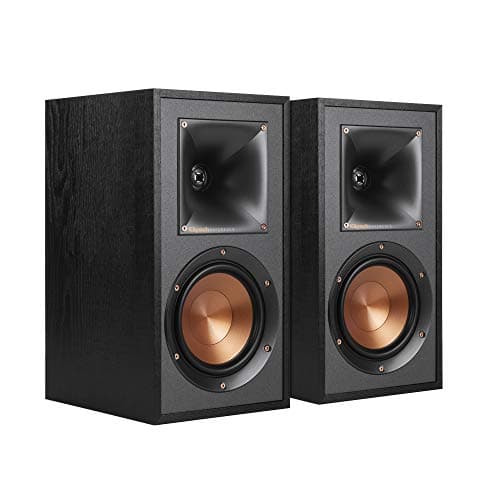 Klipsch R-51M High sensitivity means a modest amplifier drives these to a real volume — the practical answer when the amp is fixed and small. | Best for low-power amplifiers | 8.4 | |
| 2 | 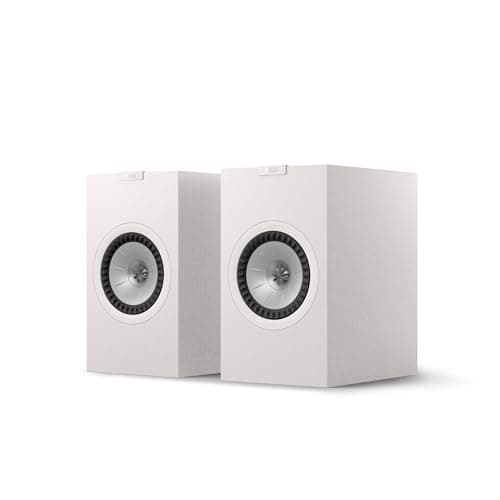 KEF Q3 Meta KEF's coaxial Uni-Q driver puts the tweeter at the woofer's acoustic center, and the Meta generation adds a metamaterial absorber behind it — both are engineering changes rather than finish upgrades. | Best imaging design | 8.0 | |
| 3 | 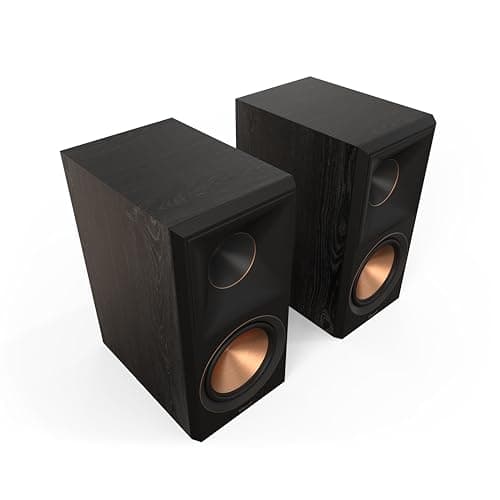 Klipsch RP-600M II Higher sensitivity and a bigger cabinet than the R-51M, which buys headroom rather than a different kind of speaker. | Best step up | 8.6 |
Toe-in is the angle your speakers are rotated inward from facing straight down the room. Full toe-in means each speaker points at your head; none means both fire straight forward and you hear them from off to one side of their axis. The usual advice is to try it and see, which is correct and also unsatisfying. Two things can be made concrete: the angle itself, which is trigonometry, and how much your particular speaker cares, which is a dispersion specification.
The angle, from two measurements
angle = arctan( (speaker separation ÷ 2) ÷ listening distance )
Inputs
- Klipsch R-51M tweeter: 1 in aluminum LTS on a 90° × 90° Tractrix horn (Klipsch spec sheet (PDF))
- Klipsch RP-600M II tweeter: 1 in titanium LTS vented tweeter on a hybrid cross-section expanded Tractrix horn (Klipsch spec sheet (PDF))
- KEF Q3 Meta driver: Uni-Q array: 165 mm (6.5 in) aluminum cone with a 25 mm (1 in) vented aluminum dome and MAT at its acoustic center (KEF spec page)
- Q Acoustics 3030i treble unit: 22 mm (0.9 in) decoupled — no dispersion figure published (Q Acoustics spec page)
Result
6 ft apart, 8 ft away: arctan(3 ÷ 8) = 20.6°
8 ft apart, 9 ft away: arctan(4 ÷ 9) = 24.0°
8 ft apart, 7 ft away: arctan(4 ÷ 7) = 29.7°
10 ft apart, 10 ft away: arctan(5 ÷ 10) = 26.6°
Equilateral triangle (separation = distance): always 26.6°
Those are the fulltoe-in angles — the rotation that points each speaker exactly at your head. Half toe-in is half of each figure. Now compare them against a Klipsch horn’s stated 90° of horizontal coverage, which is ±45° from the axis: at 24° off axis you are inside the stated coverage with 21° to spare even with the speakers firing dead ahead. That is the quantitative version of why a horn-loaded speaker is more forgiving about toe-in than a narrow dome, and why the effect you hear from rotating one is mostly a change in the balance between direct and reflected sound rather than a change in the direct sound itself.
The specification nobody else publishes
We read the published tweeter specification of every passive speaker in our registry. Klipsch is the only brand that states a dispersion angle — 90° × 90° on the Tractrix horn fitted to the R-51M, R-41M, R-52C, R-610F and R-620F, and a “hybrid cross-section expanded Tractrix” on the RP-600M II and RP-6000F II for which no angle is given.
Everybody else describes the driver and stops: ELAC a 1-inch aluminium dome, Q Acoustics a 22 mm decoupled unit, Polk a 1-inch Terylene dome, Jamo a 25 mm soft dome with an anti-diffraction waveguide. A waveguide is a dispersion-shaping device and Jamo publishes no angle for it either. KEF is the interesting case: it publishes no angle but it publishes the designthat addresses the problem, a Uni-Q array with the tweeter at the woofer’s acoustic centre, so that the two drivers radiate from the same point and the off-axis response stays consistent in a way a vertically separated pair cannot.
KEF also publishes something nobody else here does: harmonic distortion against frequency, measured at 90 dB and 1 m — under 2% above 110 Hz, under 1% from 135 Hz up. It is not a dispersion figure but it is the only measured off-the-shelf performance number on any speaker sheet in this registry, and it is the sort of disclosure that earns a pick.
Toe-in versus toe-out
Toe-out — rotating the speakers to fire away from the centre — is a real technique for one specific problem: a listening position so close to the speakers that the stereo image splits into two sources with a hole in the middle. Firing the speakers past you increases the proportion of reflected to direct sound and can pull the image back together. It is a fix for a geometry you cannot otherwise change, not a general setting, and it costs you the imaging precision that toe-in buys.
The more common problem it gets used for is a room whose side walls are too close and too reflective, where the real answer is absorption at the first reflection points rather than aiming the speakers at a different part of the wall.
What to actually do
Measure the two distances and compute your full toe-in angle from the formula above. Set both speakers straight first and listen to a familiar mono-ish vocal: if the voice sits firmly between the speakers, you have less to gain. Then go to half your computed angle, then to full, leaving everything else identical — and change one speaker at a time if you want to hear what the rotation actually does, because asymmetry is immediately obvious in a way that a symmetrical change is not.
Three things matter more than the angle and all three are free: symmetry (both speakers the same distance from their nearest side wall), tweeter height relative to your ears, and the port clearance behind a rear-ported speaker. Our placement guide has all three in priority order, and our hi-fi room treatment guide covers the side-wall question properly.
Why these three picks
The Klipsch R-51Mbecause its 90° × 90° horn is the only horizontal coverage figure published by anyone on this site, which makes it the one speaker here where the arithmetic above can be checked against a number rather than an impression. It is also 93 dB sensitive, which is why it appears on our high-sensitivity roundup.
The KEF Q3 Metabecause a coaxial driver is the structural answer to the off-axis problem rather than a shaped one, and because KEF publishes more measured performance data than any other speaker maker in the registry — including a 3.2 Ω minimum impedance, which is a number most brands withhold.
The Klipsch RP-600M IIbecause it is the step up with the same horn philosophy, at 94.5 dB with Klipsch’s own “half-space anechoic” footnote attached — worth roughly 3 dB against a free-field figure, and a footnote worth reading on every Reference Premiere sheet.
Every pick in detail
Every specification below links to the manufacturer document we read it from. Where a manufacturer does not publish a figure, we say so rather than estimating it.
Klipsch R-51M
Best for low-power amplifiersPrice as of October 16, 2026. #ad
High sensitivity means a modest amplifier drives these to a real volume — the practical answer when the amp is fixed and small.
- sensitivity
- 10/10
- bass extension
- 6/10
- amp friendliness
- 10/10
- value for money
- 9/10
- build quality
- 7/10
| Specification | Published value | Source |
|---|---|---|
| Sensitivity | 93 dB (2.83 V / 1 m) | Klipsch spec sheet (PDF) |
| Impedance | 8 Ω “compatible” (Klipsch's wording — not a measured nominal figure) | Klipsch spec sheet (PDF) |
| Minimum impedance | Not published | — |
| Frequency response | 62 Hz – 21 kHz ± 3 dB | Klipsch spec sheet (PDF) |
| Power handling | 85 W continuous / 340 W peak (a handling limit, not a recommended amplifier range) | Klipsch spec sheet (PDF) |
| Woofer | 5.25 in spun-copper IMG | Klipsch spec sheet (PDF) |
| Tweeter | 1 in aluminum LTS on a 90° × 90° Tractrix horn | Klipsch spec sheet (PDF) |
| Crossover | 1,660 Hz | Klipsch spec sheet (PDF) |
| Weight (each) | 11 lb / 5 kg | Klipsch spec sheet (PDF) |
Pros
- High sensitivity — plays loud on very little power
- The right answer for a low-wattage or tube amplifier
- Horn tweeter gives strong dispersion control
Cons
- Horn presentation is divisive and we cannot tell you how it sounds — we have not heard them
- Rear port needs breathing room from the wall
- Less low-end than the ELAC B6.2
- Previous generation — Klipsch's own page for it now points buyers to the newer Reference R-50M
Skip it if your amp already has power to spare — you are paying for sensitivity you do not need.
KEF Q3 Meta
Best imaging designPrice as of October 16, 2026. #ad
KEF's coaxial Uni-Q driver puts the tweeter at the woofer's acoustic center, and the Meta generation adds a metamaterial absorber behind it — both are engineering changes rather than finish upgrades.
- sensitivity
- 7/10
- bass extension
- 9/10
- amp friendliness
- 5/10
- value for money
- 7/10
- build quality
- 9/10
| Specification | Published value | Source |
|---|---|---|
| Sensitivity | 87 dB (2.83 V / 1 m) | KEF spec page |
| Impedance (nominal) | 4 Ω | KEF spec page |
| Minimum impedance | 3.2 Ω | KEF spec page |
| Frequency response | 49 Hz – 20 kHz (± 3 dB); 42 Hz – 20 kHz at −6 dB | KEF spec page |
| Amplifier requirements | 15–150 W | KEF spec page |
| Driver | Uni-Q array: 165 mm (6.5 in) aluminum cone with a 25 mm (1 in) vented aluminum dome and MAT at its acoustic center | KEF spec page |
| Crossover | 2.0 kHz | KEF spec page |
| Harmonic distortion | < 2% at 110 Hz and above; < 1% from 135 Hz – 20 kHz (measured at 90 dB, 1 m) | KEF spec page |
| Maximum output | 109 dB | KEF spec page |
| Dimensions (H × W × D) | 357 × 210 × 305 mm (14.1 × 8.3 × 12.0 in) | KEF spec page |
| Weight (each) | 8.2 kg / 18.1 lb | KEF spec page |
Pros
- Uni-Q coaxial driver — a real design difference, not a trim level
- Publishes both a nominal (4 Ω) and a minimum (3.2 Ω) impedance, plus a harmonic-distortion figure with its measurement condition — almost nobody publishes the last one
- 165 mm driver and a 42 Hz −6 dB figure, the deepest published extension of any bookshelf pair here
Cons
- Well above the $500 bracket at its current price
- 4 Ω nominal dipping to 3.2 Ω — this is a genuinely demanding load, not a nominal-8 Ω speaker that occasionally dips
- 18.1 lb and 12 in deep per speaker, which is a stand rather than a shelf
Skip it if your amplifier does not state a 4 Ω rating. The Q3 Meta is nominally 4 Ω before it dips, which is the hardest load in this registry.
Klipsch RP-600M II
Best step upPrice as of October 16, 2026. #ad
Higher sensitivity and a bigger cabinet than the R-51M, which buys headroom rather than a different kind of speaker.
- sensitivity
- 10/10
- bass extension
- 8/10
- amp friendliness
- 10/10
- value for money
- 7/10
- build quality
- 9/10
| Specification | Published value | Source |
|---|---|---|
| Sensitivity | 94.5 dB (2.83 V / 1 m, half-space anechoic — Klipsch's published footnote) | Klipsch spec sheet (PDF) |
| Impedance | 8 Ω “compatible” (Klipsch's wording) | Klipsch spec sheet (PDF) |
| Minimum impedance | Not published | — |
| Frequency response | 44 Hz – 25 kHz ± 3 dB | Klipsch spec sheet (PDF) |
| Power handling | 100 W continuous / 400 W peak | Klipsch spec sheet (PDF) |
| Woofer | 6.5 in Cerametallic with Faraday rings | Klipsch spec sheet (PDF) |
| Crossover | 1,500 Hz | Klipsch spec sheet (PDF) |
| Weight (each) | 18.1 lb / 8.2 kg | Klipsch spec sheet (PDF) |
Pros
- Very high sensitivity
- Larger cabinet and more extension than the R-51M
- Real wood-veneer finishes
Cons
- Well above the $500 bracket
- Large
- Rear port placement constraints remain
Skip it if you are shopping under $500 — this is a bracket up.
Frequently asked questions
How much should I toe in my speakers?
Does toe-in actually make a difference?
Which speakers publish a dispersion angle?
What is toe-out and when should I use it?
Does a coaxial driver change the toe-in question?
What matters more than toe-in?
Is there a reliable toe-in calculator?
Read next
Stereo Speaker Placement
Dolby's 22-30 degree window turned into a listening-distance rule, plus height, toe-in, boundaries and the port clearance most people miss.
The Best Bookshelf Speakers Under $300
Five passive pairs at the $300 mark, and a ten-decibel sensitivity spread that decides which amplifier each one needs.
The Best High-Sensitivity Bookshelf Speakers
The speakers that make a small amplifier sound big, ranked on published sensitivity and the condition each figure was measured under.
Find Your First Reflection Points
The mirror trick, in five minutes and for free — plus why those two points matter more than six panels elsewhere.
Bookshelf vs Floorstanding Speakers
Cabinet volume buys extension; a subwoofer buys extension you can place independently. The trade, with each maker's own numbers.
Room Treatment for a Hi-Fi Listening Room
What changes when a room has one seat instead of a console: the four surfaces that matter, in the order that returns the most per panel.
Sources
Every specification on this page was read from one of these documents. If one of them has changed, or we have made an error, tell us — corrections are logged and dated per our editorial policy.
- Klipsch R-51M — spec sheet (90° × 90° Tractrix horn, 93 dB sensitivity)
- Klipsch RP-6000F II — spec sheet (hybrid cross-section expanded Tractrix; half-space footnote)
- KEF Q3 Meta — specifications (Uni-Q array, 3.2 Ω minimum impedance, distortion vs frequency)
- Q Acoustics 3030i — specifications (22 mm decoupled tweeter, no dispersion figure)
- Jamo Studio S 809 — spec table (anti-diffraction waveguide, no angle published)