ATS Acoustics Acoustic Panel Review
The 24 x 48 x 2 in mineral wool panel that most people building a first listening room end up buying, reviewed from the numbers ATS publishes — including the two that should change your order.
The short answer
Buy it for the 250 Hz to 4 kHz band, where almost nothing at the price competes with it, and do not buy it expecting bass control. ATS publishes an NRC of 1.00 and the full one-third-octave curve behind it, which already makes it more transparent than most of this category — and that curve says 0.12 at 125 Hz against 1.17 at 500 Hz. The mineral wool core is why the midrange figures are so strong: at 250 Hz this panel is published at 0.67 where 2 in acoustic foam is published at 0.29. Two things should change how you order. ATS states plainly that “this item is not fire rated”, which rules it out of some ceiling and rental installations outright. And ATS publishes no ASTM test mounting and no core density, so the curve cannot be checked against a lab report the way Primacoustic's can.
Disclosure: we earn a commission if you buy through the links on this page, at no extra cost to you. It does not influence what we pick — our criteria are published and reproducible, so you can check our work. How we pick · Full disclosure
These picks are spec-and-price analyses, not listening tests. We have not heard this gear and we do not pretend to have: every figure below is sourced to the manufacturer and linked, and every price is live or not shown at all. Here are the rules we followed.
Quick picks
Ranked on the published criteria in How We Pick. Prices are live as of November 12, 2026. Tap any row for the full write-up.
- 8.4
| # | Product | Best for | Score | Price |
|---|---|---|---|---|
| 1 | 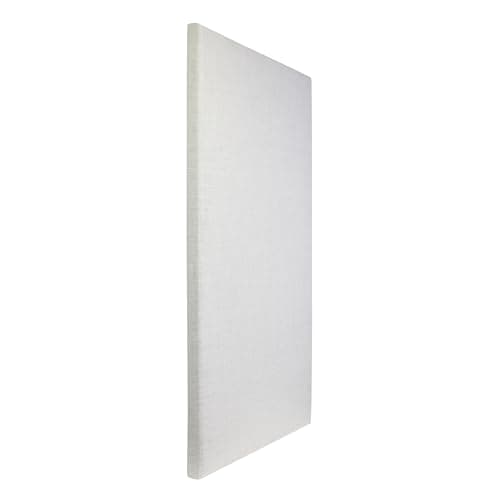 ATS Acoustics Sound Absorbing Panel (24x48) A mineral wool panel with the full absorption curve published — including the 125 Hz figure of 0.12 that its own NRC of 1.00 completely hides. | Best overall panel | 8.4 |
The ATS Acoustics 24 × 48 × 2 in panel is the default first purchase in this category, and it earns that position honestly: it is one of the few panels at its price whose maker publishes the whole absorption curve rather than a single flattering average. It is also the panel most often bought for the wrong reason, because the number on the listing — NRC 1.00 — is mathematically incapable of telling you what the panel does in the band most people are trying to fix.
This review uses nothing but ATS's own published figures, re-read on 24 October 2026. We have not measured this panel and we make no claim about how it sounds. What we can do is read the curve band by band and say what it implies, which is more than the headline number does.
The published curve, band by band
| Band | ATS 2 in mineral wool | Auralex 2 in DST-114 foam | Primacoustic 1 in Scatter Block (lab) |
|---|---|---|---|
| 125 Hz | 0.12 | 0.16 | 0.17 |
| 250 Hz | 0.67 | 0.29 | 0.28 |
| 500 Hz | 1.17 | 0.57 | 0.81 |
| 1 kHz | 1.12 | 0.75 | 1.00 |
| 2 kHz | 1.08 | 0.90 | 1.02 |
| 4 kHz | 1.08 | 1.00 | 0.95 |
| Published NRC | 1.00 | 0.65 | Not published |
ATS product page, Auralex performance data, Primacoustic engineering data sheet (PDF). The Primacoustic column is its Riverbank-lab-measured 1 in panel; its thicker Control Columns are published as calculated rather than measured, which is why we do not use them for a like-for-like row.
Read the 250 Hz and 500 Hz rows first, because that is where this panel justifies itself. At 250 Hz it is published at more than double the foam figure. At 500 Hz it is published at more than double the foam figure again, and above the lab-measured Primacoustic panel. Two inches of ROCKWOOL AFB mineral wool is simply a different material to two inches of open-cell foam, and ATS publishing the comparison-ready curve is what lets you see it.
Why NRC 1.00 cannot tell you about bass
NRC is the arithmetic average of the 250 Hz, 500 Hz, 1 kHz and 2 kHz coefficients, rounded to the nearest 0.05. The 125 Hz band is not in it. So a panel can be published at NRC 1.00 and still be close to transparent an octave lower, and this one is: 0.12 at 125 Hz means roughly 12% of the energy arriving at that band is absorbed, and about 88% is not.
absorption (sabins) = panel area (sq ft) × absorption coefficient
Inputs
- Panel size: 24 × 48 in = 8 sq ft (ATS product page)
- Coefficient at 125 Hz: 0.12 (ATS product page)
- Coefficient at 1 kHz: 1.12 (ATS product page)
Result
At 1 kHz: 8 × 1.12 = 8.96 sabins per panel. At 125 Hz: 8 × 0.12 = 0.96 sabins per panel. The same piece of wall does 9.3 times lessat 125 Hz than at 1 kHz. To buy a single panel's worth of 1 kHz absorption at 125 Hz you would need nine of them, which is not a treatment plan, it is a wallpaper project.
None of this makes the panel bad. It makes the panel a midrange and treble absorber, which is what first-reflection control needs and what finding your first reflection points is about. If the problem you are actually hearing is a boom at one note, panels on the side walls are the wrong purchase at any quantity, and the honest next step is a look at what bass traps do— or, if the boom arrived with a subwoofer, the placement and the sealed-versus-ported question we take apart in our SVS SB-1000 Pro versus Klipsch R-120SW comparison.
The coefficients above 1.00, and why they are not a mistake
ATS publishes 1.17 at 500 Hz, and a coefficient above 1.00 looks like a typo — more than all the energy absorbed. It is not. Absorption coefficients from a reverberation-room test are normalized to the sample's stated area, and a thick panel absorbs some energy through its exposed edges as well as its face, so the measured result can exceed the area you divided by. It is routine in published data: the Auralex LENRD bass trap is published at 1.55 and carries an NRC of 1.50 for the same reason.
What it does mean is that the test mounting matters, because edge effect and air gap both depend on how the sample was set up — and here is the gap in ATS's documentation: no ASTM test mounting is published, and neither is the core density. Primacoustic names Riverbank Acoustical Laboratories, cites ASTM C423-02a and E795-05, and publishes 6 lb/ft³. ATS names its core material and publishes the numbers, which is more than most, and then stops short of saying who measured them or how. We publish the curve because ATS does, and we flag that it cannot be audited.
Not fire rated, which is the one hard stop
ATS states it directly on the product page: “This item is not fire rated.” That is a credit to them for saying it, and it is also a real constraint, not a footnote:
- Overhead mounting. Anything you suspend above seating is a different risk category to something screwed to a side wall. Our acoustic ceiling panel guide treats this as the deciding spec, and it is why the Primacoustic kit — ASTM E84-09 Class A/1 — wins there despite weaker published low-frequency data.
- Rentals, condos and anything inspected. If a landlord, strata, insurer or building inspector is going to look at the wall, a Class A rating is the thing they will ask for, and this panel does not have one.
- Commercial rooms. Treating a studio, office or practice space you let other people into is a code question before it is an acoustics question.
For a private listening room, on a side wall, in a house you own, it is a fact to note rather than a disqualification — and ATS's own tri-corner bass trap is published as ASTM E84 Class A, so the brand does sell a rated product if you need one.
How it is actually built
The published construction is a solid wood internal frame, a ROCKWOOL AFB mineral wool core, a 1/4 in wood back panel and a 100% jute cover fabric, at an average 12 lb per panel. Three things follow from that list.
The wood back panel is a real functional decision, not trim. It makes the panel rigid enough to hang off the included aluminum clips rather than needing a frame built on the wall, and it means you are hanging a single-faced absorber: the published curve is for the panel as supplied, and ATS publishes no data for mounting it with an air gap behind. Spacing a thin absorber off the wall is the standard trick for pushing its useful range lower, so this is a case where the thing that makes installation easy also makes the one free improvement unavailable — and we have no published figure either way, so we are not going to tell you how much it costs you.
Twelve pounds across a 2 × 4 ft face is heavy enough that the anchors matter. The clips, screws and anchors are in the box, which is more than the loose-foam kits provide, and the fabric is offered in ten colorways plus customer-supplied, with a beveled or square edge option. For a product that is going to occupy several square feet of a room you sit in, the finish options are not a frivolous spec.
The honest DIY comparison is on our DIY versus store-bought page: the same ROCKWOOL product is sold by the bag, and if you are building the frame yourself the material cost is a fraction of the finished panel. What you are buying here is the frame, the fabric, the hardware and a published curve.
The sibling product, and the one place ATS is worse than its rivals
ATS also sells a tri-corner bass trap, and its documentation inverts the virtue of the wall panel. For the wall panel ATS publishes the full curve and the NRC. For the bass trapit publishes only an NRC — 0.95 — and NRC, as established above, excludes 125 Hz by definition. Publishing a single average that omits the band a bass trap exists to address is the one documentation failure in this brand's line, and it is why the trap is not our top corner pick on the bass trap roundup. The Auralex LENRD publishes 1.30 at 125 Hz, measured to ASTM C-423, and that is the comparison ATS declines to let you make.
Who should buy it
Buy it if you are treating the side walls and ceiling-free surfaces of a private listening room or studio, you want mineral wool rather than foam, and you want a maker who publishes the whole curve. On the published midrange figures nothing else in our wall panel roundup beats it at the price, which is why it is our first pick there.
Skip it if any part of the installation is overhead, rented, inspected or commercial — the missing fire rating is not negotiable in those rooms. Skip it if the problem you are solving is bass, because 0.12 at 125 Hz is the answer to that question and no quantity fixes it. And think twice if you need an auditable test report, because the mounting and density that would let you check this curve against a lab are not published.
How many you need is a separate calculation and it is the one most people get wrong in the generous direction: see how much room treatment you actually need. If the speakers are not yet on stands at the right height, do that first — it is cheaper than panels and it changes more.
Every pick in detail
Every specification below links to the manufacturer document we read it from. Where a manufacturer does not publish a figure, we say so rather than estimating it.
ATS Acoustics Sound Absorbing Panel (24x48)
Best overall panelPrice as of November 12, 2026. #ad
A mineral wool panel with the full absorption curve published — including the 125 Hz figure of 0.12 that its own NRC of 1.00 completely hides.
- low frequency absorption
- 8/10
- published data
- 10/10
- build quality
- 9/10
- value for money
- 7/10
- appearance
- 8/10
| Specification | Published value | Source |
|---|---|---|
| NRC | 1.00 | ATS Acoustics product page |
| Absorption coefficients | 125 Hz: 0.12 · 250 Hz: 0.67 · 500 Hz: 1.17 · 1 kHz: 1.12 · 2 kHz: 1.08 · 4 kHz: 1.08 | ATS Acoustics product page |
| Material | ROCKWOOL AFB mineral wool core, solid wood frame, 1/4 in wood back panel | ATS Acoustics product page |
| Thickness | 2 in | ATS Acoustics product page |
| Dimensions / weight | 24 × 48 × 2 in; ~12 lb per panel | ATS Acoustics product page |
| Fire rating | None — ATS states “This item is not fire rated.” | ATS Acoustics product page |
| Cover fabric | 100% jute, textured; ten colorways plus customer-supplied | ATS Acoustics product page |
| Edge options | Beveled (1/2 in 45-degree eased edge) or square | ATS Acoustics product page |
| Mounting hardware included | Aluminum clips, screws and anchors | ATS Acoustics product page |
| ASTM test mounting | Not published | — |
| Density | Not published | — |
Pros
- Publishes the full per-frequency curve, not just an NRC — so you can see what it actually does
- Mineral wool core absorbs 0.67 at 250 Hz, where 1.9 in foam manages 0.13
- Fabric-wrapped and presentable in a living room
Cons
- NRC 1.00 is a real figure and still misleading: at 125 Hz this panel absorbs 0.12. NRC averages 250 Hz–2 kHz only, so it structurally cannot show you the bass performance.
- Not fire rated — ATS states this plainly, and it may matter for your install
- Heavy at ~12 lb, and far more expensive than foam per panel
Skip it if your problem is bass. No 2-inch panel solves that — including this one — and you want corner traps instead.
Frequently asked questions
Are ATS Acoustics panels any good?
What is the NRC of the ATS 24x48x2 panel?
Will ATS acoustic panels help with bass?
Are ATS Acoustics panels fire rated?
Why is the absorption coefficient higher than 1.00?
ATS Acoustics or Auralex foam?
Should I build my own panels instead?
Have you tested these panels?
Read next
The Best Acoustic Panels for Walls
Six wall panels ranked on published absorption per band, then on the thing nobody specs: how they attach, and whether they come off again.
Find Your First Reflection Points
The mirror trick, in five minutes and for free — plus why those two points matter more than six panels elsewhere.
How Much Room Treatment Do I Need?
The Sabine equation, applied to a real room with real published coefficients — and what the answer costs.
The Best Bass Traps
Ranked on published 125 Hz absorption rather than NRC — and only one maker publishes it for a corner trap.
Acoustic Ceiling Panels and Clouds
Finding the ceiling reflection point, sizing the cloud, and the mounting problem that is the real reason it goes untreated.
DIY vs Store-Bought Acoustic Panels
Material, lab data, fire rating — the three things you are paying for, and which of them the manufacturers actually publish.
Sources
Every specification on this page was read from one of these documents. If one of them has changed, or we have made an error, tell us — corrections are logged and dated per our editorial policy.
- ATS Acoustics 24 × 48 × 2 — product page (NRC 1.00, full coefficient table, ROCKWOOL AFB core, jute fabric, 12 lb, not fire rated, included clips)
- ATS Acoustics tri-corner bass trap — product page (NRC 0.95 only, 6 lb/ft³, ASTM E84 Class A)
- Auralex performance data — 2 in DST-114 coefficients and LENRD coefficients (ASTM C-423)
- Primacoustic London 8 — engineering data sheet (Riverbank-measured 1 in row, Class A/1 fire rating, 6 lb/ft³)