The Best Onkyo Receivers
Onkyo publishes an FTC continuous power rating on every receiver here. The wattage you see in search results is the other figure, measured at 125 times the distortion.

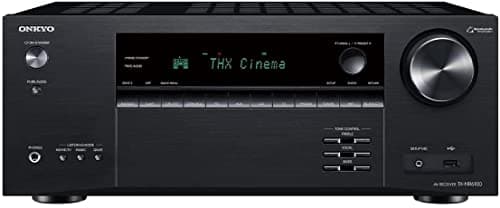
Top pick: Onkyo TX-NR6100
$899.9928% off
Best for gaming. #ad Affiliate link — we earn a commission at no extra cost to you.
The short answer
The best Onkyo receiver for most people is the TX-NR6100 — 7.2 channels, THX certified, and rated at 100 W per channel on the FTC form (8 Ω, 20 Hz–20 kHz, 0.08% THD, two channels driven), which is the only power figure on this page worth planning around. It carries six HDMI inputs with full HDMI 2.1 features on inputs 1–3 and both outputs, Dolby Atmos and DTS:X, AccuEQ room correction with AccuReflex, Chromecast and AirPlay 2, and — unusually for an AV receiver at this level — a real moving-magnet phono input specified at 3.5 mV rms into 47 kΩ. It is for the person building a 5.1.2 or 7.2 room who also owns a turntable. The budget pick is the TX-NR5100— the cheapest Onkyo AV receiver we stock, with Dolby Atmos and DTS:X intact, four HDMI inputs at 24 Gbps, and an 80 W per channel FTC rating. Its two real omissions are stated below: no phono input at all, and Onkyo’s own manual publishes speaker layouts only up to 5.1.2 despite the seven amplifier channels.
One thing to settle before you shop. Onkyo publishes two power figures for these receivers and only one of them is a rating. The TX-NR5100 is rated at 80 W per channel on the FTC form and alsocarries a 165 W figure measured at 6 Ω, 1 kHz, one channel driven, at 10% distortion. The second number is the one that shows up in search results.
Disclosure: we earn a commission if you buy through the links on this page, at no extra cost to you. It does not influence what we pick — our criteria are published and reproducible, so you can check our work. How we pick · Full disclosure
These picks are spec-and-price analyses, not listening tests. We have not heard this gear and we do not pretend to have: every figure below is sourced to the manufacturer and linked, and every price is live or not shown at all. Here are the rules we followed.
Quick picks
Ranked on the published criteria in How We Pick. Prices are live as of November 23, 2026. Tap any row for the full write-up.
- 8.2$649.00View on Amazon
$899.9928% off
- 8.4
- 8.8
| # | Product | Best for | Score | Price |
|---|---|---|---|---|
| 1 | Onkyo TX-NR6100 THX certified with three 4K120 HDMI inputs, which is the specific spec that matters if two consoles and a PC share the same receiver. | Best for gaming | 8.2 | $649.00View on Amazon $899.9928% off |
| 2 | 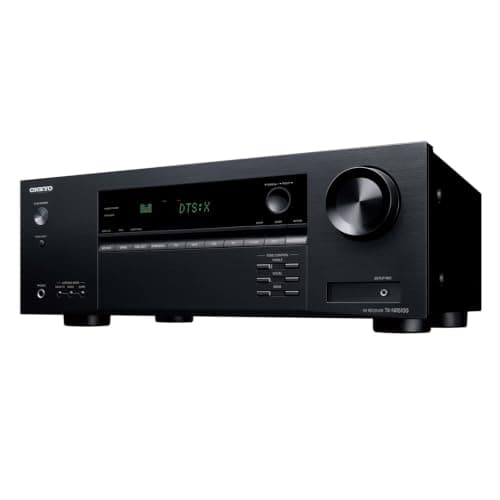 Onkyo TX-NR5100 Eighty honest watts, seven amplifier channels, Dolby Atmos and DTS:X together — and a marketing headline of 165 watts that its own manual measures at ten percent distortion. | Most receiver under $500 | 8.4 | |
| 3 | 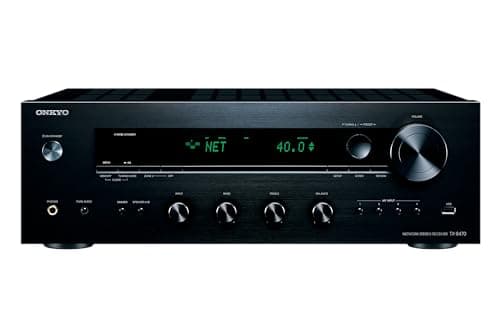 Onkyo TX-8470 The only amplifier we can verify under $500 with a moving-coil phono position as well as a moving-magnet one, and the only one whose maker states its power the FTC way. | Best phono stage under $500 | 8.8 |
Onkyo does something on these three receivers that deserves more credit than it gets: it publishes the Federal Trade Commission power form in full. Not a dynamic-power number, not a single-channel burst at an inaudible distortion level, but the full sentence — both channels driven, across the whole audio band, at a stated distortion limit, from 250 milliwatts to rated output. That sentence is the only wattage claim in consumer audio with a legal definition behind it, and it is in all three of these manuals.
So that is what this page ranks on first. Then channel count and the speaker layouts the documentation actually supports; then HDMI generation and how many of the inputs carry it; then whether there is a phono input, because a receiver with one replaces a separate purchase.
The picks compared, spec by spec
The dash in the channels row belongs to the TX-8470, which is a two-channel stereo receiver rather than an AV receiver — Onkyo publishes no surround channel count for it because it has none. That is also why it is ranked third despite carrying the highest FTC rating of the three: it is the right Onkyo for a different job, which the section below sets out.
Every figure below is the manufacturer’s own published value and links to the document we read it from. “Not published” means the manufacturer does not publish that figure; an em dash means we have no published figure for that model. Prices are live as of November 23, 2026.
Best for gaming
- Continuous power, FTC form
- 100 W/ch · 8 Ω · 2 ch · 0.08% THD
- Channels, as documented
- 7.2, THX certified
- Phono input
- Yes — MM, 3.5 mV / 47 kΩ
Most receiver under $500
- Continuous power, FTC form
- 80 W/ch · 8 Ω · 2 ch · 0.08% THD
- Channels, as documented
- 7.2 amps; manual tops out at 5.1.2
- Phono input
- None
Best phono stage under $500
- Continuous power, FTC form
- 110 W/ch · 8 Ω · 2 ch · 0.08% THD
- Channels, as documented
- —
- Phono input
- Yes — MM and MC, isolated board
| Pick | Continuous power, FTC form | Channels, as documented | Phono input | HDMI | Price |
|---|---|---|---|---|---|
| 1.Onkyo TX-NR6100Best for gaming | 100 W/ch · 8 Ω · 2 ch · 0.08% THD | 7.2, THX certified | Yes — MM, 3.5 mV / 47 kΩ | 6 in / 2 out · 2.1 on in 1–3 + both outs | |
| 2.Onkyo TX-NR5100Most receiver under $500 | 80 W/ch · 8 Ω · 2 ch · 0.08% THD | 7.2 amps; manual tops out at 5.1.2 | None | 4 in / 2 out · 24 Gbps · eARC | |
| 3.Onkyo TX-8470Best phono stage under $500 | 110 W/ch · 8 Ω · 2 ch · 0.08% THD | — | Yes — MM and MC, isolated board | 4 in / 1 out with ARC, 8K passthrough |
Prices as of November 23, 2026; every “Check Price” link goes to Amazon and earns us a commission at no extra cost to you. #ad
The two wattages, and which one is a rating
Every receiver on this page is sold in search results on a number that is not its rating. Here is the arithmetic on the clearest example.
Compare the two published measurements' conditions, not their magnitudes
Inputs
- FTC-form rating: 80 W/ch minimum RMS, 8 Ω, both channels driven, 20–20,000 Hz, no more than 0.08% THD from 250 mW to rated output (Onkyo owner's manual (PDF))
- The other published figure: 165 W at 6 Ω, 1 kHz, one channel driven, 10% THD (Onkyo owner's manual (PDF))
Result
Why the TX-NR6100 wins
It has the most completely documented feature set of the three and the highest FTC rating of the two AV receivers, and it is the only AV receiver in our registry with a phono input specified as a figure rather than mentioned as a feature.
Onkyo publishes 7.2 channels with THX certification, 100 W per channel on the FTC form, Dolby Atmos and DTS:X with 5.2.2 playback, six HDMI inputs and two outputs with HDMI 2.1 features — VRR, ALLM, QFT, DSC, QMS and eARC — on inputs 1 to 3 and both outputs, Chromecast built-in, AirPlay 2, DTS Play-Fi, a subwoofer pre-out at 1 V rms / 470 Ω, a Zone 2 line-out, and power consumption of 635 W operating and 65 W idle. The phono input is an MM stage specified at 3.5 mV rms into 47 kΩ, which is exactly the load every moving-magnet cartridge in our registry asks for.
Two honest limitations. HDMI 2.1 is on three of the six inputs; inputs 4 to 6 are HDMI 2.0 and top out at 4K/60, so plan which sources go where. And room correction is AccuEQ with AccuReflex, not Dirac Live — Onkyo’s own buying guide states Dirac starts at the TX-NR7100, which we do not stock. If Dirac is the reason you are shopping, our room correction guide explains what each system does and does not do. There are also no main-channel pre-outs listed, only the subwoofer and Zone 2 outputs, so this is not the receiver to buy as a processor for outboard power amplifiers.
The TX-NR5100: the cheap Atmos receiver with a documentation quirk
It is the budget pick and it keeps the things that matter: Dolby Atmos, DTS:X, Dolby TrueHD, Dolby Digital Plus and DTS-HD Master Audio in the bitstream list, eARC on the main output, AccuEQ with AccuReflex and subwoofer EQ with the microphone in the box, dual-band Wi-Fi with AirPlay 2, Chromecast, DTS Play-Fi, Roon Tested and Works with Sonos, Bluetooth in andout with aptX and aptX HD transmit, 8K passthrough with DSC, 4K at 100/120 Hz, HDR10+, Dolby Vision, VRR, ALLM and QFT, two subwoofer pre-outs, a 106 dB IHF-A line signal-to-noise figure and a 10 Hz–100 kHz +1 / −3 dB response in Pure Audio.
The quirk is worth knowing. It has seven amplifier channels, but Onkyo’s own manual publishes speaker layouts only up to 5.1.2 — the documented arrangements are 3.1, 5.1, 3.1.2 and 5.1.2. There is no 7.1 and no 5.1.4 layout in the documentation. If you are planning four height speakers or a seven-bed layout, that is the reason to look at the TX-NR6100 instead, or at the 7.2 bracket page. Its other omission is simpler: there is no phono input, so a turntable needs its own phono stage.
The TX-8470: the Onkyo most Onkyo shoppers are not looking for
It is a two-channel stereo receiver, it is ranked third because it cannot do surround at all, and it is the best-specified box on this page.
Onkyo publishes 110 W + 110 W on the FTC form — the highest continuous rating of the three — 0.08% THD across the band at rated output, a 106 dB IHF-A line signal-to-noise figure, an AKM AK4452 32-bit/768 kHz DAC with a Class G amplifier stage, three digital inputs (one coaxial, two optical), four HDMI inputs and one output with ARC and 8K passthrough, a subwoofer pre-out plus a main L/R pre-out and a Zone 2 output, and 9 kg of chassis.
The phono stage is the part worth the money. It is MM or MC, switched on the rear panel, on a dedicated isolated board, with published maximum inputs of 70 mV for MM and 7 mV for MC at 1 kHz and 0.5%, and published phono signal-to-noise figures of 76 dB (MM, 5 mV in) and 60 dB (MC, 0.5 mV in). No other receiver or integrated amplifier in our registry publishes phono noise figures at all, let alone separately for both cartridge types. If your room is a stereo system that occasionally plays a film through an HDMI input, this is the Onkyo to buy and the under-$500 integrated roundup is where it competes properly.
What is missing: Onkyo publishes no continuous 4 Ω rating for the North American model and no damping factor, so a 4-ohm speaker load is not something its own documents will clear.
How Onkyo compares with the other two brands we stock
All three Onkyo receivers publish the FTC form. That is not universal: our Denon ladder and our Yamaha ladder each contain models whose headline figure is measured differently, and the comparison across the three brand pages is the most useful reading in this hub if you are cross-shopping. What Onkyo does not have anywhere in its range as we stock it is Dirac Live, and what it does have that the others mostly do not is a phono input on two of three models.
One absence applies to all three brands equally and is worth repeating here: no AV receiver we cover publishes a continuous power rating with all channels driven, and none publishes a 4 Ω continuous rating. Those are the two figures a careful buyer would most want and the two the category has agreed not to print.
Every pick in detail
Every specification below links to the manufacturer document we read it from. Where a manufacturer does not publish a figure, we say so rather than estimating it.
Onkyo TX-NR6100
Best for gamingTHX certified with three 4K120 HDMI inputs, which is the specific spec that matters if two consoles and a PC share the same receiver.
- channels
- 9/10
- room correction
- 6/10
- connectivity
- 10/10
- value for money
- 8/10
- future proofing
- 8/10
| Specification | Published value | Source |
|---|---|---|
| Channels | 7.2, THX certified | Onkyo product page |
| Power output | 100 W/ch (8 Ω, 20 Hz – 20 kHz, 0.08% THD, 2 ch driven, FTC). The “210 W per channel” figure circulating in search results is a dynamic-power marketing number, not the FTC rating. | Onkyo product page |
| Room correction | AccuEQ with AccuReflex. Dirac Live is NOT available on this model — Onkyo starts Dirac at the TX-NR7100. | Onkyo receiver buying guide |
| Dolby Atmos / DTS:X | Yes / Yes (5.2.2 playback) | Onkyo spec page |
| Phono input | Yes — MM, 3.5 mV rms / 47 kΩ | Onkyo spec page |
| HDMI in / out | 6 in / 2 out. HDMI 2.1 (8K/60, 4K/120) on inputs 1–3 and both outputs; inputs 4–6 are 2.0 up to 4K/60 | Onkyo spec page |
| Streaming | Chromecast built-in, AirPlay 2, DTS Play-Fi, works with Sonos | Onkyo spec page |
| HDMI 2.1 gaming features | “HDMI 2.1 features are supported on HDMI inputs 1–3, Main Out, and Sub/Zone 2 Out in Sub Mode output including VRR, ALLM, QFT (Quick Frame Transport), DSC (Display Stream Compression), QMS (Quick Media Switching), and eARC (Main Out).” Inputs 4–6 carry HDMI 2.0 features only. | Onkyo spec page |
| Power consumption | 635 W operating, 65 W idle (on, not playing), 0.1 W standby | Onkyo spec page |
| Pre-outs | Subwoofer pre-out (1 V rms / 470 Ω) and a Zone 2/Zone B line-out (200 mV rms / 470 Ω). No main-channel pre-outs are listed | Onkyo spec page |
Pros
- Three HDMI 2.1 inputs at 8K/60 and 4K/120 — the most console-friendly receiver here
- THX certified
- MM phono input, which is unusual on a gaming-focused receiver
- 100 W/ch FTC-rated into 8 Ω across the full band
Cons
- Room correction is AccuEQ, NOT Dirac Live — Onkyo starts Dirac at the TX-NR7100, and this model has no upgrade path to it
- The “210 W per channel” figure in most search results is dynamic-power marketing; the FTC rating is 100 W
- HDMI inputs 4–6 are only HDMI 2.0, capped at 4K/60
Skip it if you have one source — you are paying for HDMI 2.1 inputs you will never fill.
Onkyo TX-NR5100
Most receiver under $500Price as of November 23, 2026. #ad
Eighty honest watts, seven amplifier channels, Dolby Atmos and DTS:X together — and a marketing headline of 165 watts that its own manual measures at ten percent distortion.
- published data
- 8/10
- power
- 8/10
- features
- 9/10
- connectivity
- 9/10
- value for money
- 8/10
| Specification | Published value | Source |
|---|---|---|
| Channels | 7.2 amplifier channels. Onkyo's own manual publishes speaker layouts up to 5.1.2 — 3.1, 5.1, 3.1.2 and 5.1.2 — so there is no 7.1 or 5.1.4 arrangement in the documentation. | Onkyo owner's manual (PDF) |
| Rated output power | “With 8 ohm loads, both channels driven, from 20 – 20,000 Hz; rated 80 watts per channel minimum RMS power, with no more than 0.08% total harmonic distortion from 250 milliwatts to rated output.” (FTC, North American models) | Onkyo owner's manual (PDF) |
| The other published figure | 165 W at 6 Ω, 1 kHz, 1 ch driven, 10% THD (North American models) — a burst measurement at a distortion level nobody listens at, and the number on Onkyo's own product page | Onkyo owner's manual (PDF) |
| THD+N | 0.08% (20 Hz – 20,000 Hz, at rated output power) | Onkyo owner's manual (PDF) |
| Signal-to-noise | 106 dB (IHF-A, line in, speaker out) | Onkyo owner's manual (PDF) |
| Frequency response | 10 Hz – 100 kHz, +1 / −3 dB (Direct/Pure Audio) | Onkyo owner's manual (PDF) |
| Dolby Atmos / DTS:X | Both — Onkyo's bitstream list carries Dolby Atmos and DTS:X, along with Dolby TrueHD, Dolby Digital Plus and DTS-HD Master Audio, and eARC passes both | Onkyo owner's manual (PDF) |
| Room correction | AccuEQ, with AccuReflex and subwoofer EQ; the setup microphone is in the box | Onkyo product page |
| Phono input | None — the analog side is three RCA inputs and a 3.5 mm jack. A turntable needs its own phono stage. | Onkyo owner's manual (PDF) |
| HDMI in / out | 4 in / 2 out (MAIN and SUB), 24 Gbps, with HDCP 2.3 on every terminal and eARC on the main output | Onkyo product page |
| Video passthrough | 8K/24p 4:2:0 uncompressed and 8K/60p 4:4:4 with DSC (the TV must support DSC); 4K inputs accepted at 100/120 Hz. HDR10, HDR10+, HLG, Dolby Vision and BT.2020, with VRR, ALLM and QFT. | Onkyo owner's manual (PDF) |
| Pre-outs | Two subwoofer pre-outs carrying the same signal, plus a Zone B pre/line output | Onkyo owner's manual (PDF) |
| Bluetooth | Yes, in and out — receives SBC and AAC, transmits SBC, aptX and aptX HD | Onkyo owner's manual (PDF) |
| Network streaming | Dual-band Wi-Fi (802.11 a/b/g/n/ac) and Ethernet, with AirPlay 2, Chromecast built-in, DTS Play-Fi, Roon Tested and Works with Sonos | Onkyo product page |
Pros
- 80 W per channel rated the FTC way — 8 Ω, 20 Hz to 20 kHz, both channels driven, 0.08% THD — which is more honest power than anything else under $500
- Dolby Atmos AND DTS:X, where the Denon at this price has neither and the Yamaha has only Atmos
- AccuEQ room correction with a microphone in the box, named and documented rather than listed as an unnamed feature
- Two subwoofer pre-outs, two HDMI outputs, and full network streaming with AirPlay 2, Chromecast and Works with Sonos
Cons
- Onkyo's own product page headlines “165 Watts per channel”; the manual measures that at 6 Ω, 1 kHz, one channel driven and 10% distortion
- Seven amplifier channels, but the manual's published speaker layouts stop at 5.1.2 — there is no 7.1 or 5.1.4 layout in it
- No phono input — the analog side is three RCA inputs and a 3.5 mm jack
- The most expensive receiver in this bracket, and close enough to $500 that a price move puts it outside
Skip it if you want the cheapest competent 5.1 you can buy. The Yamaha RX300A does Atmos for ninety dollars less, and the extra two amplifier channels here have no published layout to use them in.
Onkyo TX-8470
Best phono stage under $500Price as of November 23, 2026. #ad
The only amplifier we can verify under $500 with a moving-coil phono position as well as a moving-magnet one, and the only one whose maker states its power the FTC way.
- power
- 9/10
- phono stage
- 9/10
- value for money
- 8/10
- build quality
- 8/10
- connectivity
- 10/10
| Specification | Published value | Source |
|---|---|---|
| Power output (8 Ω) | 110 W + 110 W — “With 8 ohm loads, both channels driven, from 20 Hz – 20 kHz; rated 110 watts per channel minimum RMS power, with no more than 0.08% total harmonic distortion from 250 milliwatts to rated output” (FTC form, North American models) | Onkyo owner's manual (PDF) |
| Power output (4 Ω) | Not published as a continuous rating for the North American model. The only other North American figure on Onkyo's table is 210 W at 6 Ω, 1 kHz, 2 ch driven at 10% THD — a maximum-output burst measurement, not an RMS rating. | Onkyo owner's manual (PDF) |
| Phono input | Yes — MM or MC on a rear-panel switch, on a dedicated isolated phono board. Maximum input 70 mV (MM, 1 kHz, 0.5%) and 7 mV (MC, 1 kHz, 0.5%). | Onkyo owner's manual (PDF) |
| Phono signal-to-noise | 76 dB (IHF-A, MM 5 mV in, speaker out) · 60 dB (IHF-A, MC 0.5 mV in, speaker out) | Onkyo owner's manual (PDF) |
| THD | 0.08% (20 Hz – 20,000 Hz, at rated output power) | Onkyo owner's manual (PDF) |
| Damping factor | Not published | — |
| DAC | AKM AK4452, 32-bit / 768 kHz stereo; Class G amplifier stage | Onkyo product page |
| Digital inputs | 3 — one coaxial and two optical — plus 4 HDMI in / 1 HDMI out with ARC and 8K passthrough | Onkyo spec sheet (PDF) |
| Subwoofer out | Yes — one subwoofer pre-out, plus a main pre-out L/R and a Zone 2 pre/line out | Onkyo owner's manual (PDF) |
| Signal-to-noise (line) | 106 dB (IHF-A, line in, speaker out) | Onkyo owner's manual (PDF) |
| Dimensions and weight | 435 × 149.5 × 329 mm; 9 kg (19.8 lb) | Onkyo owner's manual (PDF) |
Pros
- 110 W per channel rated the strict way — 8 Ω, 20 Hz to 20 kHz, both channels driven, 0.08% THD — which nothing else in this bracket publishes
- MM and MC phono on a rear-panel switch, with a published signal-to-noise for each: 76 dB on MM and 60 dB on MC
- Four HDMI inputs with ARC, one coaxial and two optical digital inputs, and an AKM AK4452 32-bit/768 kHz DAC
- Subwoofer pre-out, main pre-out and a Zone 2 pre/line out all published
Cons
- Onkyo publishes no damping factor for it anywhere we can find
- The second figure on Onkyo's own North American table — 210 W at 6 Ω, 1 kHz, 10% THD — is a burst measurement at a distortion level nobody listens at
- It is a receiver: an AM/FM tuner and a second zone are part of what you are paying for whether you use them or not
- 9 kg and 435 mm wide, so it needs a rack shelf rather than a desk
Skip it if you want the shortest signal path your money will buy. This is a networked receiver with a tuner, HDMI switching and two zones, and a plain integrated puts more of the budget into the amplifier.
Frequently asked questions
What is the best Onkyo receiver?
How many watts does an Onkyo receiver really have?
Does any Onkyo receiver have a phono input?
Does the Onkyo TX-NR6100 have Dirac Live?
Is the Onkyo TX-NR5100 a 7.1 receiver?
Read next
The Best AV Receivers Under $500
Three receivers under $500, compared on the condition attached to each power figure — and all three come out at the same seventy watts.
The Best Denon Receiver
Four Denon models compared on Denon's own published figures — three AV receivers rated at an identical condition, plus the stereo integrated amplifier that is the real answer for a turntable.
The Best Yamaha Receiver
Four Yamaha models compared on Yamaha's own published figures — three AV receivers whose power ratings are measured at two different distortion limits, plus the stereo integrated amplifier that is the real answer for a turntable.
The Best AV Receivers for Gaming
Ranked on published 4K/120 input count and whether VRR is in the maker's spec table, not its ad copy. The receiver with the most HDMI inputs is not on the list, and the reason is the whole page.
AV Receiver Room Correction, Honestly
What Audyssey, YPAO and AccuEQ tiers actually publish, the one difference that is documented, and the physics room correction cannot beat.
How to Read an Amplifier Power Rating
Impedance, bandwidth, distortion, channels driven — the four conditions that turn a watts number into a spec, and which manufacturers publish all four.
Sources
Every specification on this page was read from one of these documents. If one of them has changed, or we have made an error, tell us — corrections are logged and dated per our editorial policy.