The Best Phono Preamps
Two of these seven publish no gain figure and no input loading at all. Those are the two numbers that decide whether a phono stage works with your cartridge.
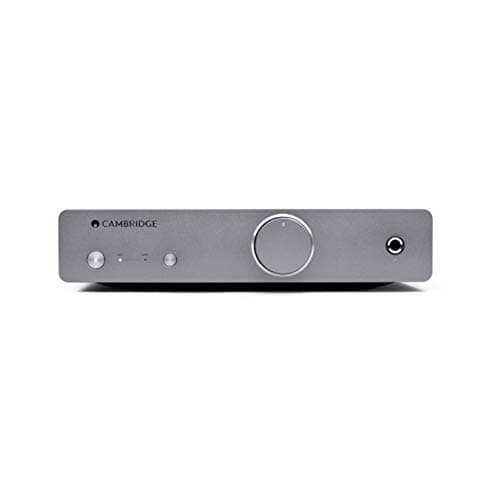
Top pick: Cambridge Audio Alva Duo
Best overall under $500. #ad Affiliate link — we earn a commission at no extra cost to you.
The short answer
The best phono preamp for most people is the Cambridge Audio Alva Duo — because it is the most completely specified phono stage we stock and the specification is good: 39 dB of gain for moving magnet and 60 dB for moving coil, loading published as both an impedance and a capacitance (47 kΩ MM, 100 Ω MC, 100 pF input), RIAA accuracy of ± 0.3 dB, an overload margin over 30 dB, equivalent input noise of about 0.09 µV, and MM distortion under 0.0025%. It is for the listener who wants one box that handles any cartridge in our registry and tells you in advance whether it will. The budget pick is the Fosi Audio Box X1 — the cheapest phono stage we stock, with a published 70 dB signal-to-noise figure, THD at or under 0.08% at 1 kHz and 3 mV, a 2 V maximum output and a headphone socket. Its cost is stated plainly below and it is the reason it ranks last: Fosi publishes no gain figure and no input loading for it at all, so you cannot check a cartridge match against it before you buy.
If you only read one section, read the one on RIAA tolerance. Cambridge quotes ± 0.3 dB and Pro-Ject quotes under 0.4 dB, so Cambridge looks tighter — but Cambridge measures from 30 Hz and Pro-Ject measures from 20 Hz, and the octave Cambridge leaves out is the one where RIAA error is largest.
Disclosure: we earn a commission if you buy through the links on this page, at no extra cost to you. It does not influence what we pick — our criteria are published and reproducible, so you can check our work. How we pick · Full disclosure
These picks are spec-and-price analyses, not listening tests. We have not heard this gear and we do not pretend to have: every figure below is sourced to the manufacturer and linked, and every price is live or not shown at all. Here are the rules we followed.
Quick picks
Ranked on the published criteria in How We Pick. Prices are live as of November 23, 2026. Tap any row for the full write-up.
- 8.5
- 8.3
- 8.4$199.00View on Amazon
$249.0020% off
- 6.8$137.00View on Amazon
$149.008% off
- 6.6
- 7.4$119.98View on Amazon
$149.9820% off
- 5.4$31.99View on Amazon
$39.9920% off
| # | Product | Best for | Score | Price |
|---|---|---|---|---|
| 1 | Cambridge Audio Alva Duo The tightest RIAA tolerance in the bracket at ± 0.3 dB, a real 60 dB moving-coil stage, and a spec sheet that states the reference conditions for every noise and distortion figure on it. | Best overall under $500 | 8.5 | |
| 2 | 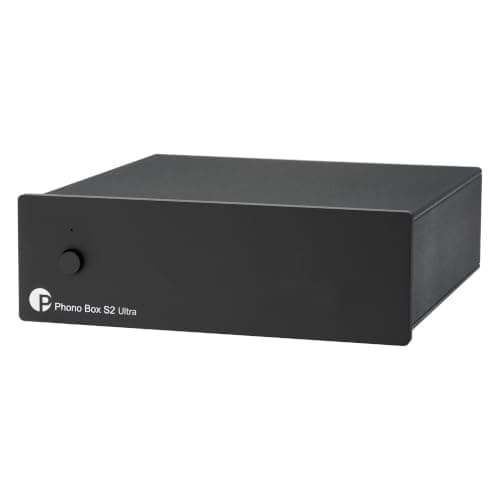 Pro-Ject Phono Box S2 Ultra Four loading impedances, two capacitance settings and four gain steps, which makes it the only stage in the bracket that can actually be set to what a cartridge maker recommends. | Best for matching a specific cartridge | 8.3 | |
| 3 | 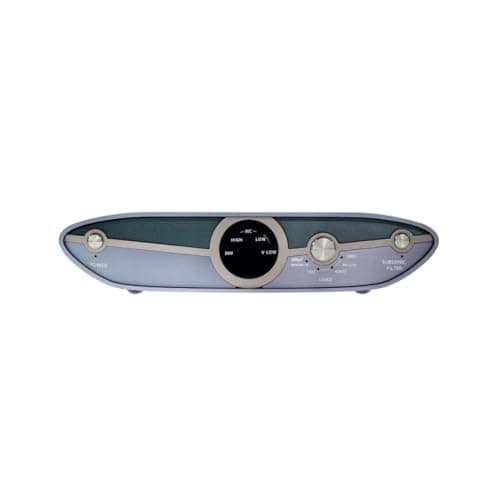 iFi ZEN Phono 3 72 dB of gain at its highest setting — the only box here that will lift a genuinely low-output moving-coil cartridge without a step-up transformer. | Best for very low-output cartridges | 8.4 | $199.00View on Amazon $249.0020% off |
| 4 | 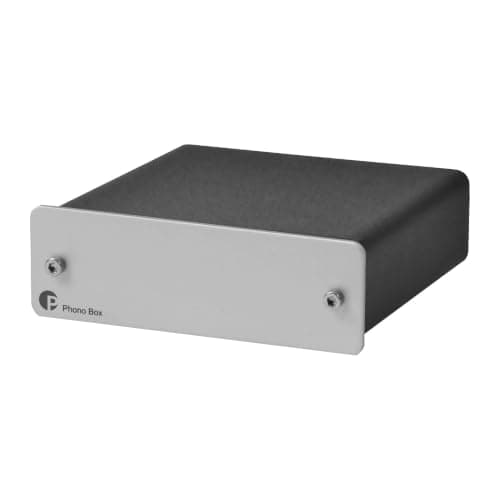 Pro-Ject Phono Box DC A 40 dB moving-magnet stage with a 60 dB moving-coil position on a rear-panel switch, at roughly what the MM-only boxes on this page ask. | Cheapest MM and MC in one box | 6.8 | $137.00View on Amazon $149.008% off |
| 5 | 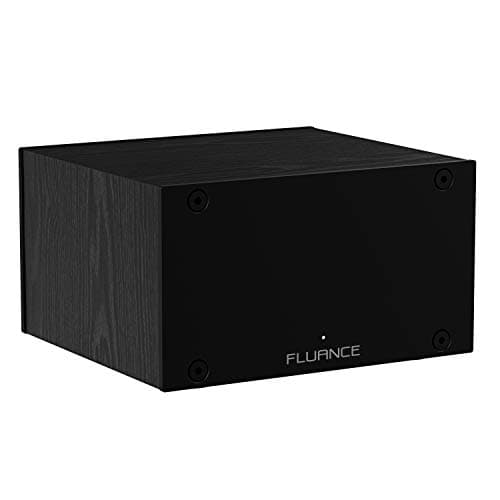 Fluance PA10 A moving-magnet stage priced to sit under a Fluance RT82 or RT85, which is precisely the gap those decks leave by shipping without one. | Best match for a Fluance deck | 6.6 | |
| 6 | 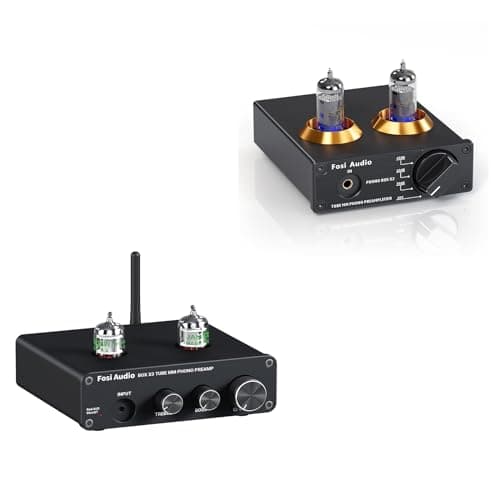 Fosi Audio Box X2 Two valves, three published gain settings and the best published THD and signal-to-noise of any tube phono stage we could verify under $150 — with no loading adjustment of any kind and no named factory tube. | Best tube phono stage you can buy today | 7.4 | $119.98View on Amazon $149.9820% off |
| 7 | 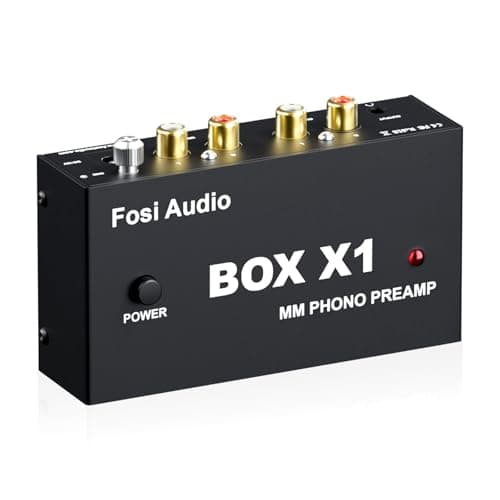 Fosi Audio Box X1 A palm-sized moving-magnet stage with a headphone output, and the only box under $50 here whose maker publishes a distortion and noise figure at all. | Best under $50 | 5.4 | $31.99View on Amazon $39.9920% off |
A phono stage does two jobs, and almost every roundup ranks it on neither of them. It amplifies a signal that arrives somewhere between a third of a millivolt and five and a half millivolts, and it applies the RIAA equalisation curve that was used to cut the record. Both jobs are specified by numbers that manufacturers either publish or quietly omit, and the omissions cluster at the cheap end in a way that matters more than price.
So this page ranks on four published criteria, in this order. First, gain — because without it you cannot tell whether your cartridge will be too quiet or will overload the input. Second, loading, stated as botha resistive impedance and a capacitance, because a moving-magnet cartridge’s treble response depends on the capacitance it sees and the manufacturer of your cartridge publishes a recommended figure for it. Third, RIAA accuracy with the frequency band it was measured across. Fourth, whether the box handles moving coil at all.
The picks compared, spec by spec
Read the first two columns together and the ranking explains itself. The two preamps with blank cells in the gain row are the Fosi Box X1 — where “Not published” is Fosi’s own position — and the iFi, whose capacitance options are published but whose resistive loading is not. The blanks in the RIAA row for the iFi and the Fluance are absences in those makers’ documents, not in our research: both publish a signal-to-noise figure and a distortion figure but no equalisation tolerance at all.
Every figure below is the manufacturer’s own published value and links to the document we read it from. “Not published” means the manufacturer does not publish that figure; an em dash means we have no published figure for that model. Prices are live as of November 23, 2026.
Best overall under $500
- Gain
- —
- Loading (impedance + capacitance)
- 47 kΩ MM / 100 Ω MC · 100 pF — fixed
- RIAA accuracy, and its band
- ± 0.3 dB — but from 30 Hz
- Cartridge support
- MM and MC
Best for matching a specific cartridge
- Loading (impedance + capacitance)
- 10 Ω / 100 Ω / 1 kΩ / 47 kΩ · 100 or 220 pF
- RIAA accuracy, and its band
- < 0.4 dB across 20 Hz–20 kHz
- Cartridge support
- MM and MC
Best for very low-output cartridges
- Loading (impedance + capacitance)
- 100 / 200 pF — no impedance published
- RIAA accuracy, and its band
- —
- Cartridge support
- MM and MC (three MC modes)
Cheapest MM and MC in one box
- Loading (impedance + capacitance)
- 47 kΩ / 120 pF MM · 100 Ω / 120 pF MC
- RIAA accuracy, and its band
- max 0.5 dB across 20 Hz–20 kHz
- Cartridge support
- MM or MC, rear switch
Best match for a Fluance deck
- Gain
- 38 dB
- Loading (impedance + capacitance)
- 100 pF — no impedance published
- RIAA accuracy, and its band
- —
- Cartridge support
- Moving magnet only
Best tube phono stage you can buy today
- Gain
- 39 / 42 / 45 dB
- Loading (impedance + capacitance)
- Not published
- RIAA accuracy, and its band
- “Standard RIAA” — no dB figure
- Cartridge support
- Moving magnet only
Best under $50
- Gain
- Not published
- Loading (impedance + capacitance)
- Not published
- RIAA accuracy, and its band
- “Standard RIAA” — no dB figure
- Cartridge support
- Moving magnet only
Prices as of November 23, 2026; every “Check Price” link goes to Amazon and earns us a commission at no extra cost to you. #ad
The RIAA figure that looks tighter and is not
RIAA accuracy is the one specification on this page that is routinely misread, because two makers quote it to different bands and nobody prints the band in a comparison table.
Compare the tolerance AND the band it is quoted across
Inputs
- Cambridge Audio Alva Duo RIAA accuracy: ± 0.3 dB, quoted across 30 Hz – 20 kHz (Cambridge Audio product page)
- Pro-Ject Phono Box S2 Ultra RIAA accuracy: < 0.4 dB, quoted across 20 Hz – 20 kHz (Pro-Ject product page)
Result
Why the Alva Duo wins
It is not the cheapest, it does not have the lowest published distortion, and it is not the most adjustable. It wins because it is the only phono stage we stock that publishes every figure needed to predict a cartridge match and then publishes the awkward ones too.
Cambridge states gain at 1 kHz for both cartridge types, the loading for both, a 300 mV nominal output with the input sensitivity that produces it (3.35 mV MM, 305 µV MC), signal-to-noise over 90 dB MM and over 70 dB MC with the reference conditions attached, THD+N under 0.0025% MM, crosstalk over 85 dB at 10 kHz, an overload margin over 30 dB, and power consumption with an auto power-down time. Three things it does notpublish are worth naming because they are the gaps in the best box here: no output impedance, no maximum output level, and no standalone frequency response with a tolerance. Its headphone output has no published power, impedance range or level either, and its switchable subsonic filter has no published corner frequency or slope — so you cannot calculate what that filter does at any given frequency.
Who should skip it: anyone with an unusual cartridge. Neither of its loading impedances is adjustable, so a moving coil that wants anything other than 100 Ω is not a match. That is exactly the case the second pick exists for.
The other six, and who each is for
Pro-Ject Phono Box S2 Ultra— for matching a specific cartridge. It is the only solid-state box here with adjustable loading: four impedances (10 Ω, 100 Ω, 1 kΩ, 47 kΩ) and two capacitances (100 pF, 220 pF), with four gain settings from 40 to 63 dB. It also publishes the lowest distortion figure in the registry at 0.00052% — with no test conditions stated, which is why it is not the headline of this page — a 89 dB V MM signal-to-noise figure, and a subsonic filter specified as −18 dB at 20 Hz. The catch is a real one: Pro-Ject does not say which gain settings it intends for MM and which for MC, so matching is on you.
iFi ZEN Phono 3— for a very low output moving coil. Four gain modes — 36 dB MM, then 48, 60 and 72 dB across three MC settings — and 72 dB is the highest published gain figure in our registry by a wide margin. Signal-to-noise is published per mode (91 dB(A) MM down to 78.6 dB(A) on MC V-Low), as is THD per mode. What iFi does not publish is any resistive loading value, only 100/200 pF of capacitance, which means that for a cartridge with a specific impedance requirement you are matching on gain alone.
Pro-Ject Phono Box DC— the cheapest box here that does both cartridge types with the loading published for each: 47 kΩ / 120 pF for MM, 100 Ω / 120 pF for MC, 40 and 60 dB of gain, 94 dBA and 75 dBA noise floors, and RIAA accuracy of max 0.5 dB across the full band. For anyone whose upgrade path runs from a moving-magnet cartridge to a moving coil, this is the sensible place to stop thinking about phono stages for a while.
Fluance PA10— for a Fluance deck or any moving-magnet cartridge. 38 dB of gain, 100 pF of loading, signal-to-noise over 90 dB, THD of 0.004% — which is better than the valve box above it and better than both Fosi boxes — and a selectable subsonic high-pass that rolls off below 20 Hz. It is moving-magnet only and publishes no resistive loading or RIAA tolerance, which is what keeps it out of the top four.
Fosi Audio Box X2— for the valve option, honestly labeled. Two tubes, three published gain modes (39 / 42 / 45 dB), a 600 mV output at a 3 mV input, a signal-to-noise figure at or over 98 dB and THD at or under 0.1%. The qualifications are all documentation: Fosi does not name the factory tube anywhere, does not state whether that 98 dB is A-weighted, does not state the measurement frequency for the distortion figure, publishes no RIAA tolerance in dB, and publishes no loading at all. Our tube phono stage roundup goes further into what a valve stage does and does not buy you.
Fosi Audio Box X1— the budget pick, and the right first phono stage for someone whose amplifier has no phono input and whose cartridge came with the turntable. 70 dB signal-to-noise, THD at or under 0.08% at 1 kHz and 3 mV, a 2 V peak-to-peak maximum output into 10 kΩ, RCA and 3.5 mm outputs, and a grounding post. It publishes no gain and no loading, which is a real limitation and not a fatal one: with the moving-magnet cartridge supplied on almost every turntable under $500 it will work, and if you later buy a cartridge with a published capacitance requirement you will have to replace it to meet that requirement.
What nobody at this price publishes
Three absences run across the whole field. Only two of the seven publish a resistive loading value for a moving-magnet input, even though every moving-magnet cartridge manufacturer publishes a recommended one. Only one publishes an overload margin, which is the figure that tells you whether a loud passage will clip the input. And not one of the seven publishes an output impedance, which is what you would need to predict how it drives a long interconnect into a high-capacitance cable. If a cartridge is already chosen, start from its published recommended load — our under-$500 cartridge roundup lists those figures — and work backwards to the box that states it will provide it.
Every pick in detail
Every specification below links to the manufacturer document we read it from. Where a manufacturer does not publish a figure, we say so rather than estimating it.
Cambridge Audio Alva Duo
Best overall under $500Price as of November 23, 2026. #ad
The tightest RIAA tolerance in the bracket at ± 0.3 dB, a real 60 dB moving-coil stage, and a spec sheet that states the reference conditions for every noise and distortion figure on it.
- published data
- 9/10
- riaa accuracy
- 10/10
- cartridge support
- 8/10
- adjustability
- 4/10
- value for money
- 8/10
| Specification | Published value | Source |
|---|---|---|
| Gain (1 kHz) | 39 dB (MM), 60 dB (MC) | Cambridge Audio product page |
| Cartridge support | MM and MC | Cambridge Audio product page |
| Loading | MM: 47 kΩ. MC: 100 Ω. Input capacitance 100 pF. Neither impedance is adjustable. | Cambridge Audio product page |
| RIAA accuracy | ± 0.3 dB (30 Hz – 20 kHz) — the tightest published figure in this bracket, tied with the NAD PP 4 | Cambridge Audio product page |
| Input sensitivity (ref. nominal output) | 3.35 mV (MM), 305 µV (MC) | Cambridge Audio product page |
| Nominal output | 300 mV | Cambridge Audio product page |
| Signal-to-noise | MM: > 90 dB; MC: > 70 dB (grounded inputs, ref. 1 V output, 20 Hz – 20 kHz bandwidth) | Cambridge Audio product page |
| THD+N (1 kHz) | MM: < 0.0025%; MC: < 0.20% (20 Hz – 20 kHz bandwidth) | Cambridge Audio product page |
| Equivalent input noise (A-weighted) | ~0.09 µV (MM), ~0.08 µV (MC) | Cambridge Audio product page |
| Overload margin | > 30 dB | Cambridge Audio product page |
| Crosstalk (10 kHz) | MM: > 85 dB; MC: 75 dB | Cambridge Audio product page |
| Headphone output | Yes — 6.35 mm. Cambridge publishes no output power, no impedance range and no level for it. | Cambridge Audio product page |
| Subsonic filter | Yes, switchable. No corner frequency and no slope are published, so its effect at any given frequency cannot be calculated. | Cambridge Audio product page |
| Power | Switch-mode supply; 10 W maximum consumption, under 0.5 W standby, auto power-down after 20 minutes | Cambridge Audio product page |
| Frequency response as a standalone figure with tolerance | Not published | — |
| Maximum output level | Not published | — |
| Output impedance | Not published | — |
Pros
- RIAA accuracy ± 0.3 dB (30 Hz – 20 kHz) — tied with the NAD PP 4 for the tightest published figure here
- 60 dB of MC gain with 100 Ω loading, enough for most low-output moving coils
- Every noise and distortion figure carries its measurement conditions and bandwidth
- Headphone output on the front, so it doubles as a desk source without a second box
Cons
- MC distortion is published as < 0.20% against < 0.0025% for MM — the moving-coil stage is far noisier by Cambridge's own figures
- Loading is fixed (47 kΩ MM, 100 Ω MC); nothing is adjustable to a cartridge's recommendation
- The subsonic filter has no published corner frequency or slope, so its effect cannot be calculated
- Nothing is published about the headphone output — no power, no impedance range, no level
Skip it if your cartridge's maker specifies a load this box cannot provide, or you want the lowest distortion figure on the page — the Pro-Ject Phono Box S2 Ultra publishes four loading impedances and a THD figure two orders of magnitude lower.
Pro-Ject Phono Box S2 Ultra
Best for matching a specific cartridgePrice as of November 23, 2026. #ad
Four loading impedances, two capacitance settings and four gain steps, which makes it the only stage in the bracket that can actually be set to what a cartridge maker recommends.
- published data
- 7/10
- riaa accuracy
- 8/10
- cartridge support
- 9/10
- adjustability
- 10/10
- value for money
- 9/10
| Specification | Published value | Source |
|---|---|---|
| Gain | 40 / 43 / 60 / 63 dB (four settings). Pro-Ject does not state which settings it intends for MM and which for MC. | Pro-Ject product page |
| Cartridge support | MM and MC | Pro-Ject product page |
| Loading | Impedance 10 Ω / 100 Ω / 1 kΩ / 47 kΩ; capacitance 100 pF / 220 pF — the only adjustable loading in this bracket apart from the Tube Box S2 | Pro-Ject product page |
| THD | 0.00052% — the lowest published distortion figure in this bracket by a wide margin. Pro-Ject states no test conditions for it. | Pro-Ject product page |
| Signal-to-noise | 89 dB V (MM). No MC figure and no reference conditions are published. | Pro-Ject product page |
| RIAA accuracy | < 0.4 dB (20 Hz – 20 kHz) — quoted across the full band, where Cambridge's figures start at 30 Hz | Pro-Ject product page |
| Subsonic filter | Switchable, −18 dB at 20 Hz. The per-octave slope is not published. | Pro-Ject product page |
| Power | Outboard supply, 18 V DC / 500 mA; consumption 18 V / 80 mA | Pro-Ject product page |
| Output voltage or maximum output level | Not published | — |
| Input sensitivity | Not published | — |
| Overload margin | Not published | — |
| Channel separation | Not published | — |
Pros
- Loading switchable across 10 Ω / 100 Ω / 1 kΩ / 47 kΩ and 100 / 220 pF — the adjustability the fixed-load boxes cannot offer
- Published THD of 0.00052%, the lowest figure on this page by a wide margin
- RIAA accuracy quoted as < 0.4 dB across the full 20 Hz – 20 kHz band, where Cambridge's figures begin at 30 Hz
- Four gain settings from 40 dB to 63 dB cover high-output MM through low-output MC
Cons
- Pro-Ject does not say which gain settings it intends for MM and which for MC, so the pairing is left to you
- The 89 dB V signal-to-noise figure is published with no reference conditions, and there is no MC noise figure at all
- No test conditions are stated for the 0.00052% THD figure either, which makes it hard to compare with Cambridge's bandwidth-qualified numbers
- No input sensitivity, no output level and no overload margin are published
Skip it if you want the flattest published playback curve or a spec sheet whose every figure carries its conditions — the Cambridge Alva Duo is tighter on RIAA and far more careful about stating how it measured things.
iFi ZEN Phono 3
Best for very low-output cartridges72 dB of gain at its highest setting — the only box here that will lift a genuinely low-output moving-coil cartridge without a step-up transformer.
- flexibility
- 9/10
- noise
- 9/10
- value for money
- 7/10
- build quality
- 8/10
- connectivity
- 9/10
| Specification | Published value | Source |
|---|---|---|
| Gain | 36 dB (MM), 48 dB (MC High), 60 dB (MC Low), 72 dB (MC V-Low) | iFi spec page |
| Cartridge support | MM and MC (MI not listed) | iFi spec page |
| Loading | 100/200 pF (MM and MC High) | iFi spec page |
| Signal-to-noise | MM: 91 dB(A); MC High: 81 dB(A); MC Low: 89.6 dB(A); MC V-Low: 78.6 dB(A) | iFi spec page |
| THD | MM: < 0.0027%; MC High: < 0.0095%; MC Low: < 0.031% | iFi spec page |
| Subsonic filter | Yes — “Intelligent Subsonic Filter” | iFi spec page |
| Power | External DC 5 V / 0.5 A (center positive) | iFi spec page |
Pros
- 72 dB gain on its MC V-Low setting — 12 dB more than the Mani 2's maximum, which is the difference between working and not with a very low-output cartridge
- Four gain settings covering MM through low-output MC, plus a subsonic filter
- Balanced output on a phono stage at this price is unusual
Cons
- Above the $200 bracket at its current live price
- Only 100/200 pF loading — the Mani 2 offers four capacitance and four resistance options
- Curved case does not stack with anything
Skip it if your cartridge is a moving magnet. You would be paying for 36 dB of gain you will never switch on — and the Mani 2 loads more flexibly for less.
Pro-Ject Phono Box DC
Cheapest MM and MC in one boxA 40 dB moving-magnet stage with a 60 dB moving-coil position on a rear-panel switch, at roughly what the MM-only boxes on this page ask.
- flexibility
- 6/10
- noise
- 8/10
- value for money
- 7/10
- build quality
- 7/10
- connectivity
- 6/10
| Specification | Published value | Source |
|---|---|---|
| Gain | 40 dB (MM) · 60 dB (MC) | Pro-Ject spec page |
| Cartridge support | MM or MC, selected by a switch on the rear panel | Pro-Ject spec page |
| Loading | MM 47 kΩ / 120 pF · MC 100 Ω / 120 pF | Pro-Ject spec page |
| Noise floor | 94 dBA (MM) · 75 dBA (MC) | Pro-Ject spec page |
| THD | 0.01% (MM) · 0.05% (MC) | Pro-Ject spec page |
| RIAA accuracy | 20 Hz – 20 kHz / max. 0.5 dB | Pro-Ject spec page |
| Subsonic filter | Not published | — |
| Power | Outboard 18 V / 200 mA DC supply; under 1 W standby | Pro-Ject spec page |
Pros
- Moving magnet and moving coil on one switch — 40 dB or 60 dB from the same box
- Pro-Ject publishes a noise figure for both positions: 94 dBA on MM, 75 dBA on MC
- RIAA accuracy published as max. 0.5 dB across 20 Hz – 20 kHz, which nothing else near this price states
Cons
- Loading is fixed in both positions — 47 kΩ / 120 pF on MM, 100 Ω on MC, with no adjustment either way
- No subsonic filter published
- One moving-coil setting only, so a cartridge that wants anything other than 100 Ω has to live with it
Skip it if your cartridge is a moving magnet and always will be. The Fluance PA10 does that job for less and you would be paying for a switch position you never use.
Fluance PA10
Best match for a Fluance deckPrice as of November 23, 2026. #ad
A moving-magnet stage priced to sit under a Fluance RT82 or RT85, which is precisely the gap those decks leave by shipping without one.
- flexibility
- 4/10
- noise
- 8/10
- value for money
- 8/10
- build quality
- 7/10
- connectivity
- 6/10
| Specification | Published value | Source |
|---|---|---|
| Gain | 38 dB | Fluance spec page |
| Cartridge support | Moving magnet only | Fluance spec page |
| Loading | 100 pF | Fluance spec page |
| Signal-to-noise | > 90 dB | Fluance spec page |
| THD | 0.004% | Fluance spec page |
| Subsonic filter | Yes — selectable high-pass, rolls off below 20 Hz | Fluance spec page |
| Power | External 24 V / 500 mA adapter; 0.4 W consumption | Fluance spec page |
Pros
- Fills the exact gap the RT82/RT85 leave
- Aluminum chassis
- Simple and quiet
Cons
- MM only
- No gain adjustment
- No subsonic filter
Skip it if you need MC support now or later.
Fosi Audio Box X2
Best tube phono stage you can buy todayTwo valves, three published gain settings and the best published THD and signal-to-noise of any tube phono stage we could verify under $150 — with no loading adjustment of any kind and no named factory tube.
- published data
- 6/10
- tube disclosure
- 5/10
- gain range
- 8/10
- adjustability
- 3/10
- value for money
- 9/10
| Specification | Published value | Source |
|---|---|---|
| Tubes | 2 × vacuum tubes included. Fosi does not name the factory tube anywhere in its spec table; the product details list 6K4, 6J1, 6J4, GE5654 and 6AK5 as compatible replacements | Fosi Audio product page |
| Gain | 3 switchable modes: 39 / 42 / 45 dB. Published in the product details rather than in the spec table | Fosi Audio product page |
| Cartridge support | Moving magnet only. No MC mode and no MC loading is published | Fosi Audio product page |
| Inputs / outputs | RCA phono in plus a 3.5 mm AUX in; RCA line out | Fosi Audio product page |
| RIAA accuracy | Published only as “Standard RIAA”, with no dB tolerance attached to it | Fosi Audio product page |
| THD | ≤ 0.1%. Fosi does not state the measurement frequency or input level for this figure | Fosi Audio product page |
| Signal-to-noise | ≥ 98 dB. Fosi does not state whether this is A-weighted | Fosi Audio product page |
| Output level | 600 mV at a 3 mV input, 1 kHz | Fosi Audio product page |
| Power | DC 12 V / 1.5 A external supply | Fosi Audio product page |
| Dimensions / weight | 4.66 × 3.85 × 1.29 in; 300 g / 0.66 lb | Fosi Audio product page |
| RIAA accuracy in dB | Not published | — |
| Resistive loading options | Not published | — |
| Input capacitance options | Not published | — |
| Factory tube type | Not published | — |
| Subsonic filter | Not published | — |
Pros
- Three published gain settings (39 / 42 / 45 dB), which is the range an ordinary moving-magnet cartridge actually needs
- THD published at ≤ 0.1% and signal-to-noise at ≥ 98 dB — the best pair of figures of any sub-$150 tube stage verified here
- 600 mV output at a 3 mV input, so the figure can be checked against your cartridge's own published output
- A 3.5 mm AUX input alongside the phono input, so one box feeds a phone and a turntable into one amplifier channel
- Tubes are socketed and Fosi lists five compatible replacement types, so rolling them is supported rather than tolerated
Cons
- No resistive loading and no capacitance setting at all. If your cartridge's maker states a load, you cannot meet it
- Fosi does not name the tube that ships in the box anywhere on the product page — on a product bought for its tubes
- RIAA conformance is published as the words 'Standard RIAA' with no dB tolerance, so it cannot be compared with any stage that publishes one
- No subsonic filter and no measurement condition attached to either the THD or the signal-to-noise figure
- MM only — no moving-coil mode, and no MC loading published
Skip it if your cartridge's maker publishes a load impedance or capacitance you are trying to hit. Nothing on this box is adjustable except gain.
Fosi Audio Box X1
Best under $50A palm-sized moving-magnet stage with a headphone output, and the only box under $50 here whose maker publishes a distortion and noise figure at all.
- flexibility
- 3/10
- noise
- 5/10
- value for money
- 7/10
- build quality
- 5/10
- connectivity
- 7/10
| Specification | Published value | Source |
|---|---|---|
| Gain | Not published | — |
| Cartridge type | Moving magnet (MM turntable input, with a grounding post) | Fosi Audio spec table |
| Signal-to-noise | 70 dB | Fosi Audio spec table |
| THD | ≤ 0.08% at 1 kHz and 3 mV | Fosi Audio spec table |
| Frequency response | “Standard RIAA” — Fosi publishes no deviation figure, so this is a statement of intent rather than a measured tolerance | Fosi Audio spec table |
| Outputs | RCA line out plus a 3.5 mm headphone output | Fosi Audio spec table |
| Output level | 2 V max (P-P) into 10 kΩ | Fosi Audio spec table |
| Input loading (impedance and capacitance) | Not published | — |
| Subsonic filter | Not published | — |
| Power | External 12 V / 1.5 A supply (100–240 V AC input) | Fosi Audio spec table |
| Dimensions / weight | 3.94 × 0.98 × 2.17 in; 0.35 lb (161 g) | Fosi Audio spec table |
Pros
- The only stage on this page with a 3.5 mm headphone output as well as RCA — a turntable and this box alone make a working system
- Fosi publishes a THD figure with its measurement condition (≤ 0.08% at 1 kHz and 3 mV), which the Pyle beneath it does not qualify at all
- Genuinely tiny at 3.94 × 0.98 × 2.17 in and 0.35 lb, with a proper grounding post
Cons
- Fosi publishes no gain figure — on a page where gain is the number that decides everything, that is the one omission that matters
- 70 dB signal-to-noise and 0.08% THD are the same modest figures the $22 Pyle publishes, at roughly twice the money
- Moving magnet only, with no loading options and no subsonic filter published
Skip it if you will ever fit a moving-coil cartridge, or you need to know the gain before you buy. Neither question is answered here.
Frequently asked questions
What is the best phono preamp?
How much gain does a phono preamp need?
Does input capacitance matter on a phono preamp?
Is a more expensive phono preamp always better specified?
Do I need a phono preamp if my amplifier has a phono input?
Read next
The Best Phono Preamps Under $200
Phono stages under $200 ranked on published gain, loading flexibility and noise — including one we would actively skip.
The Best Phono Preamps Under $500
Six phono stages from $249 to $499, ranked on published RIAA accuracy and whether the loading can be matched to your cartridge.
The Best Phono Preamps Under $100
Eight phono stages under $100, ranked on what their makers actually publish — gain, loading, noise — rather than on the box they come in.
The Best Tube Phono Preamps for a Turntable
Three tube phono stages ranked on published RIAA accuracy, loading and gain: Pro-Ject's ± 0.4 dB against Douk's ± 3 dB, with one maker refusing to put a number on it at all - and a note on which of the three has a live offer today.
Do I Need a Phono Preamp?
Yes, unless you already have one — and it might be hiding in your turntable, amplifier or speakers. Check in 30 seconds.
The Best Phono Cartridges Under $500
Six cartridges under $500 spanning an eighteen-fold range of output voltage, ranked on published output, recommended load and stylus profile — including the famous one that publishes almost nothing.
Sources
Every specification on this page was read from one of these documents. If one of them has changed, or we have made an error, tell us — corrections are logged and dated per our editorial policy.