The Best Gifts for Vinyl Lovers
The good news is that a record player is the one hi-fi component people genuinely want upgraded. The bad news is that half the obvious gifts physically do not fit half the turntables — so this page is organised around what you need to find out first.
Disclosure: we earn a commission if you buy through the links on this page, at no extra cost to you. It does not influence what we pick — our criteria are published and reproducible, so you can check our work. How we pick · Full disclosure
These picks are spec-and-price analyses, not listening tests. We have not heard this gear and we do not pretend to have: every figure below is sourced to the manufacturer and linked, and every price is live or not shown at all. Here are the rules we followed.
Quick picks
Ranked on the published criteria in How We Pick. Prices are live as of September 15, 2026. Tap any row for the full write-up.
- 7.8$149.99View on Amazon
$159.006% off
- 8.4$64.85View on Amazon
$74.0012% off
- 8.2$102.99View on Amazon
$109.996% off
- 5.4
- 7.2$159.99View on Amazon
$189.9916% off
| # | Product | Best for | Score | Price |
|---|---|---|---|---|
| 1 | 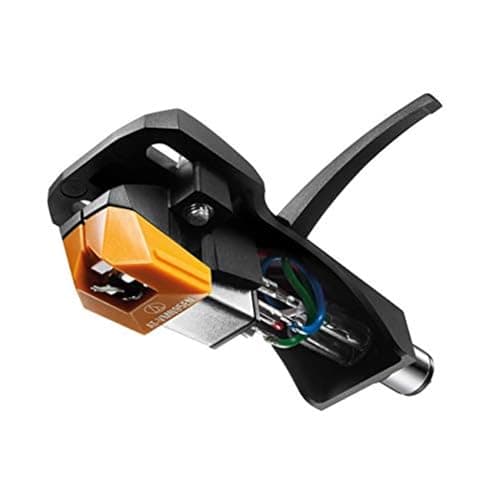 Audio-Technica AT-VM95EN/H The nude-stylus VM95 supplied already mounted and aligned on an AT-HS6 headshell, which removes the single most error-prone step in fitting a cartridge. | Best for a removable headshell | 7.8 | $149.99View on Amazon $159.006% off |
| 2 | 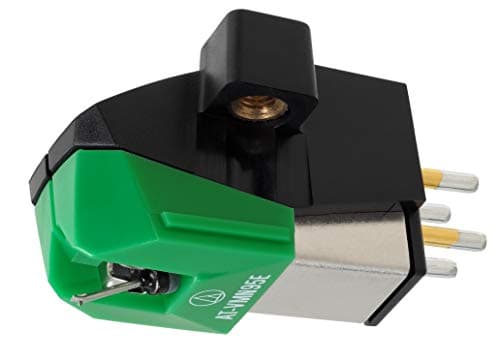 Audio-Technica AT-VM95E The cheapest way into a cartridge body that accepts seven different styli, so every later upgrade costs a stylus rather than a cartridge. | Best first upgrade | 8.4 | $64.85View on Amazon $74.0012% off |
| 3 | 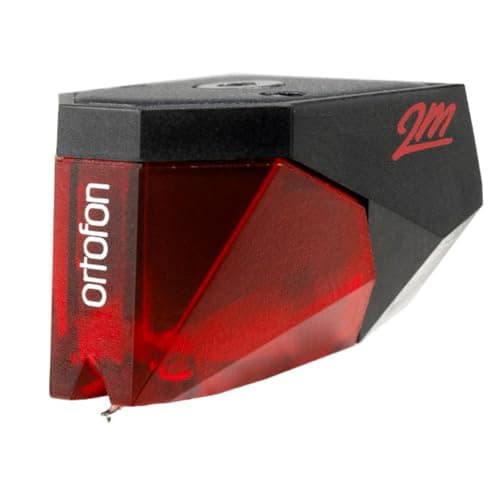 Ortofon 2M Red The only cartridge here whose maker publishes a frequency response with a tolerance and a tracking-ability figure, which makes it the one you can actually verify a claim against. | Best published data | 8.2 | $102.99View on Amazon $109.996% off |
| 4 | 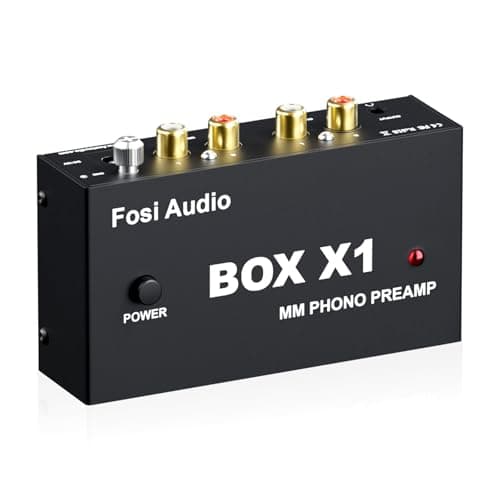 Fosi Audio Box X1 A palm-sized moving-magnet stage with a headphone output, and the only box under $50 here whose maker publishes a distortion and noise figure at all. | Best under $50 | 5.4 | |
| 5 | 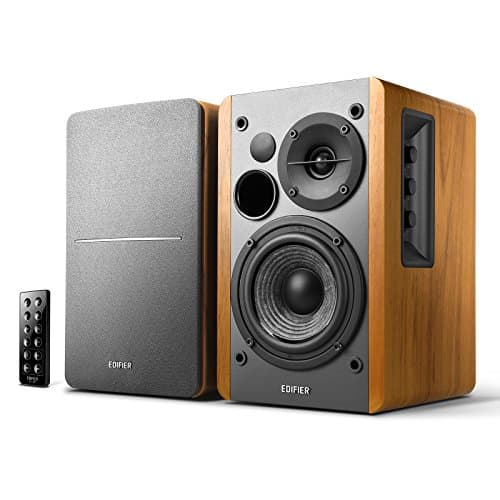 Edifier R1280DB The R1280T plus Bluetooth and optical/coaxial inputs — still no phono stage, but a far more useful set of sockets. | Best budget powered pair with digital inputs | 7.2 | $159.99View on Amazon $189.9916% off |
If you are buying for a record person and you do not listen to records yourself, the thing to understand before anything else is that a turntable is four separate products stacked on top of each other: a plinth, a motor, an arm and a cartridge. You are almost never buying them a turntable. You are buying them a better version of one of the four parts, and the parts are not universally interchangeable.
That sounds discouraging. It is actually the opposite, because it means a $65 part can be a genuinely significant present, which is not true in most categories. The cartridge is the component that physically reads the record. Improving it changes more of what they hear than anything else at the price.
The one question to answer first
Before you buy anything on this page, find out one thing: does their turntable have a removable headshell?
The headshell is the small plate at the end of the tonearm that the cartridge bolts onto. On some decks it unclips with a twist of a collar; on others the arm and headshell are one piece. You can usually tell from a photograph of the end of the arm, or by asking them what deck they own and searching the model.
It matters because the best gift here — a cartridge that arrives already mounted and aligned — only fits decks with a removable headshell. On a fixed-headshell deck it cannot be fitted at all, and you would be buying a part they cannot use.
Why a pre-mounted cartridge is the pick
Fitting a bare cartridge means aligning it on a protractor, setting the overhang, setting the tracking force and setting anti-skate, with a diamond stylus and four tiny wires involved. Plenty of people enjoy that. Plenty of others have owned a turntable for six years and never touched it, which is precisely why the cartridge is still the stock one and why it is a good present.
The Audio-Technica AT-VM95EN/H removes that entire step: it is the nude-stylus VM95 supplied already mounted and aligned on an AT-HS6 headshell. On a deck with a removable headshell, fitting it is a twist of a collar. For a gift, that is the difference between something they use on Christmas afternoon and something that sits in a drawer until spring.
Two honest caveats, both from Audio-Technica’s own documentation. It is useless on a fixed-headshell deck — on an AT-LP70X or an AT-LP60XBT it cannot be fitted at all. And Audio-Technica does not publish the combined cartridge-plus-headshell mass, which is the figure arm-resonance arithmetic needs. For most decks this is theoretical. On a very light or very heavy arm it is not.
If their deck has a fixed headshell
Then you want a bare cartridge, and the person opening it will need to align it. The AT-VM95E is the standard answer and the reason is the upgrade path rather than the part itself: the VM95 body accepts the entire VM95 stylus range, from conical up to Shibata, so every future improvement costs a stylus rather than a whole cartridge. Buying someone into that body is buying them five years of cheap upgrades.
One thing to check that catches gift-buyers specifically: several decks already ship with a VM95E, including the AT-LP120XUSB. If theirs is one of them, a second one changes nothing and you should buy a better stylus for the body they own instead.
The Ortofon 2M Red is the other standard first cartridge, and it is the one we would choose if the recipient is the sort of person who reads spec sheets. It is the only cartridge we cover whose maker publishes a frequency response with an actual tolerance (20 Hz–20 kHz at +3/−1 dB) and a tracking-ability figure. It is also the heaviest cartridge in that group at 7.2 g, which matters on a light arm, and Ortofon quotes compliance at a different convention than Audio-Technica so the two numbers are not directly comparable. Our cartridge roundup works through all of this properly.
If they are running the turntable into something with no phono input
A turntable’s output is roughly a hundred times quieter than line level and has had its bass deliberately removed at the cutting stage. A phono stage fixes both. If their record player sounds thin and quiet through their amplifier, this is why, and a $40 box solves it.
The Fosi Audio Box X1 is the pick under $50 for a reason that suits a gift: it has a 3.5 mm headphone output as well as RCA, so a turntable and this box alone make a working system with nothing else at all. Fosi also publishes a distortion figure with its measurement condition, which the cheaper boxes at this price do not. What they do not publish is a gain figure — on a page where gain decides everything, that is the omission that matters, and it is the reason this is a fourth pick rather than a first.
Check before buying: many turntables and many amplifiers already contain a phono stage. The 30-second test for whether they need one is here, and it is worth running, because buying a second phono stage for a system that has one is the most common wasted gift in this category.
If they have a turntable and nothing to play it through
It happens more than you would think — a deck bought on impulse, plugged into a Bluetooth speaker or nothing at all. A powered pair is the whole rest of the system in one box.
The Edifier R1280DB is the cheapest credible way to do it, with optical and coaxial digital inputs and Bluetooth on top of the analog pair, so it also works with a television later. The critical caveat is in capitals in our own notes on it: it has no built-in phono stage. Their turntable must have one, or you need the Fosi box above as well. If it does not and you buy only the speakers, they will get exactly no sound, on Christmas morning, in front of everybody.
What we would not buy as a gift
A turntable, unless you know they do not have one — see our under-$250 guide or the beginner roundup for that case. Giving a second deck to someone who already owns one is a large, awkward object they now have to have an opinion about.
Also: a stylus for a cartridge you have not identified. Styli are cartridge-specific, the model number is printed somewhere unhelpful, and a wrong one is non-returnable once opened. If you want to go that route, ask them outright. “What cartridge is on your turntable” is a question a record person enjoys being asked.
Every pick in detail
Every specification below links to the manufacturer document we read it from. Where a manufacturer does not publish a figure, we say so rather than estimating it.
Audio-Technica AT-VM95EN/H
Best for a removable headshellThe nude-stylus VM95 supplied already mounted and aligned on an AT-HS6 headshell, which removes the single most error-prone step in fitting a cartridge.
- specs
- 8/10
- upgrade path
- 9/10
- value for money
- 7/10
- tracking ability
- 7/10
- published data
- 8/10
| Specification | Published value | Source |
|---|---|---|
| Type | VM stereo dual magnet (moving magnet), supplied pre-mounted on an AT-HS6 headshell | Audio-Technica spec page |
| Frequency response | 20–23,000 Hz (no tolerance published) | Audio-Technica spec page |
| Channel separation | 22 dB (1 kHz) | Audio-Technica spec page |
| Output voltage | 3.5 mV (1 kHz, 5 cm/sec) | Audio-Technica spec page |
| Stylus | 0.3 × 0.7 mil elliptical, NUDE round shank (the VM95E's is bonded) | Audio-Technica spec page |
| Cantilever | Aluminum pipe | Audio-Technica spec page |
| Dynamic compliance | 7 × 10⁻⁶ cm/dyne (100 Hz) | Audio-Technica spec page |
| Static compliance | 20 × 10⁻⁶ cm/dyne | Audio-Technica spec page |
| Tracking force | 1.8–2.2 g (2.0 g standard) | Audio-Technica spec page |
| Recommended load | 47,000 Ω, 100–200 pF | Audio-Technica spec page |
| Mount / cartridge weight | Half-inch mount, 6.1 g (cartridge alone) | Audio-Technica spec page |
| Combined cartridge + AT-HS6 headshell mass | Not published | — |
| Replacement stylus | AT-VMN95EN | Audio-Technica spec page |
Pros
- Arrives mounted and aligned on an AT-HS6 headshell — no protractor, no overhang setting, no shaky hands
- A NUDE round-shank diamond, where the VM95E's is bonded: less tip mass for the groove to move
- 22 dB separation and 20 × 10⁻⁶ cm/dyne static compliance, both better than the VM95E
- Drops straight onto any deck with a standard removable headshell, including the AT-LP120XUSB
Cons
- Useless on a fixed-headshell deck — you are paying for a part you cannot fit
- Audio-Technica does not publish the combined cartridge-plus-headshell mass, which is exactly the number arm-resonance arithmetic needs
- 3.5 mV output rather than the VM95E's 4.0 mV
- You pay for a headshell you may already own
Skip it if your turntable has an integrated headshell. On an AT-LP70X or AT-LP60XBT this cannot be fitted at all.
Audio-Technica AT-VM95E
Best first upgradeThe cheapest way into a cartridge body that accepts seven different styli, so every later upgrade costs a stylus rather than a cartridge.
- specs
- 7/10
- upgrade path
- 10/10
- value for money
- 10/10
- tracking ability
- 6/10
- published data
- 9/10
| Specification | Published value | Source |
|---|---|---|
| Type | VM stereo dual magnet (moving magnet) | Audio-Technica spec page |
| Frequency response | 20–22,000 Hz (no tolerance published) | Audio-Technica spec page |
| Channel separation | 20 dB (1 kHz) | Audio-Technica spec page |
| Output voltage | 4.0 mV (1 kHz, 5 cm/sec) | Audio-Technica spec page |
| Output channel balance | 2.0 dB (1 kHz) | Audio-Technica spec page |
| Stylus | 0.3 × 0.7 mil elliptical, bonded round shank | Audio-Technica spec page |
| Cantilever | Aluminum pipe | Audio-Technica spec page |
| Dynamic compliance | 7 × 10⁻⁶ cm/dyne (100 Hz) | Audio-Technica spec page |
| Static compliance | 17 × 10⁻⁶ cm/dyne | Audio-Technica spec page |
| Tracking force | 1.8–2.2 g (2.0 g standard) | Audio-Technica spec page |
| Recommended load | 47,000 Ω, 100–200 pF | Audio-Technica spec page |
| Mount / weight | Half-inch mount, 6.1 g | Audio-Technica spec page |
| Replacement stylus | AT-VMN95E — the whole VM95 stylus range drops into this same body | Audio-Technica spec page |
Pros
- The VM95 body takes the entire VM95 stylus range — conical through Shibata — so the upgrade path costs a stylus, not a cartridge
- 4.0 mV output is the highest of any Audio-Technica cartridge here, so it suits low-gain phono stages
- Audio-Technica publishes both static and dynamic compliance, which is what arm matching needs
- Already fitted to several decks we recommend, so you may own one without knowing
Cons
- A bonded round-shank stylus — the diamond is glued to a metal carrier rather than being solid, which adds tip mass
- 20 dB channel separation is the lowest figure in this group
- 2.0 dB channel balance is the loosest here; the ML is 1.5 dB
- Audio-Technica publishes no tolerance on the 20–22,000 Hz response
Skip it if your deck already ships with a VM95E — several do, and buying a second one changes nothing. Buy a better stylus for the body you own instead.
Ortofon 2M Red
Best published dataThe only cartridge here whose maker publishes a frequency response with a tolerance and a tracking-ability figure, which makes it the one you can actually verify a claim against.
- specs
- 8/10
- upgrade path
- 8/10
- value for money
- 8/10
- tracking ability
- 7/10
- published data
- 10/10
| Specification | Published value | Source |
|---|---|---|
| Type | Moving magnet, quad-coils with split pole pins and OFC coil wire | Ortofon spec page |
| Frequency response | 20 Hz – 20 kHz, +3 / −1 dB | Ortofon spec page |
| Channel separation | 22 dB (1 kHz) | Ortofon spec page |
| Channel balance | 1.5 dB (1 kHz) | Ortofon spec page |
| Output voltage | 5.5 mV (1 kHz, 5 cm/sec) | Ortofon spec page |
| Tracking ability at 315 Hz | 70 µm | Ortofon spec page |
| Stylus | Elliptical, tip radius r/R 8/18 µm, aluminum cantilever | Ortofon spec page |
| Compliance (dynamic, lateral) | 20 µm/mN | Ortofon spec page |
| Tracking force | 1.6–2.0 g (16–20 mN); 1.8 g recommended | Ortofon spec page |
| Tracking angle | 20° | Ortofon spec page |
| Internal impedance / inductance | 1.3 kΩ DC resistance, 700 mH | Ortofon spec page |
| Recommended load | 47 kΩ, 150–300 pF | Ortofon spec page |
| Weight | 7.2 g | Ortofon spec page |
Pros
- 20 Hz – 20 kHz at +3/−1 dB — a real tolerance, which neither Audio-Technica nor Nagaoka publish
- 70 µm tracking ability at 315 Hz published, a spec almost nobody else quotes
- 5.5 mV output, the highest here, so quiet phono stages have an easier job
- The 2M Blue stylus drops straight into this body, so the upgrade is a stylus swap
Cons
- 22 dB separation is mid-pack, and the Blue's 25 dB shows what the same body can do
- A bonded elliptical stylus at this price, where the Blue's is nude
- 7.2 g is the heaviest cartridge in this group — it matters on a light arm
- Ortofon quotes compliance at the 10 Hz convention while Audio-Technica quotes 100 Hz; the two numbers are not directly comparable
Skip it if you plan to buy the 2M Blue within a year. The Blue is the same body with a better stylus, so buying Red first and upgrading costs more in total than starting at Blue.
Fosi Audio Box X1
Best under $50Price as of September 15, 2026. #ad
A palm-sized moving-magnet stage with a headphone output, and the only box under $50 here whose maker publishes a distortion and noise figure at all.
- flexibility
- 3/10
- noise
- 5/10
- value for money
- 7/10
- build quality
- 5/10
- connectivity
- 7/10
| Specification | Published value | Source |
|---|---|---|
| Gain | Not published | — |
| Cartridge type | Moving magnet (MM turntable input, with a grounding post) | Fosi Audio spec table |
| Signal-to-noise | 70 dB | Fosi Audio spec table |
| THD | ≤ 0.08% at 1 kHz and 3 mV | Fosi Audio spec table |
| Frequency response | “Standard RIAA” — Fosi publishes no deviation figure, so this is a statement of intent rather than a measured tolerance | Fosi Audio spec table |
| Outputs | RCA line out plus a 3.5 mm headphone output | Fosi Audio spec table |
| Output level | 2 V max (P-P) into 10 kΩ | Fosi Audio spec table |
| Input loading (impedance and capacitance) | Not published | — |
| Subsonic filter | Not published | — |
| Power | External 12 V / 1.5 A supply (100–240 V AC input) | Fosi Audio spec table |
| Dimensions / weight | 3.94 × 0.98 × 2.17 in; 0.35 lb (161 g) | Fosi Audio spec table |
Pros
- The only stage on this page with a 3.5 mm headphone output as well as RCA — a turntable and this box alone make a working system
- Fosi publishes a THD figure with its measurement condition (≤ 0.08% at 1 kHz and 3 mV), which the Pyle beneath it does not qualify at all
- Genuinely tiny at 3.94 × 0.98 × 2.17 in and 0.35 lb, with a proper grounding post
Cons
- Fosi publishes no gain figure — on a page where gain is the number that decides everything, that is the one omission that matters
- 70 dB signal-to-noise and 0.08% THD are the same modest figures the $22 Pyle publishes, at roughly twice the money
- Moving magnet only, with no loading options and no subsonic filter published
Skip it if you will ever fit a moving-coil cartridge, or you need to know the gain before you buy. Neither question is answered here.
Edifier R1280DB
Best budget powered pair with digital inputsThe R1280T plus Bluetooth and optical/coaxial inputs — still no phono stage, but a far more useful set of sockets.
- integration
- 7/10
- upgrade path
- 3/10
- value for money
- 9/10
- ease of setup
- 9/10
- connectivity
- 8/10
| Specification | Published value | Source |
|---|---|---|
| Type | Powered (amplifier built in) | Edifier spec page |
| Amplifier output | 21 W + 21 W RMS | Edifier spec page |
| Frequency response | 55 Hz – 20 kHz per the US spec table (Edifier's global site markets 51 Hz in body copy — the two disagree) | Edifier US spec page |
| Inputs | Optical, coaxial, Bluetooth, dual RCA | Edifier spec page |
| Built-in phono stage | Not stated either way by Edifier — assume none | Edifier spec page |
| Woofer | 4 in | Edifier spec page |
Pros
- Optical and coaxial digital inputs as well as analog
- Bluetooth
- Still inexpensive
Cons
- NO built-in phono stage
- Same modest drivers as the R1280T
- Bluetooth codec support is basic
Skip it if your turntable has no phono stage of its own.
Frequently asked questions
What is the best gift for someone who collects vinyl?
How do I know if a cartridge will fit their turntable?
Is a phono preamp a good gift?
Should I buy them a turntable?
What should I avoid buying a vinyl collector?
Read next

The Best Hi-Fi Gifts Under $100
Six sub-$100 gifts, each matched to a specific problem in the recipient's existing system rather than picked for being cheap.
Black Friday & Cyber Monday Hi-Fi and Home Theater Deals 2026
A deal board that fills itself from our live price file, plus honest buy-now-or-wait guidance for every class of gear we cover.
The Best Turntable Cartridges Under $200
Six cartridges under $200, ranked on stylus profile, published compliance and output — with the unit-conversion trap explained.
Are Turntable Cartridges Interchangeable?
Three compatibility checks — mount, mass and loading — and the decks where the answer is simply no.
Do I Need a Phono Preamp?
Yes, unless you already have one — and it might be hiding in your turntable, amplifier or speakers. Check in 30 seconds.
Cartridge and Tonearm Matching: Do the Arithmetic
One equation, two published numbers, and the compliance caveat that changes the answer. Worked through with real specs.
Sources
Every specification on this page was read from one of these documents. If one of them has changed, or we have made an error, tell us — corrections are logged and dated per our editorial policy.