Are Turntable Cartridges Interchangeable?
Mechanically, mostly. Electrically, usually. Dynamically, not necessarily — and the deck most likely to stop you is the cheap one with the cartridge molded into the arm.
Disclosure: we earn a commission if you buy through the links on this page, at no extra cost to you. It does not influence what we pick — our criteria are published and reproducible, so you can check our work. How we pick · Full disclosure
These picks are spec-and-price analyses, not listening tests. We have not heard this gear and we do not pretend to have: every figure below is sourced to the manufacturer and linked, and every price is live or not shown at all. Here are the rules we followed.
Quick picks
Ranked on the published criteria in How We Pick. Prices are live as of October 15, 2026. Tap any row for the full write-up.
- 8.4$63.25View on Amazon
$74.0015% off
- 6.8
- 8.2$99.00View on Amazon
$109.9910% off
| # | Product | Best for | Score | Price |
|---|---|---|---|---|
| 1 | 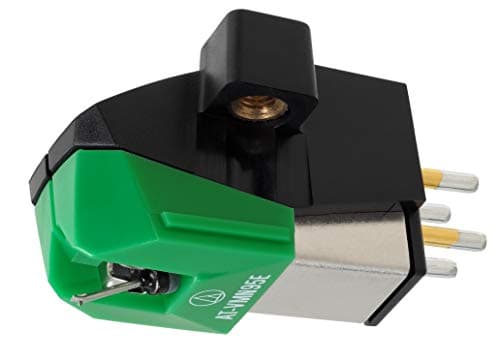 Audio-Technica AT-VM95E The cheapest way into a cartridge body that accepts seven different styli, so every later upgrade costs a stylus rather than a cartridge. | Best first upgrade | 8.4 | $63.25View on Amazon $74.0015% off |
| 2 | 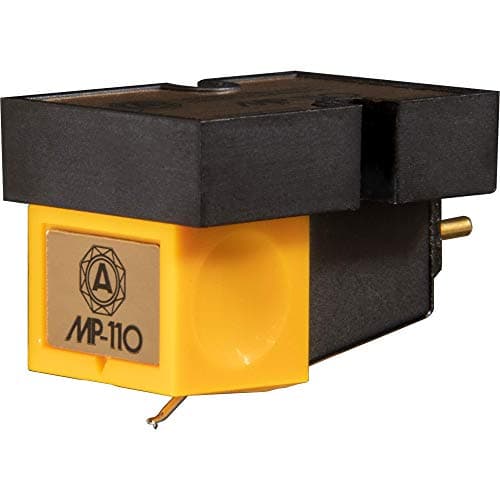 Nagaoka MP-110 A moving-permalloy cartridge with a published 5 mV output and a tracking force range that starts lower than anything else here — and no published compliance at all. | Best for a heavy tonearm | 6.8 | |
| 3 | 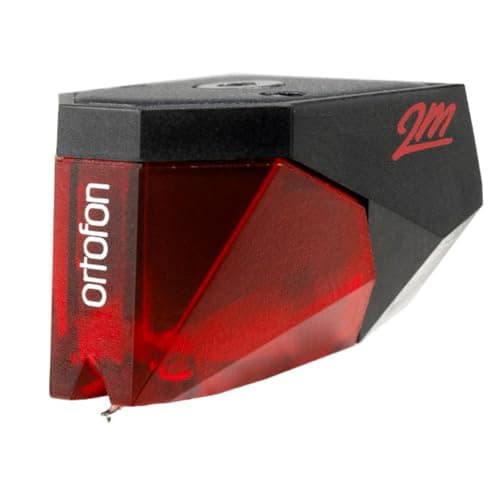 Ortofon 2M Red The only cartridge here whose maker publishes a frequency response with a tolerance and a tracking-ability figure, which makes it the one you can actually verify a claim against. | Best published data | 8.2 | $99.00View on Amazon $109.9910% off |
There are three separate compatibility questions and people usually only ask the first one. Does it bolt on, will the arm behave with it, and will the phono stage load it correctly. The first is nearly always yes. The other two are where the real answers live.
Question one: the mount
Almost every serious cartridge made in the last fifty years uses the same mechanical standard: two bolts on half-inch centers, with four color-coded pins for the two channels. It is why the phrase “half-inch mount” appears on so many spec sheets.
Audio-Technica publishes “half-inch mount, 6.1 g” for the AT-VM95E, the VM95EN/H and the VM95ML. Grado publishes something more unusual for the Prestige Green4: “P-mount or ½-inch screw mount”, meaning it fits both standards.
P-mount (also called T4P) is the other standard worth knowing: a four-pin plug that slides into the arm and fixes with one screw, with alignment set at the factory. It is simpler and it is much less common now.
If your deck has a removable headshell— the AT-LP120XUSB and the Music Hall mmf-1.5 both publish one — swapping cartridges is easier again, because you can buy a second headshell, align a cartridge in it at your leisure, and change the whole assembly in fifteen seconds.
Where the answer is simply no
Two decks in our own picks cannot take a different cartridge, and both are ones we recommend for other reasons. This is the single most useful thing on this page.
- Audio-Technica AT-LP60XBT.The cartridge is an integrated headshell design. Only the stylus swaps — Audio-Technica publishes the AT3600L cartridge with an ATN3600L replacement stylus. The upgrade path ends there and it ends early.
- Audio-Technica AT-LP70X.The cartridge body is non-removable per Audio-Technica’s own manual. Only the stylus swaps — though here that is worth more, because the whole AT-VM95 stylus range drops in.
That second case is the important nuance. A non-replaceable cartridge body with a replaceable stylus is not the same as a dead end. Audio-Technica publishes that the entire VM95 stylus range fits one body, so an LP70X owner can move from the bonded elliptical VMN95E to the nude MicroLinear VMN95ML without touching the cartridge. That is a genuine upgrade path inside a fixed body.
Question two: the arm’s effective mass
This is the one that decides whether a cartridge that bolts on will actually track well, and it is the question the specification sheets are worst at answering.
A cartridge’s suspension and the arm’s mass form a resonant system. Put a high-compliance cartridge on a heavy arm and the resonance falls into the range where warps and rumble live; put a low-compliance one on a light arm and it climbs into the audible band. Neither is catastrophic and both are avoidable.
f = 1000 ÷ (2π × √(M × C)) · M = arm effective mass + cartridge mass (g), C = compliance
Inputs
- Audio-Technica AT-VM95E dynamic compliance: 7 × 10⁻⁶ cm/dyne, MEASURED AT 100 Hz (A-T states the frequency) (Audio-Technica spec page)
- Ortofon 2M Red compliance: 20 µm/mN, dynamic lateral — Ortofon publishes NO measurement frequency (Ortofon spec page)
- Nagaoka MP-110 compliance: Not published at all (Nagaoka spec page)
Result
Units convert exactly: 1 cm/dyne × 10⁻⁶ = 1 µm/mN
Measurement frequency does NOT convert: the same cartridge reads much lower at 100 Hz than at 10 Hz
So the AT-VM95E’s 7 and the 2M Red’s 20 are not three times apart. They may be measured under different conventions, and Ortofon does not say which. A cartridge whose compliance is published without its frequency cannot be put into this formula and trusted.
Do not “fix” this by assuming Ortofon and Grado mean 10 Hz. They do not say so, and our matching page shows the answer moving from 9.6 Hz to 7.4 Hz depending on which convention it turns out to be. That is the difference between a good match and a marginal one, decided by a footnote nobody printed.
The other half of that formula is arm effective mass, and it is worse. Audio-Technica publishes none for any deck we cover. Music Hall publishes none. Fluance publishes figures of 21.8 g, 27.5 g and 28.2 g under that heading, which are far above the 8–14 g a genuine effective mass normally occupies — those look like total arm mass and we flag them rather than computing from them. Pro-Ject publishes 6.0 g for the Debut Carbon EVO, plainly labeled, and it is the only unambiguous figure on the site.
Question three: the loading
A moving-magnet cartridge is a coil and it interacts electrically with what it is plugged into. Every cartridge we cover publishes a recommended load, and they do not all agree.
| Cartridge | Recommended load | Output |
|---|---|---|
| Audio-Technica AT-VM95 range | 47 kΩ, 100–200 pF | 3.5–4.0 mV |
| Ortofon 2M Red | 47 kΩ, 150–300 pF | 5.5 mV |
| Nagaoka MP-110 | 47 kΩ, 100 pF | 5 mV |
| Grado Prestige Green4 | 10 k–47 kΩ — the only cartridge here that does not require 47 k | 4 mV |
The resistance is easy: 47 kΩ is the universal moving-magnet standard and every phono stage we cover provides it. The capacitance is the one that varies, because it includes your tonearm cable and the phono stage’s own input. Nagaoka wants 100 pF and Ortofon wants 150–300 pF, and a fixed-capacitance phono stage cannot satisfy both.
The output voltage matters for a different reason. A 5.5 mV Ortofon into a phono input rated for 2.5 mV has considerably less headroom than a 3.5 mV Audio-Technica does — and phono stage sensitivity is published per model, so the check takes a minute.
What actually changes when you swap
You have to redo the setup. All of it. A new cartridge needs its tracking force set to the new manufacturer’s published range — the AT-VM95E wants 1.8–2.2 g, the Ortofon 2M Red 1.6–2.0 g, the Nagaoka MP-110 1.5–2.0 g and the Grado Green4 1.6–1.9 g. None of those overlap perfectly.
It also needs realigning, because the new cartridge’s stylus sits at a different position relative to the mounting holes. That is a separate job with its own page, and skipping it is the usual reason a new cartridge sounds worse than the old one.
The short answers
- Half-inch to half-inch: yes, mechanically, almost always.
- Integrated headshell (AT-LP60XBT): no. Stylus only.
- Fixed body, swappable stylus (AT-LP70X): not the cartridge, but the whole VM95 stylus range fits, which is a real upgrade path.
- Compliance matching: check it, and accept that two of the four cartridges we cover publish compliance you cannot safely put in the formula.
- Loading:47 kΩ is universal; capacitance is not, and Nagaoka’s 100 pF and Ortofon’s 300 pF are a genuine conflict.
Every pick in detail
Every specification below links to the manufacturer document we read it from. Where a manufacturer does not publish a figure, we say so rather than estimating it.
Audio-Technica AT-VM95E
Best first upgradeThe cheapest way into a cartridge body that accepts seven different styli, so every later upgrade costs a stylus rather than a cartridge.
- specs
- 7/10
- upgrade path
- 10/10
- value for money
- 10/10
- tracking ability
- 6/10
- published data
- 9/10
| Specification | Published value | Source |
|---|---|---|
| Type | VM stereo dual magnet (moving magnet) | Audio-Technica spec page |
| Frequency response | 20–22,000 Hz (no tolerance published) | Audio-Technica spec page |
| Channel separation | 20 dB (1 kHz) | Audio-Technica spec page |
| Output voltage | 4.0 mV (1 kHz, 5 cm/sec) | Audio-Technica spec page |
| Output channel balance | 2.0 dB (1 kHz) | Audio-Technica spec page |
| Stylus | 0.3 × 0.7 mil elliptical, bonded round shank | Audio-Technica spec page |
| Cantilever | Aluminum pipe | Audio-Technica spec page |
| Dynamic compliance | 7 × 10⁻⁶ cm/dyne (100 Hz) | Audio-Technica spec page |
| Static compliance | 17 × 10⁻⁶ cm/dyne | Audio-Technica spec page |
| Tracking force | 1.8–2.2 g (2.0 g standard) | Audio-Technica spec page |
| Recommended load | 47,000 Ω, 100–200 pF | Audio-Technica spec page |
| Mount / weight | Half-inch mount, 6.1 g | Audio-Technica spec page |
| Replacement stylus | AT-VMN95E — the whole VM95 stylus range drops into this same body | Audio-Technica spec page |
Pros
- The VM95 body takes the entire VM95 stylus range — conical through Shibata — so the upgrade path costs a stylus, not a cartridge
- 4.0 mV output is the highest of any Audio-Technica cartridge here, so it suits low-gain phono stages
- Audio-Technica publishes both static and dynamic compliance, which is what arm matching needs
- Already fitted to several decks we recommend, so you may own one without knowing
Cons
- A bonded round-shank stylus — the diamond is glued to a metal carrier rather than being solid, which adds tip mass
- 20 dB channel separation is the lowest figure in this group
- 2.0 dB channel balance is the loosest here; the ML is 1.5 dB
- Audio-Technica publishes no tolerance on the 20–22,000 Hz response
Skip it if your deck already ships with a VM95E — several do, and buying a second one changes nothing. Buy a better stylus for the body you own instead.
Nagaoka MP-110
Best for a heavy tonearmPrice as of October 15, 2026. #ad
A moving-permalloy cartridge with a published 5 mV output and a tracking force range that starts lower than anything else here — and no published compliance at all.
- specs
- 7/10
- upgrade path
- 6/10
- value for money
- 7/10
- tracking ability
- 7/10
- published data
- 4/10
| Specification | Published value | Source |
|---|---|---|
| Type | MP (moving permalloy) stereo cartridge | Nagaoka spec page |
| Frequency response | 20 Hz – 20,000 Hz (no tolerance published) | Nagaoka spec page |
| Channel separation | 23 dB (1 kHz) | Nagaoka spec page |
| Channel balance | 1.5 dB or less | Nagaoka spec page |
| Output voltage | 5 mV (5 cm/sec) | Nagaoka spec page |
| Stylus | 0.4 × 0.7 mil bonded elliptical diamond, aluminum-alloy cantilever | Nagaoka spec page |
| Dynamic compliance | Not published | — |
| Tracking force | 1.5–2.0 g | Nagaoka spec page |
| Recommended load | 47 kΩ, 100 pF | Nagaoka spec page |
| Weight | 6.5 g (16.5 g mounted on Nagaoka's headshell) | Nagaoka spec page |
Pros
- 1.5 g minimum tracking force is the lightest published figure in this group
- 5 mV output, effectively tied with the Ortofons for the easiest load on a phono stage
- 23 dB separation beats both Audio-Technica ellipticals here
- The MP-110 body accepts the MP-100 and MP-110 stylus assemblies
Cons
- Nagaoka publishes NO compliance figure — so you cannot compute the arm/cartridge resonance, which is the whole point of the spec
- 0.4 × 0.7 mil bonded elliptical is a coarser tip than the AT-VM95ML's MicroLinear
- No tolerance published on the 20–20,000 Hz response
- Nagaoka's own documentation is Japanese-language only
Skip it if you are trying to do the resonance arithmetic properly. Without a compliance figure the calculation cannot be completed, and no amount of searching fixes that.
Ortofon 2M Red
Best published dataThe only cartridge here whose maker publishes a frequency response with a tolerance and a tracking-ability figure, which makes it the one you can actually verify a claim against.
- specs
- 8/10
- upgrade path
- 8/10
- value for money
- 8/10
- tracking ability
- 7/10
- published data
- 10/10
| Specification | Published value | Source |
|---|---|---|
| Type | Moving magnet, quad-coils with split pole pins and OFC coil wire | Ortofon spec page |
| Frequency response | 20 Hz – 20 kHz, +3 / −1 dB | Ortofon spec page |
| Channel separation | 22 dB (1 kHz) | Ortofon spec page |
| Channel balance | 1.5 dB (1 kHz) | Ortofon spec page |
| Output voltage | 5.5 mV (1 kHz, 5 cm/sec) | Ortofon spec page |
| Tracking ability at 315 Hz | 70 µm | Ortofon spec page |
| Stylus | Elliptical, tip radius r/R 8/18 µm, aluminum cantilever | Ortofon spec page |
| Compliance (dynamic, lateral) | 20 µm/mN | Ortofon spec page |
| Tracking force | 1.6–2.0 g (16–20 mN); 1.8 g recommended | Ortofon spec page |
| Tracking angle | 20° | Ortofon spec page |
| Internal impedance / inductance | 1.3 kΩ DC resistance, 700 mH | Ortofon spec page |
| Recommended load | 47 kΩ, 150–300 pF | Ortofon spec page |
| Weight | 7.2 g | Ortofon spec page |
Pros
- 20 Hz – 20 kHz at +3/−1 dB — a real tolerance, which neither Audio-Technica nor Nagaoka publish
- 70 µm tracking ability at 315 Hz published, a spec almost nobody else quotes
- 5.5 mV output, the highest here, so quiet phono stages have an easier job
- The 2M Blue stylus drops straight into this body, so the upgrade is a stylus swap
Cons
- 22 dB separation is mid-pack, and the Blue's 25 dB shows what the same body can do
- A bonded elliptical stylus at this price, where the Blue's is nude
- 7.2 g is the heaviest cartridge in this group — it matters on a light arm
- Ortofon quotes compliance at the 10 Hz convention while Audio-Technica quotes 100 Hz; the two numbers are not directly comparable
Skip it if you plan to buy the 2M Blue within a year. The Blue is the same body with a better stylus, so buying Red first and upgrading costs more in total than starting at Blue.
Frequently asked questions
Are turntable cartridges interchangeable?
Mechanically, usually — nearly all serious cartridges use the half-inch, two-bolt standard, and Audio-Technica publishes “half-inch mount” for the whole VM95 range. The exceptions are decks with an integrated headshell, such as the AT-LP60XBT, where only the stylus swaps. Fitting is only the first of three checks; arm mass and phono loading are the others.
Can I upgrade the cartridge on a cheap turntable?
It depends on the model. The AT-LP60XBT’s cartridge is an integrated headshell design and cannot be replaced — only the stylus. The AT-LP70X has a non-removable cartridge body, but the entire AT-VM95 stylus range drops into it, so you can move from a bonded elliptical to a nude MicroLinear without changing the cartridge.
Do I need to check compliance before changing a cartridge?
Yes, and you may find you cannot. Audio-Technica publishes compliance with its measurement frequency (7 × 10⁻⁶ cm/dyne at 100 Hz); Ortofon and Grado publish a µm/mN figure with no frequency at all, and Nagaoka publishes none. The units convert exactly but the measurement frequency does not, so figures without it cannot be compared reliably.
Does a new cartridge need a different phono stage?
Usually not for resistance — 47 kΩ is the moving-magnet standard and every phono stage we cover provides it. Capacitance can conflict: Nagaoka specifies 100 pF for the MP-110 while Ortofon specifies 150–300 pF for the 2M Red, and a fixed-capacitance stage cannot satisfy both. Grado is the outlier, accepting 10 k–47 kΩ.
Read next
Cartridge and Tonearm Matching: Do the Arithmetic
One equation, two published numbers, and the compliance caveat that changes the answer. Worked through with real specs.
The Best Turntable Cartridges Under $200
Six cartridges under $200, ranked on stylus profile, published compliance and output — with the unit-conversion trap explained.
Moving Magnet vs Moving Coil Cartridges
The whole MM/MC argument reduces to output voltage — and Schiit's own published noise figures show exactly what the extra gain costs.
How to Set Up a Turntable Cartridge
The five cartridge adjustments in order, the one figure that is always published, and why we will not print a null-point distance.
How to Set Up a Turntable
Nine steps, and the two everyone gets wrong. Both have a published number you can set them to.
The Best Turntables Under $500
Five decks under $500, ranked on published specs and total cost — including the phono stage two of them make you buy separately.
Sources
Every specification on this page was read from one of these documents. If one of them has changed, or we have made an error, tell us — corrections are logged and dated per our editorial policy.
- Audio-Technica AT-VM95E — mount, compliance, loading, tracking force
- Audio-Technica AT-VM95ML — the stylus that drops into the same body
- Ortofon 2M Red — compliance, loading, output, tracking force
- Nagaoka MP-110 — loading (100 pF), no compliance published
- Grado Prestige Green4 — P-mount or ½-inch, 10 k–47 kΩ load
- Audio-Technica AT-LP60XBT manual — integrated AT3600L cartridge, ATN3600L stylus
- Pro-Ject Debut Carbon EVO — the one unambiguous effective-mass figure (6.0 g)