How Does a Network Streamer Work?
A streamer does four separate things, and depending on what you already own, you may need one of them, all four, or none.
Disclosure: we earn a commission if you buy through the links on this page, at no extra cost to you. It does not influence what we pick — our criteria are published and reproducible, so you can check our work. How we pick · Full disclosure
These picks are spec-and-price analyses, not listening tests. We have not heard this gear and we do not pretend to have: every figure below is sourced to the manufacturer and linked, and every price is live or not shown at all. Here are the rules we followed.
Quick picks
Ranked on the published criteria in How We Pick. Prices are live as of October 15, 2026. Tap any row for the full write-up.
- 8.8
- 8.4
- 7.6
| # | Product | Best for | Score | Price |
|---|---|---|---|---|
| 1 | 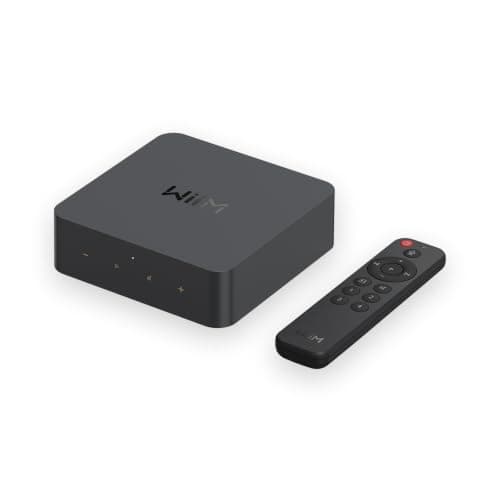 WiiM Pro Plus A streamer and DAC that publishes its line-out performance twice — once as the chip figure and once as the finished product — and is honest enough to print both. | Best streamer for an existing system | 8.8 | |
| 2 | 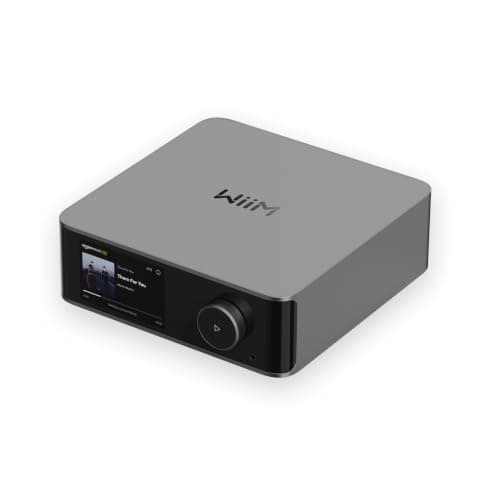 WiiM Ultra The only streamer here with a phono input and a touchscreen — and the only one whose maker publishes nothing at all about how that phono stage performs. | Best for a turntable and a streamer in one box | 8.4 | |
| 3 | 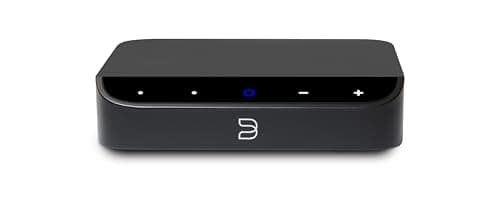 Bluesound Node Nano The most established platform here in the smallest box, with an ESS ES9039Q2M and a spec sheet that is thinner than WiiM's in every respect except pedigree. | Best for a Roon or MQA library | 7.6 |
A network streamer does four things, and they are separable. Understanding which four is the fastest route to working out whether you need one, and which one.
Job one: it fetches the data itself
This is the difference between a streamer and a Bluetooth receiver, and it is the one most worth understanding.
When you press play in a streaming app on your phone, the phone does not send the music to the streamer. It sends an instruction. The streamer then opens its own connection to Tidal or Spotify or Qobuz over your network and pulls the data down itself. Your phone is a remote control, and you can walk out of the room mid-track.
That is what “Connect” protocols mean — Spotify Connect, TIDAL Connect, Qobuz Connect, all of which the streamers we cover publish support for. A Bluetooth receiver works the opposite way: the phone decodes and transmits, the link is lossy, and walking away drops the audio. The bitrate arithmetic behind that difference is stark.
Job two: it converts the data to analog
Every streamer we cover has a DAC in it, and this is the job you can most easily take away from it. All three publish a digital output alongside the analog one, so the streamer can be reduced to a transport feeding a DAC you already own.
| Streamer | DAC | Digital outputs | Published SNR |
|---|---|---|---|
| WiiM Pro Plus | AKM AK4493SEQ | Optical and coaxial, both 192 kHz / 24-bit | 121 dB (chip figure) / 120 dB A-weighted (unit) |
| WiiM Ultra | ESS ES9038 Q2M | Optical, coaxial and USB audio out (UAC 2.0, 192 kHz / 24-bit) | 121 dB A-weighted |
| Bluesound Node Nano | ESS ES9039Q2M (Hyperstream IV) | Optical only — no coaxial output | 118 dB (published as −118 dB) |
The Node Nano row is the one to notice if you plan to use an external DAC. Optical is the only digital output, which is fine for most DACs and rules out a coaxial-only one. It is also the newest DAC silicon of the three, so the case for bypassing it is weaker than usual.
Job three: it presents a library and a control app
The software is the part you use every day and the part no specification captures. All three publish support for the protocols that matter — AirPlay 2, Google Cast, Roon Ready, DLNA, plus the Connect protocols above.
Roon Ready is worth calling out because it is a certification rather than a claim: it means the manufacturer has had the device tested against Roon’s implementation. All three publish it.
We do not review control apps, because that is a usability judgment and we do not own the hardware. What we can tell you is what each maker publishes about the DSP behind the app: WiiM publishes a 10-band parametric EQ, a 10-band graphic EQ, per-source EQ and room correction on the Pro Plus, which is considerably more than Bluesound publishes for the Node Nano.
Job four: it connects to the rest of your system
This is where the three genuinely diverge, and it is usually what decides the purchase.
- WiiM Pro Plus publishes a line input at 2 Vrms that the internal ADC digitizes at 192 kHz / 24-bit, and an optical input limited to stereo PCM (no Dolby Digital, no DTS). It can bring an analog source into the network.
- WiiM Ultra adds a phono input, HDMI ARC, a subwoofer output and a 3.5 in touchscreen. WiiM publishes no gain, RIAA accuracy, input capacitance or MC support for that phono stage, which is a real gap on the spec sheet.
- Bluesound Node Nanopublishes gigabit Ethernet — the other two are 10/100 — and no analog input of any kind. It cannot digitize a legacy source.
Wired or wireless, and why it barely matters
The bandwidth question answers itself, which is worth showing because streamer marketing implies otherwise.
bitrate = sample rate × bit depth × channels
Inputs
- Highest rate these streamers accept over the network: 192 kHz / 24-bit, 2 channels (WiiM spec page)
- WiiM Pro Plus and WiiM Ultra Ethernet: 10/100 Mbps (WiiM spec comparison)
- Bluesound Node Nano Ethernet: Gigabit (Bluesound spec page)
Result
192,000 × 24 × 2 = 9,216,000 bit/s = 9.2 Mbit/s
Nine megabits. A 10/100 Ethernet port has ten times that; a gigabit port has a hundred times. The Node Nano’s gigabit port is not doing anything for audio bandwidth that the WiiM’s 10/100 port cannot — and neither is close to being the bottleneck.
This is uncompressed PCM at the highest rate these devices accept; a FLAC stream is smaller. What wired connections actually buy is reliability rather than bandwidth: no interference, no congestion, no dropouts when someone starts a video call. That is a real benefit and it is not a bandwidth one.
What happens to the file on the way through
It is worth being precise about the chain, because a lot of streamer marketing is vague in exactly the places where being precise is easy.
- The service sends compressed data— FLAC for the lossless tiers, AAC or Ogg for the lossy ones. This arrives over your network as data, not as audio.
- The streamer decompresses it to PCM. For a lossless tier the result is bit-identical to the original file; for a lossy tier it is not, and no downstream component recovers what was discarded.
- Any DSP is applied— volume, EQ, room correction. WiiM publishes a 10-band parametric EQ and room correction on the Pro Plus; this is where they act, in the digital domain, before conversion.
- The DAC converts to analog, or the data leaves over the digital output untouched for an external DAC to handle.
Two things follow. Volume control applied in step three is digital attenuation, which is well-implemented on modern hardware but is not the same as an analog volume control after conversion. And if you use the digital output, steps three and four move to your DAC and amplifier, so the streamer’s EQ and room correction may no longer be in the chain at all — check before assuming you still have them.
Which jobs you might already have covered
Your amplifier has a DAC. Then job two is done, and you want a streamer with a good digital output rather than a good analog one. The Yamaha A-S501 and Marantz PM6007 both publish optical and coaxial inputs.
Your television is the source.Then jobs one and three are done by the television’s own apps, and what you need is a way to get the audio out — which is an HDMI eARC question, not a streamer question.
You only listen to records.Then you need none of the four, and the WiiM Ultra’s phono input is the only part of any of this that is relevant — and a dedicated phono stage publishes far more about what it does.
The short version
A streamer is a small networked computer that fetches music itself, converts it, presents it through an app, and connects to your system. If your system already has a DAC, you are buying three of the four. If your television does the streaming, you are buying two. If you want a phono input and a subwoofer output in the same box, only one of these does that — and the full comparison is on its own page.
Every pick in detail
Every specification below links to the manufacturer document we read it from. Where a manufacturer does not publish a figure, we say so rather than estimating it.
WiiM Pro Plus
Best streamer for an existing systemPrice as of October 15, 2026. #ad
A streamer and DAC that publishes its line-out performance twice — once as the chip figure and once as the finished product — and is honest enough to print both.
- measured performance
- 9/10
- connectivity
- 8/10
- features
- 9/10
- value for money
- 10/10
- published data
- 8/10
| Specification | Published value | Source |
|---|---|---|
| DAC | AKM AK4493SEQ (ADC: TI Burr-Brown PCM1861) | WiiM spec comparison |
| Analog out SNR | 121 dB (WiiM's comparison table, the AKM chip figure) · 120 dB A-weighted (WiiM's own “line-out performance” figure for the finished unit) | WiiM spec comparison |
| Analog out THD+N | −113 dB / 0.00023% (comparison table) · 0.00032% / −110 dB at 1 kHz, 44.1k–192k (line-out performance panel) | WiiM spec comparison |
| Line-out frequency response | ± 0.05 dB | WiiM spec comparison |
| Outputs | 1 × RCA line-out · 1 × optical S/PDIF (192 kHz/24-bit) · 1 × coaxial (192 kHz/24-bit) | WiiM spec comparison |
| Inputs | Line-in (2 Vrms, digitized by the ADC at 192 kHz/24-bit) · optical S/PDIF in up to 192 kHz/24-bit, stereo PCM only (no Dolby Digital or DTS) | WiiM spec comparison |
| Network | Wi-Fi 5 (802.11 b/g/n/ac, 2.4 and 5 GHz) · 10/100 Mbps Ethernet · Bluetooth 5.0 | WiiM spec comparison |
| Protocols | AirPlay 2, Google Cast Audio, Spotify Connect, TIDAL Connect, Amazon Music Casting, DLNA, Qplay 2.0, Roon Ready | WiiM spec comparison |
| EQ / room correction | 10-band parametric EQ, 10-band graphic EQ, 24 presets, per-source EQ, room correction | WiiM FAQ |
| Output impedance | Not published | — |
Pros
- AKM AK4493SEQ DAC with a published line-out SNR of 120 dB A-weighted and ±0.05 dB response for the finished unit, not just the chip
- Coaxial AND optical outputs, so it feeds an existing external DAC bit-perfectly if you already own one
- Roon Ready, AirPlay 2, Chromecast, Spotify Connect and TIDAL Connect all supported at once
- 10-band parametric EQ and room correction included, which is a genuinely rare feature at this price
Cons
- No display of any kind — everything happens in the phone app
- The optical input accepts stereo PCM only; Dolby Digital and DTS are explicitly unsupported
- No phono input, so a turntable still needs a separate stage
- WiiM publishes no output impedance, which matters if you feed a low-input-impedance amplifier
Skip it if your amplifier already streams. Paying twice for the same function is the most common mistake in this category.
WiiM Ultra
Best for a turntable and a streamer in one boxPrice as of October 15, 2026. #ad
The only streamer here with a phono input and a touchscreen — and the only one whose maker publishes nothing at all about how that phono stage performs.
- measured performance
- 9/10
- connectivity
- 10/10
- features
- 10/10
- value for money
- 7/10
- published data
- 6/10
| Specification | Published value | Source |
|---|---|---|
| DAC | ESS ES9038 Q2M | WiiM spec page |
| Analog out SNR | 121 dB (A-weighted) | WiiM spec page |
| Analog out THD+N | −116 dB (0.00015%) | WiiM spec page |
| Line-out level | 2.1 Vrms maximum | WiiM spec page |
| Headphone amplifier | TI TPA6120A2 — SNR 119 dB, THD+N −99 dB into 300 Ω falling to −92 dB into 32 Ω | WiiM spec page |
| Phono input | Yes — a dedicated input for turntables without a built-in preamp | WiiM spec page |
| Other inputs | HDMI ARC (PCM and Dolby Digital 5.1) · optical TOSLINK to 192 kHz/24-bit · RCA line-in · USB storage | WiiM spec page |
| Outputs | RCA line-out · subwoofer out · coaxial and optical S/PDIF (192 kHz/24-bit) · USB audio out (UAC 2.0, 192 kHz/24-bit) · 3.5 mm headphone | WiiM spec page |
| Network | Wi-Fi 6 (WiiM states a future Wi-Fi 6E software update) · Bluetooth 5.3 · Ethernet | WiiM spec page |
| Protocols | Spotify Connect, TIDAL Connect, Google Cast Audio, Alexa built-in, DLNA, Squeezelite, Roon Ready | WiiM spec page |
| Display | 3.5 in glass-covered color touchscreen | WiiM spec page |
| Dimensions / weight | 211 × 200 × 72 mm; 1.42 kg (3.13 lb) | WiiM spec page |
| Phono stage gain, RIAA accuracy, input capacitance or MC support | Not published | — |
Pros
- A dedicated phono input, which no other streamer on this page has
- ESS ES9038 Q2M with a published 121 dB SNR and −116 dB THD+N, the best analog figures here
- 3.5 in touchscreen, so it is usable without reaching for a phone
- HDMI ARC, subwoofer out, headphone amp and USB audio out — it can be the hub of a whole system
Cons
- WiiM publishes NO gain, RIAA accuracy, input capacitance or MC capability for the phono stage — the single feature that justifies the price step
- Meaningfully larger and heavier than the Pro Plus for the same core streaming function
- The headphone amp's THD+N degrades from −99 dB into 300 Ω to −92 dB into 32 Ω, so low-impedance headphones get the worse figure
- Wi-Fi 6E is promised via a future software update rather than shipping today
Skip it if you already own a phono stage you like. Without that feature this is a Pro Plus with a screen, at a considerable premium.
Bluesound Node Nano
Best for a Roon or MQA libraryPrice as of October 15, 2026. #ad
The most established platform here in the smallest box, with an ESS ES9039Q2M and a spec sheet that is thinner than WiiM's in every respect except pedigree.
- measured performance
- 9/10
- connectivity
- 6/10
- features
- 8/10
- value for money
- 6/10
- published data
- 7/10
| Specification | Published value | Source |
|---|---|---|
| DAC | ESS ES9039Q2M (Hyperstream IV) | Bluesound spec page |
| Sampling | Native rates up to 192 kHz, 16–24 bit | Bluesound spec page |
| Signal-to-noise | −118 dB as published by Bluesound (the sign is theirs; SNR is conventionally quoted positive, so read this as 118 dB) | Bluesound spec page |
| THD+N | 0.0007% | Bluesound spec page |
| Outputs | Stereo RCA (fixed-level option) · optical TOSLINK · USB Audio 2.0 Type A · Bluetooth headphone out · wireless subwoofer to PULSE SUB+ | Bluesound spec page |
| Coaxial digital output | None — optical only | Bluesound spec page |
| Inputs | USB Type A for storage · learning IR sensor. No analog line input and no phono input. | Bluesound spec page |
| Network | Wi-Fi 5 (802.11ac dual band) · Gigabit Ethernet · Bluetooth 5.2 with aptX Adaptive, two-way | Bluesound spec page |
| Protocols | AirPlay 2, Spotify Connect, Tidal Connect, Qobuz Connect, Roon Ready, plus MQA playback | Bluesound spec page |
| Dimensions / weight | 143 × 36 × 143 mm; 0.57 kg (1.26 lb) | Bluesound spec page |
| Power | USB-C (5 V, 2 A) | Bluesound spec page |
Pros
- ESS ES9039Q2M with Hyperstream IV — the newest DAC silicon on this page
- Gigabit Ethernet, where both WiiM streamers here are limited to 10/100
- Bluetooth 5.2 with aptX Adaptive, two-way, so it can also feed Bluetooth headphones
- BluOS is a mature multiroom platform with a longer track record than WiiM's app
Cons
- No coaxial digital output — optical only, which caps some external-DAC pairings
- No analog input at all, so it cannot digitize a legacy source the way a WiiM Pro Plus can
- Bluesound prints its signal-to-noise ratio as “−118 dB”, a sign convention error on their own sheet
- The most expensive streamer here, with fewer inputs than the WiiM Ultra
Skip it if you need to connect anything analog. It has no line input, no phono input, and no way around that.
Frequently asked questions
How does a network streamer work?
It connects to your network and fetches the music data itself. When you press play in an app on your phone, the phone sends an instruction rather than the audio; the streamer then opens its own connection to the service and pulls the stream down. That is what Spotify Connect, TIDAL Connect and Qobuz Connect mean, and it is why you can walk away mid-track.
Is a network streamer the same as a Bluetooth receiver?
No, and the difference is which device does the work. A Bluetooth receiver takes an already decoded, lossily compressed signal from your phone. A streamer fetches the original data over your network itself. A 192 kHz / 24-bit stereo stream is about 9.2 Mbit/s, which no Bluetooth codec carries.
Do I need Ethernet for a network streamer?
Not for bandwidth. The highest rate these streamers accept is 192 kHz / 24-bit stereo, about 9.2 Mbit/s — comfortably inside a 10/100 port, let alone the Node Nano’s gigabit one. What a wired connection buys is reliability: no interference, no congestion, no dropouts when the network gets busy.
Can I use a network streamer with my existing DAC?
Yes — all three we cover publish a digital output. The WiiM Pro Plus and WiiM Ultra publish optical and coaxial at 192 kHz / 24-bit, and the Ultra adds USB audio out. The Bluesound Node Nano publishes optical only, with no coaxial output at all, which rules out a coaxial-only DAC.
Read next
The Best Music Streamers With a Built-In DAC
Four streamers with built-in DACs, ranked on published output performance, inputs and protocol support.
Bluetooth vs Wi-Fi Audio
LDAC's published 990 kbps against a 1,411 kbps CD stream — and the codec-matching trap that means your phone's best codec may never be used.
What Is a DAC in Audio?
A DAC turns digital audio into analog voltage. You already own several — here is when another one helps.
Optical vs Coaxial vs USB
Per-input sample rate limits for every DAC we cover, the ground-loop problem only optical solves, and the surround-format trap on TV optical outputs.
The Best USB DACs for a PC
Six USB DACs ranked for desktop use, on USB interface, power arrangement and the published output level each one actually delivers.
Hi-Res Audio Explained
24-bit implies 146 dB of dynamic range; the best published DAC figure here is 126 dB, or about 20.6 bits. The arithmetic, and what it means.
Sources
Every specification on this page was read from one of these documents. If one of them has changed, or we have made an error, tell us — corrections are logged and dated per our editorial policy.