The Best Stereo System Under $1,000
Four boxes, one budget, and an order to spend in. The expensive mistake at this price is buying one very good component and three compromises around it.
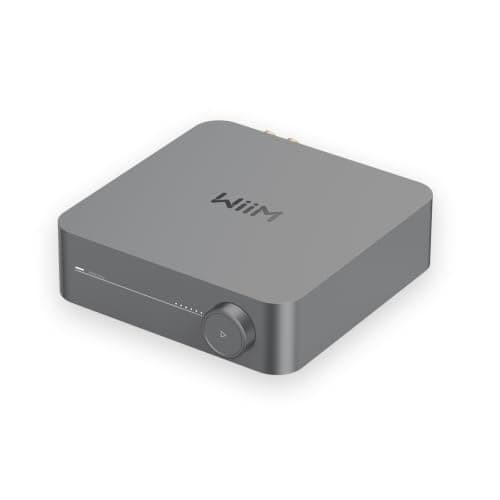
Top pick: WiiM Amp
Best one-box system for passive speakers. #ad Affiliate link — we earn a commission at no extra cost to you.
The short answer
The best stereo system under $1,000 is built around the WiiM Amp — because one box covers streaming, the TV’s HDMI ARC output, the amplifier and the subwoofer crossover, and WiiM publishes a full-band 60 W into 8 Ω and 120 W into 4 Ω to go with it. Add the Polk Monitor XT15 as the speakers, the Audio-Technica AT-LP70X as the deck and the Fluance PA10 as the phono stage, and you have a complete four-box system with change left inside the budget. It is the build for someone starting from nothing who wants records, streaming and the television through the same pair of speakers. The budget pick in the system is the Fluance PA10 — the cheapest component in the build and the one it would be easiest to skimp on further, which is why it is worth naming: it is the only stage under $100 that publishes gain, loading, noise and distortion all four.
One substitution worth knowing before you start. If you do not need a turntable, drop the deck and the phono stage, and spend the difference on the Micca RB42 instead of the Polk — a sealed 4 in two-way with a published 83 dB sensitivity at a true 1 W / 1 m, a 15–100 W power range and a 50 Hz typical in-room figure, which asks more of the amplifier and gives more back. Every price on this page comes from the live price layer and is stamped with the date it was read; nothing here quotes a total, because a total written into prose is a total that goes stale.
Disclosure: we earn a commission if you buy through the links on this page, at no extra cost to you. It does not influence what we pick — our criteria are published and reproducible, so you can check our work. How we pick · Full disclosure
These picks are spec-and-price analyses, not listening tests. We have not heard this gear and we do not pretend to have: every figure below is sourced to the manufacturer and linked, and every price is live or not shown at all. Here are the rules we followed.
Quick picks
Ranked on the published criteria in How We Pick. Prices are live as of November 12, 2026. Tap any row for the full write-up.
- 7.6
- 7.4
- 8.0
- 6.6
- 7.2
| # | Product | Best for | Score | Price |
|---|---|---|---|---|
| 1 | WiiM Amp A streamer with a power amplifier bolted on, which replaces two boxes — and gives up an order of magnitude of measured noise performance to do it. | Best one-box system for passive speakers | 7.6 | |
| 2 | 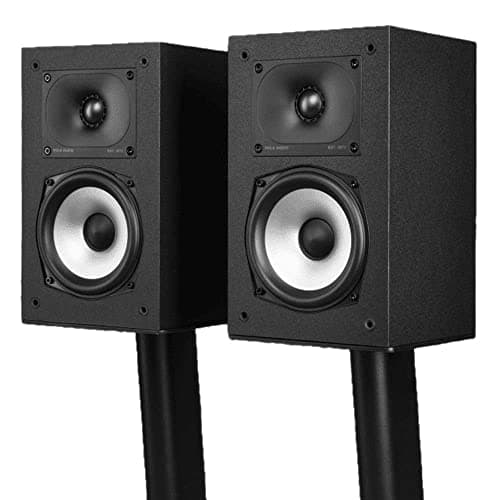 Polk Monitor XT15 48 Hz of published extension and a stated 30–150 W amplifier range, from a maker who tells you what to drive it with but not how they measured its sensitivity. | Best all-rounder under $200 | 7.4 | |
| 3 | 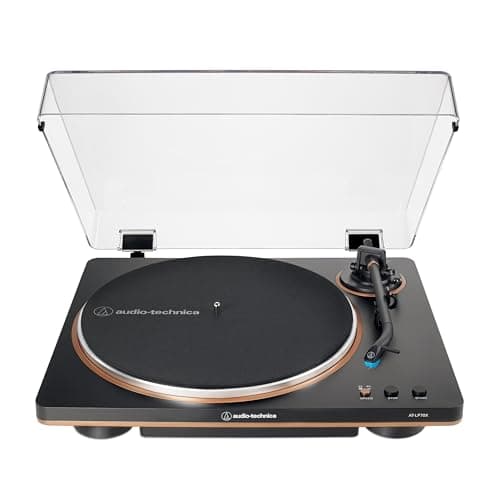 Audio-Technica AT-LP70X Fully automatic, so the arm lifts and returns on its own — the single feature that most reduces the chance of a new owner damaging a stylus or a record. | Best for beginners | 8.0 | |
| 4 | 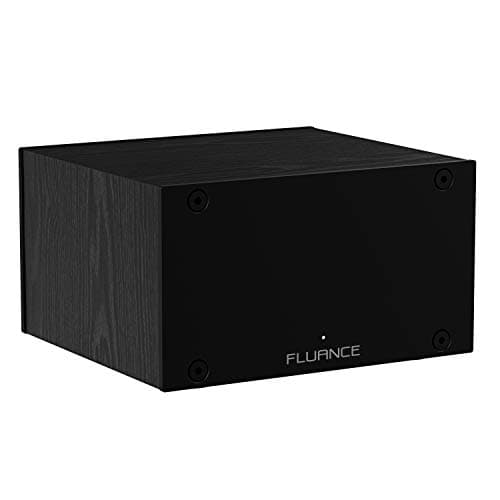 Fluance PA10 A moving-magnet stage priced to sit under a Fluance RT82 or RT85, which is precisely the gap those decks leave by shipping without one. | Best match for a Fluance deck | 6.6 | |
| 5 | 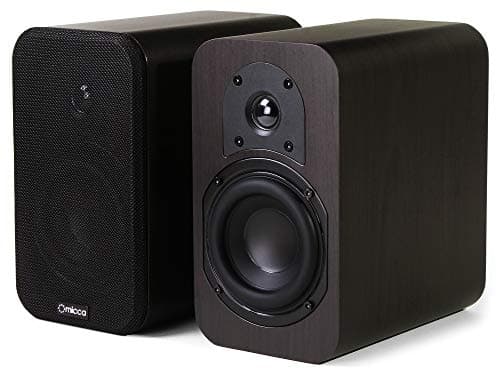 Micca RB42 A 4-inch speaker that publishes 50 Hz of extension and an honest 83 dB at 1 W — the two facts are the same fact, and Micca is unusual in showing you both. | Most bass from the smallest box | 7.2 |
A stereo system is a source, an amplifier and a pair of speakers. Under $1,000 the temptation is to buy one impressive component and then run out of money, which produces a worse system than four adequate ones. So this page is a build rather than a ranking: five products, four slots, and the reasoning for each slot in turn.
If you are still weighing whether separates are worth it over a soundbar or a Bluetooth speaker, we answer that honestly on its own page — including the cases where the answer is no.
The picks compared, spec by spec
This table is not a ranking of like against like — it is the build, slot by slot, with the one published figure that earns each component its place and what it needs from the components around it. Every row carries its own live price and buy link, which is how you cost the build without us writing a total that will be wrong next week.
Every figure below is the manufacturer’s own published value and links to the document we read it from. “Not published” means the manufacturer does not publish that figure; an em dash means we have no published figure for that model. Prices are live as of November 12, 2026.
Best one-box system for passive speakers
- Slot in the build
- Amplifier + streamer: 60 W at 8 Ω
- The figure that earns its slot
- SNR 98 dB · THD+N 0.0025%
- What it needs from the rest
- HDMI ARC · optical · RCA line-in
Best all-rounder under $200
- Slot in the build
- Speakers: 86 dB sensitivity
- The figure that earns its slot
- 48 Hz–40 kHz, no tolerance
- What it needs from the rest
- 2,200 Hz crossover; 30–150 W
Best for beginners
- Slot in the build
- Turntable: belt drive, automatic
- The figure that earns its slot
- < 0.25% (WTD)
- What it needs from the rest
- Switchable stage — or use the PA10
Best match for a Fluance deck
- Slot in the build
- Phono stage: 38 dB gain
- The figure that earns its slot
- 0.004% THD
- What it needs from the rest
- Moving magnet only
Most bass from the smallest box
- Slot in the build
- Speakers, alternative: 4–8 Ω
- The figure that earns its slot
- 15–100 W each
- What it needs from the rest
- 18 dB/octave slope published
| Pick | Slot in the build | The figure that earns its slot | What it needs from the rest | Price |
|---|---|---|---|---|
| 1.WiiM AmpBest one-box system for passive speakers | Amplifier + streamer: 60 W at 8 Ω | SNR 98 dB · THD+N 0.0025% | HDMI ARC · optical · RCA line-in | |
| 2.Polk Monitor XT15Best all-rounder under $200 | Speakers: 86 dB sensitivity | 48 Hz–40 kHz, no tolerance | 2,200 Hz crossover; 30–150 W | |
| 3.Audio-Technica AT-LP70XBest for beginners | Turntable: belt drive, automatic | < 0.25% (WTD) | Switchable stage — or use the PA10 | |
| 4.Fluance PA10Best match for a Fluance deck | Phono stage: 38 dB gain | 0.004% THD | Moving magnet only | |
| 5.Micca RB42Most bass from the smallest box | Speakers, alternative: 4–8 Ω | 15–100 W each | 18 dB/octave slope published |
Prices as of November 12, 2026; every “Check Price” link goes to Amazon and earns us a commission at no extra cost to you. #ad
Slot one: the amplifier, because it decides the rest
Spend here first. The amplifier determines which speakers you can drive, whether you can add a subwoofer, and how many of your sources actually have somewhere to plug in — and it is the component you are least likely to replace.
The WiiM Amp is the pick because it collapses three purchases into one. WiiM publishes 60 W per channel into 8 Ω and 120 W into 4 Ω, which is the clean doubling a well-behaved amplifier does and more than enough for any bookshelf pair. It publishes HDMI ARC, optical and RCA line-in; Wi-Fi, Ethernet and Bluetooth 5.1; AirPlay 2, Chromecast, Spotify Connect, TIDAL Connect, DLNA and Roon Ready; and a subwoofer output with a user-adjustable 30–250 Hz crossover. Buying a conventional integrated plus a streamer gets you the same functions for more money and two more boxes.
Its published costs are real and we are not hiding them: SNR 98 dB and THD+N 0.0025%, roughly an order of magnitude behind a conventional integrated’s line stage, and stereo PCM only over ARC, so it will not decode a Dolby Digital film soundtrack. Our full amplifier roundup for bookshelf speakers ranks the alternatives, including the two boxes here that publish a proper phono input.
Slot two: speakers, where the budget should go next
The Polk Monitor XT15 is the pick. Polk publishes 86 dB sensitivity, 48 Hz–40 kHz frequency response, a 2,200 Hz crossover, a 5.25 in bi-laminate paper woofer with a 1 in Terylene dome, and a recommended amplification range of 30–150 W per channel — which the WiiM Amp sits comfortably inside at both impedances.
Two things to read carefully in that list. Polk publishes no tolerance with the 48 Hz–40 kHz range, so it is not comparable with a ± 3 dB figure from KEF or Klipsch — a range with no tolerance can be drawn almost anywhere. And Polk publishes no nominal impedance, only “compatible with 4- and 8-ohm outputs”. Neither is a defect at this price; both are disclosure gaps worth knowing about. Our under-$200 bookshelf bracket ranks the Polk first and explains the reasoning in full.
The Micca RB42 is the alternative in the same slot and it is a genuinely different proposition: a sealed 4 in two-way, 83 dB sensitivity at a true 1 W / 1 m rather than the flattering 2.83 V reference, a published 18 dB/octave crossover slope (but no crossover frequency), and a 15–100 W power range whose lower bound doubles as a minimum amplifier recommendation. It needs about twice the power of the Polk for the same level, which the WiiM Amp has, and it gives back a smaller cabinet and a 50 Hz typical in-room figure.
SPL at 1 m = sensitivity + 10 × log10(watts)
Inputs
- Micca RB42 sensitivity: 83 dB (1 W / 1 m) (Micca spec page)
- WiiM Amp power into 8 Ω: 60 W per channel (WiiM spec page)
Result
Slot three: the turntable, if records are part of the plan
The Audio-Technica AT-LP70X is the pick for a system at this price, for one reason that has nothing to do with sound: it is fully automatic, so the arm lifts and returns by itself at the end of a side. The two most common ways a first year with records goes expensively wrong are a stylus left tracking the run-out groove and a deck plugged into the wrong kind of input, and automatic operation removes the first entirely.
It also has a switchable phono stage built in, which means you can run it straight into the WiiM Amp’s RCA line input and skip slot four completely while you save for it. What it costs you is the upgrade path: Audio-Technica’s manual confirms the cartridge body is non-removable, so the stylus swaps across the VM95 range and nothing more. Our beginner turntable roundup ranks it first and lays out the alternatives, including the AT-LP120XUSB if a removable headshell matters to you.
Slot four: the phono stage, and why it is not optional later
The AT-LP70X’s internal stage is adequate and Audio-Technica publishes very little about it. The Fluance PA10 is the cheapest external stage we rank that publishes all four figures the job is defined by: 38 dB gain, 100 pF input capacitance, better than 90 dB signal-to-noise and 0.004% THD, which is the lowest distortion figure of any stage under $100.
Why bother, if the deck already has one? Because 38 dB of published gain into a published capacitance is a thing you can match to a cartridge, and because the PA10 adds a selectable high-pass filter rolling off below 20 Hz, which matters on a warped record. Set the deck’s switch to LINE, run it through the PA10, and the two stages are not fighting each other — using both in series is worse than using either. The full sub-$100 phono stage roundup explains what each maker in that band does and does not publish, and three of the eight publish no gain figure at all.
The order to spend in, and what to cut first
If the budget is tighter than $1,000, cut in this order. First the external phono stage — the AT-LP70X’s internal one works and the PA10 is a later purchase that costs you nothing to defer. Second the turntable, if you can live with streaming for now: the WiiM Amp plus the Polks is a complete, finished two-box system that needs nothing added. Third, and only third, step down on the speakers.
What not to cut is the amplifier, because everything else plugs into it. And what not to do is buy a $600 pair of speakers and a $150 amplifier that cannot drive them: the published minimum impedance of the better bookshelf speakers sits around 3.2–3.3 Ω, and our amp and speaker matching guide shows what that asks for. If you would rather have fewer boxes than more, a powered pair under $500 plus the AT-LP70X and the PA10 is the same system in three boxes instead of four. And if the room is really for films rather than music, the 5.1 build at the same budget is a different and better answer.
Every pick in detail
Every specification below links to the manufacturer document we read it from. Where a manufacturer does not publish a figure, we say so rather than estimating it.
WiiM Amp
Best one-box system for passive speakersPrice as of November 12, 2026. #ad
A streamer with a power amplifier bolted on, which replaces two boxes — and gives up an order of magnitude of measured noise performance to do it.
- measured performance
- 6/10
- connectivity
- 8/10
- features
- 9/10
- value for money
- 9/10
- published data
- 5/10
| Specification | Published value | Source |
|---|---|---|
| Power output | 60 W per channel into 8 Ω · 120 W per channel into 4 Ω | WiiM spec page |
| Rated-power measurement condition (THD figure, both channels driven) | Not published | — |
| Audio output quality | SNR 98 dB · THD+N 0.0025% (−92 dB) — an order of magnitude worse than the Pro Plus's line-out, which is what a Class-D power stage costs you | WiiM spec page |
| Inputs | HDMI ARC · optical · RCA line-in | WiiM spec page |
| Outputs | Passive speaker terminals · subwoofer out with auto cable detection and a user-adjustable 30–250 Hz crossover | WiiM spec page |
| Network | Wi-Fi 802.11 b/g/n/ac dual band · 10/100 Mbps LAN · Bluetooth 5.1 | WiiM spec page |
| Protocols | AirPlay 2, Chromecast, Spotify Connect, TIDAL Connect, Alexa Cast, DLNA, Roon Ready | WiiM spec page |
| EQ | 10-band graphic EQ, 10-band parametric EQ, 26 presets | WiiM spec page |
| Home theater formats | Stereo PCM only — Dolby Digital and DTS are NOT supported | WiiM spec page |
| Dimensions / weight | 190 × 190 × 63 mm; 1.84 kg (4.1 lb) | WiiM spec page |
| Phono input | No | WiiM spec page |
Pros
- 60 W into 8 Ω and 120 W into 4 Ω published, which drives every passive speaker we recommend
- Subwoofer output with a user-adjustable 30–250 Hz crossover, so a 2.1 system needs nothing else
- HDMI ARC in, so a television can feed it directly
- Same app, same EQ, same Roon Ready and AirPlay 2 support as the standalone streamers
Cons
- WiiM publishes the wattage with no THD figure and no “both channels driven” condition, so the rating cannot be compared to a Yamaha or Marantz spec
- 98 dB SNR and 0.0025% THD+N — roughly twenty decibels noisier than the Pro Plus's line-out
- Stereo PCM only over HDMI ARC: no Dolby Digital, no DTS
- No phono input, and no analog preamp output to escape the internal amplifier
Skip it if you already own an amplifier you like. This is a worse DAC than the Pro Plus attached to an amplifier you did not need.
Polk Monitor XT15
Best all-rounder under $200Price as of November 12, 2026. #ad
48 Hz of published extension and a stated 30–150 W amplifier range, from a maker who tells you what to drive it with but not how they measured its sensitivity.
- specs
- 7/10
- sensitivity
- 6/10
- published data
- 6/10
- value for money
- 9/10
- bass extension
- 8/10
| Specification | Published value | Source |
|---|---|---|
| Sensitivity | 86 dB — Polk publishes NO measurement condition (no 2.83 V/1 m or 1 W/1 m qualifier) | Polk info sheet (PDF) |
| Impedance | “Compatible with 4- and 8-ohm outputs” — Polk publishes no nominal impedance value | Polk info sheet (PDF) |
| Minimum impedance | Not published | — |
| Frequency response | 48 Hz – 40 kHz (no tolerance published) | Polk info sheet (PDF) |
| Recommended amplification | 30–150 W per channel | Polk info sheet (PDF) |
| Woofer | 5.25 in bi-laminate paper | Polk info sheet (PDF) |
| Tweeter | 1 in Terylene dome | Polk info sheet (PDF) |
| Crossover | 2,200 Hz | Polk info sheet (PDF) |
| Weight (each) | 9 lb / 4.08 kg | Polk info sheet (PDF) |
Pros
- 48 Hz – 40 kHz published extension, the deepest bass figure in this bracket
- Polk publishes a recommended amplification range (30–150 W), which Klipsch and ELAC do not
- 1 in Terylene dome tweeter, the same driver family as the more expensive Signature Elite ES15
- Explicitly rated for Dolby Atmos height duty as well as stereo, so it does double service
Cons
- The 86 dB sensitivity is published with NO measurement condition, so it cannot honestly be compared to Klipsch's 2.83 V figures
- “Compatible with 4- and 8-ohm outputs” is not a nominal impedance, and no minimum is published
- 48 Hz – 40 kHz is quoted with no tolerance, which makes the endpoints unverifiable
- The 30 W lower bound rules out several of the smallest amplifiers we recommend
Skip it if your amplifier delivers under 30 W. Polk's own recommendation excludes it, and that is Polk's number, not ours.
Audio-Technica AT-LP70X
Best for beginnersPrice as of November 12, 2026. #ad
Fully automatic, so the arm lifts and returns on its own — the single feature that most reduces the chance of a new owner damaging a stylus or a record.
- specs
- 7/10
- upgrade path
- 7/10
- value for money
- 9/10
- ease of setup
- 10/10
- connectivity
- 7/10
| Specification | Published value | Source |
|---|---|---|
| Drive type | Belt drive (DC motor), fully automatic | Audio-Technica manual (PDF) |
| Wow and flutter | < 0.25% (WTD) | Audio-Technica manual (PDF) |
| Signal-to-noise | > 55 dB | Audio-Technica manual (PDF) |
| Speeds | 33⅓, 45 rpm | Audio-Technica manual (PDF) |
| Cartridge included | AT-VM95C dual moving magnet — NON-REMOVABLE. The stylus upgrades across the VM95 range; the cartridge body does not come off. | Audio-Technica manual (PDF) |
| Tonearm effective mass | Not published | — |
| Built-in phono stage | Yes — switchable PHONO/LINE, 36 dB nominal gain | Audio-Technica manual (PDF) |
| USB output | No | Audio-Technica manual (PDF) |
| Tracking force range | Not published | — |
Pros
- Fully automatic start and return — no manual cueing to get wrong
- Built-in switchable phono stage, so it works with any line input
- The stylus upgrades across the AT-VM95 range without touching the cartridge
- Published wow and flutter under 0.25%, and Audio-Technica states the figure
Cons
- The cartridge body is non-removable — only the stylus swaps, so the upgrade path ends at the VM95 range
- Belt drive, not direct drive: the belt is a consumable
- No USB output
Skip it if you want to digitize your collection — this one has no USB out.
Fluance PA10
Best match for a Fluance deckPrice as of November 12, 2026. #ad
A moving-magnet stage priced to sit under a Fluance RT82 or RT85, which is precisely the gap those decks leave by shipping without one.
- flexibility
- 4/10
- noise
- 8/10
- value for money
- 8/10
- build quality
- 7/10
- connectivity
- 6/10
| Specification | Published value | Source |
|---|---|---|
| Gain | 38 dB | Fluance spec page |
| Cartridge support | Moving magnet only | Fluance spec page |
| Loading | 100 pF | Fluance spec page |
| Signal-to-noise | > 90 dB | Fluance spec page |
| THD | 0.004% | Fluance spec page |
| Subsonic filter | Yes — selectable high-pass, rolls off below 20 Hz | Fluance spec page |
| Power | External 24 V / 500 mA adapter; 0.4 W consumption | Fluance spec page |
Pros
- Fills the exact gap the RT82/RT85 leave
- Aluminum chassis
- Simple and quiet
Cons
- MM only
- No gain adjustment
- No subsonic filter
Skip it if you need MC support now or later.
Micca RB42
Most bass from the smallest boxPrice as of November 12, 2026. #ad
A 4-inch speaker that publishes 50 Hz of extension and an honest 83 dB at 1 W — the two facts are the same fact, and Micca is unusual in showing you both.
- specs
- 7/10
- sensitivity
- 3/10
- published data
- 7/10
- value for money
- 8/10
- bass extension
- 8/10
| Specification | Published value | Source |
|---|---|---|
| Sensitivity | 83 dB (1 W / 1 m) — note the condition: this is the TRUE 1 W figure, not the flattering 2.83 V one most brands quote | Micca spec page |
| Impedance | 4–8 Ω (Micca publishes a range rather than a nominal value) | Micca spec page |
| Minimum impedance | Not published | — |
| Frequency response | 50 Hz – 20 kHz, stated as “typical in-room” — an in-room figure is not an anechoic one and carries no tolerance | Micca spec page |
| Power handling | 15–100 W each — Micca's lower bound doubles as a de facto minimum amplifier recommendation | Micca spec page |
| Woofer | 4 in coated paper cone, rubber surround | Micca spec page |
| Tweeter | 0.75 in silk dome | Micca spec page |
| Crossover | 18 dB/octave slope — Micca publishes the SLOPE but not the crossover FREQUENCY | Micca spec page |
| Dimensions | 8.7 in H × 4.9 in W × 7.9 in D | Micca spec page |
| Weight | Not published | — |
Pros
- Micca quotes sensitivity at 1 W/1 m, the harder and more honest condition — most brands quote 2.83 V, which flatters a low-impedance speaker
- 50 Hz from a 4-inch driver in an 8.7-inch cabinet is genuinely unusual
- A 10-element crossover with film capacitors and air-core coils, described in detail on Micca's own page
- Micca publishes a 15 W lower power bound, which functions as a minimum amplifier recommendation
Cons
- 83 dB is the lowest sensitivity on this site — it needs roughly five times the power of the Klipsch R-41M for the same level
- The 50 Hz figure is qualified “typical in-room”, which is not an anechoic measurement and carries no tolerance
- Micca publishes the crossover SLOPE (18 dB/octave) but not the crossover FREQUENCY
- “4–8 ohms” is a range, not a nominal impedance, and no minimum is published
Skip it if your amplifier is small. A 20 W amp that drives the Klipsch R-41M to a satisfying level will not do the same job here — the arithmetic is on our amp-matching page and it is not close.
Frequently asked questions
Can you really build a decent stereo system for under $1,000?
Do I need the separate phono preamp if the turntable has one?
Which component should get the most of the budget?
Why isn't there a total price on this page?
Read next
The Best Amplifiers for Bookshelf Speakers
Six amplifiers for bookshelf speakers, ranked on published 4-ohm power, subwoofer outputs and phono inputs rather than on headline wattage.
The Best Bookshelf Speakers Under $200
Four bookshelf pairs at the $200 mark, and a seven-decibel sensitivity gap that is worth five times the amplifier power.
The Best Turntables for Beginners
Beginner decks ranked on the two things that matter at the start — automatic operation and a phono stage in the box.
The Best Phono Preamps Under $100
Eight phono stages under $100, ranked on what their makers actually publish — gain, loading, noise — rather than on the box they come in.

The Best Home Theater System Under $1,000
A four-box build that totals under $1,000 at live prices — and the arithmetic showing why the fifth and sixth speakers are what the ceiling takes away, not the subwoofer.
Is Hi-Fi Audio Worth It?
What hi-fi means, which of its claims can be measured, where the money moves a published number, and a starter system chosen on those numbers rather than on adjectives.
The Best Powered Speakers Under $500
Five active pairs under $500, ranked on published amplifier power and its measurement condition — including the only maker here citing 16 CFR 432.3.
Sources
Every specification on this page was read from one of these documents. If one of them has changed, or we have made an error, tell us — corrections are logged and dated per our editorial policy.