The Best Phono Preamps Under $100
The cheapest box that turns a cartridge into a line signal. At this price the separator is not sound quality — it is which makers publish a gain figure, and which publish none.
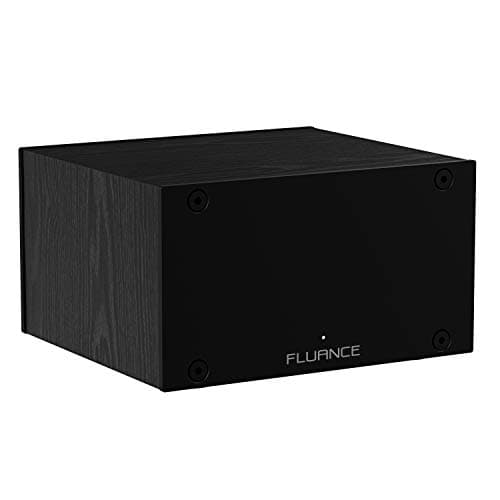
Top pick: Fluance PA10
Best match for a Fluance deck. #ad Affiliate link — we earn a commission at no extra cost to you.
The short answer
The best phono preamp under $100 is the Fluance PA10 — because it is the only stage in this band that publishes all four numbers the job is defined by: 38 dB of gain, 100 pF of input capacitance, better than 90 dB signal-to-noise and 0.004% THD, which is the lowest distortion figure published by anything here. It is the pick for someone with a moving-magnet cartridge and a receiver with no phono input who wants the cheapest box that can be checked rather than trusted. The budget pick is the Fosi Audio Box X1 — the cheapest stage here we would actually fit, and it still publishes a distortion figure with its input level (≤ 0.08% at 1 kHz and 3 mV) and a headphone output you can listen through directly. What it does not publish is any RIAA deviation figure; Fosi writes “Standard RIAA” and leaves it there.
Two things decide this page and neither is sound. The first is whether the maker publishes a gain figure at all: a phono stage with no published gain cannot be matched to a cartridge, and three of these eight publish none. The second is capacitance. A moving-magnet cartridge is specified into a load, Ortofon asks for 150–300 pF and Audio-Technica for 100–200 pF, and a stage that publishes nothing about its own loading is a stage you are matching by hope. The bracket above this one is where adjustable loading starts to appear.
Disclosure: we earn a commission if you buy through the links on this page, at no extra cost to you. It does not influence what we pick — our criteria are published and reproducible, so you can check our work. How we pick · Full disclosure
These picks are spec-and-price analyses, not listening tests. We have not heard this gear and we do not pretend to have: every figure below is sourced to the manufacturer and linked, and every price is live or not shown at all. Here are the rules we followed.
Quick picks
Ranked on the published criteria in How We Pick. Prices are live as of November 12, 2026. Tap any row for the full write-up.
- 6.6
- 6.6$52.49View on Amazon
$69.9925% off
- 7.8
- 6.6$84.99View on Amazon
$94.9811% off
- 6.5
- 5.4
- 5.6$39.00View on Amazon
$40.995% off
- 3.4$18.62View on Amazon
$21.9915% off
| # | Product | Best for | Score | Price |
|---|---|---|---|---|
| 1 | Fluance PA10 A moving-magnet stage priced to sit under a Fluance RT82 or RT85, which is precisely the gap those decks leave by shipping without one. | Best match for a Fluance deck | 6.6 | |
| 2 | 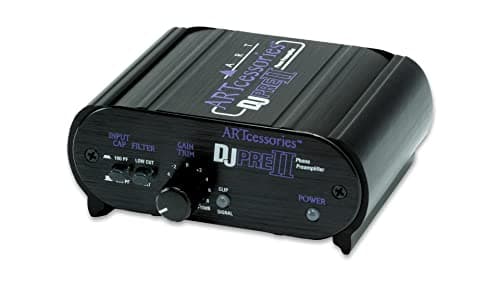 ART DJPRE II A cheap MM stage with a rumble filter and a gain trim, which is more adjustment than anything else at the price offers. | Best budget pick | 6.6 | $52.49View on Amazon $69.9925% off |
| 3 | 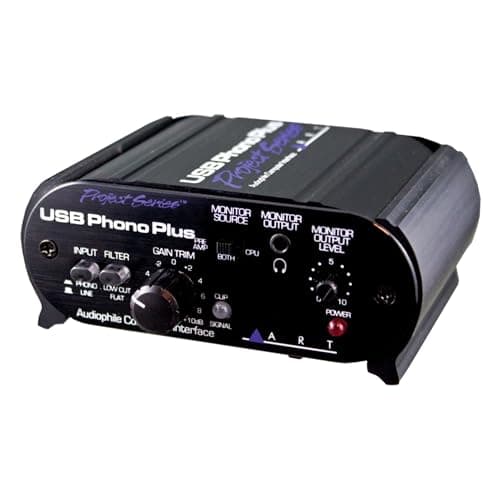 ART USB Phono Plus PS The one box on this page built around the act of recording: a gain trim with a clip LED, a low-cut filter with a published corner, a zero-latency monitor output, and a line out that stays live so it works as a plain phono stage the rest of the week. | Best for actually recording | 7.8 | |
| 4 | 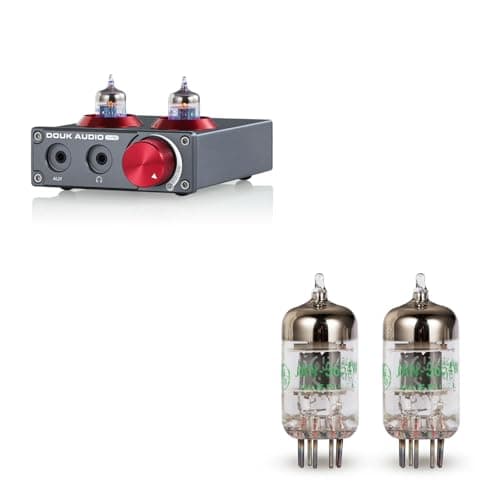 Douk Audio T4 PRO The only tube phono stage here with a real headphone output and a published power figure for it — and the only one whose published RIAA tolerance is ± 3 dB, which is the single widest equalization error published by anything in this registry. | Best if you listen on headphones | 6.6 | $84.99View on Amazon $94.9811% off |
| 5 | 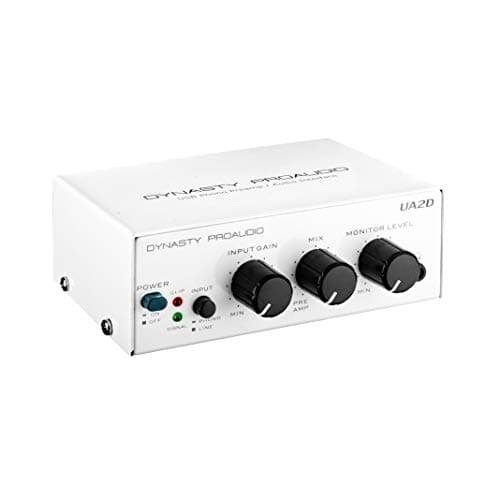 Dynasty ProAudio UA2D A cheaper box whose published figures track the ART's line for line — same 40 mV input ceiling, same +19 dBu line figure, same 16-bit converter — minus the two rows that describe the phono stage itself. | Cheapest with a preamp line out | 6.5 | |
| 6 | 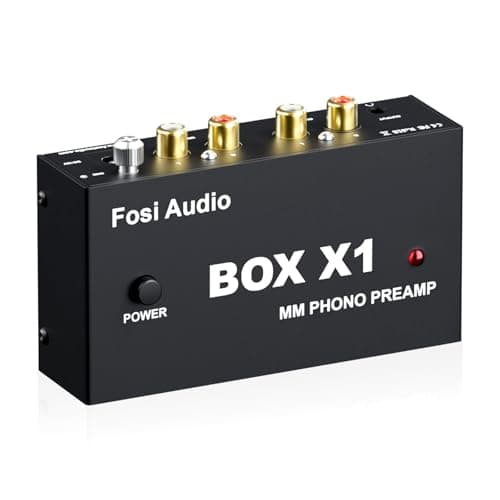 Fosi Audio Box X1 A palm-sized moving-magnet stage with a headphone output, and the only box under $50 here whose maker publishes a distortion and noise figure at all. | Best under $50 | 5.4 | |
| 7 | 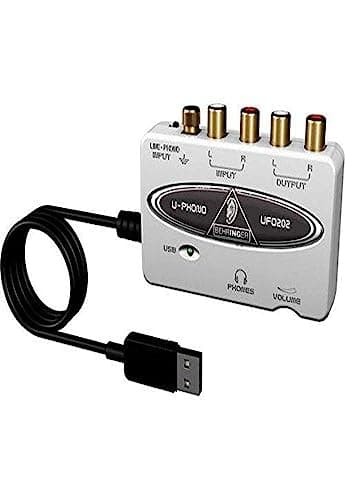 Behringer U-PHONO UFO202 The cheapest USB phono interface we can verify, with a proper converter spec table — and a phono stage Behringer publishes nothing about: no gain, no loading, no filter, and no level control on the box. | Cheapest way to get a record into a computer | 5.6 | $39.00View on Amazon $40.995% off |
| 8 | 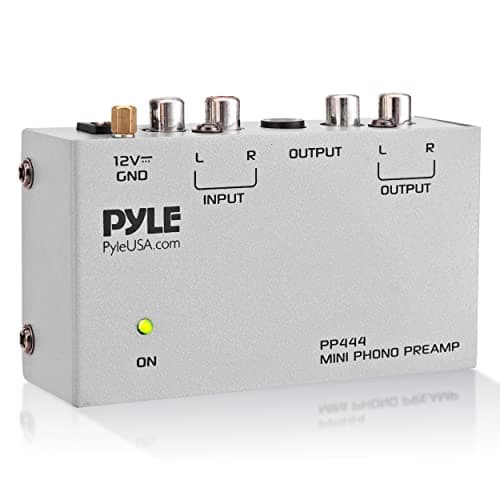 Pyle PP444 The cheapest way to get a phono signal into a line input, and the clearest example in this bracket of what that saving actually costs you. | The one we would skip | 3.4 | $18.62View on Amazon $21.9915% off |
A phono stage does two jobs: it adds about 40 dB of gain, and it undoes the RIAA equalization curve that was applied when the record was cut. Both are solved engineering. What is not solved, under $100, is disclosure — and the gap between the makers who publish and the makers who do not is the whole story of this price band.
If you are not sure you need one of these at all, start with our guide to whether you need a phono preamp: plenty of turntables and most receivers older than about 1990 already have one inside, and buying a second does nothing except add noise.
The picks compared, spec by spec
Three columns, because these are the three that separate the band: gain, loading and noise. Where a cell says “not published” or names the wrong thing, that is the finding — it is not a gap in our research, it is what the manufacturer puts on its own specification page. Every row carries its own live price and buy link.
Every figure below is the manufacturer’s own published value and links to the document we read it from. “Not published” means the manufacturer does not publish that figure; an em dash means we have no published figure for that model. Prices are live as of November 12, 2026.
Best match for a Fluance deck
- Published gain
- 38 dB
- Published loading
- 100 pF
- Published noise
- > 90 dB SNR
Best budget pick
- Published gain
- 45 dB max, ±10 dB trim
- Published loading
- 47 kΩ · 100 or 200 pF switchable
- Published noise
- > 90 dB below clipping
Best for actually recording
- Published gain
- 45 dB max, ±10 dB trim
- Published loading
- 47 kΩ · 100 pF, fixed
- Published noise
- > 90 dB below clipping
Best if you listen on headphones
- Published gain
- Not published
- Published loading
- Moving magnet only
- Published noise
- ≥ 105 dB, no weighting stated
Cheapest with a preamp line out
- Published gain
- Not published
- Published loading
- Moving magnet
- Published noise
- > 89 dB below clipping
Best under $50
- Published gain
- Not published
- Published loading
- Moving magnet, with a ground post
- Published noise
- 70 dB SNR
Cheapest way to get a record into a computer
- Published gain
- Not published
- Published loading
- Moving magnet only
- Published noise
- 89 dB A/D (converter, not phono)
The one we would skip
- Published gain
- Not published
- Published loading
- Not stated — “magnetic pickups”
- Published noise
- 70 dB (A-weighted) at 2 V
| Pick | Published gain | Published loading | Published noise | Price |
|---|---|---|---|---|
| 1.Fluance PA10Best match for a Fluance deck | 38 dB | 100 pF | > 90 dB SNR | |
| 2.ART DJPRE IIBest budget pick | 45 dB max, ±10 dB trim | 47 kΩ · 100 or 200 pF switchable | > 90 dB below clipping | |
| 3.ART USB Phono Plus PSBest for actually recording | 45 dB max, ±10 dB trim | 47 kΩ · 100 pF, fixed | > 90 dB below clipping | |
| 4.Douk Audio T4 PROBest if you listen on headphones | Not published | Moving magnet only | ≥ 105 dB, no weighting stated | |
| 5.Dynasty ProAudio UA2DCheapest with a preamp line out | Not published | Moving magnet | > 89 dB below clipping | |
| 6.Fosi Audio Box X1Best under $50 | Not published | Moving magnet, with a ground post | 70 dB SNR | |
| 7.Behringer U-PHONO UFO202Cheapest way to get a record into a computer | Not published | Moving magnet only | 89 dB A/D (converter, not phono) | |
| 8.Pyle PP444The one we would skip | Not published | Not stated — “magnetic pickups” | 70 dB (A-weighted) at 2 V |
Prices as of November 12, 2026; every “Check Price” link goes to Amazon and earns us a commission at no extra cost to you. #ad
Why gain is the first question, not the last
A moving-magnet cartridge makes a few millivolts. A line input wants something in the region of a few hundred millivolts to a couple of volts. The gap between those two is the phono stage’s whole reason to exist, and the size of the gap is what a gain figure tells you.
output = input × 10^(gain ÷ 20)
Inputs
- Fluance PA10 gain: 38 dB (Fluance spec page)
- Ortofon 2M Red output: 5.5 mV (1 kHz, 5 cm/sec) (Ortofon spec page)
Result
Three products on this page publish no phono gain figure. The Fosi Box X1 publishes an output level (2 V maximum, peak-to-peak, into 10 kΩ) and no input level to go with it, so the gain cannot be derived. The Douk T4 PRO publishes a 1.5 V output at a 0.775 V input sensitivity — but 0.775 V is a line-level figure, so it describes the AUX path and tells you nothing about the phono path. And Behringer’s specification table for the UFO202 has a Line In section and no Phono In section at all: no gain, no input impedance, no RIAA figure. None of that makes those boxes broken. It makes them unverifiable, which is a different and more useful thing to say.
Capacitance is the spec nobody mentions and every cartridge specifies
A moving-magnet cartridge is an inductor, and an inductor in parallel with the capacitance of your cable plus your phono stage forms a resonant circuit near the top of the audio band. That is why Ortofon publishes a recommended load of 47 kΩ and 150–300 pF for the 2M series, and Audio-Technica publishes 47 kΩ and 100–200 pF for the VM range. The numbers are not decorative.
Two products here publish a capacitance figure. Fluance states 100 pF. ART states 47 kΩ in parallel with a switchable 100 or 200 pF on the DJPRE II, and a fixed 47 kΩ / 100 pF on the USB Phono Plus. Everyone else publishes nothing, which means that if your cartridge asks for 150–300 pF you have no way to know whether you are inside or outside its window. Our moving-magnet cartridge roundup lists the recommended load for every cartridge we rank, which is the other half of this calculation.
The ART boxes are the same circuit with different plumbing
The DJPRE II and the USB Phono Plus PS publish identical core figures: 45 dB maximum gain at 1 kHz, a ±10 dB front-panel trim, 40 mV rms maximum phono input, better than 90 dB hum and noise referenced to clipping, below 0.01% THD typical, and a switchable low-cut filter with a published −3 dB corner at 22 Hz. That subsonic corner is the only published filter frequency on this page, and it matters on a warped record, where sub-audible arm movement eats amplifier headroom you cannot hear being used.
What separates them is the computer. The USB Phono Plus adds a 16-bit converter at 44.1 or 48 kHz, TOSLINK and coaxial digital inputs that pass only to the computer, and a three-position monitor switch with its own level control. The DJPRE II has none of that and costs less. If you will never digitise a record, the cheaper one is the same phono stage. If you will, our USB phono stage roundup ranks the recording path properly and puts the NAD PP 4 above both.
The valve option, and what it actually publishes
The Douk Audio T4 PRO is the only stage in this band with tubes in it, and the honest reason to consider it is not the tubes: it is the published headphone output, 150 mW at 32 Ω with a supported impedance range of 32–300 Ω. Nothing else here can drive a pair of headphones to a stated power.
Its RIAA figure is the problem, and Douk publishes it plainly: “conforms to RIAA characteristics (± 3 dB)”. A ± 3 dB window is a 6 dB span, a factor of two in amplitude, and because the RIAA curve is steepest at the frequency extremes that is where a loose stage drifts. Douk also states that the included tube brand and model may vary by batch, which is unusual to publish and material on a product bought for its valves. Our tube phono stage roundup sets that ± 3 dB against the ± 0.4 dB Pro-Ject publishes for the Tube Box S2 and explains why the gap is an equalization error rather than a valve character.
The two we would not fit, and why they are still listed
The Behringer UFO202 is ranked seventh because of what its own manual says. Behringer states that the phono inputs support moving-magnet cartridges only, publishes no gain and no input impedance for them, provides no level control on the unit at all — the manual’s instruction is to adjust the input sensitivity of the recording software — and does not state whether the analog line output carries the phono signal when no computer is attached. For a box bought as a stand-alone phono stage, that last omission is the one that matters.
The Pyle PP444 is ranked last. It publishes 70 dB signal-to-noise at 2 V output and 0.08% THD at 1 kHz and 3 mV, which are real figures and the worst pair on this page; its cartridge support is described only as “accommodates magnetic pickups”, with no MM or MC designation; and it publishes no capacitance. We list it because it is the cheapest thing in the category and people buy it anyway, and a roundup that silently omits the popular bad option is less useful than one that explains the ranking.
What you are actually giving up below $100
Three things, concretely. Adjustable loading, which only arrives properly in the bracket above and properly properly in the $250–$500 bracket, where the Pro-Ject Phono Box S2 Ultra publishes four resistive loads and six capacitance settings. Moving-coil support, which no stage here offers: every one of these is MM-only or unstated, so a low-output MC cartridge has nowhere to plug in. And a published RIAA deviation figure, which exactly one product in this band attempts.
None of that makes a sub-$100 stage a mistake. A 38 dB MM stage with published noise and published capacitance, feeding a line input, is a solved problem and the PA10 solves it. It is worth knowing what the next two brackets buy you before you decide you do not need them.
Every pick in detail
Every specification below links to the manufacturer document we read it from. Where a manufacturer does not publish a figure, we say so rather than estimating it.
Fluance PA10
Best match for a Fluance deckPrice as of November 12, 2026. #ad
A moving-magnet stage priced to sit under a Fluance RT82 or RT85, which is precisely the gap those decks leave by shipping without one.
- flexibility
- 4/10
- noise
- 8/10
- value for money
- 8/10
- build quality
- 7/10
- connectivity
- 6/10
| Specification | Published value | Source |
|---|---|---|
| Gain | 38 dB | Fluance spec page |
| Cartridge support | Moving magnet only | Fluance spec page |
| Loading | 100 pF | Fluance spec page |
| Signal-to-noise | > 90 dB | Fluance spec page |
| THD | 0.004% | Fluance spec page |
| Subsonic filter | Yes — selectable high-pass, rolls off below 20 Hz | Fluance spec page |
| Power | External 24 V / 500 mA adapter; 0.4 W consumption | Fluance spec page |
Pros
- Fills the exact gap the RT82/RT85 leave
- Aluminum chassis
- Simple and quiet
Cons
- MM only
- No gain adjustment
- No subsonic filter
Skip it if you need MC support now or later.
ART DJPRE II
Best budget pickA cheap MM stage with a rumble filter and a gain trim, which is more adjustment than anything else at the price offers.
- flexibility
- 5/10
- noise
- 7/10
- value for money
- 9/10
- build quality
- 6/10
- connectivity
- 6/10
| Specification | Published value | Source |
|---|---|---|
| Gain | Maximum 45 dB at 1 kHz; front-panel trim boosts or cuts up to 10 dB | ART manual (PDF) |
| Cartridge support | Not stated — the manual refers only to “magnetic cartridges” and “selectable cartridge loading”, and never says MM or MC | ART manual (PDF) |
| Loading | 47 kΩ in parallel with a switchable 100 or 200 pF | ART manual (PDF) |
| Hum and noise | > 90 dB below clipping (ART publishes this rather than a signal-to-noise figure) | ART manual (PDF) |
| THD | 0.01% typical at 1 kHz | ART manual (PDF) |
| Subsonic filter | Yes — switchable low-cut, −3 dB at 22 Hz | ART manual (PDF) |
| Power | External 7–12 V DC or 9–12 V AC at 150 mA | ART manual (PDF) |
Pros
- Gain trim and a low-cut rumble filter at a budget price
- Metal chassis
- Long track record
Cons
- MM only
- External wall wart
- Utilitarian looks
Skip it if you want moving-coil support — this is a moving-magnet box.
ART USB Phono Plus PS
Best for actually recordingNo live price right now. #ad
The one box on this page built around the act of recording: a gain trim with a clip LED, a low-cut filter with a published corner, a zero-latency monitor output, and a line out that stays live so it works as a plain phono stage the rest of the week.
- flexibility
- 7/10
- noise
- 7/10
- value for money
- 9/10
- build quality
- 7/10
- connectivity
- 9/10
| Specification | Published value | Source |
|---|---|---|
| Gain (1 kHz) | Maximum 45 dB (phono), 6 dB (line); front-panel gain trim −10 to +10 dB | ART user's manual (PDF) |
| Cartridge support | Not stated. 47 kΩ / 100 pF loading and 45 dB maximum gain are moving-magnet figures; the manual never mentions moving coil. | ART user's manual (PDF) |
| Loading | 47 kΩ / 100 pF (phono), 270 kΩ (line). Not adjustable. | ART user's manual (PDF) |
| Maximum input level | 40 mV rms at 1 kHz (phono), +19 dBu (line) | ART user's manual (PDF) |
| Hum and noise | > 90 dB below clipping. ART references noise to the clipping point, not to a cartridge input level, so this is not comparable with NAD's 76 dB. | ART user's manual (PDF) |
| THD | < 0.01% typical at 1 kHz | ART user's manual (PDF) |
| Frequency response | 10 Hz – 50 kHz, “+/- 0.5%” as printed — a percentage tolerance on a frequency response, which is not a convention we can convert to dB | ART user's manual (PDF) |
| Subsonic filter | Yes — switchable high-pass (LOW CUT), −3 dB at 22 Hz. The only filter on this page with a published corner frequency. | ART user's manual (PDF) |
| A/D and D/A | 16-bit, 44.1 or 48 kHz, selected from the computer; 0.4 ms A/D latency at 44.1 kHz | ART user's manual (PDF) |
| USB | USB 2.0 compliant, class compliant (no driver); asynchronous mode for recording, adaptive for playback | ART user's manual (PDF) |
| Digital inputs and outputs | TOSLINK in to USB, S/PDIF coaxial in to USB, TOSLINK out from USB. Digital inputs pass only to the computer — the manual states they cannot be converted to analog. | ART user's manual (PDF) |
| Analog outputs | RCA preamp line out, “always connected to the input preamp signal” — usable as a stand-alone phono stage; 1⁄8 in monitor/headphone out, +6 dBu (1.4 V rms) maximum | ART user's manual (PDF) |
| Monitoring | Three-position source switch — preamp (zero latency), computer, or both — with its own level control | ART user's manual (PDF) |
| Power | USB bus powered, or an optional external 7–12 V DC / 9–12 V AC supply at 150 mA (not included). External power overrides bus power. | ART user's manual (PDF) |
| Dimensions (H × W × D) | 1.85 × 4.6 × 4.5 in (47 × 117 × 114 mm) | ART user's manual (PDF) |
| Weight | 1.35 lb (0.61 kg) | ART user's manual (PDF) |
Pros
- 45 dB maximum gain with a −10 to +10 dB front-panel trim and a signal/clip LED — the only unit here that lets you set the level before the converter, on the box
- Switchable low-cut filter with a published corner: −3 dB at 22 Hz
- Preamp line out is “always connected to the input preamp signal”, so it is a stand-alone phono stage with no computer attached
- Zero-latency monitor/headphone output with a preamp / computer / both switch
- Optical and coaxial digital inputs to USB — a second use for the box once the records are done
- USB bus powered, with an optional external supply that overrides the bus
Cons
- Noise is published relative to clipping (> 90 dB below), not to a cartridge input level — it cannot be set beside NAD's 76 dB
- The frequency-response tolerance is printed as a percentage, which is not a convention we can convert
- The manual never says moving magnet or moving coil; the 47 kΩ / 100 pF loading and 45 dB ceiling are MM figures
- Loading is fixed; no capacitance or resistance options
- The external supply is optional and not in the box
Skip it if your cartridge is a moving coil. Nothing on this box is documented for one, and the NAD PP 4 is the only USB stage here that is.
Douk Audio T4 PRO
Best if you listen on headphonesThe only tube phono stage here with a real headphone output and a published power figure for it — and the only one whose published RIAA tolerance is ± 3 dB, which is the single widest equalization error published by anything in this registry.
- published data
- 5/10
- tube disclosure
- 4/10
- gain range
- 3/10
- adjustability
- 3/10
- value for money
- 7/10
| Specification | Published value | Source |
|---|---|---|
| Tubes | 2 × vacuum tubes, described in the feature copy as “Dual GE Tubes”. Douk states the included tube brand and model MAY VARY BY BATCH — unusual to publish, and material on a product bought for its tubes | Douk Audio parameters table |
| Cartridge support | Moving magnet only — Douk states the unit is built for MM turntables and publishes no MC mode | Douk Audio parameters table |
| Inputs / outputs | MM phono and 3.5 mm AUX in; stereo RCA and 3.5 mm headphone out | Douk Audio parameters table |
| RIAA accuracy | “Conforms to RIAA characteristics (± 3 dB)” — the loosest RIAA tolerance published by any phono stage in this registry, and seven and a half times the ± 0.4 dB Pro-Ject publishes for the Tube Box S2 | Douk Audio parameters table |
| THD | 0.2% at 1 kHz | Douk Audio parameters table |
| Signal-to-noise | ≥ 105 dB. Douk does not state whether this is A-weighted or which input it applies to | Douk Audio parameters table |
| Output level | 1.5 V, at a published input sensitivity of 0.775 V. Note that 0.775 V is a LINE-level input figure, not a cartridge-level one, so it does not describe the phono stage's gain | Douk Audio parameters table |
| AUX frequency response | 20 Hz – 20 kHz (± 0.3 dB) — this applies to the LINE input, not to the phono path | Douk Audio parameters table |
| Headphone output | 150 mW at 32 Ω; supported headphone impedance 32–300 Ω | Douk Audio parameters table |
| Power | DC 12 V / ≥ 1.5 A external supply | Douk Audio parameters table |
| Dimensions / weight | 95 × 117 × 30 mm (3.74 × 4.61 × 1.18 in); net weight published as “300 g / 0.73 lb”, two figures that do not convert to one another — 300 g is 0.66 lb. We print what Douk prints | Douk Audio parameters table |
| Gain | Not published | — |
| Resistive loading options | Not published | — |
| Input capacitance options | Not published | — |
| Output impedance | Not published | — |
| Subsonic filter | Not published | — |
Pros
- 150 mW at 32 Ω published for the headphone output, with a stated 32-300 Ω supported range — no other tube phono stage here publishes a headphone power figure
- ≥ 105 dB signal-to-noise, the highest published figure of the three stages on this page
- Phono and 3.5 mm AUX in, RCA and headphone out, and Douk states the line and headphone outputs run simultaneously
- Cheapest tube phono stage we could verify as currently purchasable, by a wide margin
- Douk publishes the tube-variance caveat openly instead of implying a fixed tube
Cons
- RIAA conformance published as ± 3 dB. That is a 6 dB window across the audio band and seven and a half times the ± 0.4 dB Pro-Ject publishes — the one specification on this page that can change what a record sounds like
- 0.2% THD at 1 kHz, ten times the Bellari's published figure and four times the Pro-Ject's worst setting
- No gain figure published at all, so you cannot tell whether it suits a 2.5 mV or a 5 mV cartridge before you buy
- The included tube brand and model may vary by batch, by Douk's own statement
- No loading, no capacitance, no subsonic filter, and the published 0.775 V input sensitivity is a line-level figure that says nothing about the phono path
Skip it if accurate RIAA equalization matters to you, which for most record collections it should. ± 3 dB is a tone control you cannot switch off.
Dynasty ProAudio UA2D
Cheapest with a preamp line outPrice as of November 12, 2026. #ad
A cheaper box whose published figures track the ART's line for line — same 40 mV input ceiling, same +19 dBu line figure, same 16-bit converter — minus the two rows that describe the phono stage itself.
- flexibility
- 5/10
- noise
- 6/10
- value for money
- 8/10
- build quality
- 6/10
- connectivity
- 7/10
| Specification | Published value | Source |
|---|---|---|
| Gain | Not published | — |
| Cartridge support | Moving magnet | Dynasty ProAudio product page |
| Loading (input impedance / capacitance) | Not published | — |
| Maximum input level | 40 mV rms at 1 kHz (phono), +19 dBu (line) — the same two figures ART publishes | Dynasty ProAudio product page |
| Hum and noise | > 89 dB below clipping (referenced to clipping, as ART's is) | Dynasty ProAudio product page |
| THD | 0.01% typical at 1 kHz | Dynasty ProAudio product page |
| Frequency response | 10 Hz – 20 kHz, ± 0.5 dB | Dynasty ProAudio product page |
| Subsonic filter | Not published | — |
| A/D and D/A | 16-bit, 44.1 or 48 kHz, USB selectable | Dynasty ProAudio product page |
| USB | “USB 2.0 compliant” | Dynasty ProAudio product page |
| Analog outputs | RCA preamp line output — the maker states it “can be used as a stand-alone Phono Preamp”; 1⁄8 in mini-jack USB monitor/headphone output | Dynasty ProAudio product page |
| Level control | Not published | — |
| Power | Not published | — |
| Dimensions (L × W × H) | 113 × 73 × 40 mm | Dynasty ProAudio product page |
| Weight | 0.22 kg | Dynasty ProAudio product page |
Pros
- Publishes a maximum phono input level (40 mV rms), THD and a noise figure — more than Behringer publishes about its phono path
- RCA preamp line out that the maker states can be used as a stand-alone phono stage
- 1⁄8 in monitor/headphone output
- In stock at the maker's own store as well as at Amazon
Cons
- No gain figure, no input impedance and no capacitance published — the two numbers that say whether a cartridge is loaded correctly
- No subsonic filter published, and no filter mentioned
- Noise is referenced to clipping, as ART's is, so it cannot be compared with a stage that references its input
- No power figure published; the maker's page lists only “USB cables included”
- Amazon's listing returned a price but no availability string when we resolved it
Skip it if you want to know what the stage is doing to your cartridge. It publishes no loading and no gain, and the ART costs a little more and publishes both.
Fosi Audio Box X1
Best under $50Price as of November 12, 2026. #ad
A palm-sized moving-magnet stage with a headphone output, and the only box under $50 here whose maker publishes a distortion and noise figure at all.
- flexibility
- 3/10
- noise
- 5/10
- value for money
- 7/10
- build quality
- 5/10
- connectivity
- 7/10
| Specification | Published value | Source |
|---|---|---|
| Gain | Not published | — |
| Cartridge type | Moving magnet (MM turntable input, with a grounding post) | Fosi Audio spec table |
| Signal-to-noise | 70 dB | Fosi Audio spec table |
| THD | ≤ 0.08% at 1 kHz and 3 mV | Fosi Audio spec table |
| Frequency response | “Standard RIAA” — Fosi publishes no deviation figure, so this is a statement of intent rather than a measured tolerance | Fosi Audio spec table |
| Outputs | RCA line out plus a 3.5 mm headphone output | Fosi Audio spec table |
| Output level | 2 V max (P-P) into 10 kΩ | Fosi Audio spec table |
| Input loading (impedance and capacitance) | Not published | — |
| Subsonic filter | Not published | — |
| Power | External 12 V / 1.5 A supply (100–240 V AC input) | Fosi Audio spec table |
| Dimensions / weight | 3.94 × 0.98 × 2.17 in; 0.35 lb (161 g) | Fosi Audio spec table |
Pros
- The only stage on this page with a 3.5 mm headphone output as well as RCA — a turntable and this box alone make a working system
- Fosi publishes a THD figure with its measurement condition (≤ 0.08% at 1 kHz and 3 mV), which the Pyle beneath it does not qualify at all
- Genuinely tiny at 3.94 × 0.98 × 2.17 in and 0.35 lb, with a proper grounding post
Cons
- Fosi publishes no gain figure — on a page where gain is the number that decides everything, that is the one omission that matters
- 70 dB signal-to-noise and 0.08% THD are the same modest figures the $22 Pyle publishes, at roughly twice the money
- Moving magnet only, with no loading options and no subsonic filter published
Skip it if you will ever fit a moving-coil cartridge, or you need to know the gain before you buy. Neither question is answered here.
Behringer U-PHONO UFO202
Cheapest way to get a record into a computerThe cheapest USB phono interface we can verify, with a proper converter spec table — and a phono stage Behringer publishes nothing about: no gain, no loading, no filter, and no level control on the box.
- flexibility
- 3/10
- noise
- 6/10
- value for money
- 8/10
- build quality
- 5/10
- connectivity
- 5/10
| Specification | Published value | Source |
|---|---|---|
| Gain | Not published. Behringer's specification table has a Line In section and no Phono In section at all — no gain, no input impedance, no RIAA figure for the phono stage. | Behringer user manual (PDF) |
| Cartridge support | Moving magnet only — “The PHONO inputs only support moving magnet cartridges” | Behringer user manual (PDF) |
| Loading (phono input impedance / capacitance) | Not published | — |
| Line input | RCA, unbalanced; approx. 27 kΩ; 2 dBV maximum | Behringer user manual (PDF) |
| Signal-to-noise | A/D 89 dB typical, D/A 96 dB typical — at 1 kHz, A-weighted. These are converter figures, not phono-stage figures. | Behringer user manual (PDF) |
| THD | 0.05% typical at −10 dBV, 1 kHz | Behringer user manual (PDF) |
| Crosstalk | −77 dB at 0 dBV, 1 kHz | Behringer user manual (PDF) |
| Frequency response | 10 Hz – 20 kHz ± 1 dB at 44.1 kHz; 10 Hz – 22 kHz ± 1 dB at 48 kHz | Behringer user manual (PDF) |
| Subsonic filter | Not published | — |
| Converter | 16-bit; 32, 44.1 or 48 kHz | Behringer user manual (PDF) |
| USB | USB 1.1, type A connector on an attached cable | Behringer user manual (PDF) |
| Level control | None on the unit. The manual's instruction is to “adjust the input sensitivity of the recording program”. | Behringer user manual (PDF) |
| Analog outputs | RCA line out, approx. 400 Ω, 2 dBV maximum; 1⁄8 in TRS headphone out, approx. 50 Ω, −2 dBu (2 × 3.7 mW into 100 Ω). Behringer does not state whether the line out carries the phono stage's signal with no computer connected. | Behringer user manual (PDF) |
| Power | USB bus only — 5 V, 100 mA maximum. No external power input. | Behringer user manual (PDF) |
| Dimensions (H × W × D) | approx. 22 × 88 × 60 mm (0.9 × 3.5 × 2.4 in) | Behringer user manual (PDF) |
| Weight | approx. 0.10 kg (0.2 lb) | Behringer user manual (PDF) |
| Sold as | The live listing is Behringer's UFO202-BK (black) SKU, which Behringer titles a “Vinyl Recording Bundle” — the unit with its bundled software, not a third-party kit | Behringer product page |
Pros
- The lowest price on this page by a wide margin
- The only unit here that publishes the converter's own signal-to-noise with a weighting (A/D 89 dB, A-weighted) plus THD at a stated level, crosstalk and a ± 1 dB frequency response
- Runs on USB bus power alone; nothing else to plug in
- Ground screw and a headphone output, on a box that weighs 100 g
Cons
- Behringer's specification table has a Line In section and no Phono In section — the phono stage has no published gain, impedance, capacitance or RIAA figure
- Moving magnet only, by the manual's own note
- No level control on the unit; the manual's instruction is to set the recording program's input sensitivity
- USB 1.1 on a captive cable
- Behringer does not state whether the line outputs carry the phono signal with no computer attached, so stand-alone use is unverified
- The live listing is the UFO202-BK SKU, titled by Behringer as a “Vinyl Recording Bundle”
Skip it if you need to set a recording level at the box, or you want to know what the phono stage is doing. Neither is published.
Pyle PP444
The one we would skipThe cheapest way to get a phono signal into a line input, and the clearest example in this bracket of what that saving actually costs you.
- flexibility
- 2/10
- noise
- 3/10
- value for money
- 5/10
- build quality
- 2/10
- connectivity
- 5/10
| Specification | Published value | Source |
|---|---|---|
| Signal-to-noise | 70 dB (A-weighted) at 2 V output | Pyle spec page |
| THD | 0.08% at 1 kHz and 3 mV input | Pyle spec page |
| Input sensitivity / impedance | 3 mV / 50 kΩ (phono) | Pyle spec page |
| Cartridge support | Not stated — the page says only “accommodates magnetic pickups”, with no MM or MC designation | Pyle spec page |
| Gain | Not published | — |
| Input capacitance | Not published | — |
| Subsonic filter | Not published | — |
| Power | 12 V DC adapter (included) | Pyle spec page |
Pros
- Extremely cheap
- Pyle does publish a signal-to-noise figure and a THD figure, which is more than Behringer manages
- Compact
Cons
- 70 dB signal-to-noise and 0.08% THD are the weakest published figures here by a wide margin — the Fluance PA10 publishes > 90 dB and 0.004%
- No gain figure and no cartridge type published — the page says only “accommodates magnetic pickups”
- No adjustment of any kind and no subsonic filter
Skip it if you care about the result. We list it because it ranks and because you deserve to know what the $17 buys: a published noise floor roughly 20 dB worse than a box costing six times as much.
Frequently asked questions
Do I need a phono preamp if my turntable already has one?
Is 38 dB of gain enough?
Does a cheap phono preamp hurt sound quality?
Can any of these take a moving-coil cartridge?
Read next
The Best Phono Preamps Under $200
Phono stages under $200 ranked on published gain, loading flexibility and noise — including one we would actively skip.
Do I Need a Phono Preamp?
Yes, unless you already have one — and it might be hiding in your turntable, amplifier or speakers. Check in 30 seconds.
The Best Phono Preamps With a USB Output
Four USB phono stages and the one deck that skips the box, ranked on what each maker publishes about the stage that feeds the converter — because every converter here is the same 16-bit, 48 kHz ceiling.
The Best Tube Phono Preamps for a Turntable
Three tube phono stages ranked on published RIAA accuracy, loading and gain: Pro-Ject's ± 0.4 dB against Douk's ± 3 dB, with one maker refusing to put a number on it at all - and a note on which of the three has a live offer today.
How to Connect a Turntable to Speakers
Four working routes from turntable to speakers, the two that do not work, and how to fix the hum.
The Best Moving Magnet Cartridges
Moving-magnet cartridges from entry to endgame, ranked on published separation and stylus geometry — including the two Ortofons with identical specs.
Sources
Every specification on this page was read from one of these documents. If one of them has changed, or we have made an error, tell us — corrections are logged and dated per our editorial policy.