Yamaha A-S501 Review
The most recommended integrated amplifier under $1,000, and the one whose most-quoted specification is a short-burst measurement being passed around as if it were continuous power.
Disclosure: we earn a commission if you buy through the links on this page, at no extra cost to you. It does not influence what we pick — our criteria are published and reproducible, so you can check our work. How we pick · Full disclosure
These picks are spec-and-price analyses, not listening tests. We have not heard this gear and we do not pretend to have: every figure below is sourced to the manufacturer and linked, and every price is live or not shown at all. Here are the rules we followed.
Quick picks
Ranked on the published criteria in How We Pick. Prices are live as of October 15, 2026. Tap any row for the full write-up.
- 8.6
| # | Product | Best for | Score | Price |
|---|---|---|---|---|
| 1 | 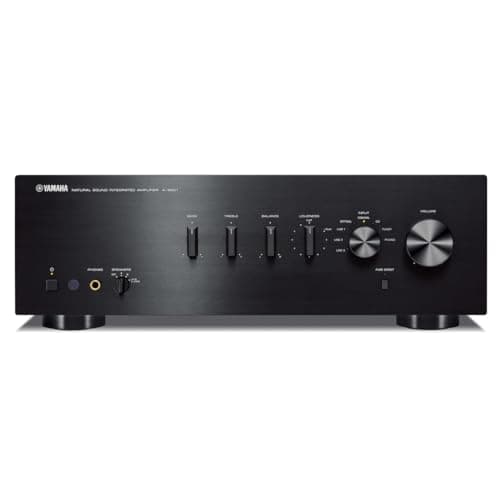 Yamaha A-S501 85 watts per channel into 8 ohms with a damping factor of 240 and an MM phono input fitted — the most amplifier here for the money, provided your speakers are an 8-ohm load. | Best overall under $1,000 | 8.6 |
We have not heard this amplifier. What follows is a reading of Yamaha’s published specifications — what they promise, what they omit, and one figure that circulates widely and means something different from what people think.
The 185 watt problem
Search for this amplifier and you will find “185 W into 4 ohms” repeated everywhere. Here is what Yamaha actually publishes.
Their rated output is 85 W + 85 W into 8 Ω, measured 20 Hz–20 kHz at 0.019% THD, described as minimum RMS. That is a proper rating: a stated band, a stated distortion figure, and a stated load.
Separately, Yamaha publishes a line labeled High Dynamic Power/Channel: 130 W into 8 Ω, 150 W into 6 Ω, 185 W into 4 Ω, 220 W into 2 Ω.
Dynamic power is a short-burst IHF measurement. It describes what the amplifier can deliver for a fraction of a second before the power supply sags — a real and useful property, since music is full of transients. It is not a continuous rating, and it cannot be compared to a continuous rating. Yamaha publishes no continuous 4-ohm rating for this amplifier at all.
So the “185 W” figure being quoted as this amplifier’s 4-ohm power overstates it by roughly a factor of two. Yamaha has not claimed otherwise — the line is clearly labeled on their own spec page. The error is downstream.
What that means if your speakers dip low
It means you cannot complete the calculation. A nominally 6-ohm speaker like the Q Acoustics 3030i publishes a 4-ohm minimum; the KEF Q3 Meta is nominally 4 Ω before it dips to 3.2 Ω. To know whether this amplifier is comfortable there you would need a continuous 4-ohm rating, and there is not one.
This is not a reason to avoid the A-S501, and it is not evidence that the amplifier struggles. It is a documented gap, and the practical response is to look at the speaker first: an easy 8-ohm load with reasonable sensitivity puts you well inside what Yamaha does rate.
Compare this to the Marantz PM6007, which publishes 60 W × 2 into 4 Ω across the full band with both channels driven. Lower power, complete information — which is why it outranks the Yamaha on our vinyl-focused amplifier page even though the Yamaha wins on 8-ohm watts.
What Yamaha publishes that its rivals do not
The rest of the sheet is unusually complete, and it is worth saying so after two sections of criticism.
- Damping factor: 240.The highest figure among the integrated amplifiers we cover — Marantz publishes 100, Cambridge above 50. Damping factor is the ratio of load impedance to the amplifier’s output impedance, and a high figure means tighter control of the woofer’s motion after the signal stops.
- THD 0.019% at 50 W into 8 Ω, 20 Hz–20 kHz. Note the condition: at a real power level, across the whole band, not at 1 kHz.
- Signal-to-noise 99 dB on CD input with the input shorted, and 82 dB or more on the MM phono input.
- Phono input: MM, 3.0 mV / 47 kΩ. A published sensitivity, which Cambridge does not provide for the AXA35.
- A subwoofer output, which turns this into a 2.1 amplifier and pairs well with a small bookshelf speaker.
The digital inputs, and the missing part number
The A-S501 has optical and coaxial digital inputs, which means it contains a DAC.
Yamaha does not publish the DAC part number, and does not publish any conversion measurements for it — no THD+N, no signal-to-noise for the digital path, nothing. Compare that to any standalone DAC in our roundup, every one of which publishes both.
That is the honest argument for adding an external converter: not that Yamaha’s is bad — we have no measurements either way — but that an external one publishes its figures and this one does not.
Also worth noting: Yamaha’s specification table contains no Bluetooth row at all. If you want wireless, the Denon PMA-600NE publishes Bluetooth 5.1 with SBC and AAC.
Who should skip it
Anyone with speakers that present a genuinely difficult load. Without a continuous 4-ohm figure you are buying on faith, and the Marantz publishes what you need.
Anyone who wants Bluetooth or HDMI. There is no Bluetooth row on the spec sheet and no HDMI at all — if a television is involved, you want a receiver.
And anyone whose speakers are very sensitive in a small room. 85 watts into a 93 dB speaker at three meters is a great deal more than anyone needs, and the money would do more work somewhere else in the system.
The verdict
On published specifications this is the strongest 8-ohm amplifier in its price bracket, and the damping factor and THD conditions are both better documented than its rivals’. The gaps are specific and worth knowing: no continuous 4-ohm rating, no DAC part number, no Bluetooth.
If your speakers are an easy load and you want the most properly-specified watts for the money, this is the one. Run the arithmetic against your own speakers first — with an amplifier this powerful, the answer is usually that it is more than enough.
Every pick in detail
Every specification below links to the manufacturer document we read it from. Where a manufacturer does not publish a figure, we say so rather than estimating it.
Yamaha A-S501
Best overall under $1,000Price as of October 15, 2026. #ad
85 watts per channel into 8 ohms with a damping factor of 240 and an MM phono input fitted — the most amplifier here for the money, provided your speakers are an 8-ohm load.
- power
- 9/10
- phono stage
- 8/10
- value for money
- 9/10
- build quality
- 9/10
- connectivity
- 6/10
| Specification | Published value | Source |
|---|---|---|
| Power output (8 Ω) | 85 W + 85 W (8 Ω, 20 Hz – 20 kHz, 0.019% THD) — minimum RMS | Yamaha spec page |
| Power output (4 Ω) | Not published as a continuous rating. Yamaha publishes only “High Dynamic Power/Channel (8/6/4/2 Ω): 130 / 150 / 185 / 220 W” — a short-burst IHF measurement, NOT an RMS rating. The “185 W into 4 Ω” figure circulating for this amp is that dynamic number, and treating it as continuous overstates the amplifier by roughly two-fold. | Yamaha spec page |
| Phono input | Yes — MM, 3.0 mV / 47 kΩ | Yamaha owner's manual (PDF) |
| THD | 0.019% (50 W into 8 Ω, 20 Hz – 20 kHz) | Yamaha spec page |
| Signal-to-noise | 99 dB (CD, input shorted); phono MM 82 dB or more | Yamaha spec page |
| Damping factor | 240 | Yamaha spec page |
| Digital inputs | Yes — optical and coaxial (Yamaha does not publish the DAC part number) | Yamaha spec page |
| Bluetooth | Not published — no Bluetooth row appears in Yamaha's specification table | Yamaha spec page |
| Subwoofer out | Yes | Yamaha spec page |
Pros
- 85 W + 85 W into 8 Ω rated across the full 20 Hz – 20 kHz band at 0.019% THD — a real rating, not a 1 kHz-only one
- Damping factor 240, the highest published here
- MM phono input and optical/coaxial digital inputs included
Cons
- Yamaha publishes NO continuous 4 Ω rating — only a “High Dynamic Power” burst figure, so its behavior into a 4 Ω speaker is genuinely unknown from the spec sheet
- No Bluetooth or network streaming
- Large and heavy
Skip it if your speakers dip to 4 Ω and you want to know what you are getting. Marantz and Denon both publish real 4 Ω ratings; Yamaha does not.
Frequently asked questions
Is the Yamaha A-S501 185W into 4 ohms?
No. That figure is Yamaha's High Dynamic Power specification — a short-burst IHF measurement, clearly labeled as such on Yamaha's own spec page. Yamaha publishes no continuous 4-ohm rating for this amplifier at all. Its rated continuous output is 85 W + 85 W into 8 Ω, 20 Hz–20 kHz at 0.019% THD. Treating the dynamic figure as continuous overstates the amplifier by roughly two-fold.
Does the Yamaha A-S501 have a phono input?
Yes — a moving magnet input specified at 3.0 mV into 47 kΩ, with a published phono signal-to-noise ratio of 82 dB or more. That covers every moving magnet cartridge we recommend. There is no moving coil input, and Yamaha does not publish an input capacitance.
Does the Yamaha A-S501 have Bluetooth?
Yamaha's specification table contains no Bluetooth row, so we do not claim it has any. It does have optical and coaxial digital inputs. If Bluetooth matters, the Denon PMA-600NE publishes Bluetooth 5.1 with SBC and AAC codecs.
What DAC is in the Yamaha A-S501?
Yamaha does not publish the part number, and publishes no conversion measurements for the digital inputs — no THD+N and no digital-path signal-to-noise. That is the practical argument for an external converter: not that the built-in one is poor, since there are no measurements either way, but that a standalone DAC publishes figures you can check.
Read next
The Best Integrated Amplifiers Under $1,000
Six amps under $1,000, and the dynamic-power trap that overstates the popular pick by roughly 2x.
Will This Amplifier Drive My Speakers?
Two published numbers, one formula, and the answer is almost always less power than you expected.
The Best Integrated Amplifiers for a Turntable
Amplifiers with a phono stage inside, ranked on published MM sensitivity and phono signal-to-noise — not watts.
Speaker Impedance Explained
Nominal versus minimum impedance, why 2.83 V is not 1 watt, and how to check your amplifier can cope.
How to Read an Amplifier Power Rating
Impedance, bandwidth, distortion, channels driven — the four conditions that turn a watts number into a spec, and which manufacturers publish all four.
Sources
Every specification on this page was read from one of these documents. If one of them has changed, or we have made an error, tell us — corrections are logged and dated per our editorial policy.