Amplifiers for 4 Ohm Speakers: Which Ones Publish a Real Rating
Every amplifier will drive a 4 ohm speaker at some volume. The question is what the maker is willing to put in writing about it, and the answers range from a full-band continuous rating to nothing at all.
Disclosure: we earn a commission if you buy through the links on this page, at no extra cost to you. It does not influence what we pick — our criteria are published and reproducible, so you can check our work. How we pick · Full disclosure
These picks are spec-and-price analyses, not listening tests. We have not heard this gear and we do not pretend to have: every figure below is sourced to the manufacturer and linked, and every price is live or not shown at all. Here are the rules we followed.
Quick picks
Ranked on the published criteria in How We Pick. Prices are live as of September 17, 2026. Tap any row for the full write-up.
- 7.8
- 7.8
- 8.6
- 7.6
| # | Product | Best for | Score | Price |
|---|---|---|---|---|
| 1 | 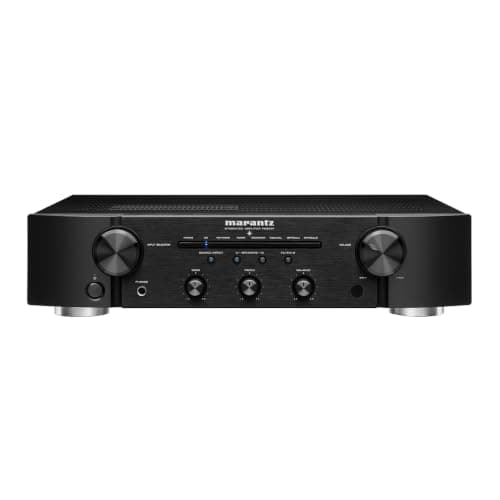 Marantz PM6007 A phono stage plus a proper DAC section in a well-made chassis, at the top of what this bracket will bear. | Best built-in DAC | 7.8 | |
| 2 | 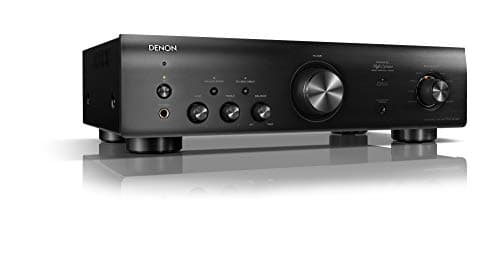 Denon PMA-600NE An integrated with a phono stage, a DAC and Bluetooth in one chassis — the fewest boxes for a mixed vinyl-and-streaming system. | Best with Bluetooth | 7.8 | |
| 3 | 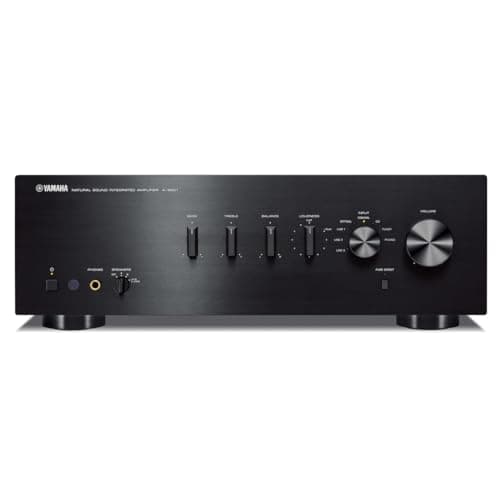 Yamaha A-S501 85 watts per channel into 8 ohms with a damping factor of 240 and an MM phono input fitted — the most amplifier here for the money, provided your speakers are an 8-ohm load. | Best overall under $1,000 | 8.6 | |
| 4 | 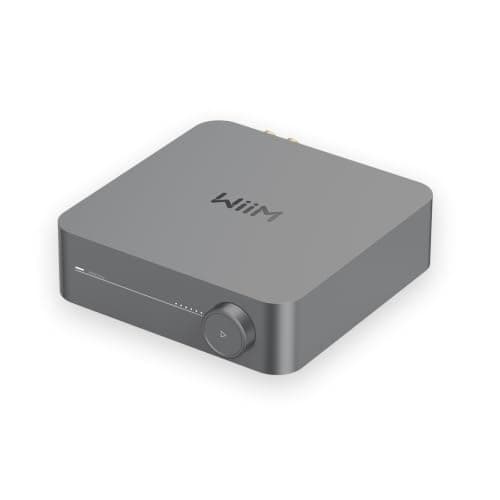 WiiM Amp A streamer with a power amplifier bolted on, which replaces two boxes — and gives up an order of magnitude of measured noise performance to do it. | Best one-box system for passive speakers | 7.6 |
A 4 ohm speaker draws twice the current of an 8 ohm speaker at the same voltage, and current is the thing an amplifier’s power supply and output stage run out of first. That is the whole reason the impedance matters. It is also why the honest measure of an amplifier for a 4 ohm load is not its 8 ohm wattage but whether the maker publishes a 4 ohm figure at all, and under what condition.
What a 4 ohm speaker asks for
An amplifier is, to a first approximation, a voltage source. Halve the load impedance and the current doubles, so the power — voltage times current — doubles too, if the supply can deliver it. A perfect amplifier rated 45 W into 8 ohms would give 90 W into 4. No real amplifier in our brackets does that, and the ratio between the two published figures is a fair measure of how much current the supply has in reserve. A ratio near 2 means a stiff supply; a ratio near 1.3 means the amplifier is running out of current before it runs out of voltage, which is how amplifiers get hot, clip, or drop into protection with a hard load.
Which speakers are 4 ohms? In our registry, the KEF Q7 Meta publishes 4 ohms nominal with a 3.2 ohm minimum. The ELAC Debut 3.0 DF63 and DF53 are published as 6 ohms on ELAC’s product pages and 4 ohms in ELAC’s owner’s manual, which our under-$2,000 floorstanding page documents. Polk publishes no nominal figure at all for the Monitor XT range, only “compatible with 4- and 8-ohm outputs”. And a nominal 8 ohm speaker can dip well below that at some frequencies, which our impedance guidecovers — the reason a published minimum, which only KEF gives, matters more than the nominal.
The four kinds of 4 ohm rating, best to worst
- Continuous, full band, both channels driven, with a distortion figure. The same condition as the 8 ohm rating. This is a real specification and it is rare at our prices.
- Continuous at 1 kHz only, with a looser distortion figure. A real measurement at an easier condition. Comparable to the 8 ohm figure only if you notice the condition changed.
- Dynamic power only. A short-burst IHF measurement, typically 20 milliseconds. It tells you the supply can deliver current briefly. It is not a continuous rating and should not be read as one.
- A number with no condition, or no number. A 4 ohm wattage with no distortion figure and no bandwidth, or an 8 ohm figure and silence about 4. Either way you are guessing.
The four amplifiers ranked on this page are one of each, in that order, and the ranking is the disclosure, not the wattage. Our power-rating guide explains each measurement condition in more depth.
I = √(P ÷ R); ratio = P(4 Ω) ÷ P(8 Ω), ideal = 2.0
Inputs
- Marantz PM6007, 8 Ω: 45 W × 2 (20 Hz – 20 kHz, both channels driven, 0.08% THD) (Marantz owner's manual)
- Marantz PM6007, 4 Ω: 60 W × 2 (20 Hz – 20 kHz, both channels driven) (Marantz owner's manual)
- Denon PMA-600NE, 8 Ω and 4 Ω: 45 W × 2 (20 Hz – 20 kHz, 0.07% THD); 70 W × 2 (4 Ω, 1 kHz, 0.7% THD) (Denon owner's manual)
Result
Full-band 4 ohm rating: the Marantz PM6007
Marantz publishes 45 W into 8 ohms and 60 W into 4 ohms, both across 20 Hz to 20 kHz with both channels driven, the 8 ohm figure at 0.08% THD. It is the only amplifier we cover whose 4 ohm rating is taken under the same bandwidth and drive condition as its 8 ohm rating. It also publishes a damping factor of 100 across 40 Hz to 20 kHz and a phono stage with 83 dB signal-to-noise. It ranks first here on disclosure alone. Its cons are that 45 W is the joint-lowest 8 ohm figure on the under-$1,000 page, and that the 4 ohm figure carries no distortion condition of its own.
1 kHz 4 ohm rating: the Denon PMA-600NE
Denon publishes 45 W into 8 ohms across the band at 0.07% THD, and 70 W into 4 ohms at 1 kHz and 0.7% THD. Both are real continuous measurements; the second is taken at a single frequency and ten times the distortion, which is the easier test. Read the two numbers side by side and the 4 ohm figure looks generous; read the conditions and it is a different measurement. Denon does not publish a damping factor. It ranks second because a 1 kHz continuous figure is still a figure, and because Denon prints the condition next to it rather than hiding it.
Dynamic power only: the Yamaha A-S501
Yamaha publishes 85 W into 8 ohms across the band at 0.019% THD — the best continuous 8 ohm figure and distortion figure of the four — and, for 4 ohms, only “High Dynamic Power/Channel (8/6/4/2 Ω): 130 / 150 / 185 / 220 W”. That is an IHF burst measurement, not a continuous rating, and the 185 W figure circulating in search results as the A-S501’s 4 ohm output is that number misread. The dynamic series does say something useful: the supply delivers rising current into falling impedance all the way to 2 ohms, briefly. What it does not say is what the amplifier delivers into 4 ohms for more than a few milliseconds. It ranks third: excellent 8 ohm disclosure, no continuous 4 ohm figure. The same is true of the Yamaha A-S301, which publishes 100 / 120 / 140 / 150 W dynamic and no continuous 4 ohm rating. Our review covers the rest of the amplifier.
A number with no condition: the WiiM Amp
WiiM publishes 60 W per channel into 8 ohms and 120 W into 4 ohms — a perfect 2.0 ratio — with no distortion figure, no bandwidth and no statement of how many channels were driven attached to either number. A Class D amplifier with a switching supply can genuinely double into 4 ohms, so the ratio is plausible. But a figure with no condition cannot be compared with the three above, and our Class D guide explains why the missing distortion figure matters more for this topology than for the others. It ranks fourth on disclosure while offering the highest published 4 ohm number on the page, which is the point of ranking on disclosure. The Cambridge AXA35 publishes 35 W into 8 ohms and nothing for 4, and the Fosi Audio V3 publishes only a 4 ohm figure (300 W per channel, no distortion condition) and no 8 ohm figure at all; neither is ranked.
AV receivers and 4 ohm speakers
None of the AV receivers we cover publishes a 4 ohm power rating; every figure is an 8 ohm, two-channels-driven number, and several manuals carry an impedance selector that lowers the rail voltage for low-impedance loads rather than adding current. If the plan is a 4 ohm pair on a receiver, the honest position is that the maker has told you nothing, and a receiver with front pre-outs feeding a stereo amplifier with a real 4 ohm rating is the route that has a number attached.
What we would do
For a 4 ohm speaker with a published minimum — the KEF — buy the amplifier with the full-band 4 ohm rating and accept its modest 8 ohm number; the ratio, not the wattage, is what the speaker cares about. For a speaker whose maker gives two impedances — the ELACs — plan for the lower one. For a speaker whose maker gives none — the Polks — treat it as 4 ohms until proven otherwise, because that is the direction in which being wrong is harmless. Our matching guide takes the sensitivity side of the same decision, and the series-parallel page covers the one case where the load is your own doing.
Every pick in detail
Every specification below links to the manufacturer document we read it from. Where a manufacturer does not publish a figure, we say so rather than estimating it.
Marantz PM6007
Best built-in DACPrice as of September 17, 2026. #ad
A phono stage plus a proper DAC section in a well-made chassis, at the top of what this bracket will bear.
- power
- 7/10
- phono stage
- 8/10
- value for money
- 7/10
- build quality
- 9/10
- connectivity
- 8/10
| Specification | Published value | Source |
|---|---|---|
| Power output (8 Ω) | 45 W × 2 (8 Ω, 20 Hz – 20 kHz, both channels driven, 0.08% THD) | Marantz owner's manual |
| Power output (4 Ω) | 60 W × 2 (4 Ω, 20 Hz – 20 kHz, both channels driven) — rated across the full band, unlike most rivals' 1 kHz-only 4 Ω figures | Marantz owner's manual |
| Phono input | Yes — MM only, 2.2 mV / 47 kΩ | Marantz owner's manual |
| Signal-to-noise | 102 dB (line); 83 dB (phono MM) | Marantz owner's manual |
| Damping factor | 100 (8 Ω, 40 Hz – 20 kHz) | Marantz owner's manual |
| Digital inputs | Coaxial and optical | Marantz owner's manual |
| Subwoofer out | Yes — 2.8 V (200 mV input, volume max) | Marantz owner's manual |
Pros
- Good DAC section with optical and coaxial in
- MM phono stage
- Solid build and finish
Cons
- Most expensive here
- No Bluetooth
- Power output is mid-pack for the money
Skip it if you already own a DAC — you are buying a second one.
Denon PMA-600NE
Best with BluetoothPrice as of September 17, 2026. #ad
An integrated with a phono stage, a DAC and Bluetooth in one chassis — the fewest boxes for a mixed vinyl-and-streaming system.
- power
- 7/10
- phono stage
- 8/10
- value for money
- 8/10
- build quality
- 7/10
- connectivity
- 9/10
| Specification | Published value | Source |
|---|---|---|
| Power output (8 Ω) | 45 W + 45 W (8 Ω, 20 Hz – 20 kHz, 0.07% THD) | Denon owner's manual |
| Power output (4 Ω) | 70 W + 70 W (4 Ω, 1 kHz, 0.7% THD) — note the softer condition: 1 kHz at 0.7% THD is a much easier test than the 8 Ω figure's 20 Hz – 20 kHz at 0.07% | Denon owner's manual |
| Phono input | Yes — MM only, 2.5 mV / 47 kΩ | Denon owner's manual |
| Signal-to-noise | 105 dB (line, input shorted); phono MM 84 dB | Denon owner's manual |
| Bluetooth | Yes — version 5.1; SBC and AAC codecs | Denon owner's manual |
| Digital inputs | Coaxial and optical, linear PCM | Denon owner's manual |
| Subwoofer out | Yes — pre-out, 1 V / 100 Hz | Denon owner's manual |
| Damping factor | Not published | — |
Pros
- Phono stage, DAC and Bluetooth all included
- Optical and coaxial inputs
- Analog Mode shuts down digital circuits
Cons
- Less power than the Yamaha A-S501
- Bluetooth is receive-only, SBC-class
- Plainer build than its price implies
Skip it if you need maximum power for hard-to-drive speakers.
Yamaha A-S501
Best overall under $1,000Price as of September 17, 2026. #ad
85 watts per channel into 8 ohms with a damping factor of 240 and an MM phono input fitted — the most amplifier here for the money, provided your speakers are an 8-ohm load.
- power
- 9/10
- phono stage
- 8/10
- value for money
- 9/10
- build quality
- 9/10
- connectivity
- 6/10
| Specification | Published value | Source |
|---|---|---|
| Power output (8 Ω) | 85 W + 85 W (8 Ω, 20 Hz – 20 kHz, 0.019% THD) — minimum RMS | Yamaha spec page |
| Power output (4 Ω) | Not published as a continuous rating. Yamaha publishes only “High Dynamic Power/Channel (8/6/4/2 Ω): 130 / 150 / 185 / 220 W” — a short-burst IHF measurement, NOT an RMS rating. The “185 W into 4 Ω” figure circulating for this amp is that dynamic number, and treating it as continuous overstates the amplifier by roughly two-fold. | Yamaha spec page |
| Phono input | Yes — MM, 3.0 mV / 47 kΩ | Yamaha owner's manual (PDF) |
| THD | 0.019% (50 W into 8 Ω, 20 Hz – 20 kHz) | Yamaha spec page |
| Signal-to-noise | 99 dB (CD, input shorted); phono MM 82 dB or more | Yamaha spec page |
| Damping factor | 240 | Yamaha spec page |
| Digital inputs | Yes — optical and coaxial (Yamaha does not publish the DAC part number) | Yamaha spec page |
| Bluetooth | Not published — no Bluetooth row appears in Yamaha's specification table | Yamaha spec page |
| Subwoofer out | Yes | Yamaha spec page |
Pros
- 85 W + 85 W into 8 Ω rated across the full 20 Hz – 20 kHz band at 0.019% THD — a real rating, not a 1 kHz-only one
- Damping factor 240, the highest published here
- MM phono input and optical/coaxial digital inputs included
Cons
- Yamaha publishes NO continuous 4 Ω rating — only a “High Dynamic Power” burst figure, so its behavior into a 4 Ω speaker is genuinely unknown from the spec sheet
- No Bluetooth or network streaming
- Large and heavy
Skip it if your speakers dip to 4 Ω and you want to know what you are getting. Marantz and Denon both publish real 4 Ω ratings; Yamaha does not.
WiiM Amp
Best one-box system for passive speakersPrice as of September 17, 2026. #ad
A streamer with a power amplifier bolted on, which replaces two boxes — and gives up an order of magnitude of measured noise performance to do it.
- measured performance
- 6/10
- connectivity
- 8/10
- features
- 9/10
- value for money
- 9/10
- published data
- 5/10
| Specification | Published value | Source |
|---|---|---|
| Power output | 60 W per channel into 8 Ω · 120 W per channel into 4 Ω | WiiM spec page |
| Rated-power measurement condition (THD figure, both channels driven) | Not published | — |
| Audio output quality | SNR 98 dB · THD+N 0.0025% (−92 dB) — an order of magnitude worse than the Pro Plus's line-out, which is what a Class-D power stage costs you | WiiM spec page |
| Inputs | HDMI ARC · optical · RCA line-in | WiiM spec page |
| Outputs | Passive speaker terminals · subwoofer out with auto cable detection and a user-adjustable 30–250 Hz crossover | WiiM spec page |
| Network | Wi-Fi 802.11 b/g/n/ac dual band · 10/100 Mbps LAN · Bluetooth 5.1 | WiiM spec page |
| Protocols | AirPlay 2, Chromecast, Spotify Connect, TIDAL Connect, Alexa Cast, DLNA, Roon Ready | WiiM spec page |
| EQ | 10-band graphic EQ, 10-band parametric EQ, 26 presets | WiiM spec page |
| Home theater formats | Stereo PCM only — Dolby Digital and DTS are NOT supported | WiiM spec page |
| Dimensions / weight | 190 × 190 × 63 mm; 1.84 kg (4.1 lb) | WiiM spec page |
| Phono input | No | WiiM spec page |
Pros
- 60 W into 8 Ω and 120 W into 4 Ω published, which drives every passive speaker we recommend
- Subwoofer output with a user-adjustable 30–250 Hz crossover, so a 2.1 system needs nothing else
- HDMI ARC in, so a television can feed it directly
- Same app, same EQ, same Roon Ready and AirPlay 2 support as the standalone streamers
Cons
- WiiM publishes the wattage with no THD figure and no “both channels driven” condition, so the rating cannot be compared to a Yamaha or Marantz spec
- 98 dB SNR and 0.0025% THD+N — roughly twenty decibels noisier than the Pro Plus's line-out
- Stereo PCM only over HDMI ARC: no Dolby Digital, no DTS
- No phono input, and no analog preamp output to escape the internal amplifier
Skip it if you already own an amplifier you like. This is a worse DAC than the Pro Plus attached to an amplifier you did not need.
Frequently asked questions
Can any amplifier drive 4 ohm speakers?
Which integrated amplifiers publish a real 4 ohm rating?
What does 'dynamic power' into 4 ohms mean?
Is a 4 ohm speaker harder to drive than an 8 ohm speaker?
Which AV receivers are good for 4 ohm speakers?
Have you tested these amplifiers into 4 ohm loads?
Read next
Speaker Impedance Explained
Nominal versus minimum impedance, why 2.83 V is not 1 watt, and how to check your amplifier can cope.
Will This Amplifier Drive My Speakers?
Two published numbers, one formula, and the answer is almost always less power than you expected.
How to Read an Amplifier Power Rating
Impedance, bandwidth, distortion, channels driven — the four conditions that turn a watts number into a spec, and which manufacturers publish all four.
The Best Floorstanding Speakers Under $2,000
Five towers that make a stereo pair under $2,000, ranked after putting every published bass figure on a common tolerance — which reorders them.
The Best Integrated Amplifiers Under $1,000
Six amps under $1,000, and the dynamic-power trap that overstates the popular pick by roughly 2x.
Wiring Two Speakers in Series vs Parallel
The impedance arithmetic for two speakers on one channel, what each wiring costs in level, and how to check your amplifier will tolerate it.
Sources
Every specification on this page was read from one of these documents. If one of them has changed, or we have made an error, tell us — corrections are logged and dated per our editorial policy.
- Marantz PM6007 — owner's manual (8 Ω and 4 Ω ratings)
- Denon PMA-600NE — owner's manual (8 Ω and 4 Ω ratings)
- Yamaha A-S501 — specifications (dynamic power series)
- WiiM Amp — specifications
- Cambridge Audio AXA35 — specifications
- KEF Q7 Meta — specifications (4 Ω nominal, 3.2 Ω minimum)
- ELAC Debut 3.0 series — owner's manual (PDF, the 4 Ω figure)