Acoustic Ceiling Panels and Clouds
Side-wall reflections get treated because they are easy to reach. The ceiling produces the same early reflection, arrives at the same time, and gets ignored because mounting it is a nuisance.

Disclosure: we earn a commission if you buy through the links on this page, at no extra cost to you. It does not influence what we pick — our criteria are published and reproducible, so you can check our work. How we pick · Full disclosure
These picks are spec-and-price analyses, not listening tests. We have not heard this gear and we do not pretend to have: every figure below is sourced to the manufacturer and linked, and every price is live or not shown at all. Here are the rules we followed.
Quick picks
Ranked on the published criteria in How We Pick. Prices are live as of October 15, 2026. Tap any row for the full write-up.
- 8.4
- 8.0
- 5.4
| # | Product | Best for | Score | Price |
|---|---|---|---|---|
| 1 | 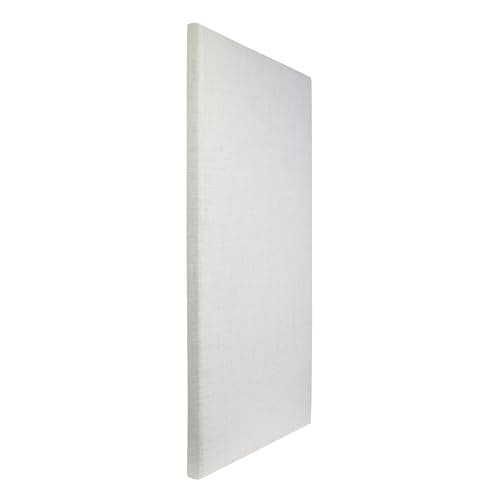 ATS Acoustics Sound Absorbing Panel (24x48) A mineral wool panel with the full absorption curve published — including the 125 Hz figure of 0.12 that its own NRC of 1.00 completely hides. | Best overall panel | 8.4 | |
| 2 | 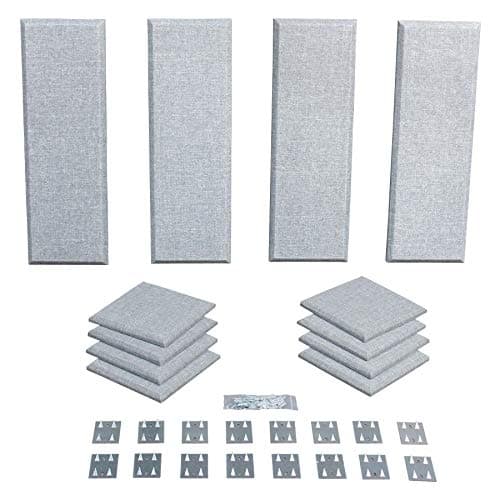 Primacoustic London 8 A planned kit of panels and corner traps with a mounting system included, which removes the hardest part of treating a room: deciding what goes where. | Best complete kit | 8.0 | |
| 3 | 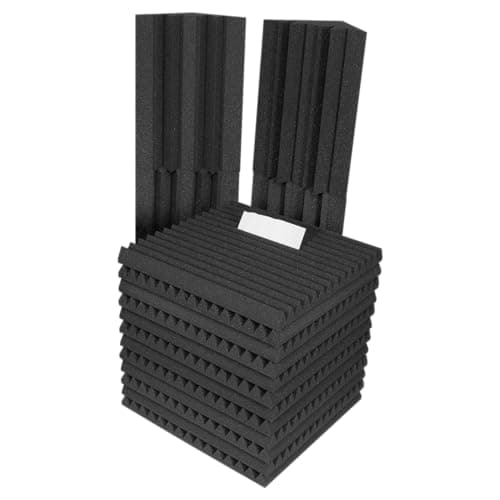 Auralex Roominator Kit A structured foam kit from a manufacturer that does publish absorption data, which separates it from the unbranded foam it resembles. | Best foam kit | 5.4 |
The ceiling is a large, flat, hard, untreated surface directly above the space between you and your speakers. It produces an early reflection with the same character as the side-wall one, and in a room with a low ceiling it arrives sooner.
It goes untreated almost universally, and the reason is not acoustic. It is that hanging twelve pounds of mineral wool overhead is harder than screwing it to a wall.
Finding the point
The mirror trick that finds the side-wall pointsworks overhead, with one extra pair of hands. Someone holds a mirror flat against the ceiling and slides it while you sit in the listening seat. Where you can see a speaker’s tweeter in the mirror, that is a reflection point. Mark both.
The two points land closer together than the side-wall ones, roughly above the midpoint between you and each speaker. In most domestic rooms a single panel spanning both, or one wide cloud, covers them.
How low is low enough to matter
The ceiling reflection matters most when the path it travels is close to the direct path, because that is when the two arrive close enough together to interfere audibly rather than being heard as a separate reflection.
reflected path = 2 × √( (d ÷ 2)² + h² ) · d = speaker-to-listener distance, h = height above ear level
Inputs
- Speaker to listener (typical stereo triangle): 3.0 m (layout per Dolby's published guide; distance is our example)
- Ceiling height above seated ear level, low room: 1.2 m (our example; Dolby's guide covers layout, not ceiling height)
- Ceiling height above seated ear level, tall room: 2.0 m (our example; Dolby's guide covers layout, not ceiling height)
Result
Low ceiling: 2 × √(1.5² + 1.2²) = 2 × 1.92 = 3.84 m → 0.84 m extra
Tall ceiling: 2 × √(1.5² + 2.0²) = 2 × 2.50 = 5.00 m → 2.00 m extra
A low ceiling puts the reflection less than a meter behind the direct sound. A tall one puts it two and a half times further back. The shorter that gap, the more the reflection behaves as interference with the direct sound rather than as a separate, later arrival — which is exactly the condition that smears imaging.
This is a geometric path-length calculation, not a prediction of audibility. Whether the reflection is a problem depends on the ceiling material, the speaker’s vertical dispersion and what else is in the room. Treat it as the reason a low ceiling deserves attention before a tall one, not as a threshold.
Which panel goes overhead
The absorption requirement is the same as a wall panel — you are treating the same band for the same reason — so the same ranking applies. What changes is that weight becomes a safety question rather than a mounting inconvenience.
- ATS 24 × 48 × 2 in— the best published curve here (1.17 at 500 Hz, 1.12 at 1 kHz) and about 12 lb per panel. Overhead, that weight needs a proper suspension: eyebolts into joists, aircraft cable, and no reliance on plasterboard alone. Note also that ATS states this panel is not fire rated.
- Primacoustic London 8— smaller, lighter panels (12 × 36 × 1.5 in columns and 12 × 12 × 1 in blocks) with 16 Surface Impalers included, and an ASTM E84 Class A/1 fabric rating. The lighter format is genuinely easier to get overhead.
- Auralex Roominator— foam, so weight stops being an issue entirely, and UL 94 HF-1 rated. It absorbs considerably less: 0.57 at 500 Hz against the ATS panel’s 1.17.
Fire rating deserves a line of its own here. ATS states plainly that its 24 × 48 panel is not fire rated; Primacoustic publishes ASTM E84-09 Class A/1 for its fabric and Auralex publishes UL 94 HF-1. That is a material difference when the panel is going over your head rather than beside you, and all three manufacturers publish it.
Flat against the ceiling, or suspended?
Both work. Suspending a panel a few inches below the ceiling puts an air gap behind it, and an air gap improves low-frequency absorption for the same thickness of material — the absorber sits where air velocity is higher rather than pressed against the boundary where it is lowest.
None of the manufacturers here publishes coefficients measured with an air gap, so we are not going to put a number on the improvement. ATS does not publish its ASTM test mounting at all, which is the specification that would tell you what condition its curve was measured under. Flat mounting is simpler, safer and still effective; the gap is a refinement, not a requirement.
Home theater ceilings have a second job
If the room is also a home theater with Dolby Atmos, the ceiling is not just a reflecting surface — it is where height speakers go, at angles Dolby publishes. A cloud directly above the seat can sit in the way of an in-ceiling height speaker or absorb the reflection an up-firing module depends on.
Up-firing Atmos modules are the sharper conflict: they work by bouncing sound off the ceiling, and an absorbent cloud in the bounce path defeats them by design. If you use up-firing modules, treat the reflection points between you and the front speakers and leave the bounce zone above and behind the modules alone.
The floor, which is the other surface nobody treats
The ceiling and the floor are a pair. Both are large, both are parallel to each other, and together they produce the vertical mode — a room 2.4 m high resonates at about 71 Hz between them, and again at every multiple.
The floor is the easier of the two to treat and almost nobody counts it as treatment. A rug between you and the speakers absorbs the floor bounce in exactly the way a ceiling cloud absorbs the ceiling one, and it needs no mounting hardware, no fire rating and no permission from anyone.
It is also why a hard-floored room is the one where the ceiling matters most. With carpet underfoot, one of the two early vertical reflections is already handled; with tile or boards, both arrive. The absorption arithmetic counts a rug the same way it counts a panel — area times coefficient — and a rug covers considerably more area than two panels do.
We do not publish absorption coefficients for rugs because rug manufacturers do not publish them. That is a genuine gap, and it is the reason this is a recommendation about sequence rather than a calculation.
The honest priority
The ceiling is third on the list, after speaker position and after the side walls. It is worth doing when the ceiling is low, when the floor is hard, or when the side walls are already treated and the imaging is still vague. It is not the place to start, and the reason it goes untreated is a mounting problem rather than an acoustic one.
Every pick in detail
Every specification below links to the manufacturer document we read it from. Where a manufacturer does not publish a figure, we say so rather than estimating it.
ATS Acoustics Sound Absorbing Panel (24x48)
Best overall panelPrice as of October 15, 2026. #ad
A mineral wool panel with the full absorption curve published — including the 125 Hz figure of 0.12 that its own NRC of 1.00 completely hides.
- low frequency absorption
- 8/10
- published data
- 10/10
- build quality
- 9/10
- value for money
- 7/10
- appearance
- 8/10
| Specification | Published value | Source |
|---|---|---|
| NRC | 1.00 | ATS Acoustics product page |
| Absorption coefficients | 125 Hz: 0.12 · 250 Hz: 0.67 · 500 Hz: 1.17 · 1 kHz: 1.12 · 2 kHz: 1.08 · 4 kHz: 1.08 | ATS Acoustics product page |
| Material | ROCKWOOL AFB mineral wool core, solid wood frame, 1/4 in wood back panel | ATS Acoustics product page |
| Thickness | 2 in | ATS Acoustics product page |
| Dimensions / weight | 24 × 48 × 2 in; ~12 lb per panel | ATS Acoustics product page |
| Fire rating | None — ATS states “This item is not fire rated.” | ATS Acoustics product page |
| ASTM test mounting | Not published | — |
| Density | Not published | — |
Pros
- Publishes the full per-frequency curve, not just an NRC — so you can see what it actually does
- Mineral wool core absorbs 0.67 at 250 Hz, where 1.9 in foam manages 0.13
- Fabric-wrapped and presentable in a living room
Cons
- NRC 1.00 is a real figure and still misleading: at 125 Hz this panel absorbs 0.12. NRC averages 250 Hz–2 kHz only, so it structurally cannot show you the bass performance.
- Not fire rated — ATS states this plainly, and it may matter for your install
- Heavy at ~12 lb, and far more expensive than foam per panel
Skip it if your problem is bass. No 2-inch panel solves that — including this one — and you want corner traps instead.
Primacoustic London 8
Best complete kitPrice as of October 15, 2026. #ad
A planned kit of panels and corner traps with a mounting system included, which removes the hardest part of treating a room: deciding what goes where.
- low frequency absorption
- 8/10
- published data
- 8/10
- build quality
- 9/10
- value for money
- 7/10
- appearance
- 8/10
| Specification | Published value | Source |
|---|---|---|
| Absorption — 1 in Scatter Blocks (LAB MEASURED) | 125 Hz: 0.17 · 250 Hz: 0.28 · 500 Hz: 0.81 · 1 kHz: 1.00 · 2 kHz: 1.02 · 4 kHz: 0.95 — tested by Riverbank Acoustical Laboratories (ASTM C423-02a, E795-05) | Primacoustic engineering data sheet (PDF) |
| Absorption — 1.5 in Control Columns (CALCULATED, NOT MEASURED) | 125 Hz: 0.31 · 250 Hz: 0.56 · 500 Hz: 1.01 · 1 kHz: 1.00 · 2 kHz: 1.01 · 4 kHz: 1.00 — Primacoustic marks this row “typical performance based on quarter wavelength calculations”. These are the kit's main panels, so the kit's headline low-frequency numbers are theoretical, not lab data. | Primacoustic engineering data sheet (PDF) |
| NRC | Not published | — |
| Material | High-density 6 lb/ft³ glass wool, acoustically transparent polyester fabric | Primacoustic engineering data sheet (PDF) |
| Kit contents | 12 panels — 4 × Control Columns (12 × 36 × 1.5 in), 8 × Scatter Blocks (12 × 12 × 1 in); 16 Surface Impalers | Primacoustic engineering data sheet (PDF) |
| Coverage | 20 sq ft (1.85 m²) — rated for rooms up to 100 sq ft (9.3 m²) | Primacoustic engineering data sheet (PDF) |
| Fire rating | ASTM E84-09 Class A/1 (fabric wrap) | Primacoustic engineering data sheet (PDF) |
Pros
- A planned set rather than a pile of panels
- Includes corner traps, not just flat absorbers
- Impaling clip mounting system included
Cons
- Expensive as a single purchase
- Sized for a specific room area — check yours first
- Limited finishes
Skip it if your room is much larger or smaller than the kit assumes — buy panels individually instead.
Auralex Roominator Kit
Best foam kitPrice as of October 15, 2026. #ad
A structured foam kit from a manufacturer that does publish absorption data, which separates it from the unbranded foam it resembles.
- low frequency absorption
- 4/10
- published data
- 8/10
- build quality
- 6/10
- value for money
- 5/10
- appearance
- 4/10
| Specification | Published value | Source |
|---|---|---|
| NRC | DST-112: 0.60 · DST-114: 0.65 (the D36 kit contains both) | Auralex product page |
| Absorption — 2 in DST-114 (ASTM C-423) | 125 Hz: 0.16 · 250 Hz: 0.29 · 500 Hz: 0.57 · 1 kHz: 0.75 · 2 kHz: 0.90 · 4 kHz: 1.00 — Auralex publishes the 125 Hz figure that shows this foam is nearly transparent to bass. Credit where it's due: most foam sellers omit that band entirely. | Auralex performance data |
| Material | Studiofoam (DST-112 and DST-114 panels) | Auralex product page |
| Kit contents | 18 × DST-114, 18 × DST-112, 72 × EZ-Stick Pro tabs | Auralex Roominator spec sheet (PDF) |
| Fire rating | UL 94 HF-1 | Auralex product page |
| Panel dimensions | Not published | — |
| Density | Not published | — |
Pros
- Auralex publishes real absorption data for its foam
- Structured kit with corner treatment
- Light — mounts with adhesive
Cons
- It is still foam: absorption falls away at low frequencies where rooms need it most
- Looks like a studio, not a living room
- Adhesive mounting can mark walls
Skip it if your problem is bass. Foam of this thickness does not solve that, and no amount of it will.
Frequently asked questions
Do I need acoustic panels on the ceiling?
Only after the side walls. The ceiling produces an early reflection of the same kind, and in a room with a low ceiling it arrives sooner — less than a meter behind the direct sound in a typical low-ceilinged room, against two meters in a tall one. Treat it when the ceiling is low, the floor is hard, or the side walls are done and imaging is still vague.
How do I find the ceiling reflection point?
The same mirror trick that finds the side-wall points, with a second person. Sit in the listening seat while someone slides a mirror flat along the ceiling. Wherever you can see a speaker’s tweeter reflected, that is a reflection point. The two points sit roughly above the midpoint between you and each speaker.
Can I hang a mineral wool acoustic panel from the ceiling?
Yes, with proper suspension. ATS publishes about 12 lb for its 24 × 48 × 2 in panel, which overhead means eyebolts into joists and cable rather than anything relying on plasterboard. ATS also states that this panel is not fire rated, while Primacoustic publishes ASTM E84 Class A/1 and Auralex publishes UL 94 HF-1 — worth weighing for a panel going above your head.
Will a ceiling cloud interfere with Dolby Atmos height speakers?
It can. In-ceiling height speakers need clear ceiling area, and up-firing Atmos modules work specifically by reflecting sound off the ceiling — an absorbent panel in that bounce path defeats them. Treat the reflection points between the seat and the front speakers, and leave the area above and behind up-firing modules untreated.
Read next
Find Your First Reflection Points
The mirror trick, in five minutes and for free — plus why those two points matter more than six panels elsewhere.
The Best Acoustic Panels for Walls
Six wall panels ranked on published absorption per band, then on the thing nobody specs: how they attach, and whether they come off again.
How Much Room Treatment Do I Need?
The Sabine equation, applied to a real room with real published coefficients — and what the answer costs.
Dolby Atmos Speaker Placement
Dolby's published height angles, ceiling versus up-firing, and what each needs from your room.
Room Treatment for a Hi-Fi Listening Room
What changes when a room has one seat instead of a console: the four surfaces that matter, in the order that returns the most per panel.
The Best Acoustic Panels for a Home Theater
Panels ranked on published per-frequency absorption — and why an NRC of 1.00 can still absorb 12% at 125 Hz.
Sources
Every specification on this page was read from one of these documents. If one of them has changed, or we have made an error, tell us — corrections are logged and dated per our editorial policy.
- ATS Acoustics 24×48×2 — coefficients, 12 lb weight, “not fire rated”
- Primacoustic London 8 — panel dimensions, Surface Impalers, ASTM E84 Class A/1
- Auralex D36 Roominator kit — contents and UL 94 HF-1 rating
- Auralex — published performance data (DST-114 coefficients)
- Dolby — published speaker setup guides