Subwoofer Placement
Corner, front wall, beside the seat — the right answer depends on specifications your subwoofer's maker either published or did not. Here is how to read them, and the crawl that settles the rest.

The short answer
Put the subwoofer where the room lets it play evenly, then use its controls to fix what is left — and check the spec sheet before you commit to a spot, because port orientation and cabinet depth decide how close to a wall it can go. A corner gives you the most output for free and the least even response; a front-wall position between the main speakers is the usual compromise; the seat-position swap (the “subwoofer crawl”) is how you find the good spot without measuring gear. Of the six subwoofers we cover, the SVS SB-1000 Prois the most placement-tolerant — sealed, so there is no port to crowd, with app control over phase, polarity, low-pass, three EQ bands and room-gain compensation. The Klipsch R-120SW is the least: the only rear-firing port in the group, on the deepest cabinet, with no published low-pass range.
Disclosure: we earn a commission if you buy through the links on this page, at no extra cost to you. It does not influence what we pick — our criteria are published and reproducible, so you can check our work. How we pick · Full disclosure
These picks are spec-and-price analyses, not listening tests. We have not heard this gear and we do not pretend to have: every figure below is sourced to the manufacturer and linked, and every price is live or not shown at all. Here are the rules we followed.
Quick picks
Ranked on the published criteria in How We Pick. Prices are live as of November 12, 2026. Tap any row for the full write-up.
- 9.0
- 7.6
- 6.6
- 8.2$329.00View on Amazon
$599.0045% off
| # | Product | Best for | Score | Price |
|---|---|---|---|---|
| 1 | 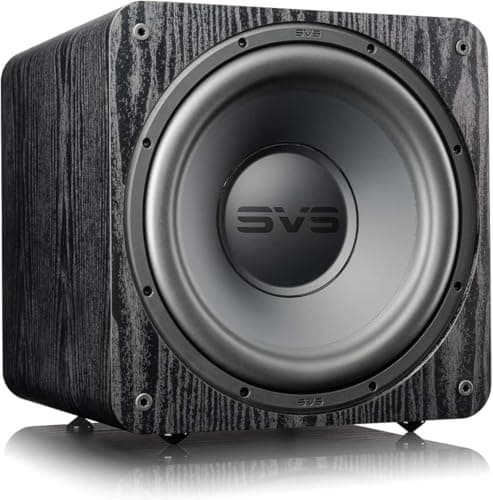 SVS SB-1000 Pro The only subwoofer here whose manufacturer publishes both a continuous power rating and the measurement condition behind its frequency response — 20–270 Hz ± 3 dB at 2 m ground plane — which is what makes its numbers comparable to anything. | Best overall | 9.0 | |
| 2 | 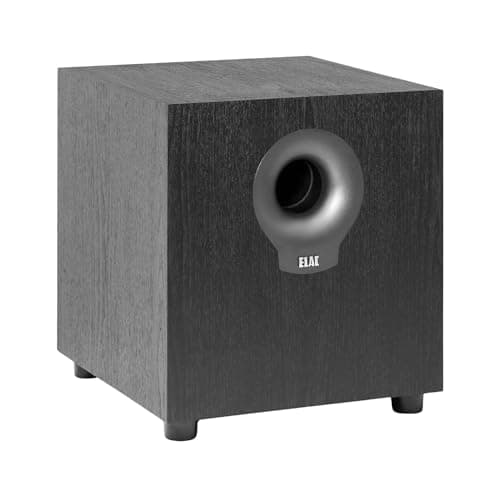 ELAC Debut 2.0 SUB3010 A 10-inch sealed box loaded by a passive radiator instead of a port, with app-driven AutoEQ — the cheapest way here to get measured room correction on the subwoofer itself rather than on the receiver. | Best automatic room EQ | 7.6 | |
| 3 | 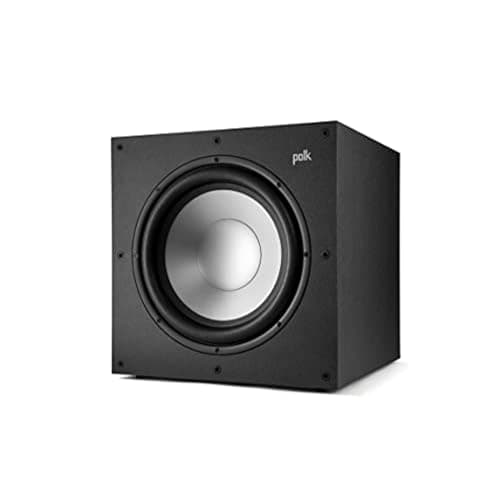 Polk Monitor XT12 A braced, ported 12-inch with line, LFE and binding-post inputs and a published 80–160 Hz crossover — and a manufacturer specification table that lists no amplifier power and no frequency response at all. | Best connectivity | 6.6 | |
| 4 | 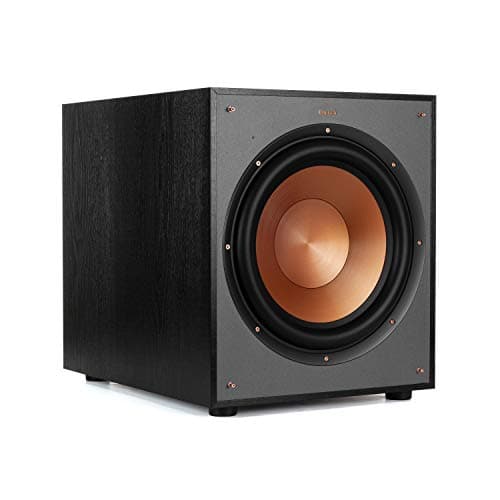 Klipsch R-120SW A 12-inch ported sub whose spec sheet publishes 200 W continuous next to the 400 W peak figure the listings quote — and whose only inputs are RCA, which is the spec that decides whether it works with your amplifier. | Best value 12-inch | 8.2 | $329.00View on Amazon $599.0045% off |
Almost every subwoofer placement guide opens with a diagram of a room. This one opens with the spec sheet, because two of the things that constrain where a subwoofer can go are printed on it: which way the port faces, and how deep the cabinet is. Get those wrong and no amount of crawling around the floor helps.
Step one: read the port, then measure the gap
A ported cabinet moves a lot of air through a hole. Put that hole close to a wall and you get two problems: the port output reflects straight back into the cabinet’s own output, and at high levels the air moving through a restricted port chuffs audibly. Which wall matters depends entirely on where the maker put the port, and the six subwoofers in our registry are split four ways.
- Sealed, no port at all:the SVS SB-1000 Pro (sealed MDF cabinet) and the ELAC SUB3010 (sealed and loaded by a 10 in passive radiator rather than a vent, in ELAC’s own words — “no port to chuff”). These two can sit as close to a wall as the cable permits.
- Front-firing port: the BIC F12 (its patented Venturi vent) and the Polk PSW 10 (a flared front-panel port). The port fires into the room, so wall proximity is not a port problem.
- Rear-firing port: the Klipsch R-120SW, alone in this group. It also has the deepest cabinet here at 19.2 in, so the front of the box is already 19.2 in into the room before you leave any clearance behind it.
- Ported, orientation not stated as front or rear:the Polk Monitor XT12, published simply as “bass reflex (ported), braced MDF”. If you plan to put a ported subwoofer in a tight spot and the sheet does not say which way the vent faces, look at the box before you buy it.
Our ported versus sealed explainer covers what the port buys you in the first place — efficiency and extension for a steeper roll-off below tuning. This page is only interested in what it costs you in position.
Step two: decide how much free output you want to buy
Every room boundary near a subwoofer reflects low frequencies back in phase with the direct sound, because the wavelengths involved are far larger than the distances. The effect is real, it is large, and it is the reason a corner is the loudest place in any room for bass.
Halving the radiating space doubles the intensity in what remains: +3 dB per boundary, in theory
Inputs
- SVS SB-1000 Pro published response and its condition: 20–270 Hz ± 3 dB, measured 2 m ground plane away from reflective structures (quasi-anechoic) — SVS is the only maker in this group that publishes the measurement condition (SVS product page)
- Klipsch R-120SW published response: 29 Hz – 120 Hz ± 3 dB, with no measurement condition stated (Klipsch spec sheet (PDF))
Result
Floor only (free standing, away from walls): the baseline the spec sheet describes
Floor + one wall: up to +3 dB· Floor + two walls (a corner): up to +6 dB
This is radiation theory, not a manufacturer figure, and the simplification matters: the full +3 dB per boundary only applies where the subwoofer is much closer to the boundary than a quarter wavelength, the room’s own modes add peaks and nulls of their own that can swamp it, and furniture and construction change it again. Use it as the reason a corner sounds louder, not as a prediction of how much. The point for placement is that none of it is in the published response — SVS measured its 20 Hz figure 2 m away from reflective structures, so your room is an addition to that curve, not a repeat of it.
The trade is evenness. A corner excites the room’s modes most strongly, which means the loudest position is also the one most likely to give you a seat where bass booms and another where it disappears. In a small room that unevenness is the dominant problem, which is why bass traps for small rooms and placement are the same conversation.
Step three: the crawl, which costs nothing
The standard procedure, and still the best one without measurement gear:
- Put the subwoofer at your listening seat, roughly at ear height if you can prop it safely there.
- Play something with continuous, repetitive low bass — a sustained bass line, not film effects.
- Crawl around the room at ear height with your head where the subwoofer could go, and listen for the positions where the bass is evenest, not loudest.
- Swap the subwoofer into the best of those positions.
The physics is reciprocity: a path from A to B behaves the same as a path from B to A, so a position that sounds even from the seat will sound even at the seat. It is not a substitute for measurement, and it is enormously better than guessing.
Step four: the controls are the part you keep using
Most people cannot put a subwoofer in the best position the crawl found, because a sofa, a door or a partner is in the way. That is where the published control set decides how much of the compromise you can claw back — and this is where our six separate sharply.
Three of the six publish no low-pass crossover range at all: the Klipsch R-120SW, the BIC F12 and the Polk PSW 10. They have a low-pass knob; their makers do not say what it covers. The two that do publish a range are the ELAC SUB3010 (50–150 Hz, continuously adjustable) and the Polk Monitor XT12 (80–160 Hz) — and that difference matters, because the XT12’s range starts at 80 Hz while three of the four bookshelf speakers we most often pair publish a −3 dB point in the 46–50 Hz region. A crossover that cannot come down to meet them leaves an overlap band you cannot remove. Our guide to adding a subwoofer to a stereo amplifier works that arithmetic through speaker by speaker; we will not restate it here.
Phase is the other control that exists because of placement. If the subwoofer and the main speakers are different distances from the seat, their output can partially cancel where the bands overlap; a 0/180 switch (published for the Klipsch R-120SW and the Polk XT12) is a coarse fix, and continuously adjustable phase is better. Two of the six go further: SVS publishes a 50 MHz DSP with app control over three presets, three parametric EQ bands per preset, adjustable low pass, phase, polarity and room-gain compensation— a control that exists specifically to undo the boundary effect above. ELAC publishes AutoEQ with eight parametric curves. Those are the two subwoofers that can be corrected in software when the room wins the argument about position.
Which of the six tolerates a difficult room best
1. SVS SB-1000 Pro.Sealed, so no port to crowd; 13.5 in high and 13 × 14.76 in on the floor, which works out as the smallest footprint in the group by a whisker over the ELAC; and the deepest control set published by anyone in this group, including room-gain compensation. It also takes both line-level and speaker-level inputs, so it can go in a system with no subwoofer output. The honest caveat: it publishes 20–270 Hz ± 3 dB measured 2 m away in the quasi-anechoic condition described above, which is a harder test than the untested numbers it sits beside.
2. ELAC SUB3010.Also sealed, loaded by a passive radiator, with AutoEQ and the only published low-pass range that reaches down to 50 Hz. It is the one whose crossover can actually meet a 50 Hz bookshelf speaker. Against it: a 10 in driver rather than a 12, RCA inputs only (no speaker-level connection), and a published 28–150 Hz response with no tolerance and no measurement condition, so it cannot be compared with the SVS figure directly.
3. Polk Monitor XT12.The most placement-relevant controls of the ported group: a published 80–160 Hz low-pass range, 0/180 phase, and speaker-level inputs on 5-way binding posts as well as line level. Against it: Polk publishes no amplifier wattage and no frequency response for this subwoofer at all — the “down to 24 Hz” is a feature bullet with no tolerance — and its low-pass range stops at 80 Hz, above three of our four reference bookshelf speakers.
4. Klipsch R-120SW.The hardest to place in this group, and both reasons are on the sheet: the only rear-firing port here, on the deepest cabinet at 19.2 in. Add clearance behind it and it occupies close to two feet of room depth. It publishes no low-pass range, and its inputs are line-level/LFE RCA only — no speaker-level option, which rules it out of systems with no subwoofer output. What it does publish is strong: 29–120 Hz ± 3 dB, 200 W continuous and a 116 dB maximum acoustic output.
Common positions, ranked by how often they work
- Front wall, between the main speakers, offset from center: the default for a reason. It keeps the subwoofer and the mains at similar distances from the seat, which makes the phase control a fine adjustment rather than a rescue.
- Front corner: maximum output, maximum unevenness. Worth trying if you need the level, and best with a subwoofer whose EQ or room-gain control can take some of it back out.
- Beside or just behind the seat: often startlingly even at one seat and poor at the others. A single-seat room can use this; a sofa usually cannot.
- Inside a cabinet or under a console: the one to avoid. A ported subwoofer in an enclosed space is the worst case for both port reflection and chuffing, and nothing on the control panel fixes it.
- Two subwoofers, opposite walls at the midpoints: the real fix for multi-seat evenness, and a different purchase than this page. Our home-theater subwoofer roundup is where that starts.
What nobody publishes, and what to do about it
No maker in this group publishes a recommended minimum wall clearance, a port tuning frequency, or the port’s diameter — the three figures that would let you calculate how close is too close rather than guess. Three of the six do not publish the low-pass range of a control they fitted. Only one publishes the measurement condition for its own frequency response, which is the figure every placement decision is measured against.
So the honest procedure is the one above: read the port orientation and the cabinet depth, leave a hand’s width behind a rear-ported box as a starting point, crawl to find the even positions, and buy a subwoofer whose published controls can correct the position you are actually able to use. If you have not chosen one yet, our sizing guide covers cabinet volume against extension, and our music-first subwoofer roundup ranks the same six on inputs and low-pass behavior for a two-channel system.
Every pick in detail
Every specification below links to the manufacturer document we read it from. Where a manufacturer does not publish a figure, we say so rather than estimating it.
SVS SB-1000 Pro
Best overallPrice as of November 12, 2026. #ad
The only subwoofer here whose manufacturer publishes both a continuous power rating and the measurement condition behind its frequency response — 20–270 Hz ± 3 dB at 2 m ground plane — which is what makes its numbers comparable to anything.
- extension
- 9/10
- published data
- 10/10
- room control
- 10/10
- value for money
- 6/10
- build quality
- 9/10
| Specification | Published value | Source |
|---|---|---|
| Frequency response | 20–270 Hz ± 3 dB, measured 2 m ground plane away from reflective structures (quasi-anechoic). SVS is the only manufacturer in this group that publishes the measurement condition. | SVS product page |
| Amplifier power | 325 W RMS continuous (820+ W peak dynamic), Sledge STA-325D class D | SVS product page |
| Driver | 12 in long-throw, 13.3 mm Xmax / 26.9 mm Xmech, 1.5 in voice coil | SVS product page |
| Enclosure type | Sealed, extra-thick MDF front baffle with internal bracing | SVS product page |
| Inputs | Unbalanced stereo RCA in/out (16 kΩ) plus speaker-level stereo input (1 kΩ); 3–12 V AC/DC trigger | SVS product page |
| DSP / app | 50 MHz Analog Devices DSP; Bluetooth app for iOS/Android with 3 nameable presets, 3 parametric EQ bands per preset, adjustable low pass, phase, polarity and room-gain compensation | SVS product page |
| Dimensions (with grille) | 13.5 in H × 13 in W × 14.76 in D (342 × 330 × 375 mm) | SVS product page |
| Weight | 26 lb (11.9 kg) unboxed with grille | SVS product page |
Pros
- 325 W RMS continuous is a continuous rating, not a peak figure dressed as one
- 20–270 Hz ± 3 dB published WITH its measurement condition — nobody else here does that
- App DSP with three parametric EQ bands per preset and room-gain compensation, which is real control over the one band room correction handles worst
- Speaker-level inputs as well as RCA, so an integrated amp with no sub output can still drive it
- Sealed 13-inch cabinet — it fits where a ported 12 will not
Cons
- The most expensive pick here
- Sealed alignment trades raw output near tuning for a gentler roll-off — a ported box of the same size will play louder at 30 Hz
- The app is the interface for the good features; the front panel alone is not
- One of these in a large open-plan room will run out before a bigger ported sub does
Skip it if your room is large and open-plan and output matters more to you than measured accuracy. A ported 12 costs less and moves more air down low.
ELAC Debut 2.0 SUB3010
Best automatic room EQPrice as of November 12, 2026. #ad
A 10-inch sealed box loaded by a passive radiator instead of a port, with app-driven AutoEQ — the cheapest way here to get measured room correction on the subwoofer itself rather than on the receiver.
- extension
- 7/10
- published data
- 6/10
- room control
- 9/10
- value for money
- 6/10
- build quality
- 8/10
| Specification | Published value | Source |
|---|---|---|
| Frequency response | 28 – 150 Hz. ELAC publishes no ± dB tolerance and no measurement condition, so this figure is not directly comparable to the SVS or Klipsch numbers. | ELAC product page |
| Amplifier power | 400 W peak / 200 W RMS, BASH-tracking | ELAC product page |
| Driver | 10 in high-excursion doped paper cone, with a 10 in doped paper passive radiator | ELAC product page |
| Enclosure type | Sealed cabinet loaded by a passive radiator rather than a port — no port to chuff | ELAC product page |
| Crossover frequency | 50 – 150 Hz, continuously adjustable | ELAC product page |
| Inputs | 2 × RCA (L, R/LFE) — no speaker-level inputs | ELAC product page |
| Room EQ | AutoEQ with app control (iOS and Android); ELAC states eight parametric curves | ELAC product page |
| Dimensions | 14.33 in W × 13.5 in H × 13.5 in D (364 × 343 × 343 mm) | ELAC product page |
| Weight | 32.1 lb (14.5 kg) | ELAC product page |
Pros
- AutoEQ with app control corrects the subwoofer to the room, which is the band a receiver's room correction handles least well
- Passive radiator rather than a port — no port to chuff at high excursion, and no minimum wall distance to respect
- 200 W RMS published alongside the 400 W peak
- Crossover continuously adjustable 50–150 Hz, published
- The shallowest cabinet here at 13.5 inches deep
Cons
- The 28–150 Hz figure carries no ± dB tolerance and no measurement condition, so it cannot be compared like-for-like with the SVS or Klipsch numbers
- RCA inputs only — no speaker-level connection
- A 10-inch driver in a small sealed box will not match a 12-inch ported sub for raw output
- Stock is intermittent; this is an older model in ELAC's line
Skip it if you want maximum output per dollar. A 12-inch ported box beats it on volume, and you are paying here for the EQ and the size.
Polk Monitor XT12
Best connectivityPrice as of November 12, 2026. #ad
A braced, ported 12-inch with line, LFE and binding-post inputs and a published 80–160 Hz crossover — and a manufacturer specification table that lists no amplifier power and no frequency response at all.
- extension
- 5/10
- published data
- 2/10
- room control
- 4/10
- value for money
- 7/10
- build quality
- 8/10
| Specification | Published value | Source |
|---|---|---|
| Amplifier power | Not published | — |
| Frequency response | Not published | — |
| Manufacturer's bass claim | Polk's feature bullet says “smooth low frequency extension down to 24 Hz”. It appears nowhere in the specification table, carries no ± dB tolerance and no measurement condition — so it is a claim, not a spec. | Polk Monitor XT12 info sheet (PDF) |
| Amplifier type | Class A/B | Polk product page |
| Low-pass crossover | 80 Hz – 160 Hz, continuously variable, plus LFE | Polk product page |
| Phase adjustment | 0/180 | Polk product page |
| Driver | 12 in bi-laminate paper cone with foam surround | Polk product page |
| Enclosure type | Bass reflex (ported), braced MDF | Polk product page |
| Inputs | Line level, LFE (single RCA) and speaker level via left/right 5-way binding posts | Polk product page |
| Dimensions | 16 in W × 16.4 in H × 17.9 in D (407 × 418 × 456 mm) | Polk product page |
| Weight | 39 lb (17.7 kg) | Polk product page |
Pros
- Line level, LFE and 5-way binding posts — the most complete input set here alongside the SVS
- Low-pass crossover published as 80–160 Hz continuously variable, with 0/180 phase
- Braced low-resonance MDF cabinet with a removable grille
- A 12-inch driver in a ported box — the alignment that moves the most air for the money
Cons
- Polk's specification table publishes NO amplifier wattage and NO frequency response — the “down to 24 Hz” is a marketing bullet with no tolerance and no measurement condition
- 39 lb and 17.9 inches deep
- No DSP, no app, no room EQ — volume, crossover, phase and nothing else
- Nothing published that lets you compare it against the SVS or the Klipsch on paper
Skip it if you want to check the claim before you buy. There is no published response spec here to check it against.
Klipsch R-120SW
Best value 12-inchA 12-inch ported sub whose spec sheet publishes 200 W continuous next to the 400 W peak figure the listings quote — and whose only inputs are RCA, which is the spec that decides whether it works with your amplifier.
- extension
- 8/10
- published data
- 8/10
- room control
- 4/10
- value for money
- 9/10
- build quality
- 7/10
| Specification | Published value | Source |
|---|---|---|
| Frequency response | 29 Hz – 120 Hz ± 3 dB | Klipsch spec sheet (PDF) |
| Amplifier power (cont/peak) | 200 W / 400 W, all-digital. The 400 W is the peak figure and it is the one the listings quote. | Klipsch spec sheet (PDF) |
| Maximum acoustic output | 116 dB | Klipsch spec sheet (PDF) |
| Driver | 12 in high-excursion spun-copper IMG woofer, front-firing | Klipsch spec sheet (PDF) |
| Enclosure type | Bass-reflex via rear-firing port, MDF | Klipsch spec sheet (PDF) |
| Inputs | Line level / LFE RCA jacks only — NO speaker-level inputs | Klipsch spec sheet (PDF) |
| Controls | Volume, low-pass, 0/180 phase, auto power on | Klipsch spec sheet (PDF) |
| Dimensions | 16.5 in H × 14 in W × 19.2 in D (419 × 356 × 488 mm) | Klipsch spec sheet (PDF) |
| Weight | 31 lb (14.1 kg) | Klipsch spec sheet (PDF) |
| Low-pass crossover range | Not published | — |
Pros
- 200 W continuous IS published, alongside the 400 W peak — Klipsch prints both
- 29 Hz – 120 Hz ± 3 dB, a real tolerance rather than a bare number
- Maximum acoustic output published at 116 dB
- Front-firing driver with a rear port, so it is less fussy about how far it sits from a wall than a down-firing design
Cons
- Line/LFE RCA inputs ONLY — no speaker-level inputs, so an integrated amp with no subwoofer output cannot drive it without a converter
- The 400 W in every listing headline is the peak figure, not the rating
- A large box: 19.2 inches deep, 31 lb
- Klipsch does not publish the low-pass crossover range, only that a low-pass control exists
- Previous generation — Klipsch's own page for it now points buyers to the newer Reference R-121SW
Skip it if your amplifier has no subwoofer output. This one has no speaker-level input, and that is a hard stop rather than an inconvenience.
Frequently asked questions
Where is the best place to put a subwoofer?
Should a subwoofer go in a corner?
How far should a subwoofer be from the wall?
Does subwoofer placement affect the crossover setting?
What is the subwoofer crawl and does it really work?
Can two subwoofers fix a bad room?
Read next
Ported vs Sealed Speakers
What a port buys in efficiency and extension, what it costs in placement and roll-off, and how the sealed and ported subwoofers we cover actually compare.
What Size Subwoofer Do You Need for a Home Theater?
Cone diameter is the wrong number. Cabinet volume and the stated measurement condition decide how low a subwoofer actually goes — with the cubic-foot arithmetic to prove it.
How to Add a Subwoofer to a Stereo Amplifier
Three connection routes, which subs support each, and why a stereo amp adds bass rather than redirecting it.
The Best Subwoofers for a Home Theater
Six subwoofers ranked on continuous power and published response, including two that publish neither.
Stereo Speaker Placement
Dolby's 22-30 degree window turned into a listening-distance rule, plus height, toe-in, boundaries and the port clearance most people miss.
Bass Traps for Small Rooms
The room-mode arithmetic that explains why small rooms sound boomy, and the corner trapping that partially fixes it.
Sources
Every specification on this page was read from one of these documents. If one of them has changed, or we have made an error, tell us — corrections are logged and dated per our editorial policy.
- SVS SB-1000 Pro — product page (sealed, 20–270 Hz ± 3 dB with measurement condition, DSP and room-gain compensation)
- ELAC SUB3010 — product page (sealed with passive radiator, 50–150 Hz low pass, AutoEQ)
- Klipsch R-120SW — spec sheet (rear-firing port, 19.2 in depth, line-level inputs only)
- Polk Monitor XT12 — info sheet (80–160 Hz low pass, 0/180 phase, speaker-level inputs)
- BIC America F12 — product page (front-firing Venturi vent, no published low-pass range)
- Polk PSW 10 — product page (front flared port, 40–160 Hz −3 dB)
- Klipsch R-51M — spec sheet (62 Hz −3 dB reference point for the crossover discussion)