Sonos Alternatives
Sonos sells one app, many rooms, and hardware that needs no amplifier. Here is what each of those is worth separately, and the boxes that publish a measurement to go with it.
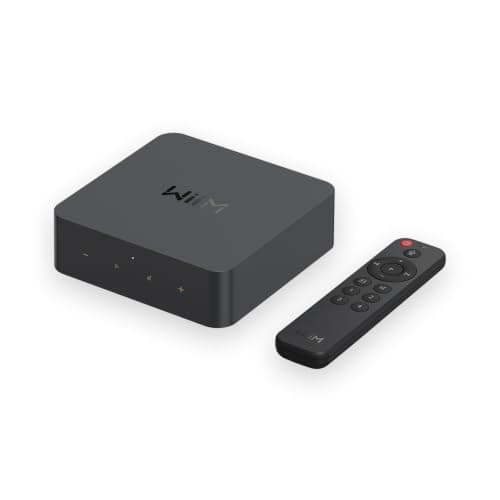
Top pick: WiiM Pro Plus
Best streamer for an existing system. #ad Affiliate link — we earn a commission at no extra cost to you.
The short answer
The best Sonos alternative is the WiiM Pro Plus — because it does the Sonos Port’s job, which is to add app-controlled streaming to a stereo you already own, and publishes the audio measurements Sonos does not: an AKM AK4493SEQ converter, 121 dB analog-out signal-to-noise, 0.00023% THD+N and a line-out frequency response of ± 0.05 dB. It supports AirPlay 2, Google Cast, Spotify Connect, TIDAL Connect, DLNA and Roon Ready, and adds 10-band parametric EQ and room correction. It is the pick for someone who wants the Sonos experience on an existing amplifier and would like to be able to check the numbers. The budget pick is the same box— the Pro Plus is the cheapest product on this page, which is the useful thing about replacing a Port with it rather than the other way round.
Which alternative is right depends entirely on which Sonos product you were looking at. If you have passive speakers and no amplifier, the WiiM Amp is the Sonos Amp’s counterpart. If a turntable and a television are part of it, the WiiM Ultra has a phono input and HDMI ARC. If your library is Roon or MQA, the Bluesound Node Nano is the one that handles both. And if what you actually wanted was a pair of speakers that needs nothing else at all, the Klipsch The Fives II is the only thing on this page that is one — at the price of having no network streaming in it.
Disclosure: we earn a commission if you buy through the links on this page, at no extra cost to you. It does not influence what we pick — our criteria are published and reproducible, so you can check our work. How we pick · Full disclosure
These picks are spec-and-price analyses, not listening tests. We have not heard this gear and we do not pretend to have: every figure below is sourced to the manufacturer and linked, and every price is live or not shown at all. Here are the rules we followed.
Quick picks
Ranked on the published criteria in How We Pick. Prices are live as of November 12, 2026. Tap any row for the full write-up.
- 8.8
- 7.6
- 8.4
- 7.6
- 7.8
| # | Product | Best for | Score | Price |
|---|---|---|---|---|
| 1 | WiiM Pro Plus A streamer and DAC that publishes its line-out performance twice — once as the chip figure and once as the finished product — and is honest enough to print both. | Best streamer for an existing system | 8.8 | |
| 2 | 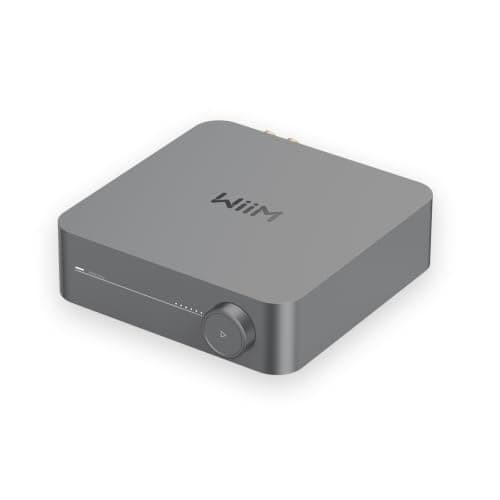 WiiM Amp A streamer with a power amplifier bolted on, which replaces two boxes — and gives up an order of magnitude of measured noise performance to do it. | Best one-box system for passive speakers | 7.6 | |
| 3 | 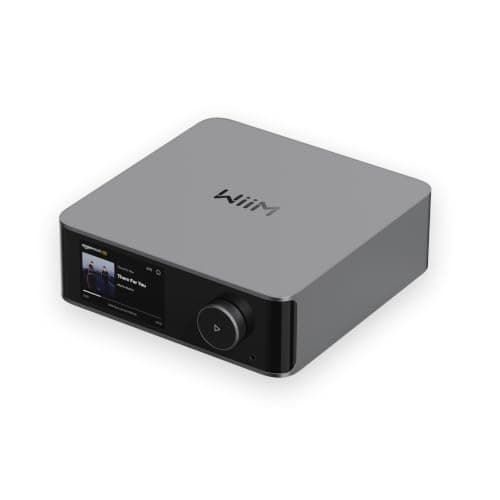 WiiM Ultra The only streamer here with a phono input and a touchscreen — and the only one whose maker publishes nothing at all about how that phono stage performs. | Best for a turntable and a streamer in one box | 8.4 | |
| 4 | 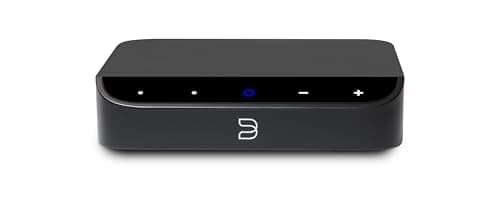 Bluesound Node Nano The most established platform here in the smallest box, with an ESS ES9039Q2M and a spec sheet that is thinner than WiiM's in every respect except pedigree. | Best for a Roon or MQA library | 7.6 | |
| 5 | 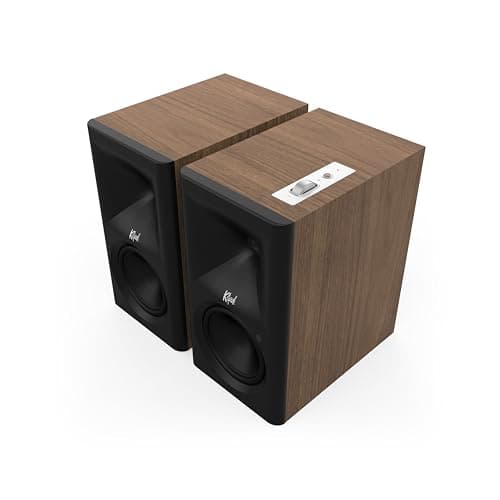 Klipsch The Fives II Powered speakers with HDMI-ARC and a phono input, built to replace both a soundbar and a stereo system in one box pair. | Most connected powered pair | 7.8 |
Sonos is three products in one reputation: an app that groups rooms, a set of self-contained powered speakers, and a pair of boxes — the Port and the Amp — that bring the same app to hi-fi equipment you already own. Shopping for an alternative means deciding which of the three you are replacing, because nothing on this page does all three.
We will be precise about Sonos rather than vague. The Sonos Port, read from sonos.com on 7 November 2026, is described by Sonos as “a WiFi network streamer with built-in DAC” whose job is to “bring the Sonos experience to your existing stereo or receiver.” Sonos publishes: analog RCA line inputs for a turntable or CD player, a digital coaxial output, a dual 10/100 Ethernet port, 802.11a/b/g/n Wi-Fi, an automatic 12 V trigger that switches your amplifier on, AirPlay 2 support from iOS 11.4, bass, treble and loudness adjustment in the app, and a Quad Core 1.4 GHz A-53 processor.
What Sonos does not publish on that page: the DAC model, a signal-to-noise figure, a THD figure, the supported sample rates, or whether the line output is fixed or variable. That is not a criticism of how the Port sounds, which we have not heard and will not guess at. It is a statement about documentation, and on a site that ranks on published figures it is the reason this page can be written at all — every alternative below publishes most or all of that list.
The picks compared, spec by spec
For reference, the Sonos Port publishes none of the first two columns — no DAC model, no signal-to-noise and no distortion figure — and does publish an RCA line input and AirPlay 2 support. Every row below carries its own live price and buy link.
Every figure below is the manufacturer’s own published value and links to the document we read it from. “Not published” means the manufacturer does not publish that figure; an em dash means we have no published figure for that model. Prices are live as of November 12, 2026.
Best streamer for an existing system
- Converter
- AKM AK4493SEQ
- Published noise
- 121 dB · 120 dB(A) for the unit
- Analog in
- Line-in, 2 Vrms, digitised
- Protocols
- AirPlay 2 · Cast · Roon Ready
Best one-box system for passive speakers
- Converter
- —
- Published noise
- SNR 98 dB · THD+N 0.0025%
- Analog in
- HDMI ARC · optical · RCA line-in
- Protocols
- AirPlay 2 · Cast · Roon Ready
Best for a turntable and a streamer in one box
- Converter
- ESS ES9038 Q2M
- Published noise
- 121 dB(A)
- Analog in
- Phono · line-in · HDMI ARC · optical
- Protocols
- Cast · Alexa · Roon Ready
Best for a Roon or MQA library
- Converter
- ESS ES9039Q2M
- Published noise
- 118 dB as published
- Analog in
- None — USB storage only
- Protocols
- AirPlay 2 · Roon Ready · MQA
Most connected powered pair
- Converter
- No wattage published
- Published noise
- —
- Analog in
- Phono · line · HDMI eARC · USB-C
- Protocols
- —
| Pick | Converter | Published noise | Analog in | Protocols | Price |
|---|---|---|---|---|---|
| 1.WiiM Pro PlusBest streamer for an existing system | AKM AK4493SEQ | 121 dB · 120 dB(A) for the unit | Line-in, 2 Vrms, digitised | AirPlay 2 · Cast · Roon Ready | |
| 2.WiiM AmpBest one-box system for passive speakers | — | SNR 98 dB · THD+N 0.0025% | HDMI ARC · optical · RCA line-in | AirPlay 2 · Cast · Roon Ready | |
| 3.WiiM UltraBest for a turntable and a streamer in one box | ESS ES9038 Q2M | 121 dB(A) | Phono · line-in · HDMI ARC · optical | Cast · Alexa · Roon Ready | |
| 4.Bluesound Node NanoBest for a Roon or MQA library | ESS ES9039Q2M | 118 dB as published | None — USB storage only | AirPlay 2 · Roon Ready · MQA | |
| 5.Klipsch The Fives IIMost connected powered pair | No wattage published | — | Phono · line · HDMI eARC · USB-C | — |
Prices as of November 12, 2026; every “Check Price” link goes to Amazon and earns us a commission at no extra cost to you. #ad
Replacing a Sonos Port: the WiiM Pro Plus
This is the closest like-for-like swap on the page and it is the one most people are actually looking for. The Pro Plus does the same job — app-controlled streaming into an existing amplifier — with RCA line out, optical and coaxial S/PDIF out at 192 kHz/24-bit, a 2 Vrms line input, Wi-Fi 5, Ethernet, Bluetooth 5.0, and AirPlay 2, Google Cast Audio, Spotify Connect, TIDAL Connect, Amazon Music Casting, DLNA, Qplay 2.0 and Roon Ready.
Where it goes further is the part that is relevant here. WiiM publishes the converter (AKM AK4493SEQ, with a TI Burr-Brown PCM1861 on the analog input), two signal-to-noise figures with their provenance distinguished — 121 dB from the chip’s own comparison table, 120 dB A-weighted for the finished unit — two THD+N figures on the same basis, and a line-out frequency response of ± 0.05 dB. It also publishes 10-band parametric EQ, 10-band graphic EQ, 24 presets, per-source EQ and room correction, which is more tone control than the Port’s bass, treble and loudness.
One shared limitation worth stating, because it is a property of the category rather than a flaw: the Pro Plus digitises its analog input through that PCM1861 at 192 kHz/24-bit. That is how any streamer with a line input has to work — digitising is the only way to send an analog source to another room — and it means a turntable connected to it does not stay in the analog domain. Our explainer on how a network streamer works covers why.
Replacing a Sonos Amp: the WiiM Amp
If your speakers are passive and you have no amplifier, the Port’s sibling is the Sonos Amp and the counterpart here is the WiiM Amp. It publishes 60 W per channel into 8 Ω and 120 W into 4 Ω, HDMI ARC, optical and RCA line-in, the same protocol list as the Pro Plus, and a subwoofer output with a user-adjustable 30–250 Hz crossover.
Two published costs. Its output measures 98 dB SNR and 0.0025% THD+N, roughly an order of magnitude behind the Pro Plus’s line output — which is what putting a class-D power stage in a 190 mm box costs. And its home-theater support is stereo PCM only: Dolby Digital and DTS are explicitly not supported, so it takes a television’s ARC output but will not decode a film soundtrack. Our amplifier roundup for bookshelf speakers ranks it first on a different set of criteria and is worth reading if the amplifier is the part you care most about.
If a turntable and a TV are both in the room: the WiiM Ultra
The Ultra is the only box on this page with a dedicated phono input for a turntable with no preamp of its own, and it adds HDMI ARC carrying PCM and Dolby Digital 5.1, optical to 192 kHz/24-bit, RCA line-in, USB storage, a 3.5 mm headphone output on a TI TPA6120A2, a subwoofer output and a 3.5 in colour touchscreen. It publishes an ESS ES9038 Q2M, 121 dB(A) analog-out signal-to-noise and −116 dB THD+N.
The asterisk on its phono input is important and WiiM publishes enough for us to state it: the line input is specified at 2 Vrms with the analog signal converted to digital by an ADC at up to 192 kHz/24-bit, and the phono input is listed as MM/MC. So the turntable is digitised on the way in. WiiM also publishes no gain figure, no RIAA accuracy and no input capacitance for that phono stage, which means there is no way to judge it against a real phono stage. It is a convenience, and a genuinely useful one, rather than a hi-fi phono input.
If your library is Roon or MQA: the Bluesound Node Nano
Bluesound publishes an ESS ES9039Q2M Hyperstream IV converter, native rates to 192 kHz at 16–24 bit, a signal-to-noise of 118 dB (Bluesound prints it as −118 dB; the sign is theirs, and SNR is conventionally positive), 0.0007% THD+N, and support for AirPlay 2, Spotify Connect, Tidal Connect, Qobuz Connect, Roon Ready and MQA playback. It runs on USB-C at 5 V / 2 A and weighs 570 g.
Two things to check before you choose it. It has no analog line input and no phono input at all — USB Type A for storage and a learning IR sensor are the only inputs — so it cannot take over a Port’s turntable duty. And its digital output is optical only, with no coaxial, which matters if your amplifier’s digital input is coaxial. Our streamer roundup ranks this hardware on conversion and output measurements rather than on Sonos parity, which is the right page if the app ecosystem is not what you are replacing.
If what you wanted was a speaker, not a streamer
Much of Sonos’s range is self-contained powered speakers, and none of the four boxes above is one. The Klipsch The Fives II is the only product on this page that needs nothing else: a powered pair with HDMI-ARC/eARC and CEC, Bluetooth 5.4 with SBC and AAC, a dedicated analog input with a built-in phono stage, RCA analog, USB-C audio, USB-A and optical, plus a subwoofer output and an HDMI output with 2.1 pass-through. Klipsch publishes 50 Hz–25 kHz ± 3 dB and a 5.25 in Jet Cerametallic woofer.
Two honest caveats. Klipsch publishes no amplifier wattage at all for it — the figure it gives instead is “Max Output: 103 dB (1 m, stereo pair)” — and the Fives II has no network streaming. There is no app, no multiroom grouping and no AirPlay; it is Bluetooth and cables. If multiroom is the whole reason you were looking at Sonos, this is not the answer. If the reason was “one purchase, no amplifier, plays the TV and a record player”, it is the only one here that does all of that, and our powered speakers for a TV page ranks it first.
What none of these replicates
One app across a whole house, with a decade of grouping behaviour behind it. WiiM’s app groups WiiM devices and Bluesound’s groups BluOS devices, and both work — but a mixed house is a mixed app, and that is a real cost that does not appear on any specification sheet. It is the honest reason people stay with Sonos, and we are not going to pretend a cheaper streamer makes it disappear.
What you get in exchange is numbers: a published converter, a published signal-to-noise, a published distortion figure, a published output level, and in three cases an analog input whose conversion path is documented. On a site that will not tell you how something sounds because we have not heard it, that is the only ground on which a recommendation can honestly be made. Bluetooth versus Wi-Fi audio covers the other half of this decision — what the transport itself costs you — and it applies equally to Sonos and to everything on this page.
Every pick in detail
Every specification below links to the manufacturer document we read it from. Where a manufacturer does not publish a figure, we say so rather than estimating it.
WiiM Pro Plus
Best streamer for an existing systemPrice as of November 12, 2026. #ad
A streamer and DAC that publishes its line-out performance twice — once as the chip figure and once as the finished product — and is honest enough to print both.
- measured performance
- 9/10
- connectivity
- 8/10
- features
- 9/10
- value for money
- 10/10
- published data
- 8/10
| Specification | Published value | Source |
|---|---|---|
| DAC | AKM AK4493SEQ (ADC: TI Burr-Brown PCM1861) | WiiM spec comparison |
| Analog out SNR | 121 dB (WiiM's comparison table, the AKM chip figure) · 120 dB A-weighted (WiiM's own “line-out performance” figure for the finished unit) | WiiM spec comparison |
| Analog out THD+N | −113 dB / 0.00023% (comparison table) · 0.00032% / −110 dB at 1 kHz, 44.1k–192k (line-out performance panel) | WiiM spec comparison |
| Line-out frequency response | ± 0.05 dB | WiiM spec comparison |
| Outputs | 1 × RCA line-out · 1 × optical S/PDIF (192 kHz/24-bit) · 1 × coaxial (192 kHz/24-bit) | WiiM spec comparison |
| Inputs | Line-in (2 Vrms, digitized by the ADC at 192 kHz/24-bit) · optical S/PDIF in up to 192 kHz/24-bit, stereo PCM only (no Dolby Digital or DTS) | WiiM spec comparison |
| Network | Wi-Fi 5 (802.11 b/g/n/ac, 2.4 and 5 GHz) · 10/100 Mbps Ethernet · Bluetooth 5.0 | WiiM spec comparison |
| Protocols | AirPlay 2, Google Cast Audio, Spotify Connect, TIDAL Connect, Amazon Music Casting, DLNA, Qplay 2.0, Roon Ready | WiiM spec comparison |
| EQ / room correction | 10-band parametric EQ, 10-band graphic EQ, 24 presets, per-source EQ, room correction | WiiM FAQ |
| Output impedance | Not published | — |
Pros
- AKM AK4493SEQ DAC with a published line-out SNR of 120 dB A-weighted and ±0.05 dB response for the finished unit, not just the chip
- Coaxial AND optical outputs, so it feeds an existing external DAC bit-perfectly if you already own one
- Roon Ready, AirPlay 2, Chromecast, Spotify Connect and TIDAL Connect all supported at once
- 10-band parametric EQ and room correction included, which is a genuinely rare feature at this price
Cons
- No display of any kind — everything happens in the phone app
- The optical input accepts stereo PCM only; Dolby Digital and DTS are explicitly unsupported
- No phono input, so a turntable still needs a separate stage
- WiiM publishes no output impedance, which matters if you feed a low-input-impedance amplifier
Skip it if your amplifier already streams. Paying twice for the same function is the most common mistake in this category.
WiiM Amp
Best one-box system for passive speakersPrice as of November 12, 2026. #ad
A streamer with a power amplifier bolted on, which replaces two boxes — and gives up an order of magnitude of measured noise performance to do it.
- measured performance
- 6/10
- connectivity
- 8/10
- features
- 9/10
- value for money
- 9/10
- published data
- 5/10
| Specification | Published value | Source |
|---|---|---|
| Power output | 60 W per channel into 8 Ω · 120 W per channel into 4 Ω | WiiM spec page |
| Rated-power measurement condition (THD figure, both channels driven) | Not published | — |
| Audio output quality | SNR 98 dB · THD+N 0.0025% (−92 dB) — an order of magnitude worse than the Pro Plus's line-out, which is what a Class-D power stage costs you | WiiM spec page |
| Inputs | HDMI ARC · optical · RCA line-in | WiiM spec page |
| Outputs | Passive speaker terminals · subwoofer out with auto cable detection and a user-adjustable 30–250 Hz crossover | WiiM spec page |
| Network | Wi-Fi 802.11 b/g/n/ac dual band · 10/100 Mbps LAN · Bluetooth 5.1 | WiiM spec page |
| Protocols | AirPlay 2, Chromecast, Spotify Connect, TIDAL Connect, Alexa Cast, DLNA, Roon Ready | WiiM spec page |
| EQ | 10-band graphic EQ, 10-band parametric EQ, 26 presets | WiiM spec page |
| Home theater formats | Stereo PCM only — Dolby Digital and DTS are NOT supported | WiiM spec page |
| Dimensions / weight | 190 × 190 × 63 mm; 1.84 kg (4.1 lb) | WiiM spec page |
| Phono input | No | WiiM spec page |
Pros
- 60 W into 8 Ω and 120 W into 4 Ω published, which drives every passive speaker we recommend
- Subwoofer output with a user-adjustable 30–250 Hz crossover, so a 2.1 system needs nothing else
- HDMI ARC in, so a television can feed it directly
- Same app, same EQ, same Roon Ready and AirPlay 2 support as the standalone streamers
Cons
- WiiM publishes the wattage with no THD figure and no “both channels driven” condition, so the rating cannot be compared to a Yamaha or Marantz spec
- 98 dB SNR and 0.0025% THD+N — roughly twenty decibels noisier than the Pro Plus's line-out
- Stereo PCM only over HDMI ARC: no Dolby Digital, no DTS
- No phono input, and no analog preamp output to escape the internal amplifier
Skip it if you already own an amplifier you like. This is a worse DAC than the Pro Plus attached to an amplifier you did not need.
WiiM Ultra
Best for a turntable and a streamer in one boxPrice as of November 12, 2026. #ad
The only streamer here with a phono input and a touchscreen — and the only one whose maker publishes nothing at all about how that phono stage performs.
- measured performance
- 9/10
- connectivity
- 10/10
- features
- 10/10
- value for money
- 7/10
- published data
- 6/10
| Specification | Published value | Source |
|---|---|---|
| DAC | ESS ES9038 Q2M | WiiM spec page |
| Analog out SNR | 121 dB (A-weighted) | WiiM spec page |
| Analog out THD+N | −116 dB (0.00015%) | WiiM spec page |
| Line-out level | 2.1 Vrms maximum | WiiM spec page |
| Headphone amplifier | TI TPA6120A2 — SNR 119 dB, THD+N −99 dB into 300 Ω falling to −92 dB into 32 Ω | WiiM spec page |
| Phono input | Yes — a dedicated input for turntables without a built-in preamp | WiiM spec page |
| Other inputs | HDMI ARC (PCM and Dolby Digital 5.1) · optical TOSLINK to 192 kHz/24-bit · RCA line-in · USB storage | WiiM spec page |
| Outputs | RCA line-out · subwoofer out · coaxial and optical S/PDIF (192 kHz/24-bit) · USB audio out (UAC 2.0, 192 kHz/24-bit) · 3.5 mm headphone | WiiM spec page |
| Network | Wi-Fi 6 (WiiM states a future Wi-Fi 6E software update) · Bluetooth 5.3 · Ethernet | WiiM spec page |
| Protocols | Spotify Connect, TIDAL Connect, Google Cast Audio, Alexa built-in, DLNA, Squeezelite, Roon Ready | WiiM spec page |
| Display | 3.5 in glass-covered color touchscreen | WiiM spec page |
| Dimensions / weight | 211 × 200 × 72 mm; 1.42 kg (3.13 lb) | WiiM spec page |
| Phono stage gain, RIAA accuracy, input capacitance or MC support | Not published | — |
Pros
- A dedicated phono input, which no other streamer on this page has
- ESS ES9038 Q2M with a published 121 dB SNR and −116 dB THD+N, the best analog figures here
- 3.5 in touchscreen, so it is usable without reaching for a phone
- HDMI ARC, subwoofer out, headphone amp and USB audio out — it can be the hub of a whole system
Cons
- WiiM publishes NO gain, RIAA accuracy, input capacitance or MC capability for the phono stage — the single feature that justifies the price step
- Meaningfully larger and heavier than the Pro Plus for the same core streaming function
- The headphone amp's THD+N degrades from −99 dB into 300 Ω to −92 dB into 32 Ω, so low-impedance headphones get the worse figure
- Wi-Fi 6E is promised via a future software update rather than shipping today
Skip it if you already own a phono stage you like. Without that feature this is a Pro Plus with a screen, at a considerable premium.
Bluesound Node Nano
Best for a Roon or MQA libraryPrice as of November 12, 2026. #ad
The most established platform here in the smallest box, with an ESS ES9039Q2M and a spec sheet that is thinner than WiiM's in every respect except pedigree.
- measured performance
- 9/10
- connectivity
- 6/10
- features
- 8/10
- value for money
- 6/10
- published data
- 7/10
| Specification | Published value | Source |
|---|---|---|
| DAC | ESS ES9039Q2M (Hyperstream IV) | Bluesound spec page |
| Sampling | Native rates up to 192 kHz, 16–24 bit | Bluesound spec page |
| Signal-to-noise | −118 dB as published by Bluesound (the sign is theirs; SNR is conventionally quoted positive, so read this as 118 dB) | Bluesound spec page |
| THD+N | 0.0007% | Bluesound spec page |
| Outputs | Stereo RCA (fixed-level option) · optical TOSLINK · USB Audio 2.0 Type A · Bluetooth headphone out · wireless subwoofer to PULSE SUB+ | Bluesound spec page |
| Coaxial digital output | None — optical only | Bluesound spec page |
| Inputs | USB Type A for storage · learning IR sensor. No analog line input and no phono input. | Bluesound spec page |
| Network | Wi-Fi 5 (802.11ac dual band) · Gigabit Ethernet · Bluetooth 5.2 with aptX Adaptive, two-way | Bluesound spec page |
| Protocols | AirPlay 2, Spotify Connect, Tidal Connect, Qobuz Connect, Roon Ready, plus MQA playback | Bluesound spec page |
| Dimensions / weight | 143 × 36 × 143 mm; 0.57 kg (1.26 lb) | Bluesound spec page |
| Power | USB-C (5 V, 2 A) | Bluesound spec page |
Pros
- ESS ES9039Q2M with Hyperstream IV — the newest DAC silicon on this page
- Gigabit Ethernet, where both WiiM streamers here are limited to 10/100
- Bluetooth 5.2 with aptX Adaptive, two-way, so it can also feed Bluetooth headphones
- BluOS is a mature multiroom platform with a longer track record than WiiM's app
Cons
- No coaxial digital output — optical only, which caps some external-DAC pairings
- No analog input at all, so it cannot digitize a legacy source the way a WiiM Pro Plus can
- Bluesound prints its signal-to-noise ratio as “−118 dB”, a sign convention error on their own sheet
- The most expensive streamer here, with fewer inputs than the WiiM Ultra
Skip it if you need to connect anything analog. It has no line input, no phono input, and no way around that.
Klipsch The Fives II
Most connected powered pairPrice as of November 12, 2026. #ad
Powered speakers with HDMI-ARC and a phono input, built to replace both a soundbar and a stereo system in one box pair.
- integration
- 10/10
- upgrade path
- 4/10
- value for money
- 6/10
- ease of setup
- 9/10
- connectivity
- 10/10
| Specification | Published value | Source |
|---|---|---|
| Type | Powered monitor (pair) | Klipsch spec sheet (PDF) |
| Amplifier output | Not published — Klipsch publishes “Max Output: 103 dB (1 m, stereo pair)” instead of any wattage figure | Klipsch spec sheet (PDF) |
| Built-in phono stage | Yes — a dedicated analog input with a built-in phono stage | Klipsch product page |
| Frequency response | 50 Hz – 25 kHz ± 3 dB | Klipsch spec sheet (PDF) |
| Woofer | 5.25 in Jet Cerametallic | Klipsch spec sheet (PDF) |
| Inputs | HDMI-ARC/eARC with CEC, Bluetooth, RCA phono, RCA analog, USB-C audio, USB-A, optical digital | Klipsch spec sheet (PDF) |
| Outputs | Single RCA line-level output for a subwoofer; HDMI output (HDMI 2.1 pass-through, eARC) | Klipsch spec sheet (PDF) |
| Bluetooth | 5.4 — A2DP, SBC and AAC codecs | Klipsch spec sheet (PDF) |
| Dimensions / weight | 12.9 × 7.2 × 10.7 in (327 × 181 × 273 mm) each; primary 18.2 lb, secondary 15.5 lb | Klipsch spec sheet (PDF) |
Pros
- HDMI-ARC — works as a TV system as well as a stereo
- Built-in phono stage, so a turntable plugs straight in
- Genuinely large drivers for a powered pair
Cons
- By far the most expensive option here
- Klipsch publishes NO amplifier wattage for these — only a “max output 103 dB” figure. You cannot compare their power to anything else here, because there is no number to compare.
- Fixed amplification, so the electronics are the ceiling
Skip it if the TV is not part of this system — most of what you are paying for is the HDMI board.
Frequently asked questions
What is the closest alternative to a Sonos Port?
Does Sonos publish audio specifications for the Port?
Which Sonos alternative works with a turntable?
Can I get multiroom without Sonos?
Read next
The Best Music Streamers With a Built-In DAC
Four streamers with built-in DACs, ranked on published output performance, inputs and protocol support.
How Does a Network Streamer Work?
The four jobs inside a streamer, why the phone is a remote rather than a source, and which of the four you can skip.
Bluetooth vs Wi-Fi Audio
LDAC's published 990 kbps against a 1,411 kbps CD stream — and the codec-matching trap that means your phone's best codec may never be used.
The Best Powered Speakers for a TV
Four ways to put stereo speakers on a television, ranked by connection: HDMI eARC with CEC, two optical inputs, one optical input, or HDMI ARC into an amplifier for passive speakers.
The Best Amplifiers for Bookshelf Speakers
Six amplifiers for bookshelf speakers, ranked on published 4-ohm power, subwoofer outputs and phono inputs rather than on headline wattage.
The Best DAC and Amp Combos Under $200
Three DAC and headphone amp combos under $200, ranked on published power into 32 and 300 ohms — plus the two DACs in this band that have no headphone stage at all.
Sources
Every specification on this page was read from one of these documents. If one of them has changed, or we have made an error, tell us — corrections are logged and dated per our editorial policy.