Sonos Amp Alternatives
The Sonos Amp does four jobs in one box. Each alternative here replaces a different subset of them, and two of them publish measurements Sonos does not.
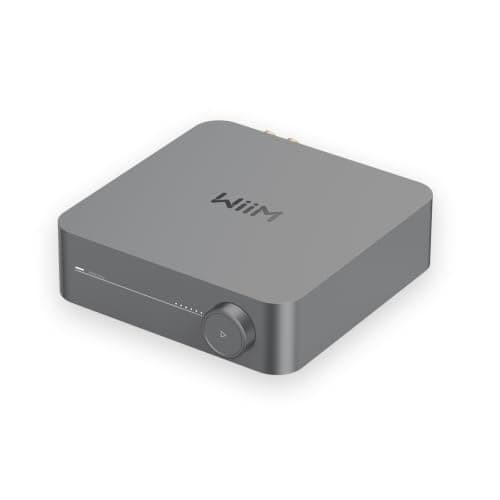
Top pick: WiiM Amp
$329.0020% off
Best one-box system for passive speakers. #ad Affiliate link — we earn a commission at no extra cost to you.
The short answer
The best Sonos Amp alternative is the WiiM Amp — it is the only box here that does the whole job in one chassis: streaming over Wi-Fi with AirPlay 2, Chromecast, Spotify Connect, TIDAL Connect and Roon Ready; an HDMI ARC input for the television; a line-in; a subwoofer output with a user-adjustable 30 to 250 Hz crossover; and a Class-D power stage driving passive speakers. It also publishes what Sonos does not: a 98 dB signal-to-noise ratio and 0.0025% THD+N. It is for the person replacing a Sonos Amp like for like and keeping the speakers. It is also the budget pick — the cheapest product in our registry that replaces every function rather than some of them, which is why the top pick and the budget pick are the same box on this page. The trade is stated plainly below: Sonos publishes 125 watts per channel at 8 Ω, WiiM publishes 60 watts, and WiiM’s spec page states stereo PCM only — no Dolby Digital and no DTS.
The Sonos Amp is not in our product registry and will not be: it is not purchasable through our channel. Every figure attributed to it on this page was read from sonos.com on November 21, 2026 and is cited in the sources at the foot of the page.
Disclosure: we earn a commission if you buy through the links on this page, at no extra cost to you. It does not influence what we pick — our criteria are published and reproducible, so you can check our work. How we pick · Full disclosure
These picks are spec-and-price analyses, not listening tests. We have not heard this gear and we do not pretend to have: every figure below is sourced to the manufacturer and linked, and every price is live or not shown at all. Here are the rules we followed.
Quick picks
Ranked on the published criteria in How We Pick. Prices are live as of November 23, 2026. Tap any row for the full write-up.
- 7.6$263.20View on Amazon
$329.0020% off
- 7.4
- 7.8
- 8.8
- 8.8$199.20View on Amazon
$249.0020% off
| # | Product | Best for | Score | Price |
|---|---|---|---|---|
| 1 | WiiM Amp A streamer with a power amplifier bolted on, which replaces two boxes — and gives up an order of magnitude of measured noise performance to do it. | Best one-box system for passive speakers | 7.6 | $263.20View on Amazon $329.0020% off |
| 2 | 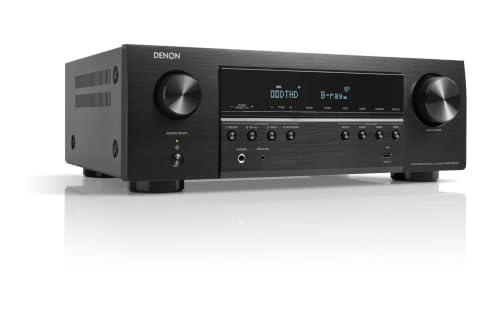 Denon AVR-S670H The X1800H's five-channel sibling: the same 8K plumbing and Audyssey correction, minus the two channels an Atmos height pair would need. | Best 5.2 option | 7.4 | |
| 3 | 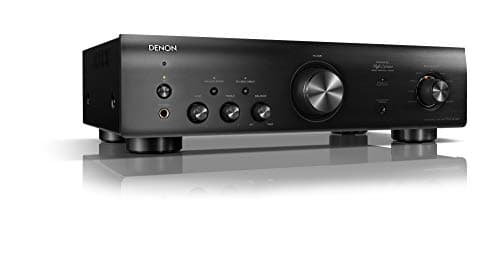 Denon PMA-600NE An integrated with a phono stage, a DAC and Bluetooth in one chassis — the fewest boxes for a mixed vinyl-and-streaming system. | Best with Bluetooth | 7.8 | |
| 4 | 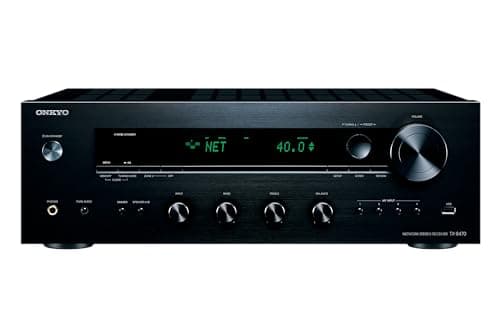 Onkyo TX-8470 The only amplifier we can verify under $500 with a moving-coil phono position as well as a moving-magnet one, and the only one whose maker states its power the FTC way. | Best phono stage under $500 | 8.8 | |
| 5 | 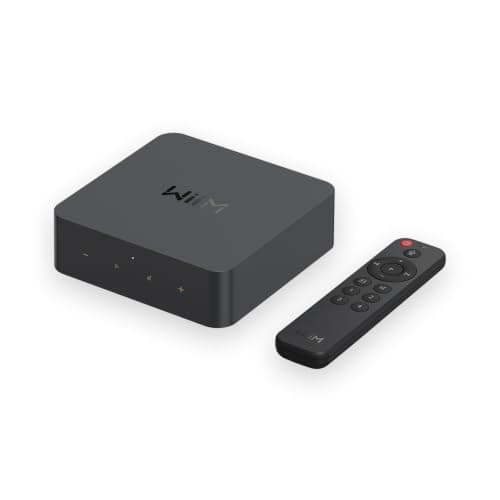 WiiM Pro Plus A streamer and DAC that publishes its line-out performance twice — once as the chip figure and once as the finished product — and is honest enough to print both. | Best streamer for an existing system | 8.8 | $199.20View on Amazon $249.0020% off |
The Sonos Amp is four products in one box, which is exactly why “what should I buy instead” is harder to answer than it looks. It is a network streamer, a 125 watt-per-channel power amplifier for passive speakers, an HDMI ARC television input, and a subwoofer manager — and most of the boxes people suggest as replacements do two of those four.
So this page is organized by job coverage rather than by price. The ranking answers: how much of the Sonos Amp does this replace, and does the manufacturer publish enough for you to check?
What Sonos publishes about the Amp, and what it does not
Read from Sonos’s own product page on November 21, 2026, the published specification is: 125 watts per channel at 8 ohms; an HDMI ARC input, with Sonos noting that a television with only an optical output needs an adapter; Apple AirPlay 2; a line-in; a subwoofer output that supports two Sonos subwoofers or a third-party one; Trueplay tuning; an Ethernet port alongside Wi-Fi; touch controls; custom banana plugs; and a chassis designed to fit standard AV racks. Sonos lists it at $799 in the structured product data on that page.
Nothing on that page states a total harmonic distortion figure, a signal-to-noise ratio, a frequency response with a tolerance, a DAC part, or a measurement condition for the 125 watts — no impedance sweep, no distortion limit, no statement of how many channels were driven. There is also no phono input, so a turntable needs its own phono stage either way. That is not a criticism of how the Amp sounds, which we have not heard. It is the reason this page compares it on the handful of figures it does publish and then shows you what each alternative publishes on top.
The alternatives, on the figures Sonos leaves blank
The second column is the whole argument of this page. Four of the five alternatives publish a noise figure and three publish a distortion figure; the Sonos Amp page publishes neither. The dash in the WiiM Pro Plus power row is correct and important — it has no power amplifier at all, which is why it is ranked fifth and why it is on the page: it replaces the streaming half of a Sonos Amp for someone who already owns an amplifier.
Every figure below is the manufacturer’s own published value and links to the document we read it from. “Not published” means the manufacturer does not publish that figure; an em dash means we have no published figure for that model. Prices are live as of November 23, 2026.
Best one-box system for passive speakers
- Power, with its condition
- 60 W / 8 Ω · 120 W / 4 Ω · no THD condition
- Noise and distortion published
- SNR 98 dB · THD+N 0.0025%
- TV input
- HDMI ARC · optical · RCA line-in
- Phono input
- No
Best 5.2 option
- Power, with its condition
- 75 W/ch · 8 Ω · 2 ch · 0.08% THD (FTC)
- Noise and distortion published
- —
- TV input
- 6 HDMI in (3 × 8K) / 1 out, eARC
- Phono input
- Yes — MM, 2.5 mV
Best with Bluetooth
- Power, with its condition
- 45 W/ch · 8 Ω · 20 Hz–20 kHz · 0.07% THD
- Noise and distortion published
- 105 dB line · 84 dB phono MM
- TV input
- Coaxial and optical — no HDMI
- Phono input
- Yes — MM, 2.5 mV / 47 kΩ
Best phono stage under $500
- Power, with its condition
- 110 W/ch · 8 Ω · 2 ch · 0.08% THD (FTC)
- Noise and distortion published
- 106 dB (IHF-A, line in)
- TV input
- 4 HDMI in / 1 out with ARC, 8K
- Phono input
- Yes — MM and MC, isolated board
Best streamer for an existing system
- Power, with its condition
- —
- Noise and distortion published
- 120 dB(A) line-out · 0.00032% THD+N
- TV input
- Optical in — no HDMI
- Phono input
- —
| Pick | Power, with its condition | Noise and distortion published | TV input | Phono input | Price |
|---|---|---|---|---|---|
| 1.WiiM AmpBest one-box system for passive speakers | 60 W / 8 Ω · 120 W / 4 Ω · no THD condition | SNR 98 dB · THD+N 0.0025% | HDMI ARC · optical · RCA line-in | No | |
| 2.Denon AVR-S670HBest 5.2 option | 75 W/ch · 8 Ω · 2 ch · 0.08% THD (FTC) | — | 6 HDMI in (3 × 8K) / 1 out, eARC | Yes — MM, 2.5 mV | |
| 3.Denon PMA-600NEBest with Bluetooth | 45 W/ch · 8 Ω · 20 Hz–20 kHz · 0.07% THD | 105 dB line · 84 dB phono MM | Coaxial and optical — no HDMI | Yes — MM, 2.5 mV / 47 kΩ | |
| 4.Onkyo TX-8470Best phono stage under $500 | 110 W/ch · 8 Ω · 2 ch · 0.08% THD (FTC) | 106 dB (IHF-A, line in) | 4 HDMI in / 1 out with ARC, 8K | Yes — MM and MC, isolated board | |
| 5.WiiM Pro PlusBest streamer for an existing system | — | 120 dB(A) line-out · 0.00032% THD+N | Optical in — no HDMI | — |
Prices as of November 23, 2026; every “Check Price” link goes to Amazon and earns us a commission at no extra cost to you. #ad
The 125 watts, and what that number is worth
The specification people quote when they argue against the WiiM Amp is the power rating, so here is the arithmetic in the units that matter.
ΔdB = 10 × log10(P1 ÷ P2)
Inputs
- Sonos Amp published output: 125 watts per channel at 8 ohms (no distortion limit, frequency band or channels-driven condition published) (Sonos product page, read 2026-11-21)
- WiiM Amp published output: 60 W per channel into 8 Ω; 120 W per channel into 4 Ω (WiiM spec page)
Result
Why the WiiM Amp wins
Because it is the only alternative that covers all four jobs, and because it publishes measurements for the one job Sonos describes only in watts.
WiiM states 60 W per channel into 8 Ω and 120 W into 4 Ω, a 98 dB signal-to-noise ratio, THD+N of 0.0025% (−92 dB), HDMI ARC plus optical plus an RCA line-in, passive speaker terminals, a subwoofer output with automatic cable detection and a 30 to 250 Hz user-adjustable crossover, dual-band Wi-Fi with 10/100 Ethernet and Bluetooth 5.1, AirPlay 2, Chromecast, Spotify Connect, TIDAL Connect, Alexa Cast, DLNA and Roon Ready, a 10-band graphic and 10-band parametric EQ with 26 presets, and a 190 × 190 × 63 mm chassis at 1.84 kg.
Three honest limitations, all published. Its home theater format support is stereo PCM only — Dolby Digital and DTS are not supported, which matters if the television is sending a surround bitstream rather than a stereo downmix. There is no phono input, so vinyl needs a separate phono stage, exactly as it does with the Sonos Amp. And WiiM does not publish the measurement condition for its rated power, which is the same gap Sonos has.
The adjustable subwoofer crossover is the one place where the substitution is a clear upgrade rather than a sideways move: a 30 to 250 Hz user-set crossover with auto cable detection is a published, adjustable number where the Sonos page describes subwoofer support as a capability.
The other four, and which jobs they replace
Denon AVR-S670H— for the room where the television is the main source. It replaces the amplifier, the TV input and the subwoofer management, adds three more HDMI inputs than Sonos has in total, and adds a phono input and Audyssey MultEQ room correction. 5.2 channels with five power amplifiers, 75 W + 75 W on the full FTC form, 8K/60 and 4K/120 passthrough, eARC, ALLM, QFT and VRR, and an MM phono input at 2.5 mV. One documentation conflict we report rather than resolve: Denon’s info sheet lists no Dolby Atmos and no DTS:X for this model while Denon’s own product page title says “with Dolby Atmos.” We trust the spec table over the page title — verify before buying if Atmos is the reason you are buying. Its pre-outs are subwoofer only, with no main-channel pre-outs.
Denon PMA-600NE— for a stereo room that wants measurements. It replaces the amplifier and adds a phono stage and a published noise floor, and it does not replace the streaming or the HDMI input. 45 W + 45 W into 8 Ω measured across 20 Hz–20 kHz at 0.07% THD — a stricter condition than anything Sonos publishes — with a 70 W + 70 W figure into 4 Ω measured at the much softer 1 kHz / 0.7% THD, which is worth noticing rather than averaging. 105 dB line signal-to-noise, 84 dB on the MM phono input, Bluetooth 5.1 with SBC and AAC, coaxial and optical digital inputs, and a subwoofer pre-out at 1 V / 100 Hz. Pair it with the WiiM Pro Plus below and you have replaced the Sonos Amp with two boxes that publish everything.
Onkyo TX-8470— for the most power with the best phono stage. 110 W + 110 W on the FTC form is the highest continuous rating on this page and comfortably above the Sonos figure even before you account for the condition. It adds four HDMI inputs with ARC and 8K passthrough, an AKM AK4452 32-bit/768 kHz DAC with a Class G output stage, a 106 dB IHF-A line signal-to-noise figure, a subwoofer pre-out plus main L/R pre-outs and a Zone 2 output, and a phono stage that is switchable MM or MC on a dedicated isolated board with published noise figures of 76 dB and 60 dB respectively. It does not replace the streaming. Onkyo publishes no continuous 4 Ω rating and no damping factor for the North American model. Our Onkyo ladder covers it in context.
WiiM Pro Plus— for the reader who already owns an amplifier and only wants the Sonos part back. An AKM AK4493SEQ DAC with a TI Burr-Brown PCM1861 ADC, a 120 dB A-weighted line-out signal-to-noise figure, THD+N of 0.00032% at 1 kHz, a line-out frequency response of ± 0.05 dB, RCA plus optical and coaxial outputs, a line-in digitised at 192 kHz/24-bit, AirPlay 2, Google Cast, Spotify Connect, TIDAL Connect, Roon Ready, and parametric EQ with room correction. Its published line-out distortion is roughly an order of magnitude better than the WiiM Amp’s — which is the clearest illustration on this page of what adding a Class-D power stage to a streamer costs you in measured performance. Like the Amp, its optical input is stereo PCM only. Our Sonos Port alternatives page is the right page if streaming is the only job you need filled.
Where no alternative here matches the Sonos Amp
Three cases, stated plainly.
If the system is already several Sonos rooms, nothing on this page joins that multiroom group. Sonos’s own page describes Trueplay tuning when the Amp is powering Sonos Architectural speakers, and the grouping behaviour across Sonos devices is the product. The WiiM Amp has its own multiroom ecosystem and AirPlay 2; it does not become a Sonos node.
If the published power figure is the requirement and the speakers are insensitive, the honest answer is one of the two receivers rather than the WiiM: the Onkyo’s 110 W and the Denon’s 75 W are rated on the FTC form, which is a stronger claim than either Sonos’s 125 W or WiiM’s 60 W.
And if the chassis has to disappear into a rack behind a wall panel, Sonos designed for that and the two receivers here did not — the WiiM Amp is the only alternative on this page in roughly the same physical class, at 190 mm square and 63 mm tall.
Every pick in detail
Every specification below links to the manufacturer document we read it from. Where a manufacturer does not publish a figure, we say so rather than estimating it.
WiiM Amp
Best one-box system for passive speakersA streamer with a power amplifier bolted on, which replaces two boxes — and gives up an order of magnitude of measured noise performance to do it.
- measured performance
- 6/10
- connectivity
- 8/10
- features
- 9/10
- value for money
- 9/10
- published data
- 5/10
| Specification | Published value | Source |
|---|---|---|
| Power output | 60 W per channel into 8 Ω · 120 W per channel into 4 Ω | WiiM spec page |
| Rated-power measurement condition (THD figure, both channels driven) | Not published | — |
| Audio output quality | SNR 98 dB · THD+N 0.0025% (−92 dB) — an order of magnitude worse than the Pro Plus's line-out, which is what a Class-D power stage costs you | WiiM spec page |
| Inputs | HDMI ARC · optical · RCA line-in | WiiM spec page |
| Outputs | Passive speaker terminals · subwoofer out with auto cable detection and a user-adjustable 30–250 Hz crossover | WiiM spec page |
| Network | Wi-Fi 802.11 b/g/n/ac dual band · 10/100 Mbps LAN · Bluetooth 5.1 | WiiM spec page |
| Protocols | AirPlay 2, Chromecast, Spotify Connect, TIDAL Connect, Alexa Cast, DLNA, Roon Ready | WiiM spec page |
| EQ | 10-band graphic EQ, 10-band parametric EQ, 26 presets | WiiM spec page |
| Home theater formats | Stereo PCM only — Dolby Digital and DTS are NOT supported | WiiM spec page |
| Dimensions / weight | 190 × 190 × 63 mm; 1.84 kg (4.1 lb) | WiiM spec page |
| Phono input | No | WiiM spec page |
Pros
- 60 W into 8 Ω and 120 W into 4 Ω published, which drives every passive speaker we recommend
- Subwoofer output with a user-adjustable 30–250 Hz crossover, so a 2.1 system needs nothing else
- HDMI ARC in, so a television can feed it directly
- Same app, same EQ, same Roon Ready and AirPlay 2 support as the standalone streamers
Cons
- WiiM publishes the wattage with no THD figure and no “both channels driven” condition, so the rating cannot be compared to a Yamaha or Marantz spec
- 98 dB SNR and 0.0025% THD+N — roughly twenty decibels noisier than the Pro Plus's line-out
- Stereo PCM only over HDMI ARC: no Dolby Digital, no DTS
- No phono input, and no analog preamp output to escape the internal amplifier
Skip it if you already own an amplifier you like. This is a worse DAC than the Pro Plus attached to an amplifier you did not need.
Denon AVR-S670H
Best 5.2 optionPrice as of November 23, 2026. #ad
The X1800H's five-channel sibling: the same 8K plumbing and Audyssey correction, minus the two channels an Atmos height pair would need.
- channels
- 6/10
- room correction
- 9/10
- connectivity
- 8/10
- value for money
- 8/10
- future proofing
- 6/10
| Specification | Published value | Source |
|---|---|---|
| Channels | 5.2 (5 power amplifiers) | Denon info sheet (PDF) |
| Power output | 75 W + 75 W (8 Ω, 20 Hz – 20 kHz, 0.08% THD, 2 ch driven) | Denon info sheet (PDF) |
| Dolby Atmos | Sources conflict. Denon's info sheet lists NO Atmos and NO DTS:X (Dolby Audio logo, TrueHD/Digital Plus/Pro Logic II only); Denon's own product-page TITLE says “with Dolby Atmos”. We trust the info sheet's spec table over the page title — verify before buying if Atmos is the reason you are buying. | Denon info sheet (PDF) |
| Room correction | Audyssey MultEQ, with Dynamic EQ and Dynamic Volume | Denon info sheet (PDF) |
| Phono input | Yes — MM, 2.5 mV input sensitivity | Denon owner's manual |
| Video passthrough | 8K/60 Hz, 4K/120 Hz | Denon product page |
| HDMI in / out | 6 in (3 x 8K) / 1 out (Main, eARC). No front-panel HDMI | Denon product page |
| HDMI 2.1 gaming features | ALLM / QMS / QFT / VRR — Yes / No / Yes / Yes | Denon product page |
| Pre-outs | Subwoofer only (0.2) — no main-channel pre-outs | Denon info sheet (PDF) |
Pros
- 8K/60 passthrough and HEOS streaming at a lower price
- Audyssey MultEQ room correction
- MM phono input, 2.5 mV / 47 kΩ
- Simpler to set up than a 7.2
Cons
- Denon's own sources conflict on Dolby Atmos: their info sheet lists none, their product-page title says it has it. Verify before buying if Atmos is the point.
- 5.2 only — five channels cannot produce height regardless of decoding
- Subwoofer pre-outs only, so no path to external amplification
Skip it if Dolby Atmos matters to you — both because five channels cannot do height, and because Denon's own documentation does not agree on whether this unit decodes it.
Denon PMA-600NE
Best with BluetoothPrice as of November 23, 2026. #ad
An integrated with a phono stage, a DAC and Bluetooth in one chassis — the fewest boxes for a mixed vinyl-and-streaming system.
- power
- 7/10
- phono stage
- 8/10
- value for money
- 8/10
- build quality
- 7/10
- connectivity
- 9/10
| Specification | Published value | Source |
|---|---|---|
| Power output (8 Ω) | 45 W + 45 W (8 Ω, 20 Hz – 20 kHz, 0.07% THD) | Denon owner's manual |
| Power output (4 Ω) | 70 W + 70 W (4 Ω, 1 kHz, 0.7% THD) — note the softer condition: 1 kHz at 0.7% THD is a much easier test than the 8 Ω figure's 20 Hz – 20 kHz at 0.07% | Denon owner's manual |
| Phono input | Yes — MM only, 2.5 mV / 47 kΩ | Denon owner's manual |
| Signal-to-noise | 105 dB (line, input shorted); phono MM 84 dB | Denon owner's manual |
| Bluetooth | Yes — version 5.1; SBC and AAC codecs | Denon owner's manual |
| Digital inputs | Coaxial and optical, linear PCM | Denon owner's manual |
| Subwoofer out | Yes — pre-out, 1 V / 100 Hz | Denon owner's manual |
| Damping factor | Not published | — |
Pros
- Phono stage, DAC and Bluetooth all included
- Optical and coaxial inputs
- Analog Mode shuts down digital circuits
Cons
- Less power than the Yamaha A-S501
- Bluetooth is receive-only, SBC-class
- Plainer build than its price implies
Skip it if you need maximum power for hard-to-drive speakers.
Onkyo TX-8470
Best phono stage under $500Price as of November 23, 2026. #ad
The only amplifier we can verify under $500 with a moving-coil phono position as well as a moving-magnet one, and the only one whose maker states its power the FTC way.
- power
- 9/10
- phono stage
- 9/10
- value for money
- 8/10
- build quality
- 8/10
- connectivity
- 10/10
| Specification | Published value | Source |
|---|---|---|
| Power output (8 Ω) | 110 W + 110 W — “With 8 ohm loads, both channels driven, from 20 Hz – 20 kHz; rated 110 watts per channel minimum RMS power, with no more than 0.08% total harmonic distortion from 250 milliwatts to rated output” (FTC form, North American models) | Onkyo owner's manual (PDF) |
| Power output (4 Ω) | Not published as a continuous rating for the North American model. The only other North American figure on Onkyo's table is 210 W at 6 Ω, 1 kHz, 2 ch driven at 10% THD — a maximum-output burst measurement, not an RMS rating. | Onkyo owner's manual (PDF) |
| Phono input | Yes — MM or MC on a rear-panel switch, on a dedicated isolated phono board. Maximum input 70 mV (MM, 1 kHz, 0.5%) and 7 mV (MC, 1 kHz, 0.5%). | Onkyo owner's manual (PDF) |
| Phono signal-to-noise | 76 dB (IHF-A, MM 5 mV in, speaker out) · 60 dB (IHF-A, MC 0.5 mV in, speaker out) | Onkyo owner's manual (PDF) |
| THD | 0.08% (20 Hz – 20,000 Hz, at rated output power) | Onkyo owner's manual (PDF) |
| Damping factor | Not published | — |
| DAC | AKM AK4452, 32-bit / 768 kHz stereo; Class G amplifier stage | Onkyo product page |
| Digital inputs | 3 — one coaxial and two optical — plus 4 HDMI in / 1 HDMI out with ARC and 8K passthrough | Onkyo spec sheet (PDF) |
| Subwoofer out | Yes — one subwoofer pre-out, plus a main pre-out L/R and a Zone 2 pre/line out | Onkyo owner's manual (PDF) |
| Signal-to-noise (line) | 106 dB (IHF-A, line in, speaker out) | Onkyo owner's manual (PDF) |
| Dimensions and weight | 435 × 149.5 × 329 mm; 9 kg (19.8 lb) | Onkyo owner's manual (PDF) |
Pros
- 110 W per channel rated the strict way — 8 Ω, 20 Hz to 20 kHz, both channels driven, 0.08% THD — which nothing else in this bracket publishes
- MM and MC phono on a rear-panel switch, with a published signal-to-noise for each: 76 dB on MM and 60 dB on MC
- Four HDMI inputs with ARC, one coaxial and two optical digital inputs, and an AKM AK4452 32-bit/768 kHz DAC
- Subwoofer pre-out, main pre-out and a Zone 2 pre/line out all published
Cons
- Onkyo publishes no damping factor for it anywhere we can find
- The second figure on Onkyo's own North American table — 210 W at 6 Ω, 1 kHz, 10% THD — is a burst measurement at a distortion level nobody listens at
- It is a receiver: an AM/FM tuner and a second zone are part of what you are paying for whether you use them or not
- 9 kg and 435 mm wide, so it needs a rack shelf rather than a desk
Skip it if you want the shortest signal path your money will buy. This is a networked receiver with a tuner, HDMI switching and two zones, and a plain integrated puts more of the budget into the amplifier.
WiiM Pro Plus
Best streamer for an existing systemA streamer and DAC that publishes its line-out performance twice — once as the chip figure and once as the finished product — and is honest enough to print both.
- measured performance
- 9/10
- connectivity
- 8/10
- features
- 9/10
- value for money
- 10/10
- published data
- 8/10
| Specification | Published value | Source |
|---|---|---|
| DAC | AKM AK4493SEQ (ADC: TI Burr-Brown PCM1861) | WiiM spec comparison |
| Analog out SNR | 121 dB (WiiM's comparison table, the AKM chip figure) · 120 dB A-weighted (WiiM's own “line-out performance” figure for the finished unit) | WiiM spec comparison |
| Analog out THD+N | −113 dB / 0.00023% (comparison table) · 0.00032% / −110 dB at 1 kHz, 44.1k–192k (line-out performance panel) | WiiM spec comparison |
| Line-out frequency response | ± 0.05 dB | WiiM spec comparison |
| Outputs | 1 × RCA line-out · 1 × optical S/PDIF (192 kHz/24-bit) · 1 × coaxial (192 kHz/24-bit) | WiiM spec comparison |
| Inputs | Line-in (2 Vrms, digitized by the ADC at 192 kHz/24-bit) · optical S/PDIF in up to 192 kHz/24-bit, stereo PCM only (no Dolby Digital or DTS) | WiiM spec comparison |
| Network | Wi-Fi 5 (802.11 b/g/n/ac, 2.4 and 5 GHz) · 10/100 Mbps Ethernet · Bluetooth 5.0 | WiiM spec comparison |
| Protocols | AirPlay 2, Google Cast Audio, Spotify Connect, TIDAL Connect, Amazon Music Casting, DLNA, Qplay 2.0, Roon Ready | WiiM spec comparison |
| EQ / room correction | 10-band parametric EQ, 10-band graphic EQ, 24 presets, per-source EQ, room correction | WiiM FAQ |
| Output impedance | Not published | — |
Pros
- AKM AK4493SEQ DAC with a published line-out SNR of 120 dB A-weighted and ±0.05 dB response for the finished unit, not just the chip
- Coaxial AND optical outputs, so it feeds an existing external DAC bit-perfectly if you already own one
- Roon Ready, AirPlay 2, Chromecast, Spotify Connect and TIDAL Connect all supported at once
- 10-band parametric EQ and room correction included, which is a genuinely rare feature at this price
Cons
- No display of any kind — everything happens in the phone app
- The optical input accepts stereo PCM only; Dolby Digital and DTS are explicitly unsupported
- No phono input, so a turntable still needs a separate stage
- WiiM publishes no output impedance, which matters if you feed a low-input-impedance amplifier
Skip it if your amplifier already streams. Paying twice for the same function is the most common mistake in this category.
Frequently asked questions
What is the best Sonos Amp alternative?
Is the WiiM Amp as powerful as the Sonos Amp?
What specifications does Sonos publish for the Amp?
Can I replace a Sonos Amp and keep my speakers?
Does the Sonos Amp have a phono input for a turntable?
Read next
Sonos Alternatives
Five alternatives to Sonos for multiroom streaming — matched on the Port's published feature set, and on the audio figures Sonos does not publish for it.
The Best Amplifiers for Bookshelf Speakers
Six amplifiers for bookshelf speakers, ranked on published 4-ohm power, subwoofer outputs and phono inputs rather than on headline wattage.
The Best Music Streamers With a Built-In DAC
Four streamers with built-in DACs, ranked on published output performance, inputs and protocol support.
Integrated Amplifier vs Receiver
Two-channel integrated versus multichannel receiver, judged on published power ratings and what each spec actually promises.
How to Read an Amplifier Power Rating
Impedance, bandwidth, distortion, channels driven — the four conditions that turn a watts number into a spec, and which manufacturers publish all four.

The Best Onkyo Receivers
All three Onkyo receivers we stock, ranked on the FTC continuous power form Onkyo publishes for each: a 7.2 THX-certified model, the cheapest Onkyo with Atmos, and a two-channel receiver with the highest rating of the three.
Sources
Every specification on this page was read from one of these documents. If one of them has changed, or we have made an error, tell us — corrections are logged and dated per our editorial policy.