Why Does My Record Player Skip?
Where it skips tells you why. Skipping everywhere is tracking force or a worn stylus; skipping when you walk across the room is a resonance problem; skipping only on loud passages is a specification one manufacturer publishes and the rest do not.
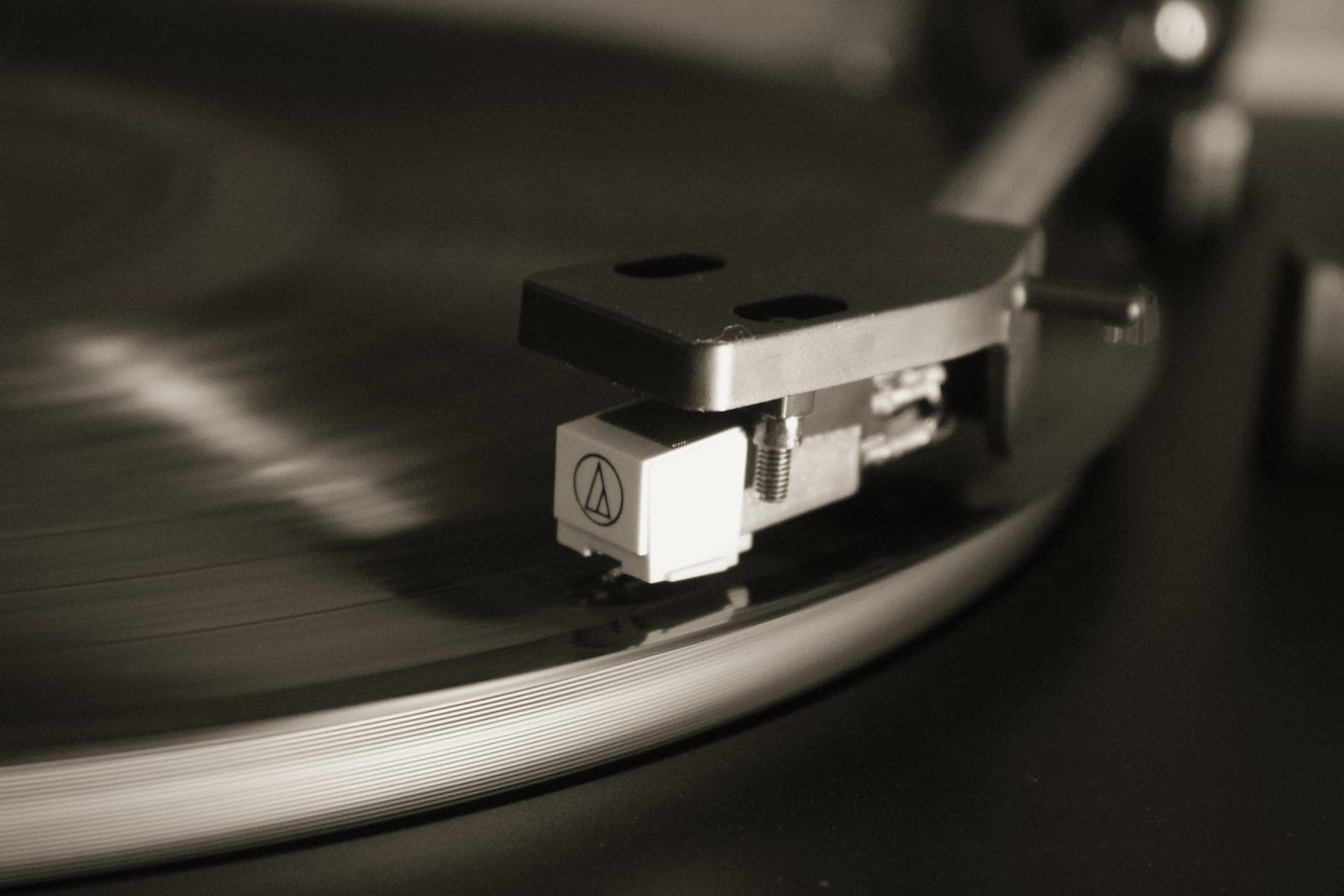
The short answer
Set the tracking force to the middle of the cartridge’s published range before anything else, and check the stylus is not worn. Those two fix most skipping. If it only happens on loud passages and the force is correct, the cartridge has run out of tracking ability — and Ortofon is the only manufacturer we cover that publishes a figure for it: 80 µm at 315 Hz for the 2M Blue against 70 µm for the 2M Red. If it happens when someone walks past, it is not the cartridge at all; it is resonance, and it is a furniture problem.
Disclosure: we earn a commission if you buy through the links on this page, at no extra cost to you. It does not influence what we pick — our criteria are published and reproducible, so you can check our work. How we pick · Full disclosure
These picks are spec-and-price analyses, not listening tests. We have not heard this gear and we do not pretend to have: every figure below is sourced to the manufacturer and linked, and every price is live or not shown at all. Here are the rules we followed.
Quick picks
Ranked on the published criteria in How We Pick. Prices are live as of October 10, 2026. Tap any row for the full write-up.
- 8.6
- 8.2
- 8.4$63.25View on Amazon
$74.0015% off
| # | Product | Best for | Score | Price |
|---|---|---|---|---|
| 1 | 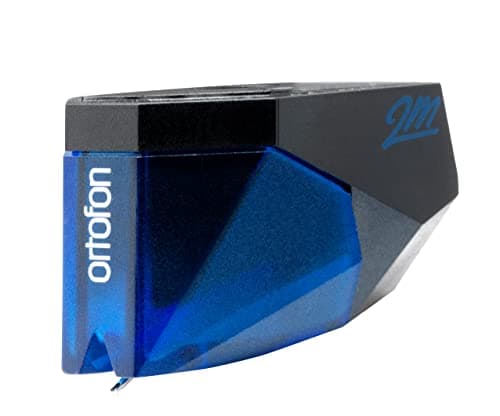 Ortofon 2M Blue The highest published output in this bracket, into the 47 kΩ input every moving-magnet phono stage already has — with a published response tolerance to go with it. | Best for a basic MM phono input | 8.6 | |
| 2 | 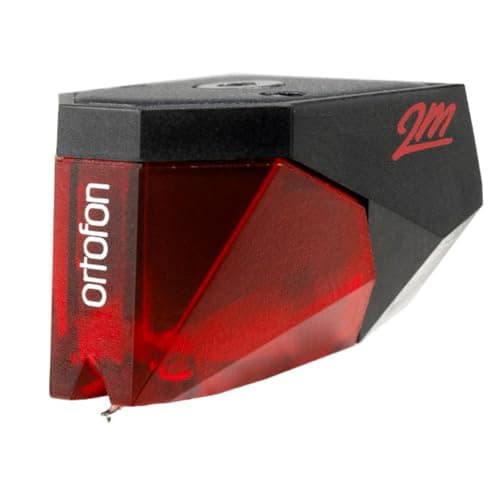 Ortofon 2M Red The only cartridge here whose maker publishes a frequency response with a tolerance and a tracking-ability figure, which makes it the one you can actually verify a claim against. | Best published data | 8.2 | |
| 3 | 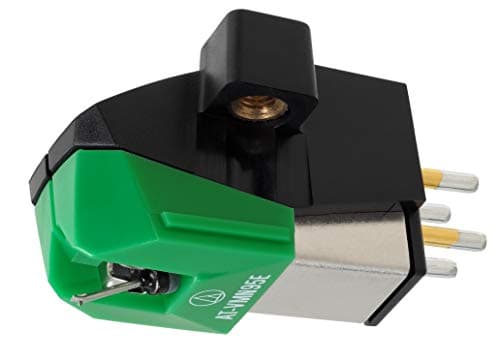 Audio-Technica AT-VM95E The cheapest way into a cartridge body that accepts seven different styli, so every later upgrade costs a stylus rather than a cartridge. | Best first upgrade | 8.4 | $63.25View on Amazon $74.0015% off |
A stylus stays in a groove because a downward force holds it there against the sideways force of the groove wall pushing it around. Skipping is that balance losing. Which half of it lost tells you what to fix, and the single most useful diagnostic is not a specification at all — it is noticing where the record skips.
It skips everywhere, on every record
Tracking force, almost always, and it is almost always too light. Every cartridge publishes a range, and the ranges are narrow:
| Cartridge | Published tracking force | Maker’s recommended value |
|---|---|---|
| Audio-Technica AT-VM95E | 1.8–2.2 g | 2.0 g |
| Audio-Technica AT-VM95ML | 1.8–2.2 g | 2.0 g |
| Ortofon 2M Red and 2M Blue | 1.6–2.0 g (16–20 mN) | 1.8 g |
| Nagaoka MP-110 | 1.5–2.0 g | None published |
| Grado Prestige Green4 | 1.6–1.9 g | None published |
The AT-VM95E’s window is 2.0 g ± 0.2 g — a ± 10% band. Setting it at the bottom of the range gives you nothing in reserve for a record that is not perfectly flat, and “as light as possible to protect the record” is the most damaging piece of folklore in vinyl: a stylus that is skating across the groove wall rather than sitting in it does far more harm than one tracking at the manufacturer’s stated force. Set it to the recommended value, or the middle of the range where none is published, and measure it with a gauge rather than trusting the counterweight’s printed scale. Our setup guide has the procedure.
If the force is right and it still skips everywhere, the next suspect is the stylus. A worn tip no longer matches the groove profile and cannot be held by it at any reasonable force. Every cartridge in the Audio-Technica VM95 range takes the same replacement stylus assembly — the AT-VMN95E for the VM95E, the AT-VMN95ML for the ML — so replacing it is a pull-and-push job, not a re-mount. After that: a dirty groove, which is a cleaning problem, and a cartridge that is misaligned in the headshell, which is an alignment problem.
It skips only on loud passages — and here is the specification for that
This is the case that is genuinely about the cartridge, and there is a measurement for it that hardly anybody prints. Tracking ability is the maximum groove amplitude, in micrometres, that the stylus can follow at a given frequency before it mistracks. It is, exactly and literally, the specification for “does it skip on loud music”.
Of every cartridge on this site, Ortofon alone publishes it: 70 µm at 315 Hz for the 2M Red and 80 µm at 315 Hz for the 2M Blue. Audio-Technica publishes none for the VM95E, VM95EN, VM95ML or VM740ML. Nagaoka publishes none. Grado publishes none. So for most of the market there is no way to compare groove-holding ability from published data at all, and the reader is left with adjectives.
level difference (dB) = 20 × log₁₀(amplitude ratio)
Inputs
- Ortofon 2M Red tracking ability: 70 µm at 315 Hz (Ortofon spec page)
- Ortofon 2M Blue tracking ability: 80 µm at 315 Hz (Ortofon spec page)
- Ortofon 2M Blue stylus and tracking force: Nude elliptical, r/R 8/18 µm; 1.6–2.0 g, 1.8 g recommended (Ortofon spec page)
Result
It skips when someone walks across the room
Then it is not the cartridge, the stylus or the force. It is the arm and cartridge resonating together at a frequency a footstep can excite, and the cure is mechanical isolation: a heavier, more rigid support; a shelf fixed to a wall rather than standing on a suspended floor; and not putting the turntable on the same surface as the speakers.
The resonance frequency is set by the cartridge’s compliance and the arm’s effective mass together, and the target is 8–12 Hz — above the range of footfall and warp energy, below the audio band. Our matching guide carries the formula, the unit conversion and the reason most manufacturers’ data is not sufficient to run it; this page will not duplicate it. What is worth saying here is which direction the published numbers point. Audio-Technica’s VM95E publishes 7 × 10⁻⁶ cm/dyne at 100 Hz, a low-compliance cartridge that suits a heavier arm; Ortofon’s 2M series publishes 20 µm/mN, which is the same unit scaled differently (1 µm/mN = 1 × 10⁻⁶ cm/dyne) but quoted at a different frequency, so the two are not directly comparable. Nagaoka publishes no compliance figure at all for the MP-110, which makes resonance arithmetic impossible for it.
It skips at the same place on one particular record
Then the record is damaged or dirty at that point and no amount of setup will fix it. Try cleaning it first — a surprising proportion of “damage” is compacted debris in the groove. If cleaning does not help, a small increase in tracking force within the published rangewill sometimes get a stylus through a damaged passage. Going above the published maximum to force it through is not a repair; it is trading one record’s bad patch for wear on every record you play afterwards.
It skips on the first track, or the last
Those two are different faults. Skipping or jumping at the very start usually means the arm is being set down outside the lead-in groove, or the anti-skate is set hard enough to pull the arm outward before the groove has taken hold. Skipping on the lasttrack points at inner-groove tracking: the groove radius is smallest there, the linear speed is lowest, and tracing error and distortion are at their worst, so a marginal alignment or a worn stylus fails there first. That makes the final track the best test track on any record — if a setup is going to misbehave, it misbehaves there before it misbehaves anywhere else.
Anti-skate deserves a note of its own. It exists to counteract the inward pull a pivoted arm generates, and both too little and too much cause mistracking — too little loads the inner groove wall, too much the outer. Start at the figure the manufacturer prints for your deck, usually equal to the tracking force, and change it in small steps while listening to a single channel.
The list, in order
- Measure the tracking force with a gauge and set it to the maker’s recommended value, not the lightest setting in the range.
- Look at the stylus under a magnifier, and replace it if the tip is visibly flattened or the cartridge has hundreds of hours on it.
- Check the platter is level and the plinth is not rocking.
- Set anti-skate to the manufacturer’s figure, then adjust in small steps.
- Clean the record.
- Check the cartridge alignment in the headshell.
- If it only happens on loud passages with everything else correct, the cartridge has reached its tracking-ability limit — and a cartridge that publishes that figure is the one to replace it with.
A hum is a different problem with a different list, and we have a page for that one. Our cartridge roundup ranks seven cartridges on their published data, including which of them tell you anything about tracking at all.
Every pick in detail
Every specification below links to the manufacturer document we read it from. Where a manufacturer does not publish a figure, we say so rather than estimating it.
Ortofon 2M Blue
Best for a basic MM phono inputPrice as of October 10, 2026. #ad
The highest published output in this bracket, into the 47 kΩ input every moving-magnet phono stage already has — with a published response tolerance to go with it.
- specs
- 8/10
- upgrade path
- 9/10
- value for money
- 9/10
- tracking ability
- 8/10
- published data
- 10/10
| Specification | Published value | Source |
|---|---|---|
| Type | Moving magnet, quad-coils with split pole pins and OFC coil wire | Ortofon spec page |
| Frequency response | 20–20,000 Hz, +2 / −1 dB | Ortofon spec page |
| Channel separation | 25 dB (1 kHz) | Ortofon spec page |
| Channel balance | 1.5 dB (1 kHz) | Ortofon spec page |
| Output voltage | 5.5 mV (1 kHz, 5 cm/sec) | Ortofon spec page |
| Tracking ability at 315 Hz | 80 µm | Ortofon spec page |
| Stylus | NUDE elliptical, tip radius r/R 8/18 µm, aluminum cantilever | Ortofon spec page |
| Compliance (dynamic, lateral) | 20 µm/mN | Ortofon spec page |
| Tracking force | 1.6–2.0 g (16–20 mN); 1.8 g recommended | Ortofon spec page |
| Internal impedance / inductance | 1.3 kΩ DC resistance, 700 mH | Ortofon spec page |
| Recommended load | 47 kΩ, 150–300 pF | Ortofon spec page |
| Weight | 7.2 g | Ortofon spec page |
Pros
- 5.5 mV is the highest published output on this page, so even a low-gain built-in phono stage has an easy job
- 20–20,000 Hz at +2 / −1 dB — a real tolerance, which neither Audio-Technica nor Denon publishes at any price here
- 80 µm tracking ability at 315 Hz published
- Shares the 2M body, so the Bronze and Black styli drop straight in later — the upgrade is a stylus, not a cartridge
Cons
- 25 dB separation and 1.5 dB channel balance are the loosest Ortofon figures in this bracket; the Bronze publishes 26 dB and 1 dB
- A nude elliptical at r/R 8/18 µm, the coarsest tip radius of the three Ortofons here
- Its +2 / −1 dB tolerance is wider than the Bronze's +2 / −0 dB
- 7.2 g on a light arm still needs checking, and Ortofon publishes no measurement frequency for its compliance figure
Skip it if you already own a 2M Red. The Blue is the same body with a better stylus, so buy the Blue stylus and keep the body you have.
Ortofon 2M Red
Best published dataPrice as of October 10, 2026. #ad
The only cartridge here whose maker publishes a frequency response with a tolerance and a tracking-ability figure, which makes it the one you can actually verify a claim against.
- specs
- 8/10
- upgrade path
- 8/10
- value for money
- 8/10
- tracking ability
- 7/10
- published data
- 10/10
| Specification | Published value | Source |
|---|---|---|
| Type | Moving magnet, quad-coils with split pole pins and OFC coil wire | Ortofon spec page |
| Frequency response | 20 Hz – 20 kHz, +3 / −1 dB | Ortofon spec page |
| Channel separation | 22 dB (1 kHz) | Ortofon spec page |
| Channel balance | 1.5 dB (1 kHz) | Ortofon spec page |
| Output voltage | 5.5 mV (1 kHz, 5 cm/sec) | Ortofon spec page |
| Tracking ability at 315 Hz | 70 µm | Ortofon spec page |
| Stylus | Elliptical, tip radius r/R 8/18 µm, aluminum cantilever | Ortofon spec page |
| Compliance (dynamic, lateral) | 20 µm/mN | Ortofon spec page |
| Tracking force | 1.6–2.0 g (16–20 mN); 1.8 g recommended | Ortofon spec page |
| Tracking angle | 20° | Ortofon spec page |
| Internal impedance / inductance | 1.3 kΩ DC resistance, 700 mH | Ortofon spec page |
| Recommended load | 47 kΩ, 150–300 pF | Ortofon spec page |
| Weight | 7.2 g | Ortofon spec page |
Pros
- 20 Hz – 20 kHz at +3/−1 dB — a real tolerance, which neither Audio-Technica nor Nagaoka publish
- 70 µm tracking ability at 315 Hz published, a spec almost nobody else quotes
- 5.5 mV output, the highest here, so quiet phono stages have an easier job
- The 2M Blue stylus drops straight into this body, so the upgrade is a stylus swap
Cons
- 22 dB separation is mid-pack, and the Blue's 25 dB shows what the same body can do
- A bonded elliptical stylus at this price, where the Blue's is nude
- 7.2 g is the heaviest cartridge in this group — it matters on a light arm
- Ortofon quotes compliance at the 10 Hz convention while Audio-Technica quotes 100 Hz; the two numbers are not directly comparable
Skip it if you plan to buy the 2M Blue within a year. The Blue is the same body with a better stylus, so buying Red first and upgrading costs more in total than starting at Blue.
Audio-Technica AT-VM95E
Best first upgradeThe cheapest way into a cartridge body that accepts seven different styli, so every later upgrade costs a stylus rather than a cartridge.
- specs
- 7/10
- upgrade path
- 10/10
- value for money
- 10/10
- tracking ability
- 6/10
- published data
- 9/10
| Specification | Published value | Source |
|---|---|---|
| Type | VM stereo dual magnet (moving magnet) | Audio-Technica spec page |
| Frequency response | 20–22,000 Hz (no tolerance published) | Audio-Technica spec page |
| Channel separation | 20 dB (1 kHz) | Audio-Technica spec page |
| Output voltage | 4.0 mV (1 kHz, 5 cm/sec) | Audio-Technica spec page |
| Output channel balance | 2.0 dB (1 kHz) | Audio-Technica spec page |
| Stylus | 0.3 × 0.7 mil elliptical, bonded round shank | Audio-Technica spec page |
| Cantilever | Aluminum pipe | Audio-Technica spec page |
| Dynamic compliance | 7 × 10⁻⁶ cm/dyne (100 Hz) | Audio-Technica spec page |
| Static compliance | 17 × 10⁻⁶ cm/dyne | Audio-Technica spec page |
| Tracking force | 1.8–2.2 g (2.0 g standard) | Audio-Technica spec page |
| Recommended load | 47,000 Ω, 100–200 pF | Audio-Technica spec page |
| Mount / weight | Half-inch mount, 6.1 g | Audio-Technica spec page |
| Replacement stylus | AT-VMN95E — the whole VM95 stylus range drops into this same body | Audio-Technica spec page |
Pros
- The VM95 body takes the entire VM95 stylus range — conical through Shibata — so the upgrade path costs a stylus, not a cartridge
- 4.0 mV output is the highest of any Audio-Technica cartridge here, so it suits low-gain phono stages
- Audio-Technica publishes both static and dynamic compliance, which is what arm matching needs
- Already fitted to several decks we recommend, so you may own one without knowing
Cons
- A bonded round-shank stylus — the diamond is glued to a metal carrier rather than being solid, which adds tip mass
- 20 dB channel separation is the lowest figure in this group
- 2.0 dB channel balance is the loosest here; the ML is 1.5 dB
- Audio-Technica publishes no tolerance on the 20–22,000 Hz response
Skip it if your deck already ships with a VM95E — several do, and buying a second one changes nothing. Buy a better stylus for the body you own instead.
Frequently asked questions
Why does my record player skip?
What tracking force should I use?
Does a lighter tracking force protect my records?
What specification tells me if a cartridge will skip?
Why does my turntable skip when I walk across the room?
Why does my record skip on the last track?
Have you tested these cartridges?
Read next
Why Does My Turntable Hum?
Diagnose by frequency first: mains-frequency hum is grounding or induction, twice-mains is a power supply, and a constant rush is the phono stage's published noise floor at the wrong gain setting.
How to Set Up a Turntable
Nine steps, and the two everyone gets wrong. Both have a published number you can set them to.
How to Set Up a Turntable Cartridge
The five cartridge adjustments in order, the one figure that is always published, and why we will not print a null-point distance.
Cartridge and Tonearm Matching: Do the Arithmetic
One equation, two published numbers, and the compliance caveat that changes the answer. Worked through with real specs.
The Best Turntable Cartridges Under $200
Six cartridges under $200, ranked on stylus profile, published compliance and output — with the unit-conversion trap explained.
How to Clean Vinyl Records
The brush-before-every-play habit, the wet method, and the three techniques that damage records — with no product recommendation, deliberately.
Sources
Every specification on this page was read from one of these documents. If one of them has changed, or we have made an error, tell us — corrections are logged and dated per our editorial policy.
- Ortofon 2M Blue — specifications (tracking ability, stylus, tolerance)
- Ortofon 2M Red — specifications (tracking ability)
- Audio-Technica AT-VM95E — specifications (tracking force, compliance, replacement stylus)
- Audio-Technica AT-VM95ML — specifications
- Nagaoka MP-110 — specifications
- Grado Prestige Green4 — specifications