How to Set Up a Turntable Cartridge
Five adjustments, in an order that matters, and only one of them comes with a number your manufacturer publishes. Here is what to do about the other four.
Disclosure: we earn a commission if you buy through the links on this page, at no extra cost to you. It does not influence what we pick — our criteria are published and reproducible, so you can check our work. How we pick · Full disclosure
These picks are spec-and-price analyses, not listening tests. We have not heard this gear and we do not pretend to have: every figure below is sourced to the manufacturer and linked, and every price is live or not shown at all. Here are the rules we followed.
Quick picks
Ranked on the published criteria in How We Pick. Prices are live as of October 14, 2026. Tap any row for the full write-up.
- 8.4$63.25View on Amazon
$74.0015% off
- 8.8
| # | Product | Best for | Score | Price |
|---|---|---|---|---|
| 1 | 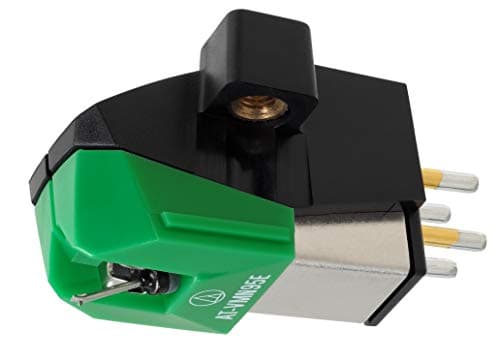 Audio-Technica AT-VM95E The cheapest way into a cartridge body that accepts seven different styli, so every later upgrade costs a stylus rather than a cartridge. | Best first upgrade | 8.4 | $63.25View on Amazon $74.0015% off |
| 2 | 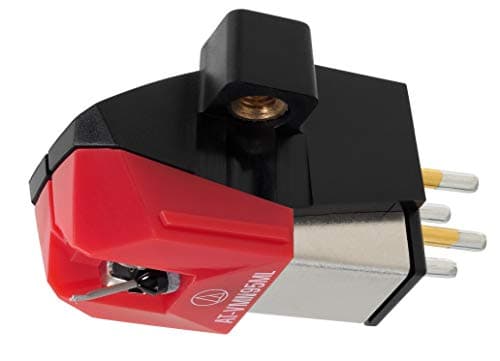 Audio-Technica AT-VM95ML A MicroLinear diamond on the same body as the $65 VM95E, with the highest published compliance and the tightest channel balance of any cartridge here. | Best stylus profile under $200 | 8.8 |
A cartridge has five adjustments and they interact, so the order is not optional. Alignment first, then tracking force, then anti-skate, then VTA, then azimuth — because changing an earlier one invalidates the ones after it.
Of the five, exactly one comes with a number the manufacturer publishes. That fact shapes the rest of this page.
1. Overhang and alignment
A record is cut by a lathe whose cutter moves in a straight line across the disc. A pivoted tonearm swings in an arc. The two paths cannot match everywhere, so alignment geometry arranges for them to match exactly at two points on the record — the null points — and to be slightly off everywhere else.
Where those two points sit depends on the alignment geometry being used, and there is more than one in common use. They give different null points, different error curves and different overhang figures.
We are not going to print a null-point distance or an overhang figure here. Not one manufacturer whose decks we cover publishes theirs — Audio-Technica, Fluance, Music Hall and Pro-Ject all publish tracking force and none of them publishes an overhang — and a geometry constant taken from somewhere else, applied to your arm, is exactly the kind of confident-sounding wrong number this site exists to avoid.
What to do instead: use the alignment protractor that came with your turntable, or one supplied by your arm’s manufacturer for that specific arm. It encodes the geometry the designer intended, including the effective arm length — Pro-Ject publishes 218.5 mm for the Debut Carbon EVO, and a protractor drawn for a different length will align your cartridge to the wrong arc.
Practically: loosen the two mounting bolts just enough to slide the cartridge, set the stylus on the protractor’s first null point, rotate the cartridge until the cantilever is parallel with the grid lines, tighten gently, then check the second null point. Expect to go back and forth two or three times.
2. Tracking force
The one adjustment with a published number, and every cartridge we cover gives a range and a recommended value inside it.
| Cartridge | Published range | Manufacturer’s recommendation |
|---|---|---|
| Audio-Technica AT-VM95E / VM95EN / VM95ML | 1.8–2.2 g | 2.0 g |
| Ortofon 2M Red | 1.6–2.0 g (16–20 mN) | 1.8 g |
| Nagaoka MP-110 | 1.5–2.0 g | No single value published |
| Grado Prestige Green4 | 1.6–1.9 g | No single value published |
Set it to the recommended value where one exists, and to the middle of the range where it does not. The instinct to go light to “protect the record” is backwards: a cartridge tracking below its designed force loses contact in loud passages, and a stylus bouncing in a groove does more damage than one sitting correctly in it.
Set it with a digital gauge rather than the arm’s counterweight dial. The dial assumes the counterweight is calibrated and the arm is level; the gauge measures what is actually happening at the stylus.
3. Anti-skate
A pivoted arm is pulled inward by the friction between stylus and groove, because the cartridge is offset from the pivot. Anti-skate applies an outward force to counter it.
Nobody publishes a correct value, because the required force varies with groove modulation, groove radius and the stylus profile. The convention is to set anti-skate equal to the tracking force, and that convention is a starting point rather than a specification.
Audio-Technica publishes that the AT-LP120XUSB’s arm adjusts from 0 to 4 g of tracking force and has an anti-skate control; it publishes no recommended anti-skate figure, and that absence is normal rather than an oversight.
4. Vertical tracking angle
VTA is set by the height of the arm pivot, and it changes the angle at which the stylus meets the groove wall. The standard starting point is an arm parallel to the record surface with the stylus in the groove.
Two of our cartridges give you something to work with here and the rest do not. Ortofon publishes a tracking angle of 20° for the 2M Red. Audio-Technica, Nagaoka and Grado publish no tracking angle at all.
Most decks in this price range have no VTA adjustment anyway — the arm height is fixed and the designer chose it. If yours does adjust, get the arm parallel and stop; chasing VTA by ear is a well-known way to spend an evening.
5. Azimuth
Azimuth is the stylus’s side-to-side tilt: whether the cantilever is perpendicular to the record. Wrong azimuth degrades channel separation, and channel separation is published.
That gives you the check nobody mentions. Audio-Technica publishes 20 dB at 1 kHz for the AT-VM95E, 22 dB for the VM95EN and 23 dB for the VM95ML; Ortofon publishes 22 dB for the 2M Red; Nagaoka publishes 23 dB; Grado publishes an average of 25 dB. Those are the figures the manufacturer measured with azimuth correct.
You cannot measure separation at home without test equipment, so the practical version is visual: look at the cartridge from the front with the stylus in a groove and get the cantilever vertical. Most decks offer no azimuth adjustment at all, which makes this a check rather than a task.
What the stylus profile changes about all of this
A more advanced stylus profile is less forgiving of misalignment, and the reason is contact geometry.
a stylus's published tip radii describe its contact patch — smaller front radius = narrower contact
Inputs
- AT-VM95E stylus: 0.3 × 0.7 mil elliptical, bonded round shank (Audio-Technica spec page)
- AT-VM95ML stylus: 2.2 × 0.12 mil MicroLinear, nude square shank (Audio-Technica spec page)
- Ortofon 2M Red stylus: Elliptical, tip radius r/R 8/18 µm (Ortofon spec page)
Result
VM95E front radius: 0.3 mil ≈ 7.6 µm
VM95ML front radius: 0.12 mil ≈ 3.0 µm
Ortofon 2M Red: 8 µm front radius, published directly in µm
The MicroLinear’s contact radius is about two and a half times smaller than the elliptical’s. A narrower contact patch reads finer groove detail and is correspondingly more sensitive to sitting at the wrong angle in the groove. Buying the better stylus and skipping the alignment gives back much of what you paid for.
Converting mils to microns is exact (1 mil = 25.4 µm); everything else here is geometry described by the manufacturers, not a measurement of performance. Note the two conventions in play: Audio-Technica publishes stylus dimensions in mils, Ortofon in microns, and Ortofon also publishes both radii as r/R where Audio-Technica gives them as a pair. We have not measured any stylus.
The same logic runs the other way and it is the useful conclusion. A better stylus is the cheapest real upgrade in vinyl — and it is only an upgrade if the alignment is right.
The order, once more
- Alignment, with your deck’s own protractor. Changing it changes everything after it.
- Tracking force, to the manufacturer’s published value, with a gauge.
- Anti-skate, matched to tracking force as a starting point.
- VTA, arm parallel, if the deck allows it.
- Azimuth, cantilever vertical, if the deck allows it.
Then check the tracking force again, because tightening the mounting bolts and moving the arm usually shifts it slightly. The rest of the deck setup — leveling, belt, speed happens before all of this. If the reason you are aligning the cartridge is that records skip, our skipping guide puts alignment sixth on a list of seven — tracking force and stylus wear come first, and inner-groove skipping is the symptom that actually points here.
Every pick in detail
Every specification below links to the manufacturer document we read it from. Where a manufacturer does not publish a figure, we say so rather than estimating it.
Audio-Technica AT-VM95E
Best first upgradeThe cheapest way into a cartridge body that accepts seven different styli, so every later upgrade costs a stylus rather than a cartridge.
- specs
- 7/10
- upgrade path
- 10/10
- value for money
- 10/10
- tracking ability
- 6/10
- published data
- 9/10
| Specification | Published value | Source |
|---|---|---|
| Type | VM stereo dual magnet (moving magnet) | Audio-Technica spec page |
| Frequency response | 20–22,000 Hz (no tolerance published) | Audio-Technica spec page |
| Channel separation | 20 dB (1 kHz) | Audio-Technica spec page |
| Output voltage | 4.0 mV (1 kHz, 5 cm/sec) | Audio-Technica spec page |
| Output channel balance | 2.0 dB (1 kHz) | Audio-Technica spec page |
| Stylus | 0.3 × 0.7 mil elliptical, bonded round shank | Audio-Technica spec page |
| Cantilever | Aluminum pipe | Audio-Technica spec page |
| Dynamic compliance | 7 × 10⁻⁶ cm/dyne (100 Hz) | Audio-Technica spec page |
| Static compliance | 17 × 10⁻⁶ cm/dyne | Audio-Technica spec page |
| Tracking force | 1.8–2.2 g (2.0 g standard) | Audio-Technica spec page |
| Recommended load | 47,000 Ω, 100–200 pF | Audio-Technica spec page |
| Mount / weight | Half-inch mount, 6.1 g | Audio-Technica spec page |
| Replacement stylus | AT-VMN95E — the whole VM95 stylus range drops into this same body | Audio-Technica spec page |
Pros
- The VM95 body takes the entire VM95 stylus range — conical through Shibata — so the upgrade path costs a stylus, not a cartridge
- 4.0 mV output is the highest of any Audio-Technica cartridge here, so it suits low-gain phono stages
- Audio-Technica publishes both static and dynamic compliance, which is what arm matching needs
- Already fitted to several decks we recommend, so you may own one without knowing
Cons
- A bonded round-shank stylus — the diamond is glued to a metal carrier rather than being solid, which adds tip mass
- 20 dB channel separation is the lowest figure in this group
- 2.0 dB channel balance is the loosest here; the ML is 1.5 dB
- Audio-Technica publishes no tolerance on the 20–22,000 Hz response
Skip it if your deck already ships with a VM95E — several do, and buying a second one changes nothing. Buy a better stylus for the body you own instead.
Audio-Technica AT-VM95ML
Best stylus profile under $200Price as of October 14, 2026. #ad
A MicroLinear diamond on the same body as the $65 VM95E, with the highest published compliance and the tightest channel balance of any cartridge here.
- specs
- 9/10
- upgrade path
- 10/10
- value for money
- 7/10
- tracking ability
- 9/10
- published data
- 9/10
| Specification | Published value | Source |
|---|---|---|
| Type | VM stereo dual magnet (moving magnet) | Audio-Technica spec page |
| Frequency response | 20–25,000 Hz (no tolerance published) | Audio-Technica spec page |
| Channel separation | 23 dB (1 kHz) | Audio-Technica spec page |
| Output voltage | 3.5 mV (1 kHz, 5 cm/sec) | Audio-Technica spec page |
| Output channel balance | 1.5 dB (1 kHz) — the tightest of any VM95 | Audio-Technica spec page |
| Stylus | 2.2 × 0.12 mil MicroLinear, nude square shank | Audio-Technica spec page |
| Cantilever | Aluminum pipe | Audio-Technica spec page |
| Dynamic compliance | 10 × 10⁻⁶ cm/dyne (100 Hz) | Audio-Technica spec page |
| Static compliance | 20 × 10⁻⁶ cm/dyne | Audio-Technica spec page |
| Tracking force | 1.8–2.2 g (2.0 g standard) | Audio-Technica spec page |
| Recommended load | 47,000 Ω, 100–200 pF | Audio-Technica spec page |
| Mount / weight | Half-inch mount, 6.1 g | Audio-Technica spec page |
| Replacement stylus | AT-VMN95ML | Audio-Technica spec page |
Pros
- 2.2 × 0.12 mil MicroLinear — a line-contact profile that sits deeper in the groove than any elliptical here
- 10 × 10⁻⁶ cm/dyne dynamic compliance, the highest published figure in this group
- 1.5 dB channel balance and 23 dB separation, both the best Audio-Technica figures here
- It is a stylus, not a cartridge — if you own any VM95 body it drops in with no alignment at all
Cons
- The most expensive cartridge here, and it shares its body with a $65 one
- A line-contact tip is less forgiving of alignment error than an elliptical
- 3.5 mV output, lower than the VM95E's 4.0 mV
- Higher compliance narrows the range of arms it suits — high compliance plus a heavy arm is the classic mismatch
Skip it if your tonearm's effective mass is unpublished and heavy-looking. High compliance on a heavy arm drops the resonance below the safe window, and most makers will not tell you the arm figure.
Frequently asked questions
How do I align a turntable cartridge?
Use the alignment protractor supplied with your turntable or arm, because it encodes the geometry the designer intended for that specific effective arm length. Slide the cartridge so the stylus sits on the protractor’s null point, rotate until the cantilever is parallel with the grid lines, tighten, then check the second null point. Expect two or three iterations.
What tracking force should I use?
The value the cartridge manufacturer publishes. Audio-Technica specifies 1.8–2.2 g with 2.0 g standard for the whole VM95 range; Ortofon specifies 1.6–2.0 g with 1.8 g recommended for the 2M Red; Nagaoka specifies 1.5–2.0 g and Grado 1.6–1.9 g, neither with a single recommended value. Set it with a digital gauge, not the counterweight dial.
What should I set anti-skate to?
No manufacturer publishes a value, because the required force varies with groove modulation, radius and stylus profile. The convention is to match anti-skate to the tracking force as a starting point. Audio-Technica publishes that the AT-LP120XUSB has an anti-skate control and publishes no recommended setting for it, which is normal across the category.
Does cartridge alignment matter more with a better stylus?
Yes. Audio-Technica publishes a 0.12 mil (about 3 µm) front radius for the VM95ML MicroLinear against 0.3 mil (about 7.6 µm) for the VM95E elliptical. The narrower contact patch reads finer detail and is correspondingly less forgiving of sitting at the wrong angle, so an expensive stylus badly aligned gives back much of what you paid for.
Read next
How to Set Up a Turntable
Nine steps, and the two everyone gets wrong. Both have a published number you can set them to.
Are Turntable Cartridges Interchangeable?
Three compatibility checks — mount, mass and loading — and the decks where the answer is simply no.
Cartridge and Tonearm Matching: Do the Arithmetic
One equation, two published numbers, and the compliance caveat that changes the answer. Worked through with real specs.
The Best Turntable Cartridges Under $200
Six cartridges under $200, ranked on stylus profile, published compliance and output — with the unit-conversion trap explained.
How to Clean Vinyl Records
The brush-before-every-play habit, the wet method, and the three techniques that damage records — with no product recommendation, deliberately.
Moving Magnet vs Moving Coil Cartridges
The whole MM/MC argument reduces to output voltage — and Schiit's own published noise figures show exactly what the extra gain costs.
Sources
Every specification on this page was read from one of these documents. If one of them has changed, or we have made an error, tell us — corrections are logged and dated per our editorial policy.
- Audio-Technica AT-VM95E — tracking force, stylus dimensions, channel separation
- Audio-Technica AT-VM95ML — MicroLinear stylus dimensions and separation
- Ortofon 2M Red — tracking force, tracking angle, stylus radii
- Nagaoka MP-110 — tracking force and channel separation
- Grado Prestige Green4 — tracking force and average separation
- Pro-Ject Debut Carbon EVO — effective arm length 218.5 mm
- Audio-Technica AT-LP120XUSB manual — arm tracking-force range and anti-skate