Hi-Fi Speakers vs Studio Monitors
One is designed to be listened through and one to be listened to, and the differences that follow are about distance and amplification far more than about honesty.
Disclosure: we earn a commission if you buy through the links on this page, at no extra cost to you. It does not influence what we pick — our criteria are published and reproducible, so you can check our work. How we pick · Full disclosure
These picks are spec-and-price analyses, not listening tests. We have not heard this gear and we do not pretend to have: every figure below is sourced to the manufacturer and linked, and every price is live or not shown at all. Here are the rules we followed.
Quick picks
Ranked on the published criteria in How We Pick. Prices are live as of October 15, 2026. Tap any row for the full write-up.
- 8.2
- 8.2$329.00View on Amazon
$479.0031% off
- 6.4
- 7.4
| # | Product | Best for | Score | Price |
|---|---|---|---|---|
| 1 | 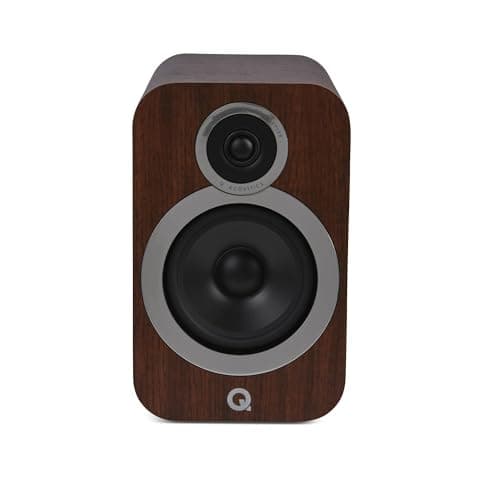 Q Acoustics 3030i The only speaker in this bracket that publishes both a minimum impedance and a recommended amplifier range, on top of a cabinet that is its whole design argument. | Best cabinet | 8.2 | |
| 2 | 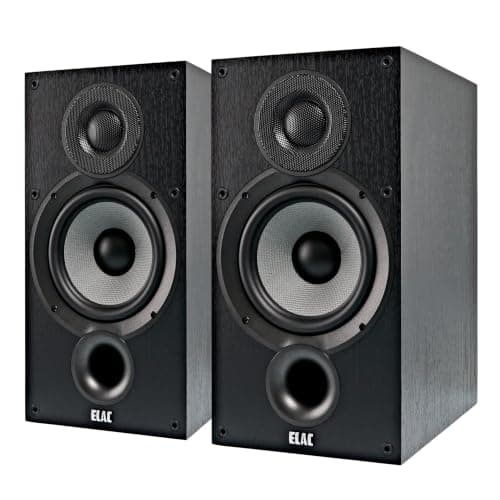 ELAC Debut 2.0 B6.2 A 6.5-inch woofer in a ported cabinet that reaches genuinely low for its size, at the cost of needing an amplifier with real current behind it — and now the outgoing Debut generation rather than the current one. | The outgoing generation, still sold | 8.2 | $329.00View on Amazon $479.0031% off |
| 3 | 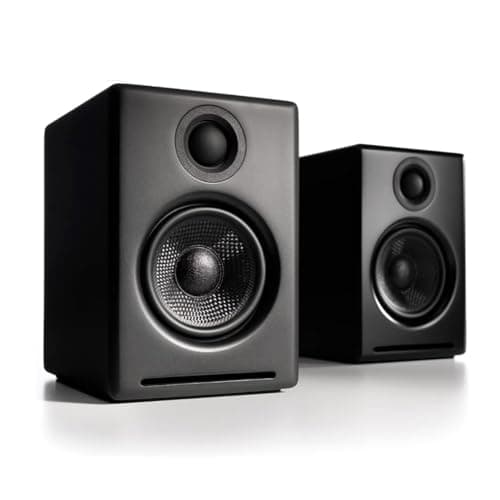 Audioengine A2+ Desktop-scale powered speakers with a built-in DAC, sized for an arm's length and honest about it. | Smallest powered option | 6.4 | |
| 4 | 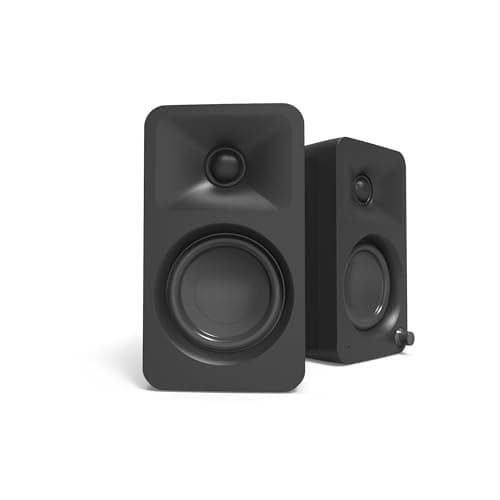 Kanto ORA Small powered reference speakers built for near-field listening, where the distance is short and the cabinet does not need to move much air. | Best for a desk | 7.4 |
“Studio monitors are more honest” is the claim, and it is the least useful way to describe the difference. The real differences are about listening distance, where the amplifier lives, and what the manufacturer chooses to publish. Those are checkable; honesty is not.
We do not currently rank studio monitors — the products we cover are hi-fi speakers, and the ones on this page are here to illustrate the comparison rather than to stand in for a monitor.
Difference one: design distance
A nearfield monitor is designed to be listened to at roughly a meter, close enough that the direct sound dominates and the room contributes relatively little. A hi-fi speaker is designed for two to four meters, where the room contributes a great deal.
That single decision drives several others. A nearfield design can use a smaller cabinet because it does not have to fill a room. It can tolerate lower sensitivity because the listener is close — halving the distance is worth six decibels. And its dispersion can be narrower, because the listener is in one place rather than spread across a sofa.
Real, and it is the root of most of the rest.
Difference two: the amplifier is inside
Most monitors are active: an amplifier per driver, with the crossover done at line level before amplification rather than at speaker level after it. Most hi-fi bookshelf speakers are passive.
Active has genuine engineering advantages — each amplifier can be matched to its driver, and a line-level crossover avoids the losses of a passive network. It also fixes your amplifier choice permanently, which is the trade.
But this is a difference between active and passive, not between monitors and hi-fi. The Audioengine A2+ and the Kanto ORA are powered hi-fi speakers and get the same benefits; plenty of studio speakers are passive. The passive-versus-powered decision is its own page and it is the one that actually matters.
Real, but mislabeled.
Difference three: what gets published
This is the most concrete difference and it cuts both ways. Look at what the hi-fi speakers we cover publish about their frequency response:
| Speaker | Published response | Tolerance stated? |
|---|---|---|
| Q Acoustics 3030i | 46 Hz – 30 kHz | Yes — +3 / −6 dB |
| Audioengine A2+ | 65 Hz – 22 kHz | Yes — ± 2.0 dB |
| ELAC Debut 2.0 B6.2 | 44 Hz – 35 kHz | No tolerance published |
| Kanto ORA | 70 Hz – 22 kHz | No tolerance published |
A response figure without limits is not a specification. “44 Hz to 35 kHz” is true of almost any speaker if you allow enough deviation. The two figures here that carry limits — Q Acoustics and Audioengine — are the only two that can be compared to anything.
Studio monitor manufacturers publish tolerance-bounded figures more consistently, because their buyers ask for them. That is a real cultural difference in the two markets, and it is a fair reason to prefer a monitor spec sheet. It is not evidence that the monitor measures better — only that it told you.
Real, and it is the strongest argument for monitors.
Difference four: what the cabinet is for
A monitor is furniture in a workplace and a hi-fi speaker is furniture in a home. Monitors get vinyl-wrapped MDF, front ports for desk placement, and controls on the back panel. Hi-fi speakers get veneers, grilles and rear ports.
This sounds cosmetic and partly is. The front-port convention is not: it exists because a monitor is expected to sit against a wall on a desk. In a small room that is a genuine engineering advantage, and it is why port position is on our small-room checklist.
Mostly cosmetic, with one real consequence.
Three differences that are not real
“Monitors are flat and hi-fi speakers are colored.”Some are, some are not, in both categories. Nobody in either category publishes an on-axis curve on a product page, so this is not a claim you can check from a spec sheet — and we do not measure speakers.
“Monitors are fatiguing.” A speaker designed for one meter listened to at three, in an untreated room, with the level set by habit rather than by the mix, will be unsatisfying. That is a use case mismatch rather than a property.
“You need monitors to hear what is really on the recording.” The room contributes more than the speaker above the transition frequency in most domestic spaces. Treating the room changes what you hear more than swapping categories does.
The volume-control problem
There is one practical difference nobody mentions and it decides more purchases than the acoustics do. Active speakers have their volume control on the back of one cabinet, or on a remote, or in an app — and each maker solves it differently.
Look at what the powered hi-fi speakers we cover publish about their inputs, because that is where the difference lives. The Audioengine A2+ publishes 3.5 mm, RCA, USB and Bluetooth. The Kanto ORA publishes RCA line level, USB-C at 24-bit/96 kHz and Bluetooth 5.0. Both take a digital feed directly, which means the computer’s volume control is in the chain whether you want it there or not.
A passive pair plus an amplifier puts the volume control on a knob at a fixed place, and that knob is an analog attenuator after the DAC rather than a digital one before it. For most people that is an ergonomic preference rather than a technical one, and it is worth deciding deliberately rather than discovering after the box is open.
The third route is a DAC with a preamp mode — the Topping E30 II and FiiO K11 both publish one — feeding powered speakers set to a fixed level. That gives you one control, in the right place, and it works with either category.
The question that actually decides it
How far away will you be sitting, and is there a desk?
At a meter, on a desk, against a wall — a nearfield design, active, front-ported, is the right tool, and a powered hi-fi speaker like the Audioengine A2+ or the Kanto ORA is doing the same job under a different name.
At three meters in a room with a sofa, a hi-fi bookshelf speaker on stands is the right tool, and its wider dispersion and larger cabinet are features rather than compromises.
The category label is doing less work than the distance is. That is the honest summary, and it is why we cover one category rather than pretending to arbitrate between two.
Every pick in detail
Every specification below links to the manufacturer document we read it from. Where a manufacturer does not publish a figure, we say so rather than estimating it.
Q Acoustics 3030i
Best cabinetNo live price right now. #ad
The only speaker in this bracket that publishes both a minimum impedance and a recommended amplifier range, on top of a cabinet that is its whole design argument.
- sensitivity
- 8/10
- bass extension
- 8/10
- amp friendliness
- 7/10
- value for money
- 8/10
- build quality
- 10/10
| Specification | Published value | Source |
|---|---|---|
| Sensitivity | 88 dB (2.83 V / 1 m) | Q Acoustics spec page |
| Impedance (nominal) | 6 Ω | Q Acoustics spec page |
| Minimum impedance | 4 Ω | Q Acoustics spec page |
| Frequency response | 46 Hz – 30 kHz (+3 dB / −6 dB) | Q Acoustics spec page |
| Recommended amplifier power | 25–75 W (stereo amplifier); 50–145 W (AV receiver, 2 ch driven) | Q Acoustics spec page |
| Bass unit | 165 mm (6.5 in) | Q Acoustics spec page |
| Treble unit | 22 mm (0.9 in) decoupled | Q Acoustics spec page |
| Crossover | 2.4 kHz | Q Acoustics spec page |
| Dimensions (H × W × D) | 325 × 200 × 329 mm (12.8 × 7.9 × 13.0 in), including grille and terminals | Q Acoustics spec page |
| Weight (each) | 6.4 kg / 14.1 lb | Q Acoustics spec page |
Pros
- Publishes a minimum impedance (4 Ω) and a recommended amplifier range (25–75 W) — almost nobody else at this price does
- 88 dB sensitivity, the highest here outside the horn-loaded Klipsch
- Unusually inert cabinet for the price, with P2P bracing
- A published 46 Hz low end, which is real extension rather than a bigger box
Cons
- Dips to 4 Ω, so a weak amplifier will struggle despite the friendly sensitivity figure
- Large and deep for a bookshelf at 325 × 200 × 329 mm and 6.4 kg each — this wants a stand
- Reflex port, so it needs clearance behind it
Skip it if your amplifier is rated only into 8 Ω and says nothing about 4 Ω. This speaker's published 4 Ω minimum is exactly the case that exposes it.
ELAC Debut 2.0 B6.2
The outgoing generation, still soldA 6.5-inch woofer in a ported cabinet that reaches genuinely low for its size, at the cost of needing an amplifier with real current behind it — and now the outgoing Debut generation rather than the current one.
- sensitivity
- 6/10
- bass extension
- 9/10
- amp friendliness
- 6/10
- value for money
- 10/10
- build quality
- 8/10
| Specification | Published value | Source |
|---|---|---|
| Sensitivity | 87 dB (2.83 V / 1 m) | ELAC spec page |
| Impedance | 6 Ω | ELAC spec page |
| Minimum impedance | Not published | — |
| Frequency response | 44 Hz – 35 kHz (no tolerance published) | ELAC spec page |
| Maximum power input | 120 W (a handling limit — ELAC publishes no recommended amplifier range) | ELAC spec page |
| Woofer | 6.5 in woven aramid-fiber cone | ELAC spec page |
| Tweeter | 1 in cloth dome | ELAC spec page |
| Crossover | 2,200 Hz | ELAC spec page |
| Weight (each) | 16.3 lb / 7.4 kg | ELAC spec page |
Pros
- 6.5in woofer reaches genuinely low for a bookshelf
- Front port, so it tolerates being near a wall better than a rear-ported box
- Well-braced cabinet for the price
Cons
- Wants more amplifier than its size suggests — check the arithmetic before pairing
- Large for a 'bookshelf' speaker
- Finish is functional rather than furniture
- The outgoing generation — ELAC's Debut 3.0 DB63 now builds on it, though ELAC publishes the same 87 dB and 6 Ω for both, so our sensitivity arithmetic holds for either
- ELAC publishes no response tolerance and no recommended amplifier range for this generation. The DB63 publishes both, which is the real reason it ranks ahead
Skip it if your amplifier is a low-power desktop unit. Run the power arithmetic on our amp-matching guide first.
Audioengine A2+
Smallest powered optionPrice as of October 15, 2026. #ad
Desktop-scale powered speakers with a built-in DAC, sized for an arm's length and honest about it.
- integration
- 6/10
- upgrade path
- 3/10
- value for money
- 6/10
- ease of setup
- 9/10
- connectivity
- 7/10
| Specification | Published value | Source |
|---|---|---|
| Type | Powered (amplifier built in) | Audioengine tech specs (Gen 3) |
| Amplifier output | 20 W RMS per channel at 4 Ω; 30 W peak per channel (AES) | Audioengine tech specs (Gen 3) |
| Frequency response | 65 Hz – 22 kHz ± 2.0 dB | Audioengine tech specs (Gen 3) |
| Inputs | 3.5 mm, RCA L/R, USB, Bluetooth | Audioengine tech specs (Gen 3) |
| Woofer | 2.75 in aramid fiber | Audioengine tech specs (Gen 3) |
Pros
- Very compact
- Built-in USB DAC
- Wood cabinets at a small size
Cons
- Little low-end extension without a sub
- No phono stage
- Near-field only
Skip it if this is for a room rather than a desk.
Kanto ORA
Best for a deskPrice as of October 15, 2026. #ad
Small powered reference speakers built for near-field listening, where the distance is short and the cabinet does not need to move much air.
- integration
- 8/10
- upgrade path
- 4/10
- value for money
- 7/10
- ease of setup
- 9/10
- connectivity
- 9/10
| Specification | Published value | Source |
|---|---|---|
| Type | Powered (amplifier built in) | Kanto spec page |
| Amplifier output | 50 W total RMS (100 W peak); 9 W RMS per tweeter, 16 W RMS per woofer | Kanto spec page |
| Frequency response | 70 Hz – 22 kHz (no tolerance published) | Kanto spec page |
| Inputs | RCA line-level, USB-C (24-bit/96 kHz), Bluetooth 5.0 | Kanto spec page |
| Built-in phono stage | Not stated — inputs are line-level only, so assume none | Kanto spec page |
| Woofer | 3 in paper cone | Kanto spec page |
Pros
- Genuinely desk-sized
- USB-C input as well as analog
- Sub output for when the low end runs out
Cons
- Small drivers mean limited low end without a subwoofer
- No built-in phono stage
- Near-field by design
Skip it if this is a living-room system — these are built for a meter away, not four.
Frequently asked questions
What is the difference between studio monitors and hi-fi speakers?
Design distance, mainly. Nearfield monitors are engineered for about a meter where the direct sound dominates; hi-fi speakers are engineered for two to four meters where the room contributes heavily. Most monitors are active with a line-level crossover, most hi-fi bookshelf speakers are passive, and monitor manufacturers publish tolerance-bounded frequency response more consistently.
Are studio monitors more accurate than hi-fi speakers?
They are more consistently specified, which is not the same claim. Of the hi-fi speakers we cover, only the Q Acoustics 3030i (+3 / −6 dB) and Audioengine A2+ (± 2.0 dB) publish a tolerance with their response figure. A response range without limits cannot be compared to anything. We do not measure speakers and make no accuracy claim of our own.
Can I use studio monitors for listening to music at home?
Yes, at the distance they were designed for. A nearfield monitor at a meter on a desk is in its intended use case. The same monitor at three meters in an untreated room is not, and that mismatch — rather than any property of the speaker — is behind most complaints that monitors sound fatiguing.
Should I buy monitors or bookshelf speakers for a desk?
Either, if it is powered and the port is not aimed at a close wall. A powered hi-fi speaker such as the Audioengine A2+ (20 W RMS per channel, 65 Hz – 22 kHz ± 2.0 dB) is doing the same job as a nearfield monitor under a different name. The category label matters less than the distance and the port.
Read next
Passive vs Powered Speakers
Total cost, upgrade path, and why powered speakers correctly refuse to publish a sensitivity figure.
Stereo Speaker Placement
Dolby's 22-30 degree window turned into a listening-distance rule, plus height, toe-in, boundaries and the port clearance most people miss.
The Best Bookshelf Speakers Under $500
Six pairs under $500 — and only one publishes a minimum impedance and a recommended amp range.
Speaker Sensitivity Explained
2.83 V/1 m versus 1 W/1 m, what the conversion is worth in decibels, and the twelve-decibel spread that means sixteen times the power.
The Best Speakers for a Small Room
Four speakers for rooms where the wall is close, chosen on port position, cabinet size and the extension figure each maker publishes.
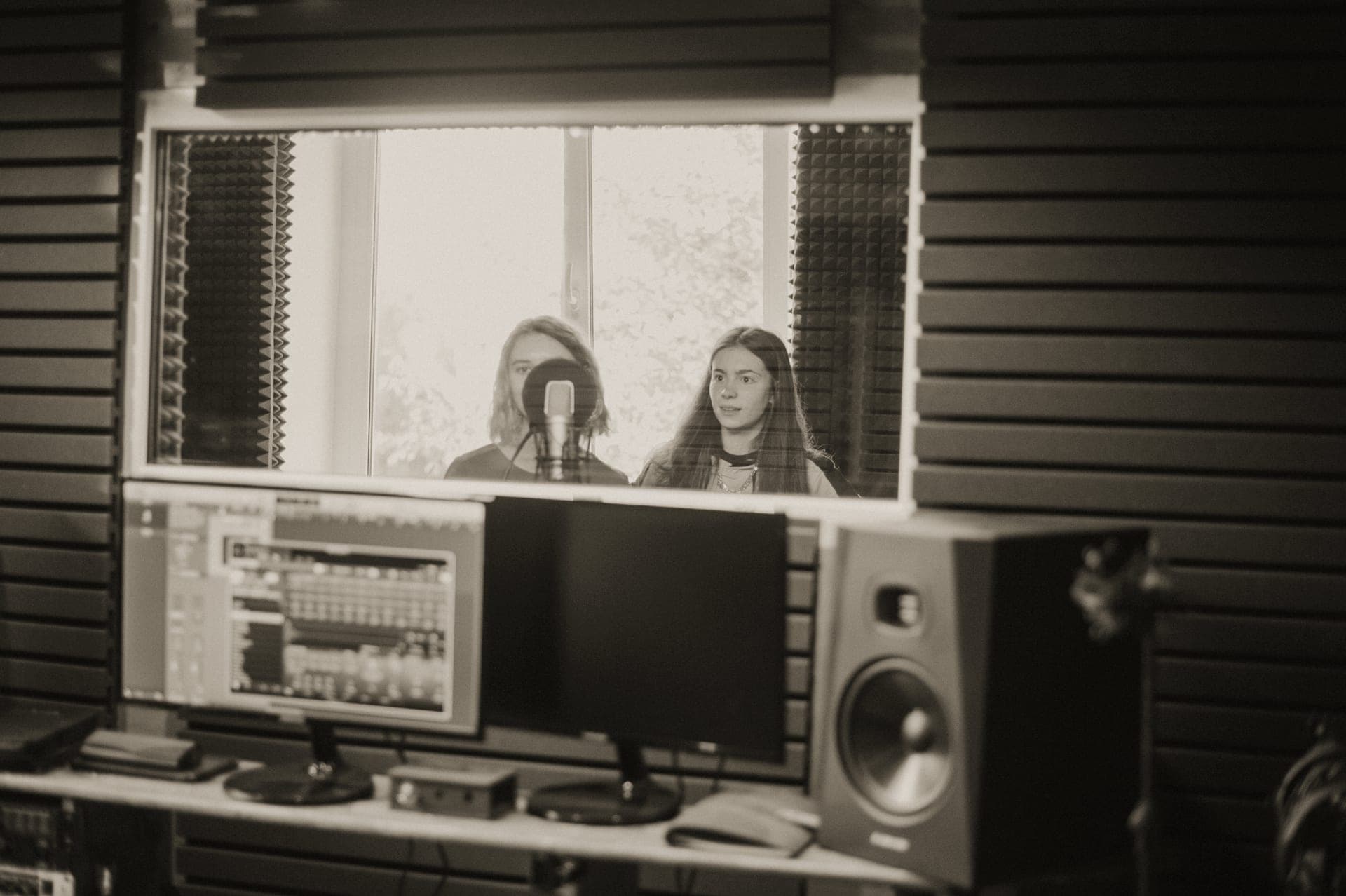
Room Treatment for a Hi-Fi Listening Room
What changes when a room has one seat instead of a console: the four surfaces that matter, in the order that returns the most per panel.
Sources
Every specification on this page was read from one of these documents. If one of them has changed, or we have made an error, tell us — corrections are logged and dated per our editorial policy.