Bass Traps for Small Rooms
A small room does not have less bass than a large one. It has fewer, further-apart resonances, and that is a harder problem than having more of them.
Disclosure: we earn a commission if you buy through the links on this page, at no extra cost to you. It does not influence what we pick — our criteria are published and reproducible, so you can check our work. How we pick · Full disclosure
These picks are spec-and-price analyses, not listening tests. We have not heard this gear and we do not pretend to have: every figure below is sourced to the manufacturer and linked, and every price is live or not shown at all. Here are the rules we followed.
Quick picks
Ranked on the published criteria in How We Pick. Prices are live as of October 15, 2026. Tap any row for the full write-up.
- 7.4
- 7.2
- 8.4
| # | Product | Best for | Score | Price |
|---|---|---|---|---|
| 1 | 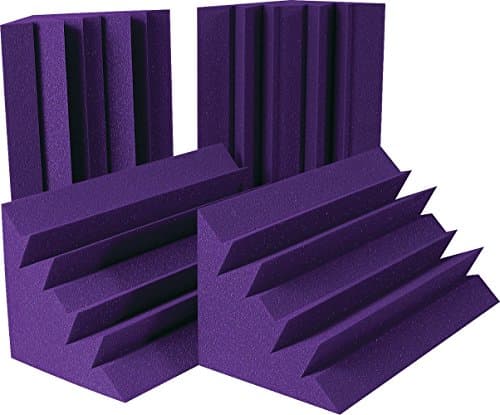 Auralex LENRD Bass Trap The one corner trap on this site whose maker publishes an absorption coefficient at 125 Hz — 1.30, against 0.11 for the same company's 2-inch flat foam. | The only trap here with a published 125 Hz figure | 7.4 | |
| 2 | 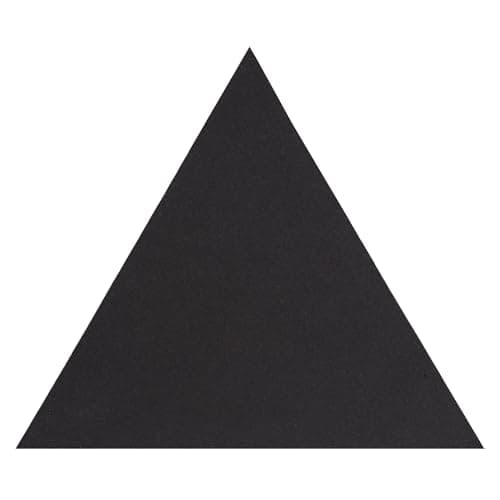 ATS Acoustics Tri-Corner Bass Trap A rigid fiberglass corner section at 6 lb per cubic foot, chosen on material and geometry because ATS publishes no per-frequency data for it at all. | Best bass trap | 7.2 | |
| 3 | 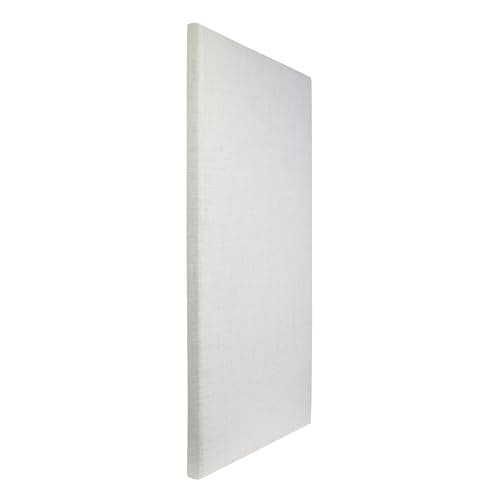 ATS Acoustics Sound Absorbing Panel (24x48) A mineral wool panel with the full absorption curve published — including the 125 Hz figure of 0.12 that its own NRC of 1.00 completely hides. | Best overall panel | 8.4 |
Every room resonates at frequencies set by its dimensions. A small room’s resonances sit higher and further apart, and that is why small rooms sound worse in the bass rather than better.
The arithmetic takes a minute, it needs nothing but a tape measure, and it will tell you which note in your room is the problem before you spend anything.
The calculation
A room resonates when a half-wavelength fits exactly between two parallel surfaces. That happens at a frequency set by the distance and the speed of sound, and again at every multiple of it.
f = c ÷ (2 × L) · c = speed of sound ≈ 343 m/s (1,125 ft/s) in air at 20 °C
Inputs
- Small room, longest dimension: 4.0 m (13.1 ft) (example dimensions; the 100 sq ft room rating is Primacoustic's)
- Small room, width: 3.0 m (9.8 ft) (example dimensions; the 100 sq ft room rating is Primacoustic's)
- Ceiling height: 2.4 m (7.9 ft) (example dimensions; the 100 sq ft room rating is Primacoustic's)
Result
Length: 343 ÷ (2 × 4.0) = 43 Hz (and 86, 129, 172 Hz…)
Width: 343 ÷ (2 × 3.0) = 57 Hz (and 114, 171 Hz…)
Height: 343 ÷ (2 × 2.4) = 71 Hz (and 143, 214 Hz…)
Three fundamentals at 43, 57 and 71 Hz, spread across the octave where most bass lines live and where a subwoofer crossed at 80 Hz does all its work. In a larger room those three would sit lower and closer together, and closer together is better — it is what makes a room’s bass response smooth rather than lumpy.
This gives axial modes only — the ones between two parallel surfaces, which are the strongest. Real rooms also have tangential and oblique modes involving four and six surfaces, and the speed of sound varies slightly with temperature and humidity. Treat these three numbers as the strongest resonances, not the complete list, and note that doors, openings and non-parallel walls all change the answer.
Why fewer modes is worse, not better
It is tempting to read “fewer resonances” as “less of a problem”. It is the opposite. At the frequency of a mode, the room adds energy at some positions and cancels it at others. When modes are packed closely together, their peaks and nulls overlap and average out into something reasonably even.
A small room’s modes are spread out, so each one stands alone. Between them there is a dip; on them there is a peak. That is the boominess — a couple of notes far louder than the rest, and one note that vanishes when you move your head.
This is also why the fix is partly furniture arrangement. Moving the seat 30 cm can move you out of a null, which no amount of trapping does.
What corner traps can actually do
Pressure is highest where surfaces meet, so corners are where a porous absorber sees the most air velocity to work against. That is the whole reason traps go in corners and not on the middle of a wall.
| Product | 125 Hz absorption | What the maker publishes |
|---|---|---|
| Auralex LENRD | 1.30 | Full ASTM C-423 curve, 125 Hz to 4 kHz, plus NRC 1.50 |
| ATS corner bass trap | Not published | NRC 0.95 only — and NRC excludes 125 Hz by definition, which is the band this product exists to address |
| ATS 24×48×2 wall panel | 0.12 | Full curve — and it shows the panel is not a bass product |
The LENRD is first here for one reason: it is the only corner product we cover whose maker publishes the band it is sold for. Compare it against Auralex’s own 2 in wall foam at 0.16 in that band — same company, same lab, same standard, eight times the absorption. That comparison exists only because Auralex prints both numbers.
How many corners, and how much is enough
A rectangular room has four vertical corners and eight horizontal ones where walls meet the ceiling and floor. Treating all twelve is a studio answer. For a small listening room the practical sequence is:
- The two front vertical corners, behind and beside the speakers, where a stereo pair drives the room hardest.
- The two rear vertical corners, which matter more in a small room than a large one because the rear wall is close enough to be part of the problem.
- Wall-ceiling corners only if the first four have not done enough, and accepting that this is where the mounting gets difficult.
A LENRD is a 1 ft × 1 ft × 2 ft triangular section, so a floor-to-ceiling column in a 2.4 m room is four of them. Four corners is sixteen. That is the honest quantity, and it is why the how-much question deserves arithmetic rather than a starter kit.
How to hear which mode is your problem
You have three calculated frequencies. Working out which one is actually causing trouble takes about ten minutes and no equipment beyond what plays music.
- Find a track with a walking bass line— something that moves stepwise through the octave rather than sitting on one note. Anything where the bass plays a scale works.
- Listen for the note that jumps out. In a room with a strong mode, one note in the line is noticeably louder and hangs on longer than its neighbors. That is the mode, and it will be near one of your three calculated frequencies.
- Move your head half a meter and listen again.If the loud note changes character or disappears, it is positional — a mode, confirmed. If it stays exactly the same everywhere, the problem is more likely the speaker or the source than the room.
- Match it to the dimension. A problem near your length calculation points at the front-to-back mode, which the front and rear corners address. Near the height figure points at floor-to-ceiling, which corner columns help least and which is the hardest of the three to treat.
This is a diagnostic rather than a measurement, and it is deliberately not presented as one. What it gives you is the difference between buying traps for a problem you have identified and buying them because a forum said to.
The cheaper things to try first
Two of them cost nothing and both move more decibels than a first pair of traps.
Move the subwoofer.Position changes which modes it excites and how strongly. The crawl method — sub in the listening seat, crawl the room, listen for where the bass is most even — is described in the setup guide and is free.
Move the seat. A null is a position, not a property of the room. Thirty centimeters forward or back frequently recovers a missing note entirely.
Do both, then measure the result by ear on music you know well, and only then buy traps for what remains. A small room will always need some; it will need fewer after these two steps.
What traps will not fix
They will not change where the modes are. Only the dimensions do that, and you are not moving the walls. Trapping reduces how strongly the modes ring and shortens their decay, which turns a boom into a note — a genuine, audible improvement, and not the same thing as a flat response.
They will also not help a neighbor. Bass is the band absorption is worst at stopping, and porous traps are absorbers rather than barriers.
Every pick in detail
Every specification below links to the manufacturer document we read it from. Where a manufacturer does not publish a figure, we say so rather than estimating it.
Auralex LENRD Bass Trap
The only trap here with a published 125 Hz figurePrice as of October 15, 2026. #ad
The one corner trap on this site whose maker publishes an absorption coefficient at 125 Hz — 1.30, against 0.11 for the same company's 2-inch flat foam.
- low frequency absorption
- 8/10
- published data
- 9/10
- build quality
- 6/10
- value for money
- 6/10
- appearance
- 5/10
| Specification | Published value | Source |
|---|---|---|
| NRC | 1.50 | Auralex product page |
| Absorption coefficients (ASTM C-423) | 125 Hz: 1.30 · 250 Hz: 1.55 · 500 Hz: 1.53 · 1 kHz: 1.48 · 2 kHz: 1.48 · 4 kHz: 1.51 | Auralex performance data |
| Dimensions | 1 ft × 1 ft × 2 ft (triangular corner section) | Auralex product page |
| Material | Auralex Studiofoam | Auralex product page |
| Fire rating | UL 94 HF-1 | Auralex product page |
| Density | Not published | — |
| Test mounting for the published coefficients | Not published | — |
Pros
- Auralex publishes the full ASTM C-423 curve including the 125 Hz band, which almost nobody in this category does
- 1.30 at 125 Hz against 0.11 for Auralex's own 2 in Studiofoam Wedges — the shape of the trap is doing the work, not the material
- A one-foot triangular section that fits a wall-wall or wall-ceiling corner without brackets
- UL 94 HF-1 fire rating published
Cons
- It is still foam, not mineral wool — the published curve is excellent for foam, and foam is the cheaper material
- Auralex does not publish the test mounting for these coefficients, and mounting changes low-frequency results substantially
- Coefficients above 1.00 are an artifact of the reverberation-room method, not literal 130% absorption
- Sold in packs, so the real cost is a multiple of the single-unit price
Skip it if your corners are already occupied, or you have not yet treated your first reflection points — those come first and cost less.
ATS Acoustics Tri-Corner Bass Trap
Best bass trapPrice as of October 15, 2026. #ad
A rigid fiberglass corner section at 6 lb per cubic foot, chosen on material and geometry because ATS publishes no per-frequency data for it at all.
- low frequency absorption
- 10/10
- published data
- 4/10
- build quality
- 9/10
- value for money
- 6/10
- appearance
- 7/10
| Specification | Published value | Source |
|---|---|---|
| NRC | 0.95 (published for the 2 in fiberglass core) | ATS Acoustics product page |
| Absorption coefficients | Not published. ATS gives only a single NRC figure, and NRC by definition excludes 125 Hz — the band a bass trap exists to address. | ATS Acoustics product page |
| Material | Rigid fiberglass core, frameless | ATS Acoustics product page |
| Density | 6 lb per cubic foot | ATS Acoustics product page |
| Thickness | 2 in, with 35° mitered edges for corner mounting | ATS Acoustics product page |
| Sizes | 12, 18 and 24 in sections — the price here is the 24 in | ATS Acoustics product page |
| Fire rating | ASTM E84 Class A | ATS Acoustics product page |
Pros
- Corner placement targets pressure maxima where bass builds up
- 6 lb/ft³ rigid fiberglass rather than foam, and ATS publishes the density
- ASTM E84 Class A fire rating, published — which the ATS flat panel does not have
Cons
- Expensive per unit
- ATS publishes only an NRC, and NRC by definition excludes 125 Hz — the band a bass trap exists for
- Takes up real corner volume
- You need several to make a measurable difference
Skip it if your room has no accessible corners — the placement is the product.
ATS Acoustics Sound Absorbing Panel (24x48)
Best overall panelPrice as of October 15, 2026. #ad
A mineral wool panel with the full absorption curve published — including the 125 Hz figure of 0.12 that its own NRC of 1.00 completely hides.
- low frequency absorption
- 8/10
- published data
- 10/10
- build quality
- 9/10
- value for money
- 7/10
- appearance
- 8/10
| Specification | Published value | Source |
|---|---|---|
| NRC | 1.00 | ATS Acoustics product page |
| Absorption coefficients | 125 Hz: 0.12 · 250 Hz: 0.67 · 500 Hz: 1.17 · 1 kHz: 1.12 · 2 kHz: 1.08 · 4 kHz: 1.08 | ATS Acoustics product page |
| Material | ROCKWOOL AFB mineral wool core, solid wood frame, 1/4 in wood back panel | ATS Acoustics product page |
| Thickness | 2 in | ATS Acoustics product page |
| Dimensions / weight | 24 × 48 × 2 in; ~12 lb per panel | ATS Acoustics product page |
| Fire rating | None — ATS states “This item is not fire rated.” | ATS Acoustics product page |
| ASTM test mounting | Not published | — |
| Density | Not published | — |
Pros
- Publishes the full per-frequency curve, not just an NRC — so you can see what it actually does
- Mineral wool core absorbs 0.67 at 250 Hz, where 1.9 in foam manages 0.13
- Fabric-wrapped and presentable in a living room
Cons
- NRC 1.00 is a real figure and still misleading: at 125 Hz this panel absorbs 0.12. NRC averages 250 Hz–2 kHz only, so it structurally cannot show you the bass performance.
- Not fire rated — ATS states this plainly, and it may matter for your install
- Heavy at ~12 lb, and far more expensive than foam per panel
Skip it if your problem is bass. No 2-inch panel solves that — including this one — and you want corner traps instead.
Frequently asked questions
Do small rooms need bass traps more than large rooms?
Yes. A small room’s resonances sit higher and further apart, so each one stands alone as a peak with a dip beside it rather than averaging out with its neighbors. A 4.0 × 3.0 × 2.4 m room has axial modes near 43, 57 and 71 Hz — spread right across the octave a subwoofer works in.
How do I calculate my room's bass modes?
Divide the speed of sound by twice each dimension: f = c ÷ (2 × L), with c about 343 m/s (1,125 ft/s) in air at 20 °C. Do it for length, width and height, then take multiples of each. Those are the axial modes — the strongest ones. A room 4.0 m long resonates at 43 Hz, 86 Hz, 129 Hz and so on.
How many bass traps does a small room need?
Start with the two front vertical corners, then the two rear. Floor-to-ceiling coverage in a 2.4 m room takes four Auralex LENRDs per corner, since each is a 1 × 1 × 2 ft section — so sixteen for four corners. That is the honest quantity for full corner columns; partial columns still help, they just help less.
Will bass traps fix boomy bass in a small room?
Partly. Traps reduce how strongly a mode rings and shorten its decay, which turns a boom into a note. They do not move the mode — only the room’s dimensions set that. Moving the subwoofer and moving the seat are free, change more, and should be tried first.
Read next
The Best Bass Traps
Ranked on published 125 Hz absorption rather than NRC — and only one maker publishes it for a corner trap.
Bass Traps vs Acoustic Panels
Same material, different thickness and placement — and that decides whether your room gets fixed or just quieter in the treble.
How Much Room Treatment Do I Need?
The Sabine equation, applied to a real room with real published coefficients — and what the answer costs.
Room Treatment for a Hi-Fi Listening Room
What changes when a room has one seat instead of a console: the four surfaces that matter, in the order that returns the most per panel.
The Best Subwoofers for a Home Theater
Six subwoofers ranked on continuous power and published response, including two that publish neither.
Find Your First Reflection Points
The mirror trick, in five minutes and for free — plus why those two points matter more than six panels elsewhere.
Sources
Every specification on this page was read from one of these documents. If one of them has changed, or we have made an error, tell us — corrections are logged and dated per our editorial policy.