The Best Turntable Brands
Every brand here makes a deck we would recommend. They differ enormously in what they will tell you about it, and one of them will not tell you anything.
Disclosure: we earn a commission if you buy through the links on this page, at no extra cost to you. It does not influence what we pick — our criteria are published and reproducible, so you can check our work. How we pick · Full disclosure
These picks are spec-and-price analyses, not listening tests. We have not heard this gear and we do not pretend to have: every figure below is sourced to the manufacturer and linked, and every price is live or not shown at all. Here are the rules we followed.
Quick picks
Ranked on the published criteria in How We Pick. Prices are live as of October 15, 2026. Tap any row for the full write-up.
- 8.6$349.00View on Amazon
$449.0022% off
- 8.4
- 8.0
- 7.4
- 6.6
| # | Product | Best for | Score | Price |
|---|---|---|---|---|
| 1 | 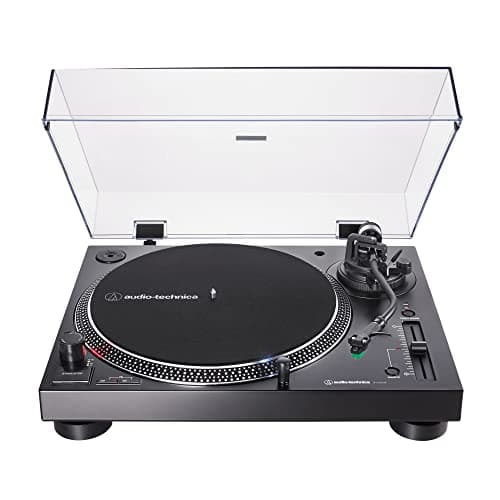 Audio-Technica AT-LP120XUSB A direct-drive deck with a switchable phono stage and USB out, which means it works with any amplifier you already own and needs nothing else on day one. | Best overall under $500 | 8.6 | $349.00View on Amazon $449.0022% off |
| 2 | 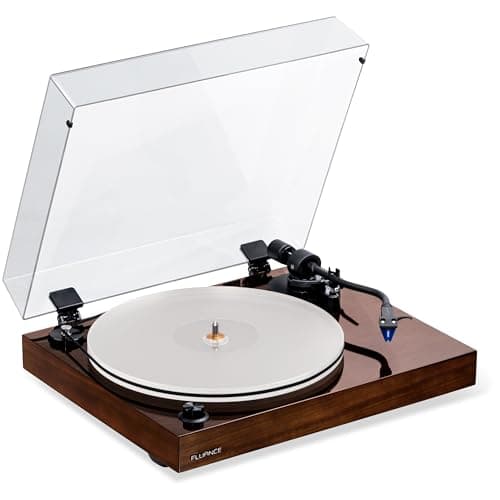 Fluance RT85 An acrylic platter and an Ortofon 2M Blue — the cartridge alone accounts for a large share of the price, which is the right place for the money to go. | Best overall under $1,000 | 8.4 | |
| 3 | 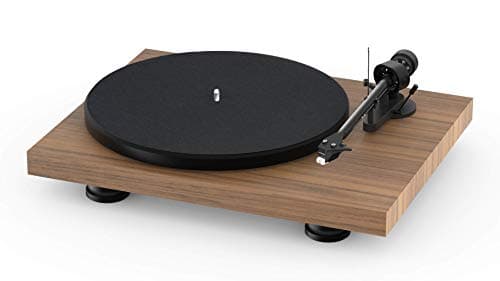 Pro-Ject Debut Carbon EVO A one-piece carbon-fiber tonearm and electronic speed change, on a deck whose whole design argument is the arm rather than the platter. | Best tonearm under $1,000 | 8.0 | |
| 4 | 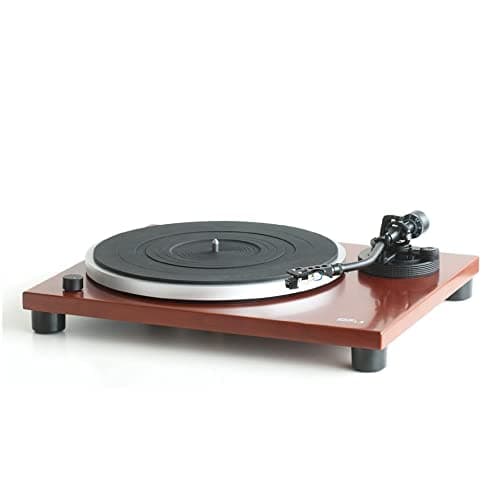 Music Hall mmf-1.5 A belt-drive deck whose built-in phono stage can be switched out of circuit entirely, which is the version of that feature worth paying for. | Best built-in phono stage under $1,000 | 7.4 | |
| 5 | 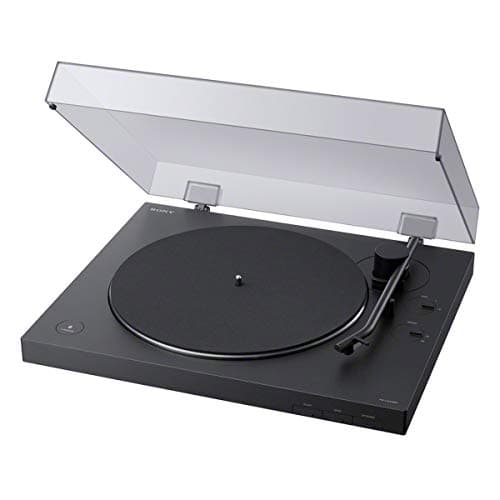 Sony PS-LX310BT Fully automatic, Bluetooth, a built-in phono stage and USB out — the most connection options in the bracket, on the lightest build in it. | Fully automatic with Bluetooth | 6.6 |
We have not heard any of these turntables, so this page cannot rank brands on sound. It ranks them on something we can check: what each one publishes about its own products.
That turns out to be a more useful ranking than it sounds, because the gaps are large, specific, and they cluster by brand rather than by price.
The disclosure table
| Brand | Wow & flutter | Signal-to-noise | Effective arm mass | Where it is published |
|---|---|---|---|---|
| Audio-Technica | < 0.2% WRMS (LP120XUSB) | > 50 dB | Not published on any model | Full manual PDFs, freely accessible |
| Fluance | 0.07% (RT85, RT82) | 69 dB weighted (RT85) | Published, but the figures look like total arm mass | Product pages |
| Pro-Ject | ± 0.17% at 33 rpm | 68 dB | 6.0 g — the only unambiguous figure we found | Datasheet PDF |
| Music Hall | < 0.12% typical AND < 0.15% limit (Classic) — both published | > 65 dB typical AND > 62 dB limit (Classic) | Not published | Product page |
| Sony | Nothing accessible | Nothing accessible | Nothing accessible | All Sony hosts returned HTTP 403 |
1. Audio-Technica — the deepest range and the best documentation
Audio-Technica publishes full manual PDFs for every deck, freely accessible, with complete specification tables. It is also the only brand here that makes both the turntables and the cartridges, which is why its upgrade path is the cleanest: the whole AT-VM95 stylus range drops into one body, so a stylus upgrade is a two-minute job with no realignment.
What it does not publish is tonearm effective mass, on any model. That is the one figure needed for resonance arithmetic, and its absence is a real gap in an otherwise exemplary set of documents.
The range is also the reason it leads: from the fully automatic AT-LP60XBT to the direct-drive AT-LP120XUSB with a switchable phono stage and USB output, it covers more of the market than anyone else here.
2. Fluance — the best published numbers, with one figure to distrust
Fluance publishes the strongest measured figures in this group: 0.07% wow and flutter and 69 dB signal-to-noise for the RT85, against Pro-Ject’s ± 0.17% and 68 dB and Audio-Technica’s < 0.2% and > 50 dB. On those two specs Fluance is ahead of everyone.
It also states plainly which decks need an external phono stage — “Separate Phono Preamp Required” on the RT82 and RT85 — and publishes that the RT81’s internal stage has a true bypass. Both are useful disclosures that cost sales.
The figure to distrust is tonearm effective mass. Fluance publishes 21.8 g, 27.5 g and 28.2 g under that heading for the RT82, RT85 and RT81. A genuine effective mass normally falls between about 8 and 14 g, so these look like total arm mass. We publish them as Fluance does and we do not compute resonance from them.
3. Pro-Ject — the specification that makes the arithmetic possible
Pro-Ject publishes “Effective arm length/mass: 218.5 mm / 6.0 g” for the Debut Carbon EVO. That is the only unambiguous, plainly-labeled effective-mass figure across every deck on this site, and it is the reason the EVO is the one turntable we can run a full cartridge-matching calculation on.
Pro-Ject also does something rarer still: its own datasheet advises that “it is always better to opt for a separate phono stage” rather than selling you the convenience of an internal one. A manufacturer arguing against its own upsell is worth noticing.
It sits third rather than higher because the range we could verify is narrow — one deck — and because its published wow and flutter of ± 0.17% is more than twice Fluance’s 0.07%. The head-to-head against the AT-LP120XUSB goes through it in detail.
4. Music Hall — the only brand publishing typical and limit figures
Music Hall does something no other brand here does: on the Classic it publishes both a typical and a limit figure for its measured specs. Wow and flutter is “typical < 0.12% WTD at 3 kHz RMS, limit < 0.15%”. Signal-to-noise is “typical > 65 dB DIN-B, limit > 62 dB”.
That is how a manufacturing specification is properly written. A single number tells you what a good example does; a typical-and-limit pair tells you what the production tolerance is, which is what you are actually buying when you buy one unit rather than the review sample.
One caveat we would rather print than bury: the deck we can point a working buy link at is the mmf-1.5, not the Classic, and Music Hall publishes the ordinary single-figure format for it — “less than 0.1% WTD at 3 kHz RMS” and “more than 65 dB DIN-B”. The typical-and-limit discipline above is real and it is Music Hall’s, but it is on the Classic’s page rather than on every model. The Classic is still sold direct by Music Hall; it is not currently available through the retailer we link.
The mmf-1.5 also publishes a factory-mounted Melody cartridge on a removable headshell and a bypassableinternal phono stage — bypassable rather than merely switchable, which means an external stage later takes the internal electronics out of circuit instead of stacking on top of them. Music Hall sits fourth only because effective mass is missing and because the strongest disclosure is on one model rather than the range.
5. Sony — nothing we could verify
We tried. On 17 July 2026, every Sony-hosted source for the PS-LX310BT — sony.com, electronics.sony.com, the UK, Australian and Middle East sites, and the official operating-instructions PDF — returned HTTP 403 to both our fetcher and to curl with a browser user agent. The STR-DH190 receiver returned the same.
Retailer listings carry figures. Retailer spec fields are unreliable and our sourcing rule excludes them, so we publish nothing for this deck rather than something we could not read at source.
The PS-LX310BT may well be a good turntable. It is a fully automatic belt-drive deck with Bluetooth output and it sells in volume. We simply cannot tell you a single verified thing about how it measures, and that is a brand-level problem rather than a product-level one.
Brands that are not here, and why
Rega, Technics, Denon and several others make turntables we would like to cover. None could be verified as currently purchasable through our affiliate channel at the time of writing, and we do not ship a recommendation for a product we cannot verify is buyable.
That is a limitation of our channel rather than a judgment on those brands. Rega and Technics in particular sell through specialist dealers, which is exactly where the specialist tier of this market lives.
Every pick in detail
Every specification below links to the manufacturer document we read it from. Where a manufacturer does not publish a figure, we say so rather than estimating it.
Audio-Technica AT-LP120XUSB
Best overall under $500A direct-drive deck with a switchable phono stage and USB out, which means it works with any amplifier you already own and needs nothing else on day one.
- specs
- 8/10
- upgrade path
- 9/10
- value for money
- 9/10
- ease of setup
- 7/10
- connectivity
- 10/10
| Specification | Published value | Source |
|---|---|---|
| Drive type | Direct drive (DC servo motor) | Audio-Technica manual (PDF) |
| Wow and flutter | < 0.2% WRMS (33 rpm) at 3 kHz | Audio-Technica manual (PDF) |
| Signal-to-noise | > 50 dB | Audio-Technica manual (PDF) |
| Speeds | 33⅓, 45, 78 rpm | Audio-Technica manual (PDF) |
| Cartridge included | AT-VM95E (VM type) on an AT-HS6 headshell | Audio-Technica manual (PDF) |
| Tonearm effective mass | Not published | — |
| Built-in phono stage | Yes — switchable PHONO/LINE, 36 dB nominal gain, RIAA equalized | Audio-Technica manual (PDF) |
| USB output | Yes — 16-bit, 44.1 or 48 kHz selectable, USB 1.1 | Audio-Technica manual (PDF) |
| Tracking force | Arm adjusts 0–4 g; the included AT-VM95E tracks 1.8–2.2 g (2.0 g standard) | Audio-Technica manual (PDF) |
Pros
- Switchable built-in phono stage — works with an amp that has no phono input
- Direct drive, so speed is locked without a belt to stretch or replace
- USB output for digitizing records without a separate interface
- Adjustable tracking force, anti-skate and a removable headshell
Cons
- Heavier and larger than the belt-drive decks in this bracket
- The bundled AT-VM95E is a competent cartridge, not an endgame one
- Removable headshell adds a mechanical joint some purists avoid
Skip it if you want the smallest possible footprint, or you already own a good phono stage and would rather put the money into the cartridge.
Fluance RT85
Best overall under $1,000Price as of October 15, 2026. #ad
An acrylic platter and an Ortofon 2M Blue — the cartridge alone accounts for a large share of the price, which is the right place for the money to go.
- specs
- 9/10
- upgrade path
- 9/10
- value for money
- 8/10
- ease of setup
- 6/10
- connectivity
- 5/10
| Specification | Published value | Source |
|---|---|---|
| Drive type | Belt drive | Fluance spec page |
| Wow and flutter | 0.07% | Fluance spec page |
| Signal-to-noise | 69 dB (weighted) | Fluance spec page |
| Cartridge included | Ortofon 2M Blue, pre-installed | Fluance spec page |
| Tonearm effective mass | 0.97 oz (27.5 g) as published — same caution as the RT82 and RT81. | Fluance spec page |
| Built-in phono stage | No — Fluance states “Separate Phono Preamp Required” | Fluance spec page |
Pros
- Ortofon 2M Blue included — a genuinely good cartridge, not a starter one
- Acrylic platter needs no separate mat and damps better than steel
- Isolated motor and a machined aluminum tonearm
Cons
- No built-in phono stage — a separate one is mandatory
- No USB
- The 2M Blue's stylus is the expensive consumable here
Skip it if you need a phono stage and speakers too. At this price the total system cost is what bites, not the deck.
Pro-Ject Debut Carbon EVO
Best tonearm under $1,000Price as of October 15, 2026. #ad
A one-piece carbon-fiber tonearm and electronic speed change, on a deck whose whole design argument is the arm rather than the platter.
- specs
- 9/10
- upgrade path
- 8/10
- value for money
- 7/10
- ease of setup
- 6/10
- connectivity
- 5/10
| Specification | Published value | Source |
|---|---|---|
| Drive type | Belt drive with electronic speed control | Pro-Ject datasheet (PDF) |
| Wow and flutter | 33 rpm: ±0.17%; 45 rpm: ±0.15% | Pro-Ject datasheet (PDF) |
| Signal-to-noise | 68 dB | Pro-Ject datasheet (PDF) |
| Speeds | 33, 45 electronically; 78 via the included round belt | Pro-Ject datasheet (PDF) |
| Cartridge included | Ortofon 2M Red, pre-adjusted | Pro-Ject datasheet (PDF) |
| Tonearm effective mass | 6.0 g (published as “Effective arm length/mass: 218.5 mm / 6.0 g”) | Pro-Ject datasheet (PDF) |
| Built-in phono stage | No — Pro-Ject's datasheet says “it is always better to opt for a separate phono stage” | Pro-Ject datasheet (PDF) |
Pros
- One-piece carbon tonearm — stiffer than the alloy arms at this price
- Electronic speed change; no belt to move by hand between 33 and 45
- Height-adjustable feet and a heavier steel platter
Cons
- No built-in phono stage
- Carbon arm has no removable headshell, so cartridge swaps are fiddlier
- Costs more than the RT85 while including a lesser cartridge
- Discontinued — Pro-Ject has removed its product page, and the maker's current turntable range lists the Debut EVO 2 rather than this deck, so what is on sale is remaining stock
Skip it if you swap cartridges often — the fixed headshell makes that a bench job rather than a two-minute one.
Music Hall mmf-1.5
Best built-in phono stage under $1,000No live price right now. #ad
A belt-drive deck whose built-in phono stage can be switched out of circuit entirely, which is the version of that feature worth paying for.
- specs
- 7/10
- upgrade path
- 8/10
- value for money
- 8/10
- ease of setup
- 6/10
- connectivity
- 8/10
| Specification | Published value | Source |
|---|---|---|
| Drive type | Belt drive, DC motor | Music Hall spec page |
| Speeds | 33 1/3, 45 and 78 rpm, full manual | Music Hall spec page |
| Wow and flutter | Less than 0.1% WTD at 3 kHz RMS | Music Hall spec page |
| Signal-to-noise | More than 65 dB (DIN-B) | Music Hall spec page |
| Platter | 305 mm die-cast aluminum | Music Hall spec page |
| Tonearm | Static-balanced S-shaped, 230 mm effective length, removable headshell | Music Hall spec page |
| Cartridge included | Music Hall Melody moving magnet with a diamond stylus | Music Hall spec page |
| Tonearm effective mass | Not published | — |
| Built-in phono stage | Yes — bypassable | Music Hall spec page |
| Dimensions / weight | 17.1 × 14.5 × 5 in; 12 lb | Music Hall spec page |
Pros
- The built-in phono stage is bypassable, so an external stage later takes the internal electronics out of circuit rather than stacking on top of them
- Real cherry wood veneer plinth
- Music Hall Melody moving-magnet cartridge fitted to a removable headshell
- Plays 78s as well as 33 and 45
Cons
- Fully manual — nothing lifts or returns the arm for you
- Music Hall publishes one wow-and-flutter figure and one signal-to-noise figure for this deck, not the typical-and-limit pair it prints for the dearer Classic
- No tonearm effective mass published, so cartridge compliance matching is guesswork
Skip it if you already own a phono stage and would rather put the money into the cartridge — the stage here is bypassable, but you still paid for it.
Sony PS-LX310BT
Fully automatic with BluetoothPrice as of October 15, 2026. #ad
Fully automatic, Bluetooth, a built-in phono stage and USB out — the most connection options in the bracket, on the lightest build in it.
- specs
- 6/10
- upgrade path
- 3/10
- value for money
- 5/10
- ease of setup
- 10/10
- connectivity
- 10/10
| Specification | Published value | Source |
|---|---|---|
| Published specifications | Unavailable. Every Sony-hosted source for this deck — sony.com, its regional sites, and the official operating-instructions PDF — returned HTTP 403 when we tried to read them on 17 July 2026. Retailer listings carry figures, but retailer spec fields are unreliable and we do not use them as a source for specifications. We would rather show you nothing than show you something we could not verify. | Sony product page (returned 403) |
Pros
- Automatic operation plus Bluetooth plus USB plus a built-in phono stage
- Genuinely one-box: works with a wireless speaker or an amp with no phono input
- Low, compact footprint
Cons
- Cartridge is not a standard user-replaceable mount
- Plastic-heavy construction relative to the Fluance decks
- Live price has been sitting well above its typical street price — check it before buying
Skip it if you want to upgrade anything later. This is a finished appliance, not a platform.
Frequently asked questions
What is the best turntable brand?
On published documentation, Audio-Technica — it publishes full manual PDFs with complete specification tables for every deck, makes its own cartridges, and offers the widest verified range. Fluance publishes the strongest measured figures (0.07% wow and flutter, 69 dB signal-to-noise on the RT85). We have not heard any of these turntables and do not rank them on sound.
Which turntable brand publishes the most complete specifications?
Music Hall publishes the most rigorous format we found — on the Classic, both a typical and a limit figure for wow and flutter and signal-to-noise, which describes production tolerance rather than one good example. Pro-Ject publishes the only unambiguous tonearm effective mass we found (6.0 g for the Debut Carbon EVO). Audio-Technica publishes the most accessible documents.
Why are Rega and Technics not in this list?
Neither could be verified as currently purchasable through our affiliate channel, and we do not publish a recommendation for a product we cannot verify is buyable. Both sell primarily through specialist dealers, which is where the specialist tier of this market lives. That is a limitation of our channel, not a judgment on the brands.
Is Fluance a good turntable brand?
Its published measured figures are the strongest here — 0.07% wow and flutter and 69 dB signal-to-noise for the RT85 — and it states plainly which decks need an external phono stage. One caution: the figures Fluance publishes as tonearm effective mass (21.8 to 28.2 g) are far above the 8–14 g range a genuine effective mass usually occupies, so they look like total arm mass and we do not compute resonance from them.
Read next
The Best Turntables Under $500
Five decks under $500, ranked on published specs and total cost — including the phono stage two of them make you buy separately.
Pro-Ject vs Audio-Technica
Debut Carbon EVO against AT-LP120XUSB: arm versus features, and the one published spec that settles it.
The Best Turntables Under $1,000
Four decks under $1,000, judged on where the money went — and only one publishes a tonearm effective mass you can actually use.
Belt Drive vs Direct Drive Turntables
Seven decks, two drive types, and published wow-and-flutter figures that refuse to line up the way the internet says they should.
The Best Turntables for Beginners
Beginner decks ranked on the two things that matter at the start — automatic operation and a phono stage in the box.
Audio-Technica AT-LP120XUSB Review
Direct drive, a switchable 36 dB phono stage, USB and 78 rpm — reviewed against Audio-Technica's own manual.
Sources
Every specification on this page was read from one of these documents. If one of them has changed, or we have made an error, tell us — corrections are logged and dated per our editorial policy.
- Audio-Technica AT-LP120XUSB — manual (wow and flutter, S/N, phono stage, USB)
- Fluance RT85 — spec page (0.07% W&F, 69 dB S/N, arm mass figure)
- Pro-Ject Debut Carbon EVO — datasheet (effective arm length/mass 218.5 mm / 6.0 g)
- Music Hall Classic — spec page (typical and limit figures)
- Music Hall mmf-1.5 — spec page (single figures, bypassable phono stage)
- Sony PS-LX310BT — product page (returned HTTP 403; no specifications obtainable)