FiiO K7 Review
Everyone quotes the 2,000 mW. Almost nobody quotes the four figures beside it that tell you whether this is the right box for your headphones — including the one where FiiO publishes an upper impedance limit.
The short answer
The K7 is the right box if you own a demanding full-size headphone and you will use the 4.4 mm socket; it is more box than most people need otherwise. FiiO publishes 2,000 mW per channel balanced into 32 Ω and 560 mW into 300 Ω, against 1,220 mW and 140 mW single-ended — so the balanced output is 1.64 times the power at 32 Ω and four timesat 300 Ω. Output impedance is published at under 1 Ω on both sockets, which keeps every headphone from 16 Ω upward inside the usual damping guideline. The two caveats are in the same table: FiiO recommends 16–300 Ωand publishes an upper bound, so a 600 Ω headphone is outside its own recommendation; and the DAC path is 8 dB noisier than the analog line input(≥ 120 dB(A) over USB against ≥ 128 dB(A) from AUX). If you listen single-ended on an IEM, almost everything you are paying for here is switched off.
Disclosure: we earn a commission if you buy through the links on this page, at no extra cost to you. It does not influence what we pick — our criteria are published and reproducible, so you can check our work. How we pick · Full disclosure
These picks are spec-and-price analyses, not listening tests. We have not heard this gear and we do not pretend to have: every figure below is sourced to the manufacturer and linked, and every price is live or not shown at all. Here are the rules we followed.
Quick picks
Ranked on the published criteria in How We Pick. Prices are live as of November 12, 2026. Tap any row for the full write-up.
- 8.8
| # | Product | Best for | Score | Price |
|---|---|---|---|---|
| 1 | 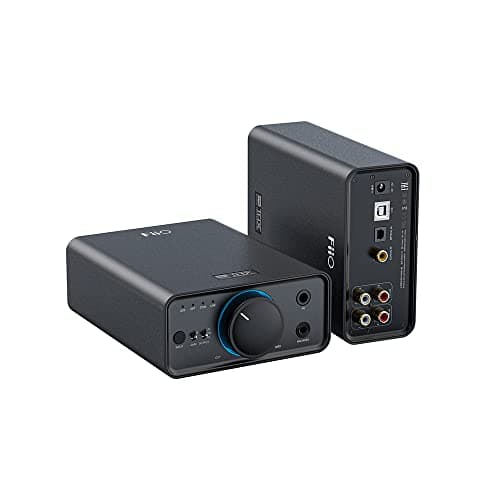 FiiO K7 A DAC with a genuinely powerful balanced headphone amplifier attached, which is the reason to choose it over a DAC-only box. | Best DAC and headphone amp combo | 8.8 |
The FiiO K7 is the most recommended desktop DAC and headphone amplifier of its generation, and the recommendation is almost always the same sentence: two thousand milliwatts, THX amplifier modules, done. That sentence is true and it is also the least informative part of a parameters page that runs to several dozen published figures — including output impedance, peak output voltage, crosstalk per socket, noise floor per input and a recommended headphone impedance range with an upper limit, which is a thing hardly any manufacturer publishes at all.
This review is built on that page and nothing else. We have not measured the K7 and we have not sat with it against a shortlist of rivals, so there is no listening verdict here and we are not going to imply one. What follows is what FiiO is willing to be held to, read carefully, with the arithmetic shown — because three of those published figures change the buying decision and none of them is the 2,000 mW.
What it is, and what is inside it
A desktop DAC and headphone amplifier in one chassis, switchable between three modes — headphone, speaker (preamp) and pure DAC. FiiO publishes the parts: two AK4493S converters in a dual-mono arrangement, an XMOS XUF208 USB receiver, two NJU72315 volume chips and two THX AAA 788+ amplifier modules. Inputs are USB-B, optical, coaxial and an analog RCA line in; outputs are RCA line out, a 6.35 mm single-ended headphone jack and a 4.4 mm balanced one. It runs from an external 12 V / 2 A supply and weighs about 610 g.
Two things in that list are worth pausing on. The analog line inputmeans the K7 can be used as a pure headphone amplifier for a source that already has a DAC — and as the figures below show, that is its quietest path. And the volume control is a potentiometer with ADC sampling rather than a digital attenuator, with only two gain positions, low and high. Two steps is not many; a sensitive IEM and a 250 Ω planar are both expected to live inside the same pair of them.
Finding one: balanced is a four-times upgrade, but only at high impedance
Every K7 review quotes 2,000 mW balanced against 1,220 mW single-ended into 32 Ω and concludes that the 4.4 mm socket is worth about 60% more power. That is correct at 32 Ω and badly wrong everywhere else, because FiiO also publishes both figures at 300 Ω.
ratio = balanced output power ÷ single-ended output power, at the same load
Inputs
- 6.35 mm single-ended, 32 Ω: ≥ 1,220 mW + 1,220 mW (THD+N < 1%) (FiiO parameters page)
- 4.4 mm balanced, 32 Ω: ≥ 2,000 mW + 2,000 mW (THD+N < 1%) (FiiO parameters page)
- 6.35 mm single-ended, 300 Ω: ≥ 140 mW + 140 mW (THD+N < 1%) (FiiO parameters page)
- 4.4 mm balanced, 300 Ω: ≥ 560 mW + 560 mW (THD+N < 1%) (FiiO parameters page)
Result
Finding two: the DAC is the noisier half of this DAC
FiiO publishes signal-to-noise and noise floor separately for the analog AUX input and for the USB (DAC) path, and the DAC path loses both times: ≥ 128 dB(A) from AUX against ≥ 120 dB(A) over USB, with the noise floor following at < 3.1 µV(A) against < 4.4 µV(A) on the single-ended output. On the balanced output the same split appears: < 5.1 µV(A) from AUX, < 7.7 µV(A) over USB.
Eight decibels is not a problem — 120 dB(A) is an extremely quiet amplifier by any standard, and nobody is going to hear the difference on music. It is interesting for what it tells you about where the limit sits. If you already own a DAC you are happy with, feeding the K7’s line input gives you its best published noise figures, not a compromise. The K7 as a pure headphone amplifier is a slightly better headphone amplifier than the K7 as a DAC-plus-amplifier.
The same pattern shows in distortion, and it points the other way from what you would expect: the headphone output publishes < 0.0003%THD+N at 1 kHz / 32 Ω while the line output publishes < 0.0005%at 1 kHz / 10 kΩ. The amplifier section measures better than the converter feeding it. That is a compliment to the THX modules and a reminder that in 2026 the amplifier is rarely the weak link — which is the argument our DAC-versus-amp page makes at length.
Finding three: FiiO publishes a ceiling, and it is 300 Ω
The recommended headphone impedance is published as 16–300 Ω. Most manufacturers publish a minimum or nothing at all; an explicit upper bound is unusual and it is useful, because it tells you where FiiO stops claiming the box is suited to the load rather than leaving you to infer it from a power table.
It also creates an honest tension with this site’s own high-impedance roundup, which ranks the K7. The resolution is that “high impedance” usually means 250 or 300 Ω — the Beyerdynamic and Sennheiser classics — and at 300 Ω balanced the K7 publishes 560 mW, which is a great deal of power. A 600 Ωheadphone is a different matter: it sits outside FiiO’s published recommendation and FiiO publishes no power figure at that load, so there is nothing to check. We will not extrapolate one.
At the other end, 16 Ω is the published floor and the output impedance figure backs it up.
damping ratio = headphone impedance ÷ amplifier output impedance (the common guideline is ≥ 8)
Inputs
- FiiO K7 — output impedance: < 1 Ω at 32 Ω, both the 6.35 mm and 4.4 mm outputs (FiiO parameters page)
- FiiO K7 — recommended headphone impedance: 16–300 Ω (FiiO parameters page)
Result
Where it is weaker than the headlines suggest
- The digital inputs are not equals. USB carries PCM up to 384 kHz/32-bit and DSD256; coaxial stops at 192 kHz/24-bit; optical stops at 96 kHz/24-bit. If you were planning to feed it from a television over optical, that is the ceiling, and no DSD arrives over either S/PDIF input.
- Single-ended crosstalk is ordinary. FiiO publishes ≥ 77 dB at 32 Ω on the 6.35 mm output against ≥ 124 dBbalanced — a 47 dB gap. Seventy-seven decibels is inaudible in practice, but it is the one specification where the single-ended socket is not just lower-powered than the balanced one, it is measurably worse.
- Two gain positions.Low and high, and nothing between. With a potentiometer rather than a stepped digital attenuator, a very sensitive IEM can end up living in the bottom of the knob’s travel where channel balance is least consistent — a general property of analog volume controls, not a defect FiiO has published a figure for.
- The line output is fixed at ≥ 2 Vrms. Useful and predictable for feeding a power amplifier; not a variable preamp output unless you switch the unit into its speaker/preamp mode.
- Frequency response widens outside the audio band.± < 0.4 dB from 20 Hz to 20 kHz over USB is excellent; extend the window to 50 kHz and the published figure becomes ± < 2.2 dB. That is a filter rolling off above the audible band, which is what it should do, and it is worth knowing before you read 2.2 dB as a fault.
- No enclosure dimensions are publishedon the parameters page at all — only the 610 g weight. For a box this size, on a desk, that is a strange thing to leave out.
- It needs a 12 V / 2 A brick. This is not a bus-powered dongle and it was never pretending to be.
Who should buy it, and who should not
Buy it ifyou own a full-size headphone of 150 Ω or more, or a low-sensitivity planar, and you are willing to use a 4.4 mm balanced cable. That is the case where the published figures justify the box: 560 mW into 300 Ω balanced is four times what the single-ended socket delivers and more than most desktop units publish at that load. It is also a sensible buy if you want one chassis to do headphones, a preamp feed to powered speakers and a pure DAC feed to an integrated amplifier, because the mode switch is a published feature rather than a hack.
Skip it ifyour headphones are sensitive IEMs or ordinary 32 Ω portables used single-ended. In that configuration you are paying for a power reserve you cannot use, a balanced socket you are not plugging into, and a 610 g chassis with an external supply. The cheaper K11 covers that case— and note that FiiO publishes a higherline-output SNR for the K11 (≥ 126 dB(A) against the K7’s ≥ 116 dB(A)), which is one of the odder comparisons in FiiO’s own range.
Skip it also ifyou never use headphones at all. In pure-DAC duty the K7’s whole amplifier section is dead weight, and a DAC-only box in the same bracket spends the budget on the converter instead. And if your headphone is 600 Ω, this is outside FiiO’s published recommendation — read the high-impedance page before assuming the 2,000 mW figure covers you.
Every published figure, with its source
The complete spec block for this unit — all twenty-two published rows plus the one gap — is in the Every pick in detailsection below this article. Every value links to the FiiO page it was read from on 31 October 2026, and the gap is FiiO’s rather than ours.
How it sits against the rest of our DAC coverage
The K7 is the top pick on our DAC and amp combo roundup, and it appears on the under-$500 bracket and the high-impedance roundup. If you are choosing between it and its cheaper sibling, that decision has its own page: FiiO K7 vs K11, decided on published data from both parameters pages. And if the question behind the question is whether a DAC is the upgrade you need at all, what a DAC actually does and DAC versus amp are the honest starting points.
One last piece of context for anyone building a system rather than a desk: the box at the end of the chain still matters more than the box at the start. If this K7 is feeding powered monitors or an integrated amplifier, the speakers it ends up driving will do more to change what you hear than any DAC in this price range.
Every pick in detail
Every specification below links to the manufacturer document we read it from. Where a manufacturer does not publish a figure, we say so rather than estimating it.
FiiO K7
Best DAC and headphone amp comboPrice as of November 12, 2026. #ad
A DAC with a genuinely powerful balanced headphone amplifier attached, which is the reason to choose it over a DAC-only box.
- measured specs
- 9/10
- inputs
- 8/10
- value for money
- 9/10
- build quality
- 9/10
- features
- 9/10
| Specification | Published value | Source |
|---|---|---|
| Chipset | DAC: 2 × AK4493S; USB: XMOS XUF208; amp: 2 × THX AAA 788+ | FiiO parameters page |
| Max sample rate | USB: PCM 384 kHz/32-bit, DSD256; coaxial: 192 kHz/24-bit; optical: 96 kHz/24-bit | FiiO parameters page |
| Inputs | USB-B, line in (RCA), optical, coaxial | FiiO parameters page |
| Outputs | Line out (RCA), 4.4 mm balanced headphone, 6.35 mm single-ended headphone | FiiO parameters page |
| Headphone power | 6.35 mm: ≥ 1,220 mW + 1,220 mW (32 Ω); ≥ 140 mW + 140 mW (300 Ω). 4.4 mm balanced: ≥ 2,000 mW + 2,000 mW (32 Ω); ≥ 560 mW + 560 mW (300 Ω). All at THD+N < 1%. The balanced 300 Ω figure was missing from this row until a 2026-10-31 re-read of the same page; FiiO labels it “Output power3”, which is why it is easy to miss | FiiO parameters page |
| THD+N | Line out: < 0.0005% (1 kHz/10 kΩ) | FiiO parameters page |
| Signal-to-noise | Line out ≥ 116 dB (A-weighted) | FiiO parameters page |
| Output modes | Switchable between headphone, speaker (preamp) and pure DAC | FiiO product page |
| Output impedance | < 1 Ω at 32 Ω, on BOTH the 6.35 mm and the 4.4 mm output | FiiO parameters page |
| Peak output voltage | ≥ 18.9 Vpp (6.35 mm single-ended); ≥ 37.7 Vpp (4.4 mm balanced) — almost exactly double, which is what the balanced topology predicts | FiiO parameters page |
| Recommended headphone impedance | 16–300 Ω. FiiO publishes an UPPER bound, which most makers do not | FiiO parameters page |
| Headphone THD+N | < 0.0003% (1 kHz / 32 Ω / dBA) on both headphone outputs — lower than the figure published for the line output | FiiO parameters page |
| Headphone signal-to-noise | ≥ 128 dB(A) from the analog AUX input; ≥ 120 dB(A) over USB. The DAC path is the noisier of the two by 8 dB, on FiiO's own figures | FiiO parameters page |
| Channel crosstalk | ≥ 77 dB at 32 Ω single-ended; ≥ 124 dB at 32 Ω balanced; ≥ 102 dB on the line output (1 kHz / 10 kΩ) | FiiO parameters page |
| Headphone noise floor | < 3.1 μV(A) from AUX in; < 4.4 μV(A) over USB (single-ended). Balanced: < 5.1 μV(A) and < 7.7 μV(A) | FiiO parameters page |
| Line output level | ≥ 2 Vrms, fixed | FiiO parameters page |
| Line output frequency response | 20 Hz – 20 kHz ± < 0.4 dB over USB; ± < 0.8 dB over S/PDIF. Out to 50 kHz: ± < 2.2 dB (USB), ± < 1.7 dB (S/PDIF) | FiiO parameters page |
| Volume and gain | Potentiometer with ADC sampling; two gain positions only (low / high) | FiiO parameters page |
| Volume IC | 2 × NJU72315 | FiiO parameters page |
| Power / weight | DC 12 V / 2 A external supply; approximately 610 g | FiiO parameters page |
| Enclosure dimensions | Not published | — |
Pros
- Powerful balanced headphone output, not a token one
- Gain switching for sensitive and demanding headphones
- Line out for a separate amplifier
Cons
- Larger than a DAC-only box
- You pay for the headphone amp whether you use it or not
- External power brick
Skip it if you never use headphones — the Modi 5 or E30 II is cheaper and smaller.
Frequently asked questions
Is the FiiO K7's balanced output worth using?
Can the FiiO K7 drive 600 ohm headphones?
Does the FiiO K7 work as a preamp for powered speakers?
What sample rates does the FiiO K7 support?
Did you measure the FiiO K7 yourselves?
Read next
FiiO K7 vs K11
The K7 publishes 2.3x the headphone power at both 32 and 300 ohms. The K11 publishes a 126 dB line-out S/N against the K7's 116 dB — and a 300 ohm balanced figure the K7 leaves blank.
The Best DAC and Amp Combos
Four DAC and headphone amp combos, ranked on published power into 32 Ω and 300 Ω rather than on chip names.
Headphone Impedance and How Much Power You Need
Why published headphone power collapses at high impedance, what output impedance does to the sound, and how to check a pairing before you buy.
The Best DACs for High-Impedance Headphones
Ranked on published power at 300 Ω and 600 Ω instead of 32 Ω. The collapse is about 8-9x on every single-ended output here, and only one product publishes a 600 Ω figure at all.
The Best DACs Under $500
Seven DACs under $500. They all measure superbly — so the decision is inputs, outputs and whether you want a headphone amp.
DAC vs Amp: Which Do You Need?
Not alternatives — consecutive steps. If your system is silent, you need the amp.
Sources
Every specification on this page was read from one of these documents. If one of them has changed, or we have made an error, tell us — corrections are logged and dated per our editorial policy.