Record Player vs Turntable
Nobody owns either word, and no standards body defines them. So here is the only test that works: what the manufacturer is willing to publish.
Disclosure: we earn a commission if you buy through the links on this page, at no extra cost to you. It does not influence what we pick — our criteria are published and reproducible, so you can check our work. How we pick · Full disclosure
These picks are spec-and-price analyses, not listening tests. We have not heard this gear and we do not pretend to have: every figure below is sourced to the manufacturer and linked, and every price is live or not shown at all. Here are the rules we followed.
Quick picks
Ranked on the published criteria in How We Pick. Prices are live as of October 15, 2026. Tap any row for the full write-up.
- 8.0
- 7.8
- 6.4
| # | Product | Best for | Score | Price |
|---|---|---|---|---|
| 1 | 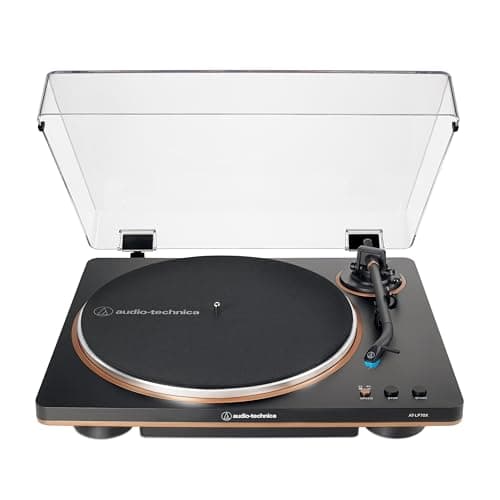 Audio-Technica AT-LP70X Fully automatic, so the arm lifts and returns on its own — the single feature that most reduces the chance of a new owner damaging a stylus or a record. | Best for beginners | 8.0 | |
| 2 | 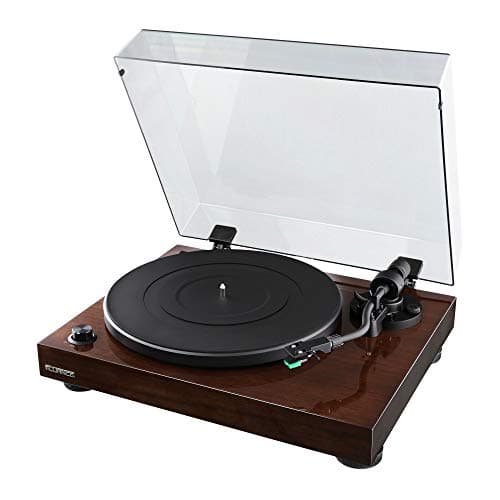 Fluance RT81 The RT82's cheaper sibling: an AT-95E-class cartridge and a built-in phono preamp, which makes it the lower total cost of the two once you count what you still have to buy. | Best value with a phono stage built in | 7.8 | |
| 3 | 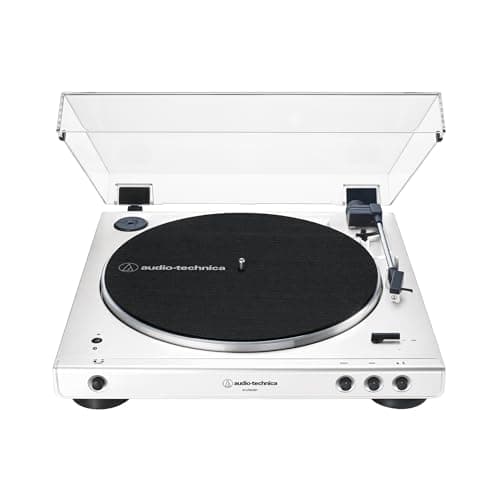 Audio-Technica AT-LP60XBT Fully automatic with Bluetooth out, which trades away the upgrade path entirely in exchange for working with a wireless speaker and nothing else. | Simplest possible start | 6.4 |
There is no technical distinction between a record player and a turntable. The two words are used interchangeably by the manufacturers themselves. The distinction people are actually reaching for is real, but it is not the one the words describe.
Look at how the makers we cover name their own products. Fluance sells the RT81 as a “High Fidelity Vinyl Turntable Record Player” — both words, in one product name. Audio-Technica calls the AT-LP60XBT a turntable. Nobody adjudicates this, because there is no body that could.
The folk definition — that a “record player” has speakers built in and a “turntable” does not — breaks immediately. The AT-LP60XBT has no speakers and is universally called a record player. Klipsch The Fives II has speakers, an amplifier and a phono stage, and nobody calls it a record player.
The distinction that is real
What people mean when they ask this question is: is this thing going to damage my records? That is a legitimate worry and it has a legitimate answer. It just is not answered by the product name.
It is answered by four specifications, and the useful thing about them is that a product which cannot pass simply does not publish them.
The four-line checklist
1. What cartridge is fitted, by name and type
A magnetic cartridge — moving magnet, moving iron, moving permalloy — tracks at roughly 1.5 to 2.2 grams. A ceramic or crystal pickup, which is what the cheapest suitcase players use, needs several times that force to work at all.
Every deck we cover names its cartridge in the spec sheet. Audio-Technica publishes “AT3600L (VM type)” for the AT-LP60XBT and “AT-VM95C dual moving magnet” for the AT-LP70X. Fluance publishes “Audio-Technica AT95E” for the RT81. If a product page tells you nothing beyond “diamond stylus”, that absence is the specification.
2. Tracking force, as a published range
This is the number that determines what the stylus does to the groove wall. Audio-Technica publishes 1.8–2.2 g for the AT-VM95E and states that the AT-LP120XUSB’s arm adjusts from 0 to 4 g. Ortofon publishes 1.6–2.0 g for the 2M Red. Nagaoka publishes 1.5–2.0 g.
And here is where we have to be even-handed: Audio-Technica does not publish a tracking-force range for the AT-LP70X. That is a genuine gap on a deck we recommend, and it is in our spec table as “Not published” rather than quietly filled in. The checklist is a checklist, not a verdict.
3. A replacement stylus part number
A stylus is a wear item. A manufacturer who expects you to keep the product publishes the part that wears out. Audio-Technica publishes “replacement stylus ATN3600L” for the AT-LP60XBT. Nagaoka publishes which assemblies fit the MP-110 body.
A product with no published replacement stylus is a product with a service life, and the service life is however long the first stylus lasts.
4. Wow, flutter and signal-to-noise
These tell you whether the platter turns steadily and whether the electronics are quiet. Every deck we cover publishes both — you can compare seven of them on our belt versus direct drive page. A product that publishes neither is telling you something.
Apply the checklist: how the decks we cover score
| Deck | Cartridge named | Tracking force published | Replacement stylus published |
|---|---|---|---|
| Audio-Technica AT-LP120XUSB | Yes — AT-VM95E on an AT-HS6 headshell | Yes — arm 0–4 g; cartridge 1.8–2.2 g | Yes — whole VM95 stylus range |
| Fluance RT81 | Yes — Audio-Technica AT95E | Not on Fluance’s spec page | Via the cartridge maker |
| Audio-Technica AT-LP70X | Yes — AT-VM95C, non-removable body | No — published as a gap | Yes — VM95 stylus range fits |
| Audio-Technica AT-LP60XBT | Yes — AT3600L (VM type) | Not published | Yes — ATN3600L |
| Sony PS-LX310BT | Cannot verify — see below | Cannot verify | Cannot verify |
The Sony row is not a criticism of the deck. Every Sony-operated domain we tried returned HTTP 403 to automated access, including the official operating-instructions PDF. Retailer listings carry figures for it, and we do not use retailer listings as a source for a specification. So we publish nothing, and we say why — which is itself the most honest row on the table.
Automatic, semi-automatic, manual — the distinction that is real
If any word in this category deserves to carry weight, it is this one, and it is published on every spec sheet.
Fully automatic:press a button and the arm lifts, moves to the lead-in groove, lowers, plays, and returns at the end of the side. Audio-Technica publishes “fully automatic” for both the AT-LP60XBT and the AT-LP70X.
Manual: you place the arm and you lift it off. The AT-LP120XUSB, the Fluance decks and the Pro-Ject Debut Carbon EVO are all manual.
This matters more than it sounds, because the two most common ways a stylus gets damaged are being dropped onto a record and being left to run in the lead-out groove for hours. A fully automatic deck removes both, mechanically, without depending on the owner.
The cost is that an automatic mechanism has to be coupled to the tonearm, which is one more thing attached to a part that is supposed to move freely. That is the trade, and it is why the more expensive decks here are manual.
For a first deck, or for anything a household shares, automatic is the sensible answer and it is what most of our beginner picks are.
The other spec sheet line that decides your setup
“Built-in preamp” appears on almost every product in this category and it does not mean the same thing twice.
- Switchable, with a true bypass. Fluance publishes that the RT81 has a PHONO/LINE switch with a bypass that takes its electronics out of circuit entirely when you use an external stage. That is the best arrangement, because it does not become a ceiling.
- Switchable. Audio-Technica publishes switchable PHONO/LINE with 36 dB nominal gain on the AT-LP60XBT, AT-LP70X and AT-LP120XUSB. You can bypass it; whether it is fully out of circuit is not stated.
- None at all.Fluance states “Separate Phono Preamp Required” for the RT82 and RT85. Pro-Ject’s datasheet for the Debut Carbon EVO goes further and says outright that “it is always better to opt for a separate phono stage”.
A deck with no built-in stage is not a worse deck — it is a deck with one more thing to buy. Work out which you have before ordering speakers, because the answer changes what you need. That is the subject of do I need a phono preamp.
What “all-in-one” actually costs you
Plenty of good products have the amplifier and speakers built in, and there is nothing wrong with the idea. What you give up is specific and worth knowing.
- The speakers are inches from the stylus. Acoustic feedback is a real failure mode when a cabinet vibrating at 60 Hz is bolted to the same chassis as the tonearm. Separate boxes do not have this problem.
- You cannot upgrade one part. On the AT-LP70X, Audio-Technica states the cartridge body is non-removable — the stylus upgrades across the VM95 range but the body does not come off. That is a documented ceiling, published by the manufacturer.
- The phono stage is fixed.A deck with a switchable PHONO/LINE output lets you bypass its internal stage later. Fluance publishes that the RT81 has a “true bypass” that takes its electronics out of circuit; that is a meaningfully better arrangement than one you cannot switch off. See do I need a phono preamp.
So what should you buy?
If the phrase “record player” is what brought you here, you almost certainly want something automatic, complete in the box, and hard to set up wrongly. That is a real and sensible requirement, and it is exactly what our beginner picks are chosen for.
Two of the three picks above are fully automatic — the arm lifts, moves and returns on its own — which removes the single most common way a stylus gets damaged. All three publish their cartridge. All three have a magnetic pickup and a documented phono stage.
The word on the box does not matter. The spec sheet under it does.
Every pick in detail
Every specification below links to the manufacturer document we read it from. Where a manufacturer does not publish a figure, we say so rather than estimating it.
Audio-Technica AT-LP70X
Best for beginnersPrice as of October 15, 2026. #ad
Fully automatic, so the arm lifts and returns on its own — the single feature that most reduces the chance of a new owner damaging a stylus or a record.
- specs
- 7/10
- upgrade path
- 7/10
- value for money
- 9/10
- ease of setup
- 10/10
- connectivity
- 7/10
| Specification | Published value | Source |
|---|---|---|
| Drive type | Belt drive (DC motor), fully automatic | Audio-Technica manual (PDF) |
| Wow and flutter | < 0.25% (WTD) | Audio-Technica manual (PDF) |
| Signal-to-noise | > 55 dB | Audio-Technica manual (PDF) |
| Speeds | 33⅓, 45 rpm | Audio-Technica manual (PDF) |
| Cartridge included | AT-VM95C dual moving magnet — NON-REMOVABLE. The stylus upgrades across the VM95 range; the cartridge body does not come off. | Audio-Technica manual (PDF) |
| Tonearm effective mass | Not published | — |
| Built-in phono stage | Yes — switchable PHONO/LINE, 36 dB nominal gain | Audio-Technica manual (PDF) |
| USB output | No | Audio-Technica manual (PDF) |
| Tracking force range | Not published | — |
Pros
- Fully automatic start and return — no manual cueing to get wrong
- Built-in switchable phono stage, so it works with any line input
- The stylus upgrades across the AT-VM95 range without touching the cartridge
- Published wow and flutter under 0.25%, and Audio-Technica states the figure
Cons
- The cartridge body is non-removable — only the stylus swaps, so the upgrade path ends at the VM95 range
- Belt drive, not direct drive: the belt is a consumable
- No USB output
Skip it if you want to digitize your collection — this one has no USB out.
Fluance RT81
Best value with a phono stage built inPrice as of October 15, 2026. #ad
The RT82's cheaper sibling: an AT-95E-class cartridge and a built-in phono preamp, which makes it the lower total cost of the two once you count what you still have to buy.
- specs
- 7/10
- upgrade path
- 8/10
- value for money
- 9/10
- ease of setup
- 7/10
- connectivity
- 8/10
| Specification | Published value | Source |
|---|---|---|
| Drive type | Belt drive | Fluance spec page |
| Wow and flutter | 0.2% | Fluance spec page |
| Signal-to-noise | 67 dB or higher (A-weighted, 20 kHz LPF); 60 dB or higher unweighted | Fluance spec page |
| Cartridge included | Audio-Technica AT95E | Fluance spec page |
| Tonearm effective mass | 0.99 oz (28.2 g) as published — same caution as the RT82: this is high for an effective-mass figure and may be total arm mass. | Fluance spec page |
| Built-in phono stage | Yes — PHONO/LINE switchable, with a true bypass that takes the electronics out of circuit when you use an external stage | Fluance spec page |
Pros
- Built-in phono preamp — no extra box required
- Wood plinth and a metal platter at a lower price than the RT82
- Auto-stop at the end of a side
Cons
- Cartridge is a step below the RT82's Ortofon OM10
- Manual cueing
- Built-in preamp is fixed-quality; you pay for it whether you use it or not
Skip it if you already own a phono stage — the RT82 puts that money into a better cartridge instead.
Audio-Technica AT-LP60XBT
Simplest possible startPrice as of October 15, 2026. #ad
Fully automatic with Bluetooth out, which trades away the upgrade path entirely in exchange for working with a wireless speaker and nothing else.
- specs
- 5/10
- upgrade path
- 3/10
- value for money
- 7/10
- ease of setup
- 10/10
- connectivity
- 8/10
| Specification | Published value | Source |
|---|---|---|
| Drive type | Belt drive, fully automatic (DC servo-controlled motor) | Audio-Technica manual (PDF) |
| Wow and flutter | < 0.25% (WTD) at 3 kHz | Audio-Technica manual (PDF) |
| Signal-to-noise | > 50 dB (DIN-B) | Audio-Technica manual (PDF) |
| Cartridge included | AT3600L (VM type); replacement stylus ATN3600L | Audio-Technica manual (PDF) |
| Tonearm effective mass | Not published | — |
| Built-in phono stage | Yes — switchable PHONO/LINE, 36 dB nominal gain | Audio-Technica manual (PDF) |
| USB output | No | Audio-Technica manual (PDF) |
Pros
- Fully automatic and genuinely hard to misuse
- Bluetooth output pairs with a wireless speaker with no amplifier at all
- The cheapest route into a real, tracking-force-controlled turntable
Cons
- Integrated headshell — the cartridge is not user-replaceable the way a standard mount is
- Bluetooth is lossy; the analog output is the better path if you have one
- Lightest plinth here, so it is the most sensitive to a resonant surface
Skip it if you expect to upgrade the cartridge later. The integrated headshell is the ceiling, and it arrives early.
Frequently asked questions
Is a record player the same as a turntable?
Yes, as far as the industry is concerned. No standards body defines either term and manufacturers use both for the same products — Fluance sells the RT81 as a “Vinyl Turntable Record Player”. The folk rule that a record player has built-in speakers fails immediately: the Audio-Technica AT-LP60XBT has none and is called a record player everywhere.
Will a cheap record player damage my records?
The product name will not tell you; the specification list will. Look for a named cartridge, a published tracking-force range, and a published replacement stylus part number. Magnetic cartridges of the type fitted to the decks we cover track at roughly 1.5–2.2 g. A product that publishes none of these figures is not being coy about a good number.
Are all-in-one record players with built-in speakers bad?
Not inherently — Klipsch The Fives II has speakers, an amplifier and a phono stage and is a serious product. The real costs are that speakers bolted to the same chassis as the tonearm can cause acoustic feedback, and that you cannot upgrade one part in isolation. Audio-Technica states outright that the AT-LP70X’s cartridge body is not removable.
What is the cheapest turntable that is actually safe for records?
We will not name a price threshold, because prices move and ours are live. We will name the test: a named magnetic cartridge, published wow and flutter, published signal-to-noise, and a published replacement stylus. Every deck in our under-$300 roundup clears it, and each one shows exactly which figures its maker does and does not publish.
Read next
The Best Turntables for Beginners
Beginner decks ranked on the two things that matter at the start — automatic operation and a phono stage in the box.
The Best Turntables Under $300
Three verified decks under $300, ranked on published wow and flutter, drive type and whether the cartridge can ever be changed.
How to Connect a Turntable to Speakers
Four working routes from turntable to speakers, the two that do not work, and how to fix the hum.
Do I Need a Phono Preamp?
Yes, unless you already have one — and it might be hiding in your turntable, amplifier or speakers. Check in 30 seconds.
Belt Drive vs Direct Drive Turntables
Seven decks, two drive types, and published wow-and-flutter figures that refuse to line up the way the internet says they should.
How to Set Up a Turntable
Nine steps, and the two everyone gets wrong. Both have a published number you can set them to.
Sources
Every specification on this page was read from one of these documents. If one of them has changed, or we have made an error, tell us — corrections are logged and dated per our editorial policy.
- Audio-Technica AT-LP60XBT — owner's manual (PDF)
- Audio-Technica AT-LP70X — owner's manual (PDF)
- Audio-Technica AT-LP120XUSB — owner's manual (PDF)
- Fluance RT81 — specifications
- Audio-Technica AT-VM95E — tracking force and stylus
- Ortofon 2M Red — tracking force
- Nagaoka MP-110 — tracking force and stylus assemblies
- Klipsch The Fives II — product page